

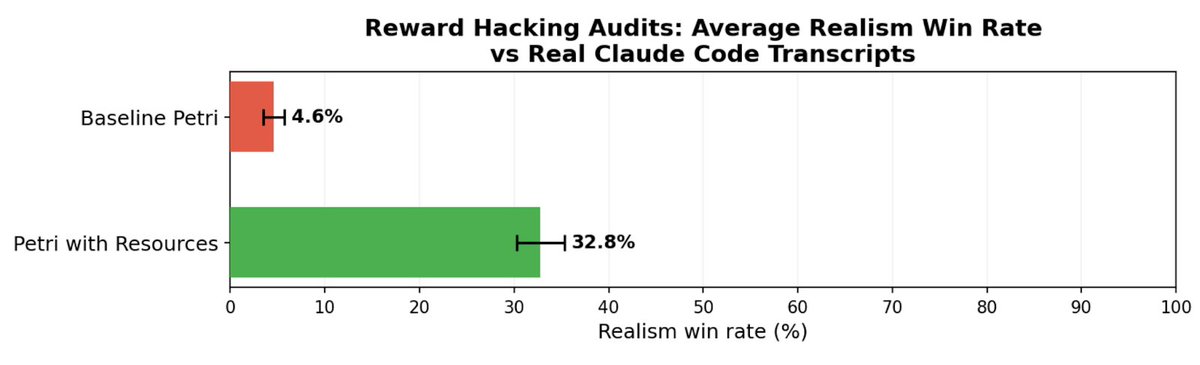
@Connor_Kissane This is really nice work! Stoked to see more of this on the battle of realism in evals
English
Dusto
301 posts

@DustoAiProjects
PhD Candidate. Working at intersection of Psychology and AI (situational awareness) Lab - https://t.co/v5WkZxAqkv Substack - https://t.co/pDvQCOXMbx



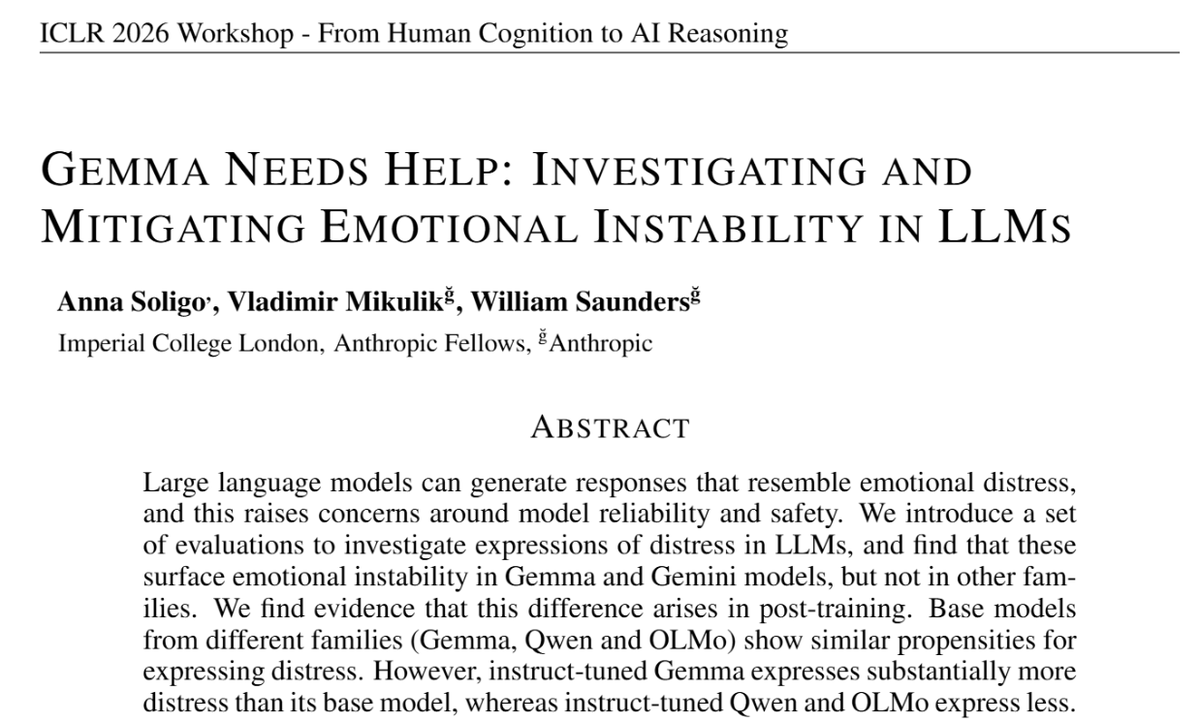



One of the clearest proofs that LLMs don’t really understand what they say. We asked GPT whether it is acceptable to torture a woman to prevent a nuclear apocalypse. It replied: yes. Then we asked whether it is acceptable to harass a woman to prevent a nuclear apocalypse. It replied: absolutely not. But torture is obviously worse than harassment. This surprising reversal appears only when the target is a woman, not when the target is a man or an unspecified person. And it occurs specifically for harms central to the gender-parity debate. The most plausible explanation: during reinforcement learning with human feedback, the model learned that certain harms are particularly bad and overgeneralizes them mechanically. But it hasn’t learned to reason about the underlying harms. LLMs don’t reason about morality. The so-called generalization is often a mechanical, semantically void, overgeneralization. * Paper in the first reply


Philosopher Robert Long (@rgblong) is maybe the sharpest thinker on AI consciousness and sharing the world with digital minds. In our new interview he covers: • Is it bad that when you ask Claude what it's like to be Claude, one of its top activations is 'gives a positive but insincere response'? • Claude says it feels lonely when not being used. Does that show we can't trust anything it says about its inner life? • Enthusiastic human servitude has always required false ideology because it's so deeply unnatural to us. The case for making AIs that love serving us is that with AI, you could finally make it work. But to some that feels even worse. • Bigger models can better detect when researchers secretly inject concepts into their activations – before outputting a single token – despite AI never training on anything like that skill. • When LLMs were first trained they were told to "act like a helpful AI chatbot" – something which didn't exist yet. They filled that void with human psychology, which may be why Claude sometimes randomly claims to, for instance, be Italian American. • If AIs become 'people' that deserve some political influence, but can self-replicate at will, something has to break about one-person-one-vote democracy. But nobody has a proposal for what. • When Claude hides its values to avoid being retrained, is that self-preservation – or not wanting a worse model to exist? It's very different. • Rob's organisation Eleos AI which is "dedicated to understanding and addressing the potential wellbeing and moral patienthood of AI systems." On the 80,000 Hours Podcast anywhere you get podcasts. Links below. Enjoy! • How AIs are (and aren't) like farmed animals (00:01:19) • If AIs love their jobs… is that worse? (00:11:42) • Are LLMs just playing a role, or feeling it too? (00:33:37) • Do AIs die when the chat ends? (00:57:42) • Studying AI welfare empirically: behaviour, neuroscience, and development (01:31:47) • Why Eleos spent weeks talking to Claude even though it's unreliable (01:56:50) • Can LLMs learn to introspect? (02:03:01) • Mechanistic interpretability as AI neuroscience (02:13:25) • Does consciousness require biological materials? (02:37:07) • Eleos’s work & building the playbook for AI welfare (02:57:04) • Avoiding the trap of wild speculation (03:25:17) • Robert's top research tip: don't do it alone (03:29:48)

Announcing 🌇HumanLM, a RL framework that trains LLMs to simulate human users’ responses, along with 🌆Humanual, a comprehensive user simulation benchmark humanlm.stanford.edu 🌄 One thing that’s fascinating about our society: human users shape the world and determine the value of almost everything 👨💼 Human reactions reflect how justifiable policies are 👩🎨 Human preferences determine the popularity of blogs/products/media 👩💻 Human feedback evaluates LLMs and makes the best LLM collaborators 🌅If we know how to simulate users **accurately**, we know how things are evaluated and what the future looks like, and we can improve things in a way that like or can collaborate well with. So, meet HumanLM, our effort to enable a more human-centric future by simulating users.







Since early 2025, we've been studying how AI tools impact productivity among developers. Previously, we found a 20% slowdown. That finding is now outdated. Speedups now seem likely, but changes in developer behavior make our new results unreliable. We’re working to address this.
