Dylan Kalisvaart

22 posts

Dylan Kalisvaart

Dylan Kalisvaart

@DylanKalisvaart

PhD candidate at Delft University of Technology | Passion for quantitative fluorescence microscopy using AI and intelligent control

Delft, the Netherlands Katılım Kasım 2021
27 Takip Edilen25 Takipçiler
Dylan Kalisvaart retweetledi
Biophysical Reports
Biophysical Reports@BiophysReports·
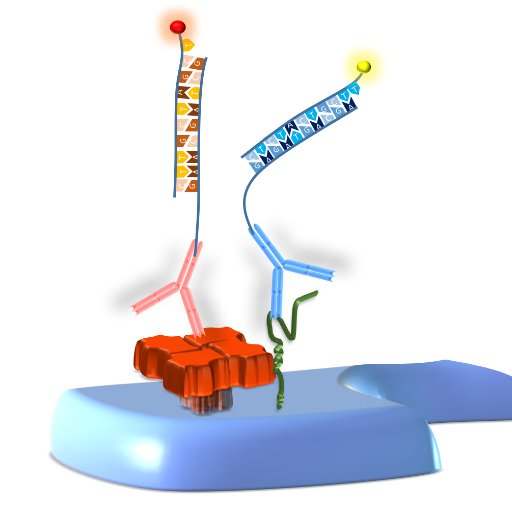
Read about the cover art for the newly released issue of Biophysical Reports on the BPS Blog: ow.ly/6wY250QSiOR
English
0
2
2
358
Dylan Kalisvaart retweetledi
Biophysical Reports
Biophysical Reports@BiophysReports·
Check out an article from our most read list: "Quantifying the minimum localization uncertainty of image scanning localization microscopy." (Dylan Kalisvaart et al.) ow.ly/8zQU50QGIuP
English
0
2
1
265
Dylan Kalisvaart retweetledi
Nano IJ
Nano IJ@nanomicroscopy·
Bayesian posterior density estimation reveals degeneracy in three-dimensional multiple emitter localization dlvr.it/T0DVKZ
Nano IJ tweet media
English
0
2
3
676
Dylan Kalisvaart
Dylan Kalisvaart@DylanKalisvaart·
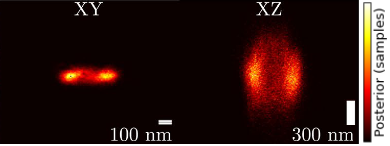
These solutions are statistically indistinguishable from the truth, raising the maximum possible localization error. With biplane imaging, this ambiguity is omitted completely. (Figure 4)
Dylan Kalisvaart tweet media
English
1
0
1
53
Dylan Kalisvaart
Dylan Kalisvaart@DylanKalisvaart·
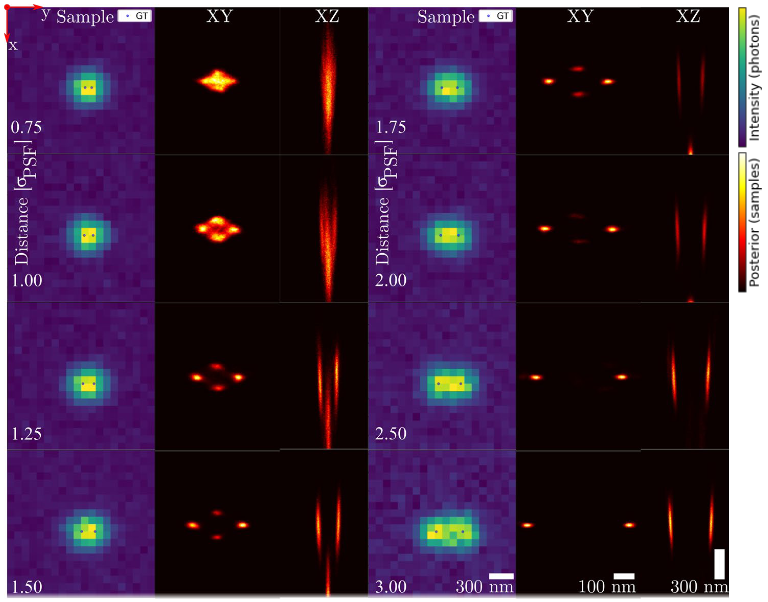
We show that for multiple emitter astigmatic imaging, a pair of ambiguous localizations appears once the emitters get closer than 2.5 times the in-focus standard deviation of the point spread function. (Figure 2)
Dylan Kalisvaart tweet media
English
1
0
1
65
Dylan Kalisvaart
Dylan Kalisvaart@DylanKalisvaart·
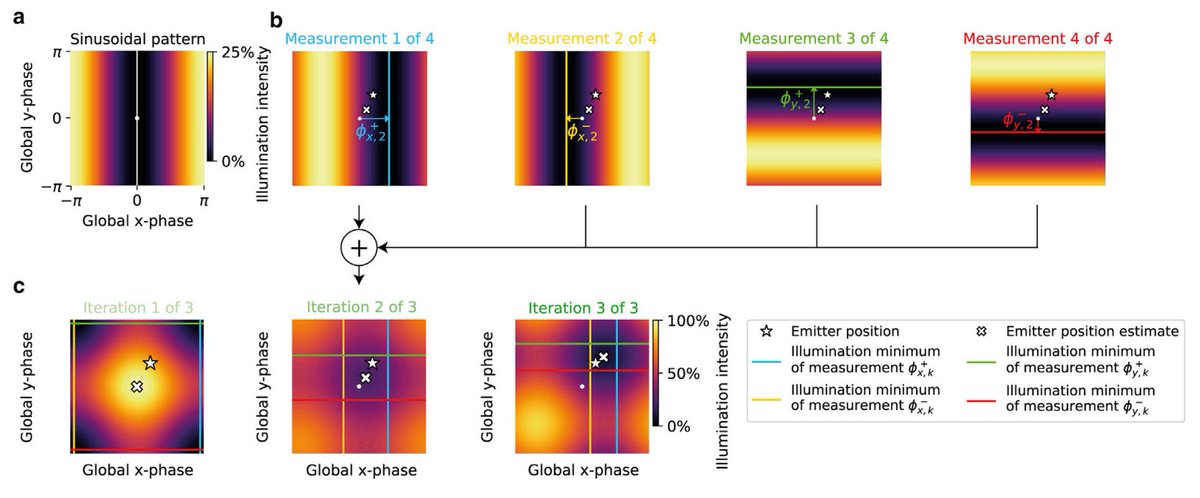
A modulation enhanced analysis paves the way for spinning disk microscopy with patterned illumination. Our research suggests the possibility of elevating the enhancement factor to 3.5-fold using doughnut-shaped illumination patterns. (Supp. Fig. 33ade)
Dylan Kalisvaart tweet media
English
0
0
0
53
Dylan Kalisvaart
Dylan Kalisvaart@DylanKalisvaart·
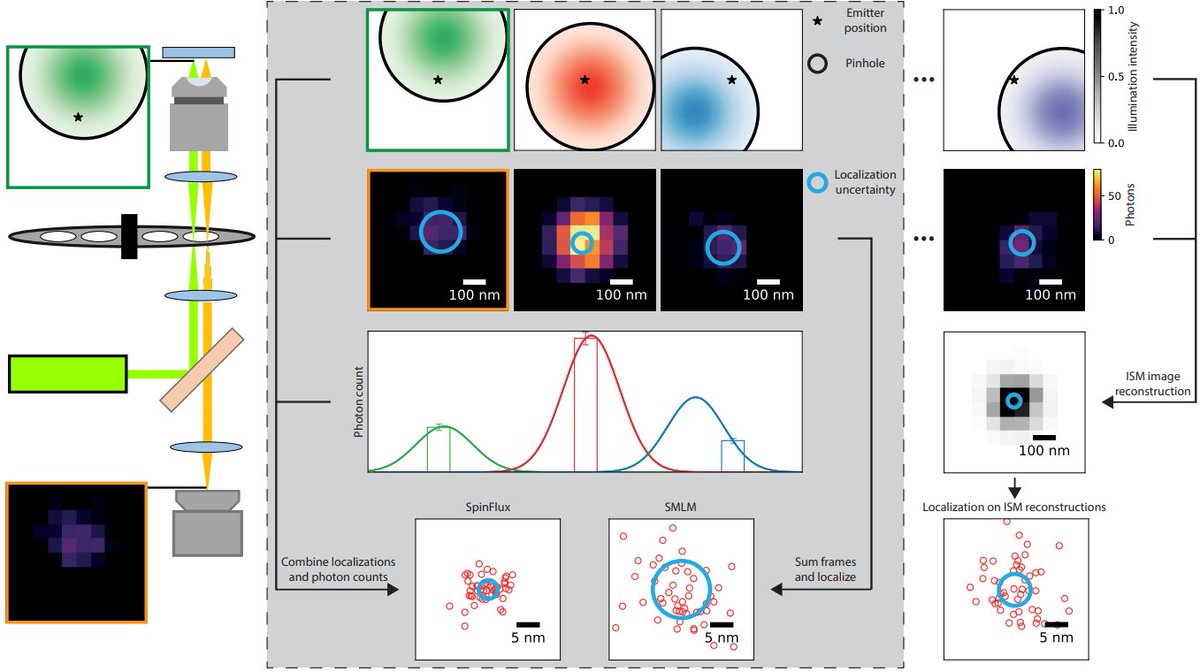
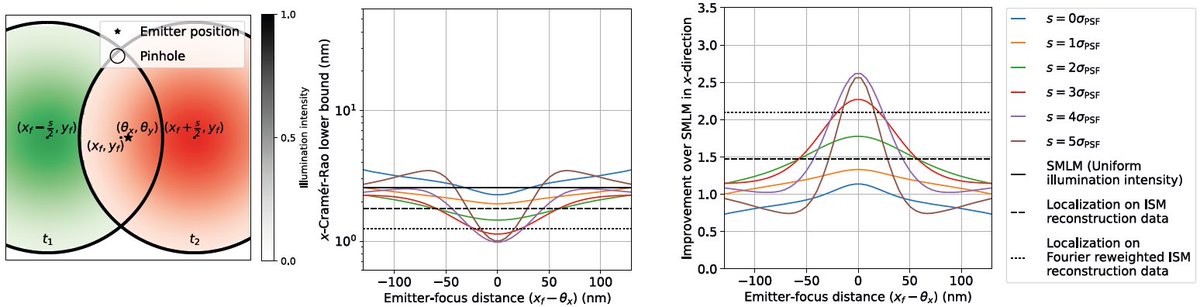
As a second step, we explore the idea of conducting localization directly on raw data, foregoing the ISM reconstruction steps, as in #MINFLUX and #SIMFLUX. Intriguingly, our findings indicate the potential for a remarkable 2.6-fold enhancement in localization precision. (Fig. 4)
Dylan Kalisvaart tweet media
English
1
0
0
70
Dylan Kalisvaart
Dylan Kalisvaart@DylanKalisvaart·
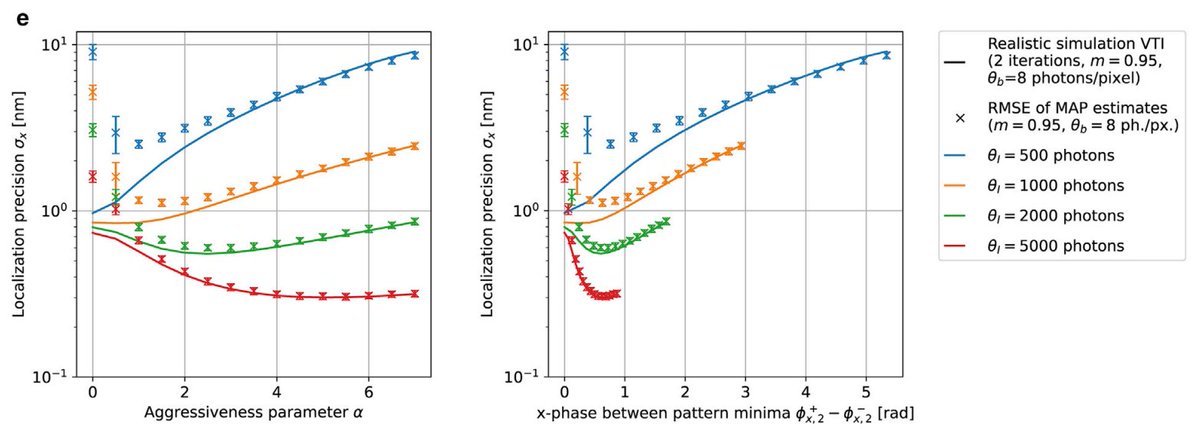
Lastly (Fig. 2e), we found that the optimal pattern positioning is a function of the modulation contrast, the photon budget and the expected background. In particular, the best precision is not necessarily achieved by placing intensity minima as close to the emitter as possible!
Dylan Kalisvaart tweet media
English
1
0
1
0