
Sabitlenmiş Tweet
EAS
2.9K posts


The upside to Japan’s risk aversion – ample petroleum reserves
The Yen has weakened against the US$ since the Iran war drove the oil price higher, but so too has the AU$.
Japan imports most of its energy needs, so a roaring oil price hurts the terms of trade and can put pressure on the economy as consumers take a hit in the wallet and manufacturers’ costs increase.
This is particularly the case as LNG imported from Australia is also linked to the oil price.
Australia, on the other hand, is a substantial net energy exporter, and its exports are assisted by the closure of the Strait of Hormuz.
Indeed, Japan recently asked Australia to increase its LNG production as 6% of its supply comes via the Strait of Hormuz.
So why are the currencies weakening in lockstep, despite the Reserve Bank raising rates on 17 March?
The answer is, because the ultimate source of both countries’ petroleum products is the Middle East, much of which comes via the Strait of Hormuz.
However, that is only part of the answer. Japan should be much more negatively exposed to this dynamic than Australia.
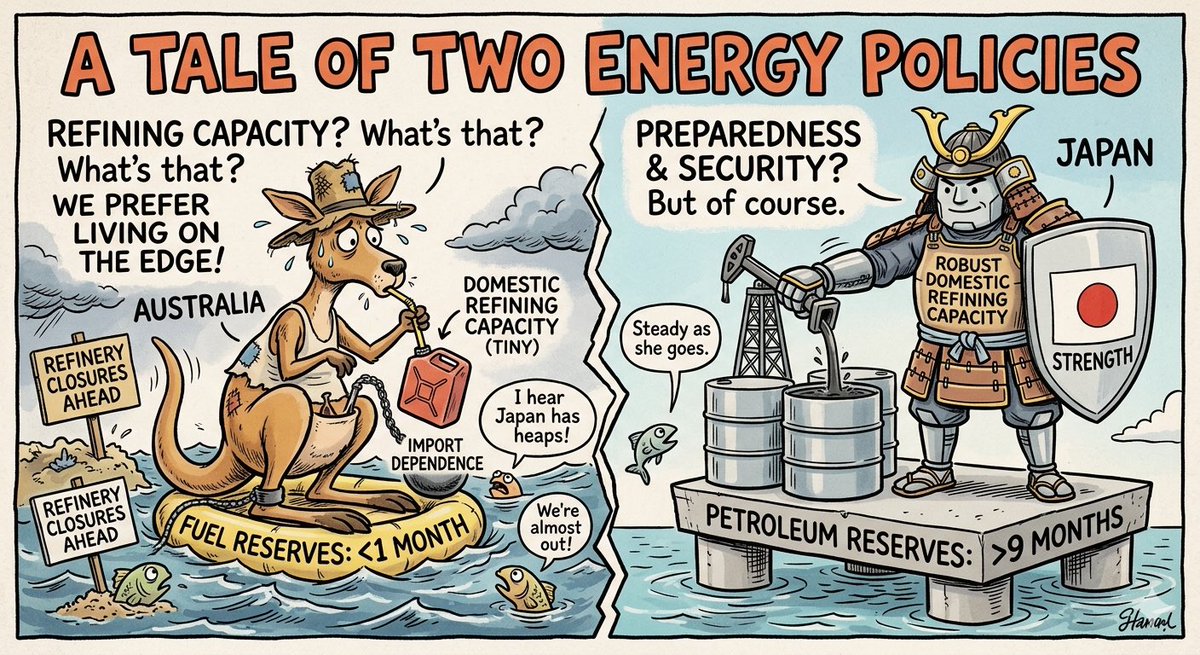
The key difference between the two countries is Japan’s risk aversion and forward planning.
Japan has almost 260 days’ worth of petroleum reserves between private and public stockpiles. Australia has around four weeks only.
Australia is already experiencing shortages of diesel as farmers and others panic-buy.
Meanwhile, Japan sits relatively comfortably. We talk a lot about too much aversion to risk-taking at the corporate level, and justifiably so when companies are saving up years’ worth of shareholders’ cash for a rainy day.
Occasionally though, what usually seem to be overly cautionary measures appear prudent.
Particularly when compared with the absolute disregard of Australia and fellow just-in-time-oil-inventory practitioner, New Zealand, for the precarious nature of their crucial supply chains amplified by a lack of domestic refining capability.
English
@teddy_okuyama The fact that 4733 remains near all-time highs should dispel the narrative that AI is the reason for 3994 weakness?
English

Here's my hot take: it's bullish for Nvidia if Google has a rival AI chip because that means the whole industry is healthier. I'm actually less skeptical now about stock market bull run.
English
@teddy_okuyama The only Takaichi healthcare policy I've seen are related to healthcare security (supply chain), have you seen her discuss other policies?
English

Everyone tends to assume that the U.S. and China are competing over AI because the technology directly benefits both economies. I’m not convinced. I can see how AI could help the US by boosting productivity and offsetting labor shortages.
But I’ve never really believed that AI offers comparable benefits to China’s economy, which suffers from chronically weak aggregate demand and excess capacity in both supply and productivity.
My intuition is that China’s pursuit of AI has less to do with its economic fundamentals and more to do with geopolitical and technological signaling. In other words, China is investing in AI because the US is, just as the US and Soviet Union once competed in aerospace during the Cold War. When I think about China’s most pressing economic challenges, I struggle to see how AI directly helps address them.
English
@InvestInJapan That's true, the 60 years olds aren't really on Mercari and even if they are, might not go thru the hassle of listing 50 items there.
English

They have B2C and B2B channels including auction houses. So they do seem to have an extensive sales channel.
AFAIK Mercari is both a competitor and partner. Partner in the sense they sell through them but kinda competitor in the sense Mercari may want the sellers for themselves.
Ultimately though BuySell are targeting a cohort of sellers Mercari can't, so in that sense I don't think the competition is actually there.
English
One of the companies I mentioned is BuySell Technologies. $7685.JP. 11.7x EBITDA - which could sustain double digit growth for many years.
What struck me is that this is a business I don't htthinkink exists in any other part of the world and they have unique access to a resource others have failed to do. I think they have 2 unique points.
1)Access to a unique resource
2)A strong Acquisition track record
Their main business, the home visit purchase biz flips the resale business on it's head. Instead of getting sellers to visit resale stores. BuySell gets their agents to visit their homes to buy off items from sellers.
What they've realised is that this market is estimated to be potentially 20x larger than the traditional resale market. Why? They've realised they have access to goods that remain dormant in households that never end up in resale stores. Thus giving them unique access to this resource.
Theres also huge value for seller's who are mainly selling items to declutter. A completely different demographic to those that typically participate in Resale. These are 50+ yo who are getting too old to carry heavy clutter to stores. BuySell realised there are valuable items in these houses that can be resold at attractive margins. To do that BuySell will initially offer to buy less valuable items like stamps, kimono and during the 2 hour visit, agents will engage with the seller to see if there's anything else worth selling.
Why is it difficult to replicate?
BuySell has 750+ agents driving through Japan to buy/appraise items. These people need to be trained in such a way that they can buy items that sellers originally did not think about selling. You also need to know what goods you should buy for a profitable resale.
IT infrastructure to enable extensive information on items they are appraising +having established retail channels which includes B2C but also B2B like auction houses.
A Huge compliance department to ensure the business is trusted by sellers/buyers, which competitors don't have. Ultimately you have strangers coming to your home, so you need to become a trusted brand.
The demographic they are trying to win over are older, so customer acquisition can be tricky. You need to have a good strategy for marketing using both digital and analogue channels like flyers. This is hard to do efficiently. They know the right mix.
Finally they do have the more traditional resale store format biz. For this, they are a quasi 'serial acquirer' Realising that they are a late entrant in this market, they have acquired smaller resale chains of which there are many. The incredible part here is that BuySell has integrated these acquisitions and 3-9xed their earnings in just a few years! This track record has now given them an advantage as an 'acquirer of choice' for business owners that are looking to sell.
An interesting point and potential catalyst is when the company company hinted on updated their MT targets, as it seems too conservative now given the strong progress.
Full details in the write up!
Made in Japan 🇯🇵@InvestInJapan
Free to read: Twitter, now X's early survival was thanks to Japan. Co-founder of Digital Garage, Joi Ito, helped it scale in Japan and up until then, there was no real monetisation. Twitter continued to burn cash. He created the ad monetisation model for the 🇯🇵 market, which was rolled out globally! Crazy to think fintwit may have never existed in it's current form. In my new post, I cover some stuff on $4819.JP, Cashless Payments, and a Treasure hunting firm with a serial acquirer twist. Full link in bio (Free to read!)
English
@pandawatch88 @TheLongHappy Agreed $TCOM's AI tools are just not there. If I were to use AI for trip planning, it would be Chatgpt and not $TCOM's in-house tools unless they improve it a lot.
Your point on dynamic search is an interesting use case!
English

Ive tried tcom AI travel assistant just to see what it does, and frankly it sucks.
The key use case for me, and it is not working yet, is smth like "i want to travel to X city in Europe, sometime in November, length of stay 1 week, im flexible on dates, but i want to travel flat bed. Over the next month keep an eye on the cheapest tickets, and let me know when something below price Y shows up".
AI should be great at looking at prices for you dynamically, over different pairings, options, and during an open ended period of time, to hit you when things you like show up. I havent found a good tool yet.
English
EAS retweetledi

Any thoughts on Gen AI impact on OTAs? Has it changed the way you plan and book?
Comments welcomed.
$TCOM $BKNG
English
GENDA is up 20% today. Any bulls/bears here?
On 2Q earnings, I didn't think it was that strong although low expectations + stronger SSSG of domestic arcades (maybe management hinting share repurchases helped too).
Longer term, Japanese IP popularity remains the biggest tailwind. But can also point to issues including management turnover, aggressive accounting, increasing debt, lower M&A discipline (?) etc.
English
@ETH_Zurich3773 I hope the rest of the world doesn't find out how good (and cheap even paying out of pocket) these big Korean hospitals are...
English

Will the boomer PMs say I was wrong on crypto before dying
English
EAS retweetledi
Ugh.
I'm doing it. I'm jumping on the substack bandwagon.
I simply have too many Japanese ideas. I certainly can't buy all of them. And just tweeting them out feels like a waste. So I'm gonna grift you 10 bucks a month for it.
I also have a slightly different spin on things.
English