
THE SH0KT 8AER
89 posts





Leo knew… H/t @QuiteMidlife
Reasons why I think we could rally for a bit, provided Iran/oil don't derail things: - HF gross/net exposures have come down (esp. for tech and momentum stocks) - Retail sentiment looks washed (Fidelity’s order book showed more sell orders than buy orders today for many tech/AI favorites. Big contrast relative to a few weeks ago.) - Breadth (in terms of the % of stocks above their 50 and 200-day moving averages) looks pretty good - Stock correlation has fallen to very low levels (maybe this reverses with a broad-based rally) - Bank earnings and other data points to healthy consumer spending - The tech giants are set to report, and (judging by recent news flow) it seems unlikely they’ll disclose/say anything about their cloud businesses or capex plans that’ll truly spoil the fun

Retail is outright panicked right now, even though the NYSE composite is at it's highest weekly close ever. It doesn't make a ton of sense, but my take remains this is quite bullish.

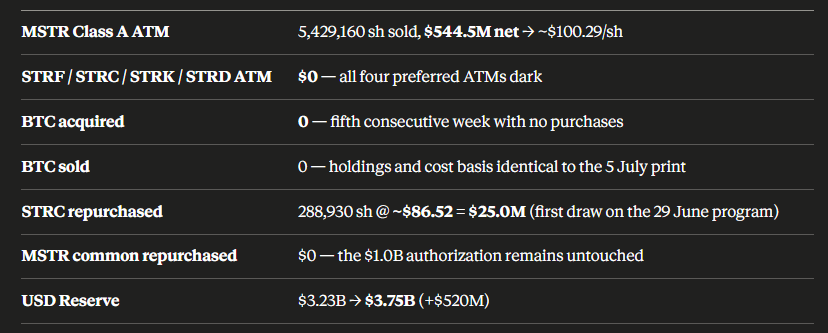
$MSTR At this point, it should be clear that applying aggressive financial engineering to an asset with no native yield or cash-flow generation was a major mistake. The company had one job: keep the balance sheet structurally sound enough to do the only thing it was designed to do, which is hold $BTC forever. Instead, the crisis was handled in the worst possible way. Buying more BTC while the market’s core concern was preferred dividend coverage only reduced the cash buffer further. The company offered no credible solution other than potentially diluting common shareholders below mNAV. Then Saylor’s conference comments, where he framed prior guidance as advice to shareholders rather than the firm’s own issuance posture, only damaged credibility further. Hope is not a strategy. Reflexivity has now reversed. The premium-to-NAV flywheel once worked like this: Issue equity above implied cost of capital → buy BTC → BTC per share rises → premium is justified → issue more equity. Below 1.0x mNAV, that machine runs backwards. Drastic times require drastic measures. So how does the bleed stop and confidence get restored? First, acknowledge the mistakes. Then act decisively. Time allows fear to spread into panic. Only decisive liability management can restore the image of $MSTR and Saylor at this point. A. Liability management is the core solution. Repurchase discounted preferreds through a combination of open-market accumulation via a Rule 10b5-1 plan and a fixed-price or Dutch tender under Reg 14E, priced roughly 5 to 8 points above market. Buying back discounted senior claims is far more NAV-accretive per dollar than buying back common stock. It also cuts cash burn. A common buyback at 0.82x mNAV transfers only about +22 cents of value per dollar and does nothing to reduce cash burn. The sequencing matters: Start with STRD and STRK because they trade at the deepest discounts and offer the highest claim accretion per dollar. Then move to STRC for scale, because it is the largest single cash-burn line and the keystone security to defend. Leave STRF alone for now. It is money-good, the most senior, and trades at the smallest discount. Bidding for it would signal stress in the best part of the capital structure for very little economic capture. B. Fund it with BTC-collateralized debt, not BTC sales. The company should create a Bitcoin-collateralized term facility, not sell BTC. Use a secured BTC facility at roughly 8% all-in, with a likely range of 7% to 9%, and 30% to 50% LTV. The carry is positive across the structure: Borrow at roughly 8% secured to retire preferred claims costing 13% to 16% on an effective basis. That creates 500 to 600 basis points of positive carry, plus the discount capture. This is the cornerstone of the new narrative. Financed deleveraging could restart the reflexive premium. An asset sale would confirm the bear case. C. Restore capital discipline. Suspend the common ATM while the stock trades below 1.0x mNAV. Pause net-new BTC purchases while below 1.0x mNAV. Redirect all available capacity toward discount capture. A small common-buyback sleeve can exist for signaling purposes, but it should not be the primary tool. The real opportunity is in retiring discounted preferred claims. The math is compelling. Net of roughly $240 million per year of facility cost, the program is approximately +$177 million per year cash-flow positive on day one. It would deliver roughly $1.14 billion of immediate NAV accretion to common shareholders and retire approximately $4.1 billion of par claims for $3.0 billion of financed cash. The maximum-scale option is full STRC retirement. At roughly $85.85, full STRC retirement would require about $9.0 billion of cash, capture approximately $1.49 billion of discount, and remove roughly $1.21 billion per year of dividends. That is the single largest lever on coverage. The most important thing is getting rid of the negative reflexive loop MSTR is in, that can only be done through very strong action and taking the hit now rather than later.



JUST IN: 🇷🇺 Russia to finalize bill tomorrow establishing a legal framework for crypto.