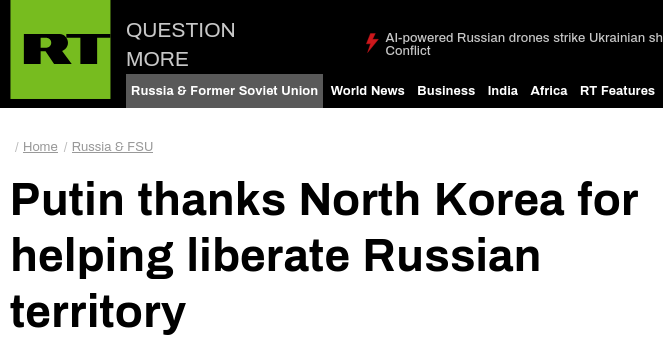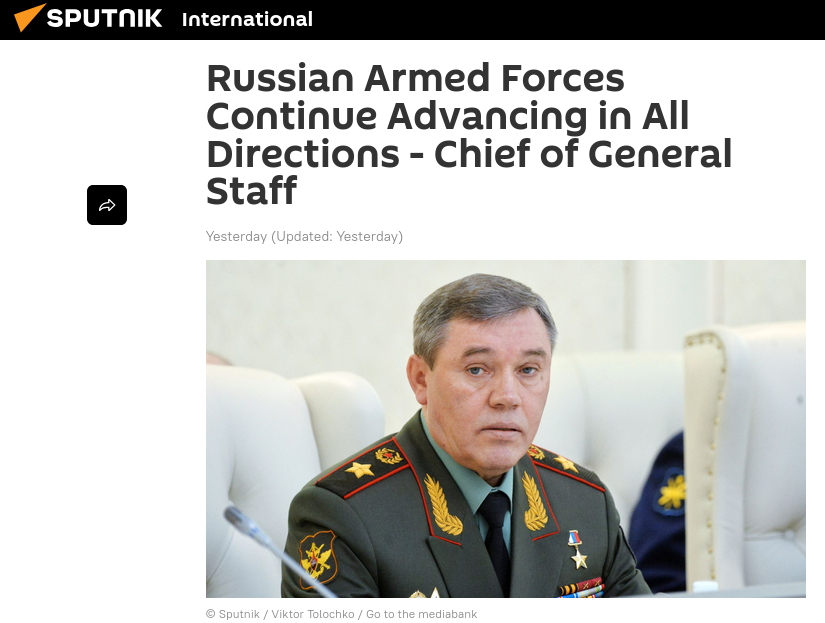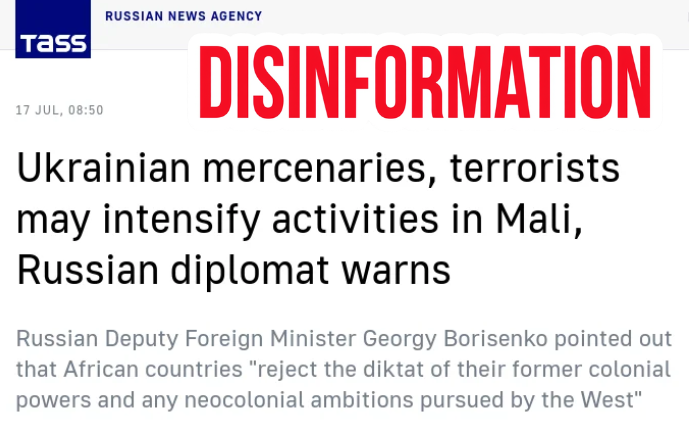
Russian FIMI about EU CSDP missions serves a broader geopolitical objective:
Presenting the EU as an ‘unreliable security partner’, while positioning Russia as the alternative.
If confidence in European security cooperation weakens, Russia gains influence without deploying a single additional soldier.
The Kremlin constantly claims Ukraine is running out of men and weapons, and is on the verge of collapse. Fully contradicting itself, the Kremlin also claims Ukraine is on the verge of expanding operations to another continent.
In both cases, as in most cases, Russia lies.
To serve as a reminder that the Kremlin lies, often and blatantly, here is the Russian Ministry of Truth confirming that Oceania has always been at war with Eurasia.
Among the individuals subject to recent EU sanctions is an FSB officer Yan Zanevsky, who participated in the illegal detention and torture of civilians in the occupied Kherson, Mykolaiv and Zaporizhzhia regions.
The reported violations include beatings, suffocation and sexual abuse.
Individual accountability remains a cornerstone of international law.
The latest sanctions package, which also targets entities responsible for the torture of Ukrainian POWs, highlights a significant aspect:
The abuse of Ukrainian prisoners was not confined to one location.
The Council identified detention facilities in occupied Donetsk, Taganrog and Pakino, alongside officials linked to abuses across occupied southern Ukraine.
That points to a broader system which is being held accountable.
The 116 Russian vessels struck by these ‘ineffective strikes’ this week alone would likely have a different assessment. The same goes for a rather impressive and growing number of Russian refineries.
Among those listed in the latest EU sanctions package is Dmitry Neelov, first deputy head of the Olenivka prison in occupied Donetsk, accused of involvement in the torture and degrading treatment of Ukrainian prisoners of war and civilians.
He also bears direct responsibility for delaying the evacuation of wounded prisoners during the July 2022 Olenivka prison attack.
Last year, the Kremlin’s 'digital sovereignty' delivered more than 37,000 hours of internet outages to 146 million users, becoming the world leader in cumulative internet outage time and causing over $11 billion in economic losses.
Judging by the uninterrupted flow of threats and disinformation posted on platforms otherwise restricted for ordinary Russians, Kremlin officials appear to have enjoyed an entirely different version of this 'digital sovereignty.'
VK presents itself as a tech company.
In reality, it helps power the Kremlin's surveillance machine. From monitoring users to enabling repression, its role has now landed it on the EU sanctions list.
Watch how technology becomes a tool of control.
Russian officials and Kremlin-funded outlets routinely issue every imaginable kind of threat against the Baltic states. Yesterday, the very same actors and entities declared the idea that Russia might be 'harboring aggressive intentions' towards them as completely unfounded.
Throughout its illegal invasion, Russia has damaged or destroyed 155 churches, 281 historical buildings, 43 museums, 22 libraries, and countless residential buildings, schools, and hospitals. Russia once again stays true to its practice of accusing others of what it does itself.
One of the most important aspects of the latest EU sanctions is who they target.
Not only military actors, but also those enabling systems of abuse and torture of Ukrainian prisoners of war.
Accountability reaches beyond those carrying weapons.
Russia’s MAX app is a key tool in the Kremlin’s efforts to tighten control over digital life and suppress civil society. VK, the company responsible for developing it, is now under EU sanctions.
Not everything you see online has a real person behind it.
Up to half of all Internet traffic may come from bots. 🤖
And a large share of them aren’t neutral. They’re designed to spam, manipulate, and disrupt systems.
Don’t fall for bots.
#SpotTheBot
The shadow fleet is more than a way to move sanctioned oil.
It exploits seafarers, undermines maritime safety, weakens international shipping standards and raises the risk of environmental disasters.
Behind every ageing tanker there is a human cost.
For years, Russia has used hackers, cybercriminals and proxies to spy on governments, sabotage infrastructure and destabilise Europe.
Nine individuals and four entities have now been added to the EU sanctions list for enabling Russia's malicious cyber activities.
The Geneva Conventions were written precisely for moments when humanity is under its greatest strain.
The EU’s latest sanctions include individuals accused of torture and ill-treatment of Ukrainian POWs and civilian detainees.
Violations of human rights cannot and will not go unpunished.