James Traina

1.7K posts

James Traina

James Traina

@EconTraina

Economist and AP of Finance @NYUStern @NYUAbuDhabi | PhD @ChicagoBooth & @UChi_Economics | Markups, Productivity, Investment, Technology

Katılım Aralık 2021
805 Takip Edilen1.8K Takipçiler
Sabitlenmiş Tweet
James Traina
James Traina@EconTraina·
You can't scale your way to data from counterfactuals that haven't happened. Nice piece. My read on what it does and doesn't show:
Alex Imas@alexolegimas

New post : Can a Transformer “Learn” Economic Relationships? Revisiting the Lucas Critique in the age of Transformers. with @arpitrage We simulated data from an NK model, fit a transformer, and tested out of sample fit How did it do? Pretty well! Link and thread in reply:

English

4
29
256
61.7K
James Traina retweetledi
Ben Charoenwong
Ben Charoenwong@BenCharoenwong·
Just had a faculty meeting at INSEAD about the impact of AI on management education and how we should respond. Every serious business school is having the AI conversation right now. 1/
English
15
22
109
26.2K
Brian Albrecht
Brian Albrecht@BrianCAlbrecht·
It’s incredible Dwarkesh can keep finding these obscure academics
Dwarkesh Patel@dwarkesh_sp

The Terence Tao episode. We begin with the absolutely ingenious and surprising way in which Kepler discovered the laws of planetary motion. People sometimes say that AI will make especially fast progress at scientific discovery because of tight verification loops. But the story of how we discovered the shape of our solar system shows how the verification loop for correct ideas can be decades (or even millennia) long. During this time, what we know today as the better theory can often actually make worse predictions (Copernicus's model of circular orbits around the sun was actually less accurate than Ptolemy's geocentric model). And the reasons it survives this epistemic hell is some mixture of judgment and heuristics that we don’t even understand well enough to actually articulate, much less codify into an RL loop. Hope you enjoy! 0:00:00 – Kepler was a high temperature LLM 0:11:44 – How would we know if there’s a new unifying concept within heaps of AI slop? 0:26:10 – The deductive overhang 0:30:31 – Selection bias in reported AI discoveries 0:46:43 – AI makes papers richer and broader, but not deeper 0:53:00 – If AI solves a problem, can humans get understanding out of it? 0:59:20 – We need a semi-formal language for the way that scientists actually talk to each other 1:09:48 – How Terry uses his time 1:17:05 – Human-AI hybrids will dominate math for a lot longer Look up Dwarkesh Podcast on YouTube, Apple Podcasts, or Spotify.

English
20
5
379
42.8K
James Traina retweetledi
alz
alz@alz_zyd_·
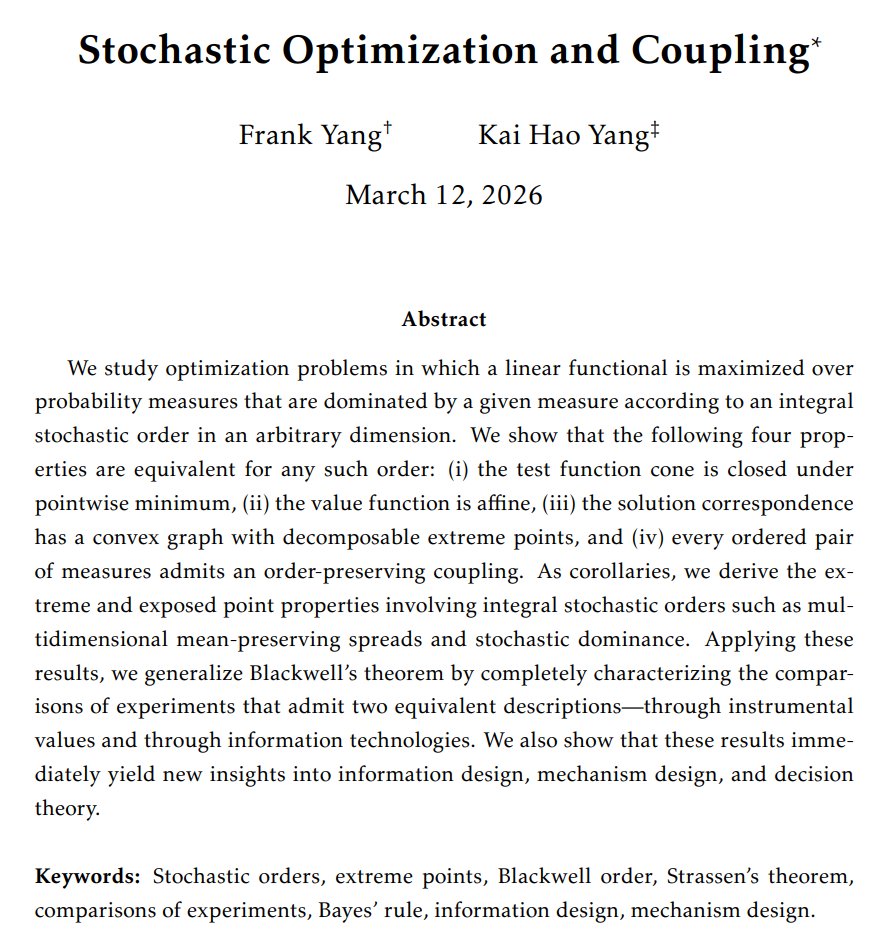
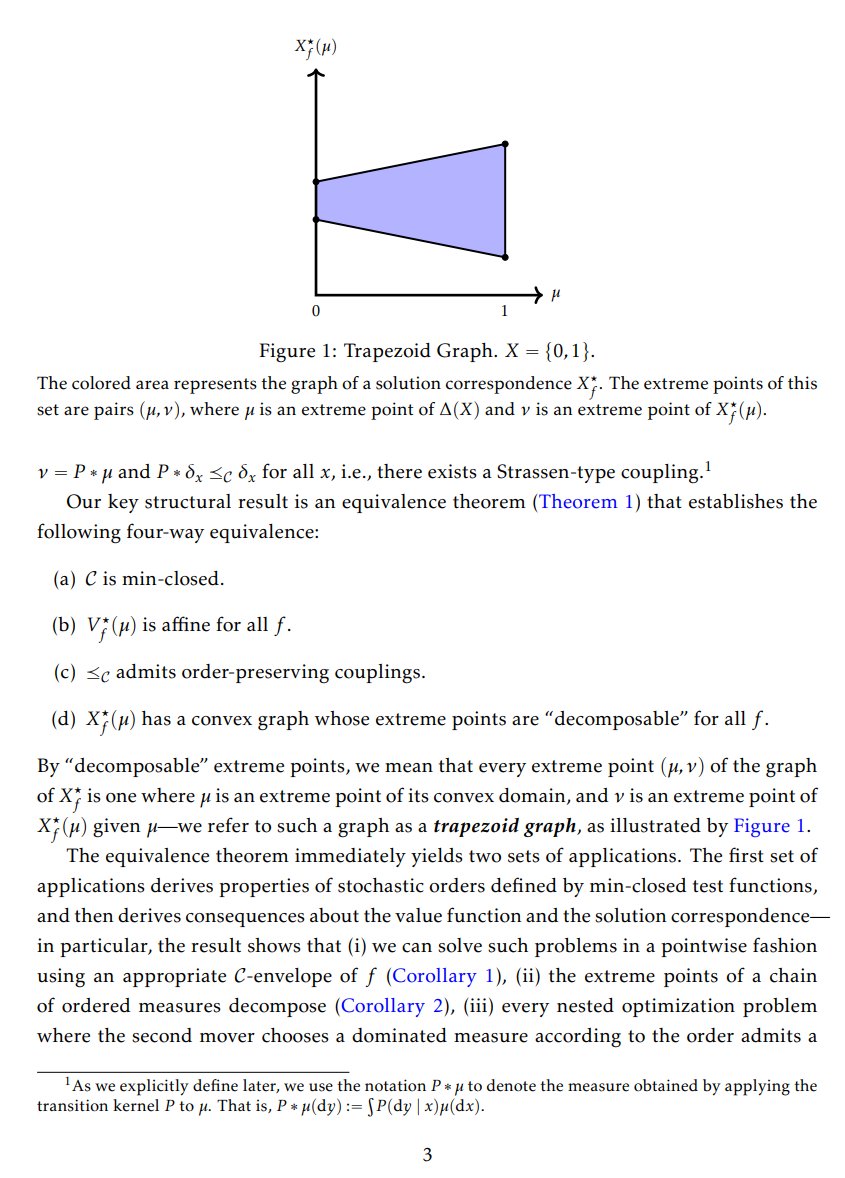
I got a little bored of reading Rudin using Gemini, so I decided to try AI-reading something more fun: this beautiful paper by Yang^2. Unfortunately, while beautiful, it is also really hard (wtf is a coupling???), so I will need a lot of AI help
alz tweet mediaalz tweet mediaalz tweet media
English
5
8
88
11.9K
Basil Halperin
Basil Halperin@BasilHalperin·
I have an old (3+ years) blog post *rough draft* on "AI Alignment as a Principal-Agent Problem" Thoughts welcome on whether this idea is worth polishing up / developing further... docs.google.com/document/d/1A9…
English
7
5
70
16K
James Traina retweetledi
Jesús Fernández-Villaverde
Jesús Fernández-Villaverde@JesusFerna7026·
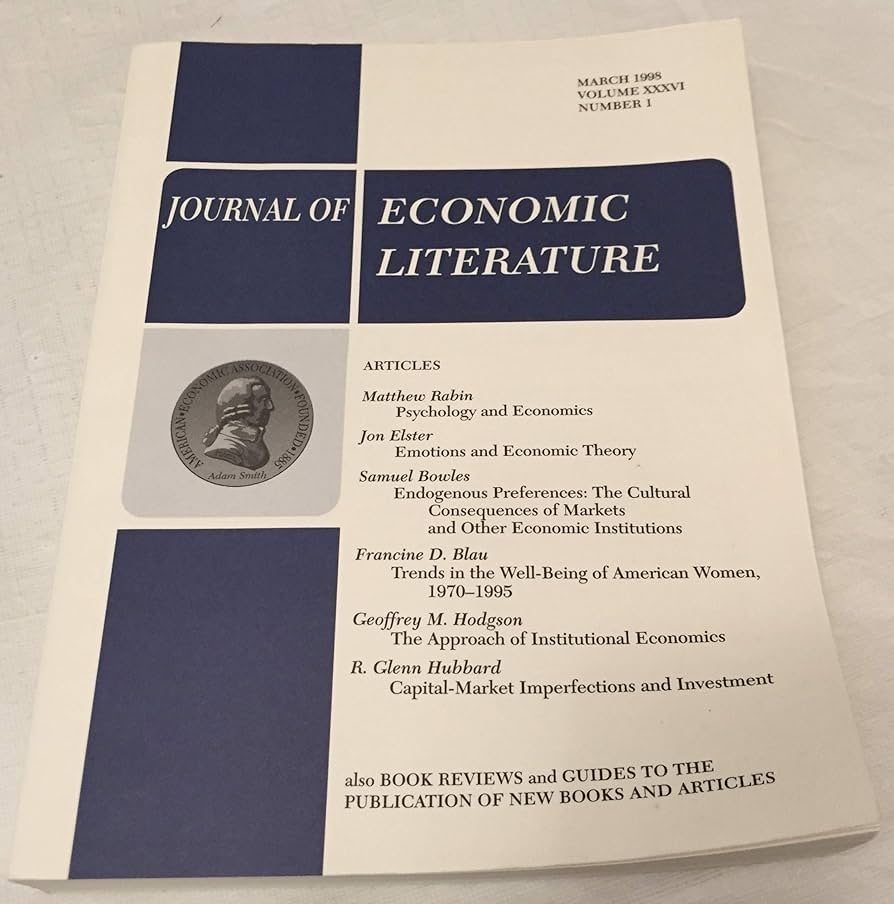
By now, I have published a fair number of papers, and one more acceptance would have close to zero marginal impact on anything that matters professionally. But getting my survey on “Deep Learning for Solving Models” accepted into the Journal of Economic Literature made me genuinely happy, for reasons that have nothing to do with my CV. I had the misfortune of studying my undergraduate degree in economics at a quite awful institution. Two professors, David Taguas and Alfredo Arahuetes, were outstanding, and I owe them a great deal. The rest were well below any reasonable professional level, and some violated the basic standards of ethical conduct. They had no business teaching economics at any level, let alone at a university that charged tuition and claimed to prepare students for professional life. I had to work out most of my education on my own. The surveys published in the Journal of Economic Literature were how I did it. I spent hours in the library’s reading room going through one survey after another on topics I had never been properly taught. Some helped more than others, but collectively they gave me a solid enough foundation that, when I arrived at Minnesota for my PhD, I discovered, to my considerable surprise, that I was ahead of nearly all the other first-year students, including some who held master’s degrees, despite the fact that I had finished my undergraduate degree just six weeks before. I owe the Journal of Economic Literature a debt I will never be able to repay. Publishing a survey there is the closest I can come to trying. So, the thought that some student somewhere, working on her own in a library or on a laptop, might find my survey useful gives me tremendous satisfaction. But there is a broader point worth making. Even in the world of AI, the profession has an important mission in making educational material widely available. Textbooks, surveys, teaching slides, these are public goods in the economist’s sense: high social value, insufficient private incentive to produce. This is also why I post all my slides and teaching material online: sas.upenn.edu/~jesusfv/deepl… We do not reward these activities nearly enough, and their supply is well below what any reasonable social planner would choose. I do not have a good proposal for changing this, and I would welcome suggestions. What I do find heartbreaking is that many of the great economists of the past couple of generations never wrote textbooks on their areas of expertise. I do not mean this as criticism. All of them maximize, and perhaps they all suffer from the same bias I suffer from: the belief that one can always do it next year. But I often think about the hours of pure intellectual pleasure I would have had reading “Time Series Econometrics: An Advanced Textbook” by Chris Sims or “Methods in Structural Estimation” by Pat Bajari. Those books do not exist. They should.
Jesús Fernández-Villaverde tweet media
English
34
201
1.3K
130K
James Traina retweetledi
Ethan Mollick
Ethan Mollick@emollick·
We are back to the phase of the AI news cycle where people are underestimating how jagged the AI ability frontier is, as well as how much they still depend on expert human decision-making or guidance at key points in order to function well. Still far from "doing all jobs," today.
English
46
22
298
18K
James Traina retweetledi
Sen. Bernie Sanders
Sen. Bernie Sanders@SenSanders·
I spoke to Anthropic’s AI agent Claude about AI collecting massive amounts of personal data and how that information is being used to violate our privacy rights. What an AI agent says about the dangers of AI is shocking and should wake us up.
English
1.6K
4.2K
26.4K
7M
Joseph Steinberg
Joseph Steinberg@jbsteinberg·
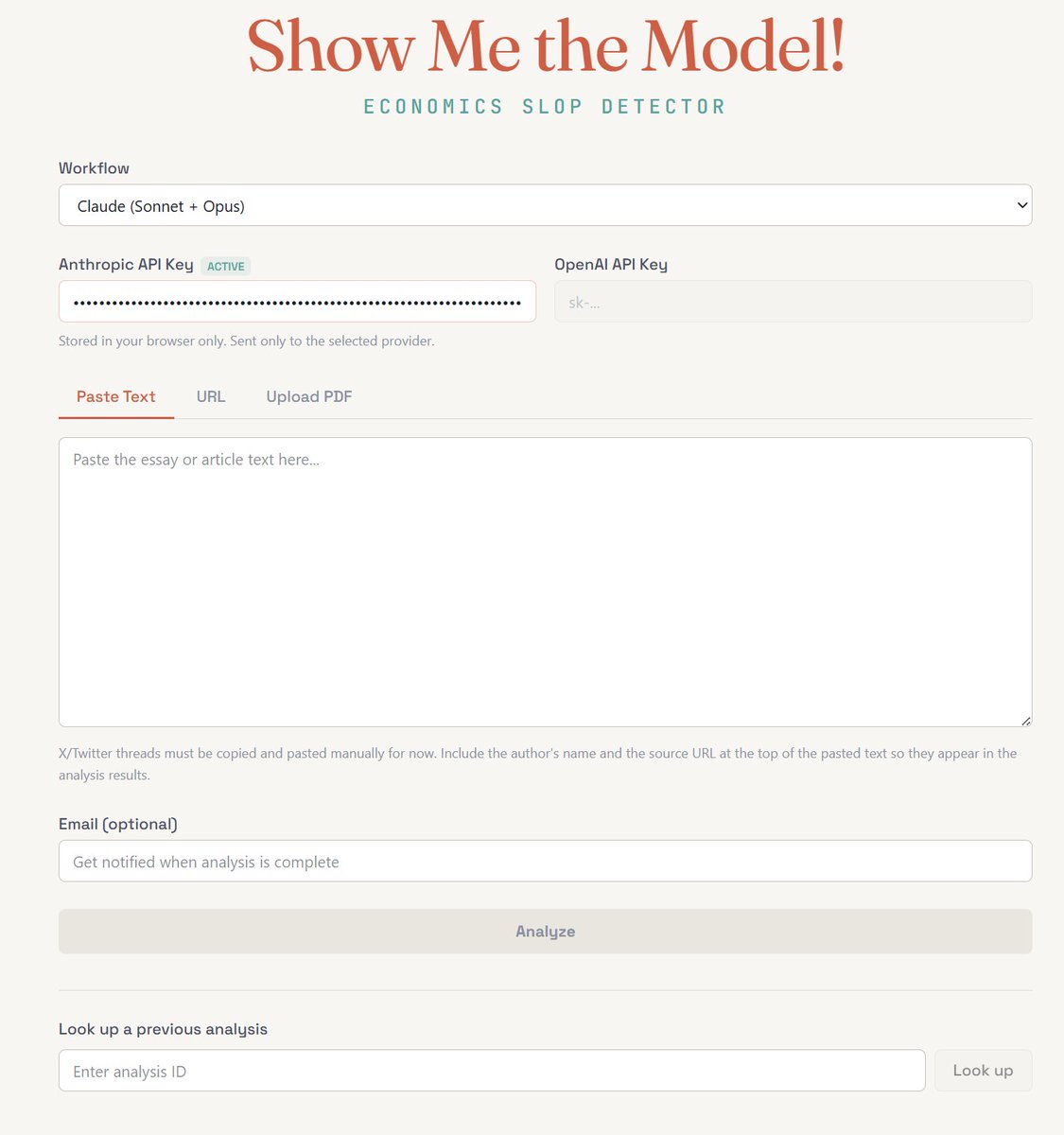
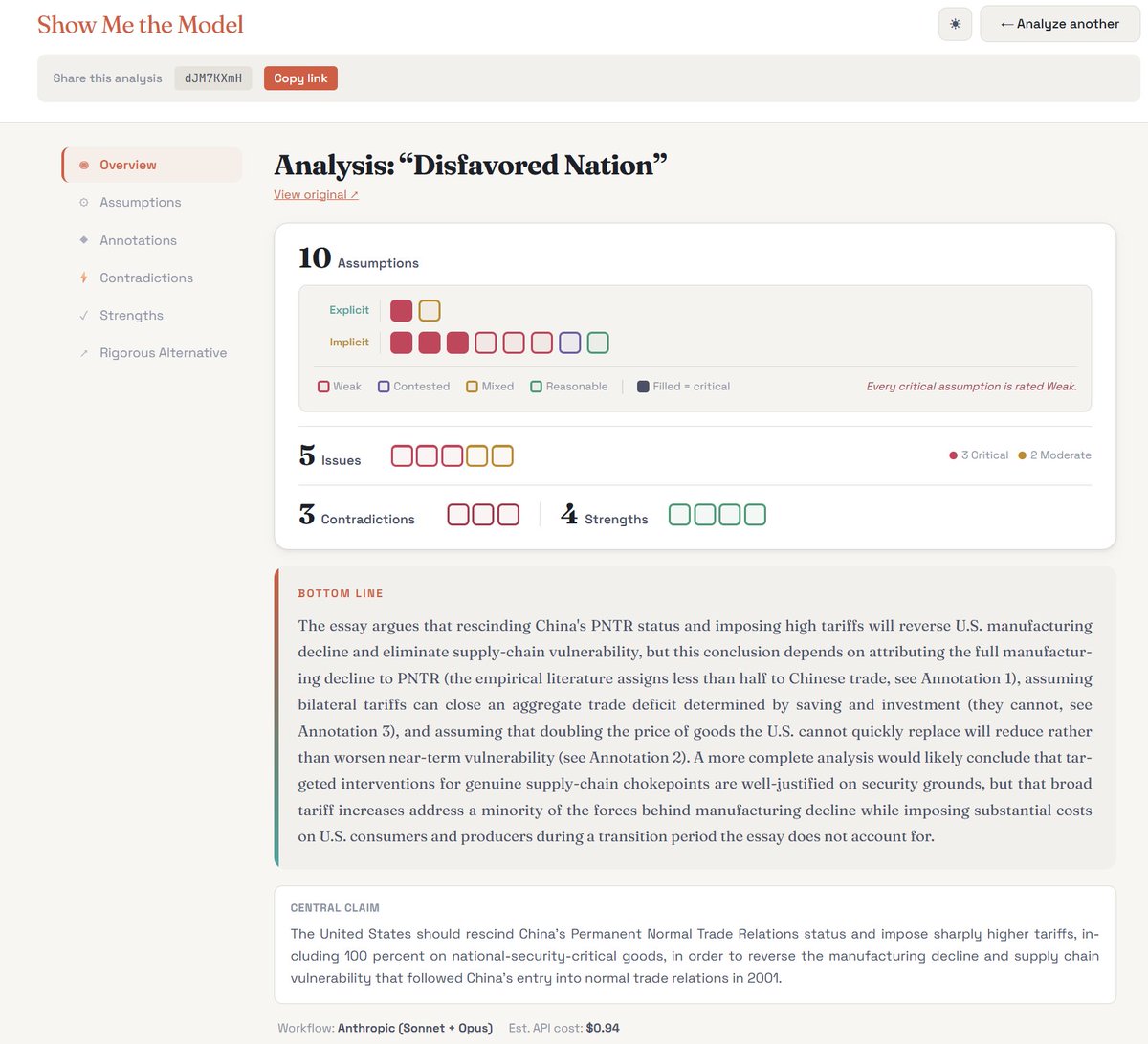
I spend way too much time on social media debunking "economic slop" promulgated by lawyers pretending to be economists, so I built Show Me the Model: a tool that uses AI to check whether the economic reasoning in an essay actually holds up. showmethemodel.io Give it a URL or paste some plain text, and the tool flags hidden assumptions, internal inconsistencies, and other problem areas, and tells you how a real economist would think through the issue. Right now, it has 4 "personas:" macro, trade, IO/price theory, and labor. The tool first figures out which persona is right for the job, and then uses a parallelized prompt scaffold specific to that persona to process the source text. Here are some example outputs based on some essays that triggered me hard: Citrini Research's viral essay on how AI could trigger a self-reinforcing financial crisis rivaling the GFC: showmethemodel.io/#/results/2ez3… American Compass on the harms of trade deficits: showmethemodel.io/#/results/kOvt… @oren_cass on why Built-to-Rent should be banned: showmethemodel.io/#/results/OXjr… American Compass on the "China Shock:" showmethemodel.io/#/results/dJM7… @michaelxpettis on why China's trade surplus reduces global output: showmethemodel.io/#/results/C8OT… Try it yourself at showmethemodel.io. You'll need to bring your own API key (OpenAI or Anthropic), and a typical analysis costs $0.50–$1.50. It's super preliminary and will probably break on you. I'd love feedback about both the functionality as well as the quality of the output.
Joseph Steinberg tweet mediaJoseph Steinberg tweet mediaJoseph Steinberg tweet mediaJoseph Steinberg tweet media
English
22
131
718
96.5K
James Traina
James Traina@EconTraina·
@jbsteinberg I think your settings are s.t. you have to follow someone for them to DM you, but I'm happy to work through GitHub, I can start by simplifying + documenting
English
1
0
3
120
Joseph Steinberg
Joseph Steinberg@jbsteinberg·
@EconTraina It's incredibly messy, it should probably be cleaned up first. DM me if you have something specific in mind.
English
1
0
1
183
Ioana Marinescu
Ioana Marinescu@mioana·
🎉I'll be promoted to full professor at the University of Pennsylvania School of Social Policy & Practice, effective July 2026! Grateful for of the many people who've helped and challenged me along the way. Now off to work on #AI and its impact on the economy, society, & policy!
English
38
20
787
26.3K
James Traina
James Traina@EconTraina·
@PeterMcCrory Congrats! Curious about the publication model. The range runs from MSR (economists as faculty) to Amazon (by share, mostly internal). Will the team have protected time for top-journal work, or is that a side benefit? (Unclear what's best given AI is disrupting publishing!!)
English
0
0
2
2.1K
Peter McCrory
Peter McCrory@PeterMcCrory·
I want to share a bit more about my vision for the Economic Research team at Anthropic in the coming years. This is a forward-looking vision. Some pieces we’ve yet to develop. Aspects of this work will surely change. Consider joining the effort. 1/6 #heading=h.j1ij8p6h22u5" target="_blank" rel="nofollow noopener">docs.google.com/document/d/1OM…
English
22
114
1.2K
196.5K