economics_for_upsc

788 posts

economics_for_upsc

economics_for_upsc

@Economics_Upsc

I'm an Economics Graduate from Hindu College and post graduate from Delhi School of Economics. Here to make Economics (GS portion) simpler for you guys!

Delhi Katılım Haziran 2025
60 Takip Edilen14K Takipçiler
Sabitlenmiş Tweet
economics_for_upsc
economics_for_upsc@Economics_Upsc·
WPI inflation rises to 42-mth high of 8.3%!! What is WPI? Wholesale Price Index measures average price changes of goods at the wholesale/producer level, before they reach consumers. It's different from CPI which tracks retail prices. WPI has 3 components: Primary Articles ∼22.6%, Fuel & Power ∼13.2%, and Manufactured Products ∼64.2%. So "manufactured products" moves the index most. WPI inflation jumped to 8.3% in April, a 42-month high. That's more than double March's 3.9%. The trigger:Crude petroleum prices climbed 88% in April. Since India imports ∼85% of its oil, that surge rippled through everything. Breakdown by fuel - Petrol inflation: 2.5% in March → 32.4% in April - Diesel inflation: 3.3% → 25.2% - LPG: From 1.5% contraction in March to 10.9% increase in April Manufacturing impact: Manufactured products, which make up nearly 64% of WPI, saw a "broad-based increase." Higher fuel and transport costs push up factory input costs, so prices of finished goods rise too. Why this matters: 1. Cost-push inflation: This is classic cost-push. When crude spikes, it raises transport, power, and raw material costs across industries. Producers pass it on. 2. CPI impact next: High WPI often feeds into CPI with a lag. If producers face 8.3% higher input costs, retail prices usually follow. 3. Policy signal: RBI watches CPI for rate decisions, but sustained high WPI pressures margins and can force rate hikes or fiscal action on fuel taxes. April's 8.3% WPI was driven almost entirely by the crude oil shock. Fuel costs exploded, and that fed into transport + manufacturing. With manufactured goods as 64% of the index, the impact was broad, not just energy. #upsc #upsceconomics #upsc2026
economics_for_upsc tweet media
English
1
27
167
7.2K
economics_for_upsc
economics_for_upsc@Economics_Upsc·
DGFT tightens its grip on Gold!! x.com/i/status/20555…
economics_for_upsc@Economics_Upsc

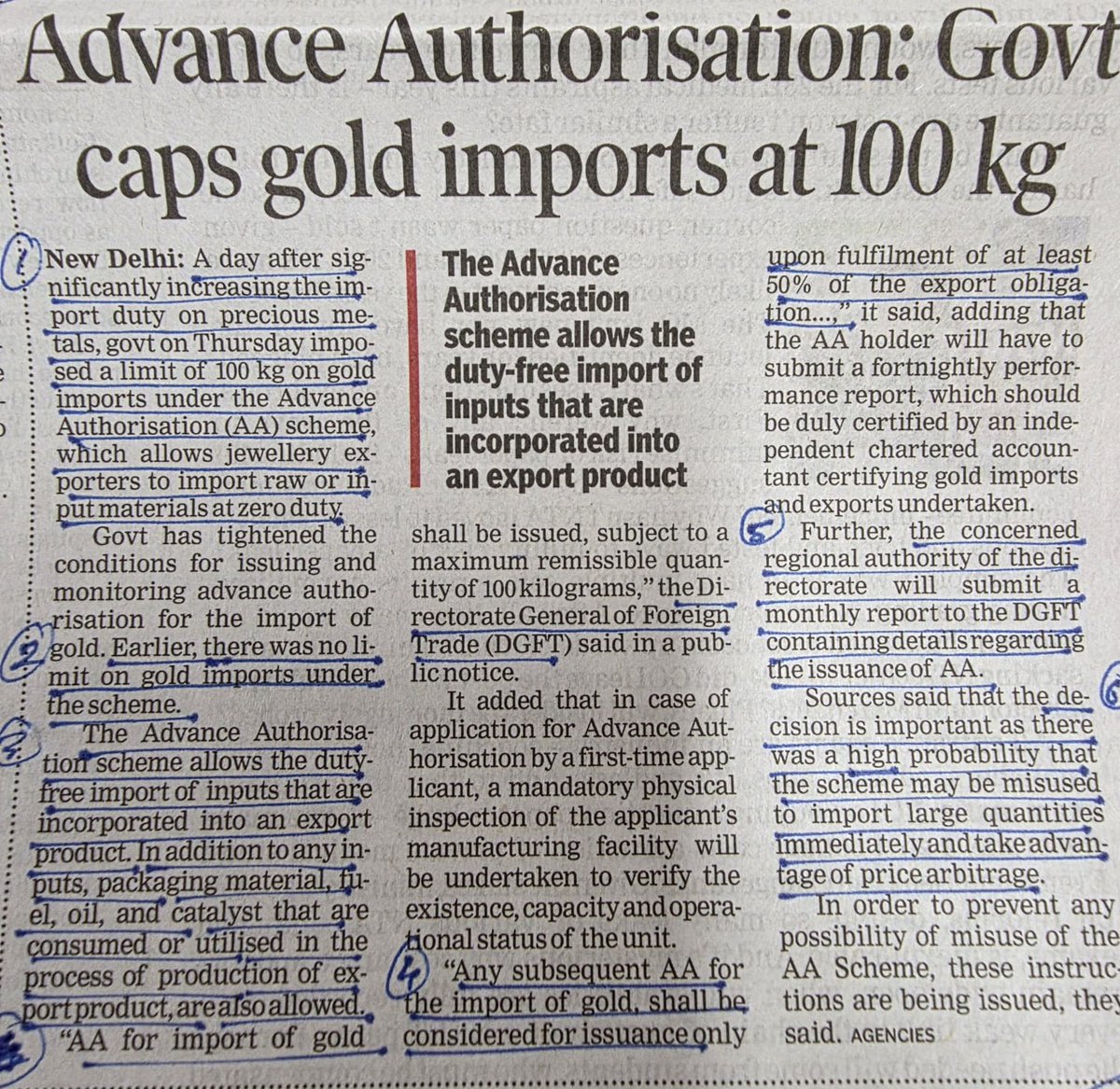
Advance Authorisation: Govt caps gold imports at 100 kg!! 1. What is the Advance Authorisation (AA) Scheme? AA is a key duty-exemption scheme under India's Foreign Trade Policy. It lets exporters import raw materials, inputs, fuel, packaging, etc. _duty-free_ if those inputs are physically incorporated into products meant for export. Goal: Make Indian exports competitive by removing input cost of customs duty. For jewellery exporters, this meant they could import gold without paying the normal import duty, manufacture jewellery, and export it. What changed: 1. New cap: Govt imposed a 100 kg limit on gold imports under AA. Earlier, there was no limit. 2. Timing: Came a day after govt hiked import duty on precious metals. 3. Tighter monitoring: DGFT issued new rules to prevent misuse. New conditions for gold under AA: 1. Max 100 kg per authorisation: "AA for import of gold shall be issued, subject to a maximum remissible quantity of 100 kilograms" — DGFT notice. 2. Export obligation check: Subsequent AA for gold only issued after fulfilling at least 50% of export obligation from previous AA. 3. Fortnightly reports: AA holder must submit performance reports every 15 days, certified by independent CA, showing gold imports vs exports. 4. First-time scrutiny: Physical inspection of manufacturing facility mandatory for first-time applicants to verify capacity. 5. Monthly DGFT reporting: Regional authorities must send monthly reports to DGFT on all AAs issued. Why the govt did this: Sources say there was a "high probability that the scheme may be misused to import large quantities immediately and take advantage of price arbitrage." With import duty on gold hiked, the duty-free AA route became very attractive. Without a cap, exporters could import huge amounts of duty-free gold, potentially divert some to the domestic market, and profit from the duty differential. The 100 kg cap + stricter tracking closes that loophole. The cap ensures exporters bring in only what they can reasonably process/export, and the new reporting makes diversion harder. #upsc #upsceconomics #upsc2026

English
0
0
15
868
economics_for_upsc
economics_for_upsc@Economics_Upsc·
Advance Authorisation: Govt caps gold imports at 100 kg!! 1. What is the Advance Authorisation (AA) Scheme? AA is a key duty-exemption scheme under India's Foreign Trade Policy. It lets exporters import raw materials, inputs, fuel, packaging, etc. _duty-free_ if those inputs are physically incorporated into products meant for export. Goal: Make Indian exports competitive by removing input cost of customs duty. For jewellery exporters, this meant they could import gold without paying the normal import duty, manufacture jewellery, and export it. What changed: 1. New cap: Govt imposed a 100 kg limit on gold imports under AA. Earlier, there was no limit. 2. Timing: Came a day after govt hiked import duty on precious metals. 3. Tighter monitoring: DGFT issued new rules to prevent misuse. New conditions for gold under AA: 1. Max 100 kg per authorisation: "AA for import of gold shall be issued, subject to a maximum remissible quantity of 100 kilograms" — DGFT notice. 2. Export obligation check: Subsequent AA for gold only issued after fulfilling at least 50% of export obligation from previous AA. 3. Fortnightly reports: AA holder must submit performance reports every 15 days, certified by independent CA, showing gold imports vs exports. 4. First-time scrutiny: Physical inspection of manufacturing facility mandatory for first-time applicants to verify capacity. 5. Monthly DGFT reporting: Regional authorities must send monthly reports to DGFT on all AAs issued. Why the govt did this: Sources say there was a "high probability that the scheme may be misused to import large quantities immediately and take advantage of price arbitrage." With import duty on gold hiked, the duty-free AA route became very attractive. Without a cap, exporters could import huge amounts of duty-free gold, potentially divert some to the domestic market, and profit from the duty differential. The 100 kg cap + stricter tracking closes that loophole. The cap ensures exporters bring in only what they can reasonably process/export, and the new reporting makes diversion harder. #upsc #upsceconomics #upsc2026
economics_for_upsc tweet media
English
1
31
170
9.3K
economics_for_upsc
economics_for_upsc@Economics_Upsc·
Upsc PYQ Answer: (a) Both Statement II and Statement III are correct and both of them explain Statement I* Context: What is a circular economy?* Unlike the traditional "take-make-dispose" linear model, a circular economy keeps resources in use for as long as possible through reusing, repairing, refurbishing, remanufacturing, and recycling. Statement I: Circular economy reduces the emissions of greenhouse gases — Correct: Extracting raw materials, manufacturing, and waste disposal are major GHG sources. By closing the loop, we cut energy-intensive mining/manufacturing and reduce landfill methane. EU estimates show circular economy measures could cut global GHG emissions by 39%. Statement II: Circular economy reduces the use of raw materials as inputs — Correct: Core principle. Reuse and recycling mean less virgin ore, timber, crude oil, etc. need to be extracted. Statement III: Circular economy reduces wastage in the production process — Correct: Circular design aims for zero waste. By-products become inputs for other processes. Think industrial symbiosis — waste heat from one factory powers another. Lean manufacturing + recycling scrap cuts process waste. Since both II and III are correct and both causally lead to I, option (a) is right. #upsc #upsceconomics #upscprelims
economics_for_upsc tweet media
English
0
10
58
2.7K
economics_for_upsc
economics_for_upsc@Economics_Upsc·
"Third attempt" is the lucky charm for UPSC aspirants"!!?? (The Print) 1. The Union Public Service Commission’s Civil Services Exam is India’s toughest recruitment test for IAS, IPS, IFS and other Group A services. ∼11-13 lakh people apply each year, ∼5-6 lakh appear for Prelims, ∼13,000 qualify for Mains, ∼2,500 reach the interview, and ∼700-1,000 finally get selected. Success rate is <0.1%. 2. What ThePrint found from UPSC Annual Report 2023-24: i. First-timers dominate but rarely clear: 48.2% of candidates in CSE 2022 were first-timers, but only 6.2% of them got selected. In 2018, 54.2% were first-timers with 7.9% success. ii. Third & fourth attempts are the “sweet spot” - 2022: 12.6% cleared in 2nd attempt, 21.9% in 3rd, 22.0% in 4th - From 2018-2022, third attempt success stayed between 19.7% to 24% 3. Why this matters - The pattern shows CSE “increasingly favours candidates who can afford years of preparation and repeated attempts”. Clearing it often requires 2-3 years of full-time prep, which may be a disadvantage to those who can’t afford coaching or long gaps without income. 4. Related reform context: Multiple committees over decades, including the Kothari Committee in 1976, have recommended reducing attempts and upper age limit. The idea was to prevent the exam from becoming an endurance test for only those with financial backing. 5. Other useful context from UPSC data: Scale: 11.35 lakh applied in 2022; 5.73 lakh appeared for Prelims. 2023 saw ∼13 lakh applicants. Dropout: Over 50% of registered candidates don’t even appear for Prelims. Background: Engineers made up 53.1% of selections in 2023-24, down from 62.7% in 2019. Humanities grads rose to 29%. Bottom line: ThePrint uses UPSC’s own data to show that while nearly half the aspirants are first-timers, the odds jump significantly by the 3rd/4th attempt. #upsc #upsc2026 #upscprelims theprint.in/feature/upsc-a…
English
1
20
142
12.3K
economics_for_upsc
economics_for_upsc@Economics_Upsc·
"Third attempt"- the "sweet spot" in UPSC!! x.com/i/status/20540…
economics_for_upsc@Economics_Upsc

"Third attempt" is the lucky charm for UPSC aspirants"!!?? (The Print) 1. The Union Public Service Commission’s Civil Services Exam is India’s toughest recruitment test for IAS, IPS, IFS and other Group A services. ∼11-13 lakh people apply each year, ∼5-6 lakh appear for Prelims, ∼13,000 qualify for Mains, ∼2,500 reach the interview, and ∼700-1,000 finally get selected. Success rate is <0.1%. 2. What ThePrint found from UPSC Annual Report 2023-24: i. First-timers dominate but rarely clear: 48.2% of candidates in CSE 2022 were first-timers, but only 6.2% of them got selected. In 2018, 54.2% were first-timers with 7.9% success. ii. Third & fourth attempts are the “sweet spot” - 2022: 12.6% cleared in 2nd attempt, 21.9% in 3rd, 22.0% in 4th - From 2018-2022, third attempt success stayed between 19.7% to 24% 3. Why this matters - The pattern shows CSE “increasingly favours candidates who can afford years of preparation and repeated attempts”. Clearing it often requires 2-3 years of full-time prep, which may be a disadvantage to those who can’t afford coaching or long gaps without income. 4. Related reform context: Multiple committees over decades, including the Kothari Committee in 1976, have recommended reducing attempts and upper age limit. The idea was to prevent the exam from becoming an endurance test for only those with financial backing. 5. Other useful context from UPSC data: Scale: 11.35 lakh applied in 2022; 5.73 lakh appeared for Prelims. 2023 saw ∼13 lakh applicants. Dropout: Over 50% of registered candidates don’t even appear for Prelims. Background: Engineers made up 53.1% of selections in 2023-24, down from 62.7% in 2019. Humanities grads rose to 29%. Bottom line: ThePrint uses UPSC’s own data to show that while nearly half the aspirants are first-timers, the odds jump significantly by the 3rd/4th attempt. #upsc #upsc2026 #upscprelims theprint.in/feature/upsc-a…

English
0
0
17
1.7K
economics_for_upsc
economics_for_upsc@Economics_Upsc·
FPI outflows- too hot to handle!!?? x.com/i/status/20538…
economics_for_upsc@Economics_Upsc

FPI outflows cross ₹2L cr, highest since 1993!! 1. Foreign Portfolio Investors are overseas funds, institutions, or individuals who buy Indian stocks/bonds. Unlike FDI which is long-term investment in companies, FPI money is "hot money" — it can enter/exit quickly based on market sentiment. Net outflow means FPIs sold more Indian equities than they bought. 2. In just over 4 months of 2026 till May 8, FPIs pulled out a record ₹2.06 lakh crore from Indian stocks. This is the worst yearly outflow since 1993, when India first allowed foreign funds to invest in domestic stocks. It already beats the full-year 2025 outflow of ₹1.66 lakh crore. 3. Foreign holding in Indian stocks fell to a 14-year low of 14.7%, now below domestic institutions at 18.9% — per JM Financial. 4. Why the sell-off? a. Geopolitics + currency crash: Over half the outflow was in March alone, right after the war in West Asia started and the rupee crashed below ₹95/$, its lowest ever vs USD. b. Oil prices: Goldman Sachs notes foreign funds usually buy India when oil prices fall. But they didn’t return during the early-April oil correction, despite heavy selling in March’s oil rally. c. Earnings downgrades: FPIs likely sold in anticipation of an earnings downgrade cycle. Poor visibility on recovery means they won’t rush back. Gist: 2026 is already the worst year for FPI equity outflows in 30+ years. The trigger was March’s West Asia war + rupee crash. While selling may have peaked, Goldman expects FPIs to stay cautious near-term. #upsc #upsceconomics #upsc2026 #FPI

English
0
6
21
2K
economics_for_upsc
economics_for_upsc@Economics_Upsc·
FPI outflows cross ₹2L cr, highest since 1993!! 1. Foreign Portfolio Investors are overseas funds, institutions, or individuals who buy Indian stocks/bonds. Unlike FDI which is long-term investment in companies, FPI money is "hot money" — it can enter/exit quickly based on market sentiment. Net outflow means FPIs sold more Indian equities than they bought. 2. In just over 4 months of 2026 till May 8, FPIs pulled out a record ₹2.06 lakh crore from Indian stocks. This is the worst yearly outflow since 1993, when India first allowed foreign funds to invest in domestic stocks. It already beats the full-year 2025 outflow of ₹1.66 lakh crore. 3. Foreign holding in Indian stocks fell to a 14-year low of 14.7%, now below domestic institutions at 18.9% — per JM Financial. 4. Why the sell-off? a. Geopolitics + currency crash: Over half the outflow was in March alone, right after the war in West Asia started and the rupee crashed below ₹95/$, its lowest ever vs USD. b. Oil prices: Goldman Sachs notes foreign funds usually buy India when oil prices fall. But they didn’t return during the early-April oil correction, despite heavy selling in March’s oil rally. c. Earnings downgrades: FPIs likely sold in anticipation of an earnings downgrade cycle. Poor visibility on recovery means they won’t rush back. Gist: 2026 is already the worst year for FPI equity outflows in 30+ years. The trigger was March’s West Asia war + rupee crash. While selling may have peaked, Goldman expects FPIs to stay cautious near-term. #upsc #upsceconomics #upsc2026 #FPI
economics_for_upsc tweet media
English
0
10
52
3.6K
economics_for_upsc
economics_for_upsc@Economics_Upsc·
Time for shared cooling!!?? 1. India faces extreme heat — Rajasthan hit 50°C in summer 2024, Delhi’s in a heatwave, and 57% of districts face high heat risk. AC demand is set to rise 8x by 2037-38. Installing millions of individual ACs building-by-building would be “catastrophic for the climate” — they’re inefficient, leak HFCs, and dump more heat into cities. 2. District Cooling Systems (DCS) DCS is a shared air-conditioning utility. Instead of each building having its own chillers, centralized plants make chilled water and pipe it through insulated underground networks to dozens or hundreds of buildings. Each building draws cooling like electricity or piped gas, metered and billed. 3. Why DCS works better: a. Energy savings: 30-50% less energy vs standard ACs. Industrial chillers in DCS have a COP of 5-7 vs 2-3 for split ACs — meaning 5-7 units of cooling per unit of electricity. b. Peak demand: Cuts peak power demand for cooling by 40-80%. c. Proven tech: Paris has run Climespace since 1991 at ∼100% energy efficiency. Dubai has the world’s largest DCS serving Burj Khalifa, Dubai Mall, Metro. Singapore runs one in Marina Bay since 2006. 4. Planned urban developments, IT parks, SEZs, and smart cities are ideal for DCS if built in at the master-planning stage. Tamil Nadu’s 2024 report flagged Chennai’s OMR corridor, Coimbatore TIDEL Park, SIPCOT estates, and new developments in Madurai/Tuticorin as priority locations. 5. India lacks a legal/regulatory framework. No Indian Standards (IS) classification, no zoning codes for cooling pipe networks, no environmental regulations. Only GIFT City has provisions. Maharashtra has a DCS tariff, but other states haven’t created a tariff category. #upsc #upsceconomics #climatechange #upsc2026
economics_for_upsc tweet media
English
3
46
306
12.2K
economics_for_upsc
economics_for_upsc@Economics_Upsc·
PSL- time for revamp!!?? x.com/i/status/20533…
economics_for_upsc@Economics_Upsc

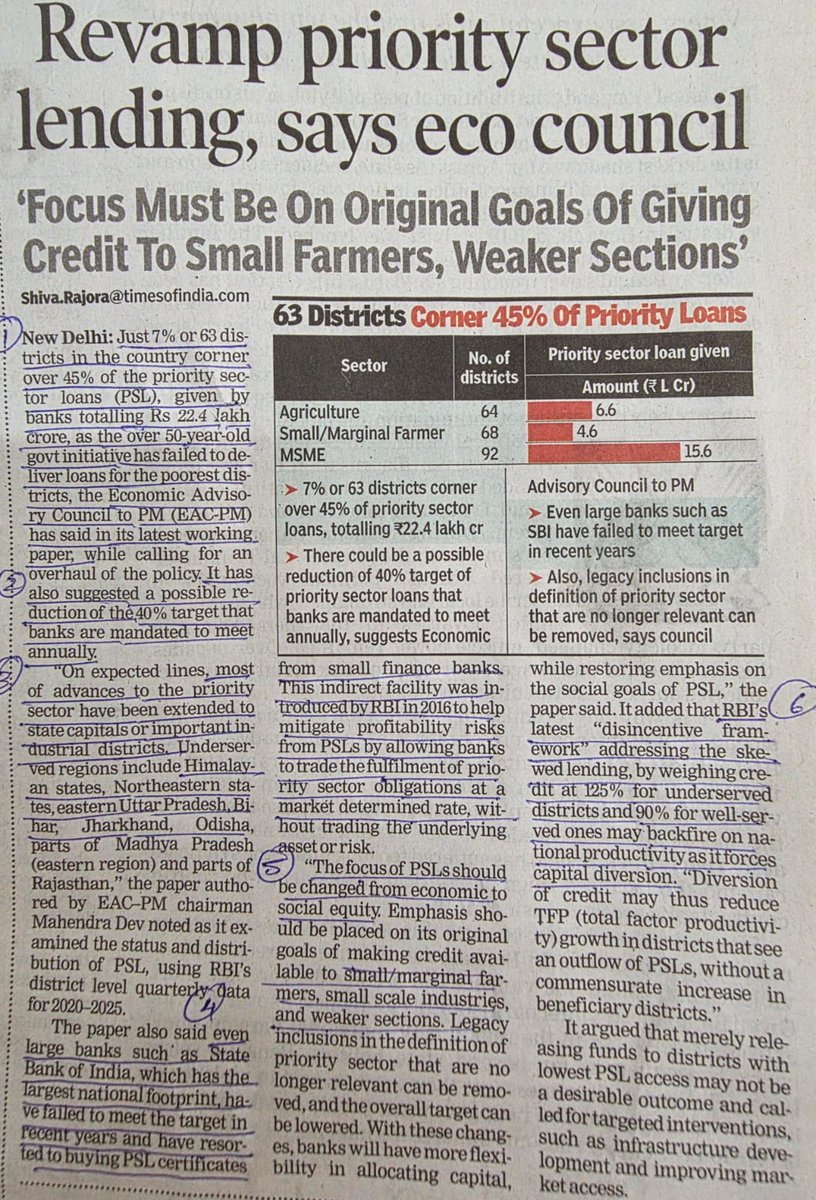
Priority sector lending- time for revamp!!?? (Times of India, 8th May, 2026) 1. What is Priority Sector Lending (PSL)? PSL is a 50+ year old RBI mandate that requires banks to give 40% of their total loans to specific "priority" sectors — agriculture, small/marginal farmers, MSMEs, weaker sections, education, housing, etc. The idea was to ensure credit reaches underserved people who wouldn't otherwise get bank loans. 2. The Problem the EAC-PM found: The Economic Advisory Council to the PM, in a working paper by chairman Mahendra Dev, analyzed RBI district-level data for 2020-2025 and found PSL isn't working as intended. 3. Key findings: i. Extreme concentration: Just 7% of districts — 63 districts — get 45% of all PSL, totaling ₹22.4 lakh crore. ii. Rich areas benefit, poor areas don’t: Most PSL goes to state capitals or big industrial districts. Underserved regions like Himalayan states, Northeast, eastern UP, Bihar, Jharkhand, Odisha, parts of MP and Rajasthan get little. iii. Banks missing targets: Even SBI, with the largest national footprint, has failed to meet PSL targets and resorts to buying PSL certificates from small finance banks. This "PSL trading" was allowed by RBI in 2016. 4. EAC-PM’s recommendations: a. Overhaul PSL: Shift focus from "economic" to "social equity" and back to original goals — credit for small/marginal farmers, small industries, weaker sections. b. Cut the 40% target: Suggests possibly reducing the mandatory 40% PSL quota to give banks more flexibility. c. Remove outdated categories: Drop "legacy inclusions" in the PSL definition that are no longer relevant. d. Criticizes RBI’s new rule: RBI’s “disincentive framework” that weighs credit at 125% for underserved districts and 90% for well-served ones may backfire. Forcing capital diversion could hurt total factor productivity growth in districts losing PSL without helping beneficiary districts. Just dumping funds into low-PSL districts won’t work. Need targeted interventions like infrastructure and better market access first. (Crux: The council says PSL has drifted from helping the poorest. It's now concentrated in already-developed districts, and the current fix-it rules might hurt national productivity. They suggest a revamp that restores the social focus and gives banks flexibility.) #upsc #upsceconomics #prioritysectorlending #upsc2026

English
0
2
27
2K
economics_for_upsc
economics_for_upsc@Economics_Upsc·
Priority sector lending- time for revamp!!?? (Times of India, 8th May, 2026) 1. What is Priority Sector Lending (PSL)? PSL is a 50+ year old RBI mandate that requires banks to give 40% of their total loans to specific "priority" sectors — agriculture, small/marginal farmers, MSMEs, weaker sections, education, housing, etc. The idea was to ensure credit reaches underserved people who wouldn't otherwise get bank loans. 2. The Problem the EAC-PM found: The Economic Advisory Council to the PM, in a working paper by chairman Mahendra Dev, analyzed RBI district-level data for 2020-2025 and found PSL isn't working as intended. 3. Key findings: i. Extreme concentration: Just 7% of districts — 63 districts — get 45% of all PSL, totaling ₹22.4 lakh crore. ii. Rich areas benefit, poor areas don’t: Most PSL goes to state capitals or big industrial districts. Underserved regions like Himalayan states, Northeast, eastern UP, Bihar, Jharkhand, Odisha, parts of MP and Rajasthan get little. iii. Banks missing targets: Even SBI, with the largest national footprint, has failed to meet PSL targets and resorts to buying PSL certificates from small finance banks. This "PSL trading" was allowed by RBI in 2016. 4. EAC-PM’s recommendations: a. Overhaul PSL: Shift focus from "economic" to "social equity" and back to original goals — credit for small/marginal farmers, small industries, weaker sections. b. Cut the 40% target: Suggests possibly reducing the mandatory 40% PSL quota to give banks more flexibility. c. Remove outdated categories: Drop "legacy inclusions" in the PSL definition that are no longer relevant. d. Criticizes RBI’s new rule: RBI’s “disincentive framework” that weighs credit at 125% for underserved districts and 90% for well-served ones may backfire. Forcing capital diversion could hurt total factor productivity growth in districts losing PSL without helping beneficiary districts. Just dumping funds into low-PSL districts won’t work. Need targeted interventions like infrastructure and better market access first. (Crux: The council says PSL has drifted from helping the poorest. It's now concentrated in already-developed districts, and the current fix-it rules might hurt national productivity. They suggest a revamp that restores the social focus and gives banks flexibility.) #upsc #upsceconomics #prioritysectorlending #upsc2026
economics_for_upsc tweet media
English
0
21
132
6.2K
economics_for_upsc
economics_for_upsc@Economics_Upsc·
India tops foreign remittances!! x.com/i/status/20529…
economics_for_upsc@Economics_Upsc

India tops global remittances!!! (Times of India, Friday, 8th May, 2026) #1 globally: India received $137.7 billion in remittances in 2024, making it the only country to cross the $100 billion mark. Huge growth: remittances have gone up from $68.9Bn in 2015 and $53Bn in 2010, driven by strong earnings of Indians in US, UAE, UK, Canada, and Australia. Other top countries 2024: Mexico $68Bn is at second spot, followed by China at $48B and Philippines $38B+ based on the chart trend. Why India leads: Largest diaspora at ∼19 million, with major populations in UAE, US, and Saudi Arabia. Changing migration pattern: While Gulf nations still employ millions in construction/services, there’s rapid growth in high-skilled migration from India in tech, healthcare, engineering, and research. Source: World Migration Report 2026 by International Organisation for Migration. (Pl note: *What are remittances?* Remittances are money that people working abroad send back to their families/friends in their home country. Think of it as an Indian working in Dubai sending part of their salary to parents in Kerala, or a software engineer in the US transferring money home to Uttar Pradesh. It’s usually done through banks, wire transfers, or apps like Western Union, Wise, etc. Role in India’s economic development:*l India is the world’s #1 recipient — $137.7 billion in 2024 alone. That’s huge. Here’s why it matters: 1. Foreign exchange & current account support* - Remittances are India’s largest source of forex after IT services exports. - They help offset the trade deficit. We import more goods than we export, but remittance inflows reduce pressure on the rupee and keep our current account healthier. 2. Household consumption & poverty reduction* - Money goes directly to families, often in rural/semi-urban areas. - Used for food, education, healthcare, housing, weddings. This boosts local consumption and reduces poverty. World Bank studies show remittances directly improve household living standards. 3. Investment & savings - Families also invest remittance money in small businesses, agriculture, or real estate. - In states like Kerala, Punjab, and UP, remittances have funded construction booms and local enterprises. 4. Development without debt* - Unlike loans or FDI, remittances don’t have to be repaid. No interest, no conditions. It’s a stable, counter-cyclical flow — even during global downturns, migrants often send more money home to support families. 5. Regional impact - Some states depend heavily on it. Kerala gets ∼20-25% of its state GDP from remittances. Bihar, UP, and Tamil Nadu also see major inflows. It reduces regional inequality. The flip side: Heavy dependence on remittances can also mean “brain drain” and vulnerability if Gulf/US job markets slow down. But overall, that $138B is a massive, stable cushion for India’s economy.) #upsc #upsceconomics #upscprelims #upsc2026

English
0
2
31
1.7K
economics_for_upsc
economics_for_upsc@Economics_Upsc·
India tops global remittances!!! (Times of India, Friday, 8th May, 2026) #1 globally: India received $137.7 billion in remittances in 2024, making it the only country to cross the $100 billion mark. Huge growth: remittances have gone up from $68.9Bn in 2015 and $53Bn in 2010, driven by strong earnings of Indians in US, UAE, UK, Canada, and Australia. Other top countries 2024: Mexico $68Bn is at second spot, followed by China at $48B and Philippines $38B+ based on the chart trend. Why India leads: Largest diaspora at ∼19 million, with major populations in UAE, US, and Saudi Arabia. Changing migration pattern: While Gulf nations still employ millions in construction/services, there’s rapid growth in high-skilled migration from India in tech, healthcare, engineering, and research. Source: World Migration Report 2026 by International Organisation for Migration. (Pl note: *What are remittances?* Remittances are money that people working abroad send back to their families/friends in their home country. Think of it as an Indian working in Dubai sending part of their salary to parents in Kerala, or a software engineer in the US transferring money home to Uttar Pradesh. It’s usually done through banks, wire transfers, or apps like Western Union, Wise, etc. Role in India’s economic development:*l India is the world’s #1 recipient — $137.7 billion in 2024 alone. That’s huge. Here’s why it matters: 1. Foreign exchange & current account support* - Remittances are India’s largest source of forex after IT services exports. - They help offset the trade deficit. We import more goods than we export, but remittance inflows reduce pressure on the rupee and keep our current account healthier. 2. Household consumption & poverty reduction* - Money goes directly to families, often in rural/semi-urban areas. - Used for food, education, healthcare, housing, weddings. This boosts local consumption and reduces poverty. World Bank studies show remittances directly improve household living standards. 3. Investment & savings - Families also invest remittance money in small businesses, agriculture, or real estate. - In states like Kerala, Punjab, and UP, remittances have funded construction booms and local enterprises. 4. Development without debt* - Unlike loans or FDI, remittances don’t have to be repaid. No interest, no conditions. It’s a stable, counter-cyclical flow — even during global downturns, migrants often send more money home to support families. 5. Regional impact - Some states depend heavily on it. Kerala gets ∼20-25% of its state GDP from remittances. Bihar, UP, and Tamil Nadu also see major inflows. It reduces regional inequality. The flip side: Heavy dependence on remittances can also mean “brain drain” and vulnerability if Gulf/US job markets slow down. But overall, that $138B is a massive, stable cushion for India’s economy.) #upsc #upsceconomics #upscprelims #upsc2026
economics_for_upsc tweet media
English
0
10
95
5.3K
economics_for_upsc
economics_for_upsc@Economics_Upsc·
Banks to follow new ECL guidelines from 1.4.2027!! x.com/i/status/20518…
economics_for_upsc@Economics_Upsc

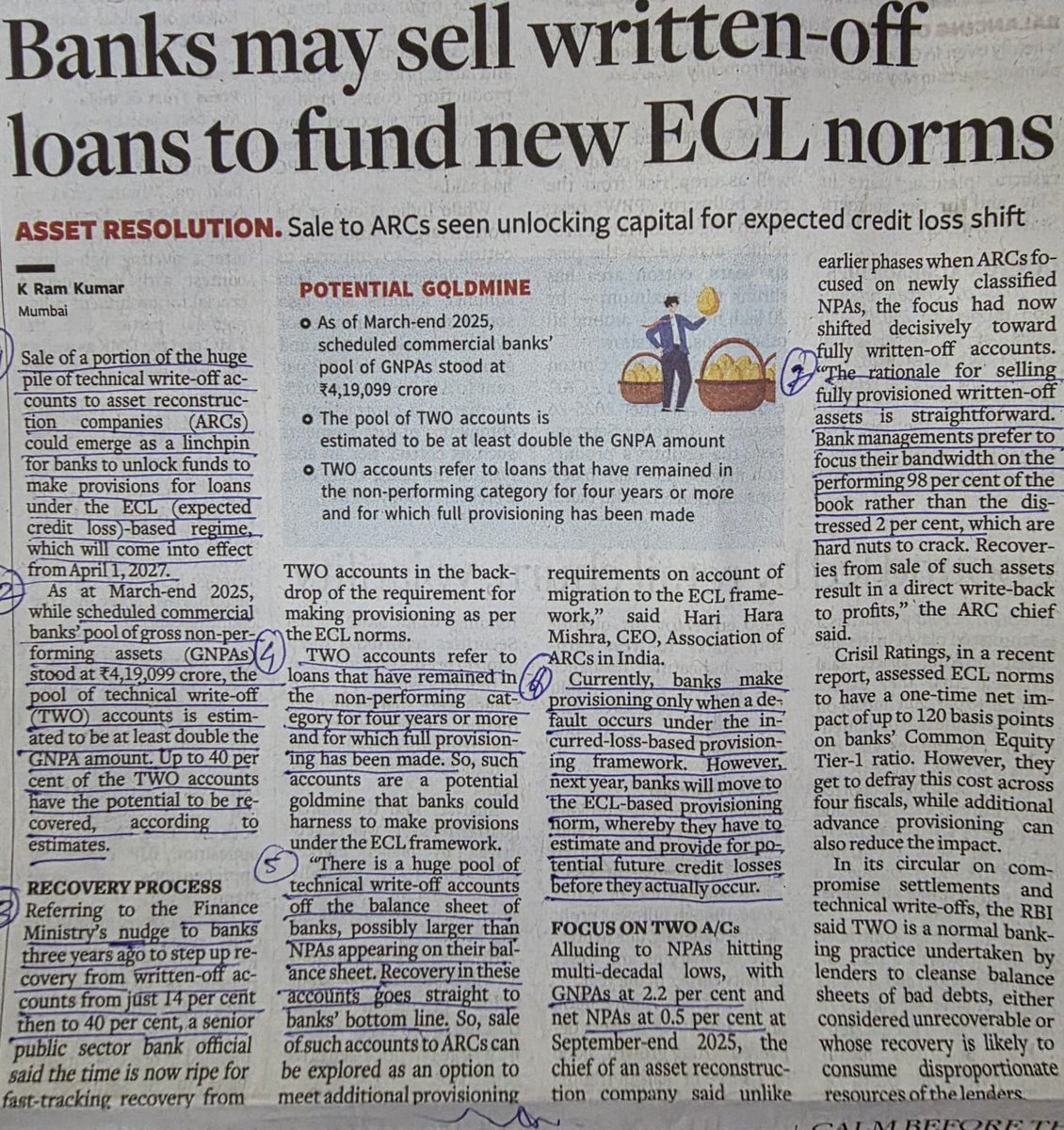
Banks may sell "written-off" loans to fund new ECL norms!! 1.Sale of a portion of the huge pile of "technical write-off" accounts to asset reconstruction companies (ARCs) could emerge as a linchpin for banks to unlock funds to make provisions for loans under the ECL (expected credit loss) based regime which will come into effect from April 1, 2027. 2.While Scheduled commercial banks’ gross non-per forming assets (GNPAs) stood at Rs. 4,19,099 crore, the pool of technical write-off (TWO) accounts is estimated to be at least double the GNPA amount. Up to 40 percent of the TWO accounts have the potential to be recovered, according to estimates. 3.Finance Ministry had nudged the banks three years ago to step up recovery from written-off accounts from just 14 percent then to 40 per cent. 4.TWO accounts refer to loans that have remained in the non-performing category for four years or more and for which full provisioning has been made. 5.“There is a huge pool of technical write-off accounts the balance sheet of banks, possibly larger than LPAs appearing on their balance sheet. Recovery in these accounts goes straight to banks’ bottom line. 6.Currently, banks make provisioning only when a default occurrs under incurred-loss-based provisioning framework. However, from next year, banks will move to the ECL-based provisioning norm, whereby they have to estimate and provide for potential future credit losses before they actually occur. ( GNPA stand at 2.2 per cent and net NPAs at 0.5 per cent at September end, 2025. ) 7.The rationale for selling fully provisioned written-off assets in straightforward Bank managements prefer to focus their bandwidth on the performing 98 per cent of the book rather than the distressed 2 per cent, ( Pl note: Technical write-off accounts are bad loans (NPAs) that banks remove from their main balance sheet for accounting purposes—usually after 100% provisioning—to clean up financial statements, while retaining the legal right to recover the money. They differ from active NPAs by moving from on-balance sheet (assets) to off-balance sheet, reducing reported Gross NPA ratios without forgiving the debt. Usage Examples & Context Balancing Books: Used when a loan has been a Non-Performing Asset (NPA) for an extended period, usually with 100% provisioning already made. Recovering "Unrecoverable" Debt: The borrower remains liable, and the bank continues to pursue legal remedies, sell the debt, or enforce security, despite it being written off. Improving Ratios: Helps banks manage and reduce their Gross NPA ratios. Typical Candidates: Often used for doubtful or loss assets where recovery is expected to be slow or require disproportionate resources.) #upsc #upscprelims #upsc2026 #upsceconomics

English
0
1
13
1.1K
economics_for_upsc
economics_for_upsc@Economics_Upsc·
Banks may sell "written-off" loans to fund new ECL norms!! 1.Sale of a portion of the huge pile of "technical write-off" accounts to asset reconstruction companies (ARCs) could emerge as a linchpin for banks to unlock funds to make provisions for loans under the ECL (expected credit loss) based regime which will come into effect from April 1, 2027. 2.While Scheduled commercial banks’ gross non-per forming assets (GNPAs) stood at Rs. 4,19,099 crore, the pool of technical write-off (TWO) accounts is estimated to be at least double the GNPA amount. Up to 40 percent of the TWO accounts have the potential to be recovered, according to estimates. 3.Finance Ministry had nudged the banks three years ago to step up recovery from written-off accounts from just 14 percent then to 40 per cent. 4.TWO accounts refer to loans that have remained in the non-performing category for four years or more and for which full provisioning has been made. 5.“There is a huge pool of technical write-off accounts the balance sheet of banks, possibly larger than LPAs appearing on their balance sheet. Recovery in these accounts goes straight to banks’ bottom line. 6.Currently, banks make provisioning only when a default occurrs under incurred-loss-based provisioning framework. However, from next year, banks will move to the ECL-based provisioning norm, whereby they have to estimate and provide for potential future credit losses before they actually occur. ( GNPA stand at 2.2 per cent and net NPAs at 0.5 per cent at September end, 2025. ) 7.The rationale for selling fully provisioned written-off assets in straightforward Bank managements prefer to focus their bandwidth on the performing 98 per cent of the book rather than the distressed 2 per cent, ( Pl note: Technical write-off accounts are bad loans (NPAs) that banks remove from their main balance sheet for accounting purposes—usually after 100% provisioning—to clean up financial statements, while retaining the legal right to recover the money. They differ from active NPAs by moving from on-balance sheet (assets) to off-balance sheet, reducing reported Gross NPA ratios without forgiving the debt. Usage Examples & Context Balancing Books: Used when a loan has been a Non-Performing Asset (NPA) for an extended period, usually with 100% provisioning already made. Recovering "Unrecoverable" Debt: The borrower remains liable, and the bank continues to pursue legal remedies, sell the debt, or enforce security, despite it being written off. Improving Ratios: Helps banks manage and reduce their Gross NPA ratios. Typical Candidates: Often used for doubtful or loss assets where recovery is expected to be slow or require disproportionate resources.) #upsc #upscprelims #upsc2026 #upsceconomics
economics_for_upsc tweet media
English
0
7
50
3.1K
economics_for_upsc
economics_for_upsc@Economics_Upsc·
What are HFIs?? High-frequency indicators (HFIs) are economic data points that are released frequently—typically on a daily, weekly, or monthly basis—to provide a real-time "pulse" of economic activity. Unlike traditional macro indicators like GDP, which are comprehensive but released with significant time lags, HFIs act as proxies that help policymakers and analysts identify immediate trends and potential turning points in the business cycle. Key Characteristics 1. Timeliness: They offer up-to-the-minute insights before quarterly or annual data is available. 2. Granularity: They often focus on specific sectors like energy, transport, or retail. 3. Nowcasting: They are used in statistical models to predict the current state of the economy (the "now") rather than the future. Common Examples of High-Frequency Indicators Industrial & Energy 1. Electricity Consumption: A robust proxy for industrial and business activity; higher usage typically suggests a growing economy. 2. Index of Industrial Production (IIP): Measures monthly changes in the volume of production across mining, manufacturing, and electricity. 3. Steel and Cement Consumption: Reflects the health of infrastructure and construction sectors. Trade & Logistics 4. GST E-way Bills: Real-time data on the movement of goods; a key indicator of internal trade. 5. Railway Freight & Port Cargo: Indicators of the volume of goods being transported across the country. 6. Fuel Consumption: Petrol and diesel usage levels signal trends in logistics and personal mobility. Consumer Activity 7. Vehicle Sales/Registrations: Passenger car, two-wheeler, and tractor sales reflect consumer confidence and rural demand. 8. Airline Passenger Traffic: Tracks the recovery and growth of the travel and tourism sectors. 9. Digital Transactions (UPI): High-frequency data on retail spending and formal economic activity. Financial & Market Indicators 10. Bank Credit Growth: Measures lending to businesses and individuals, signaling economic expansion. 11. Purchasing Managers' Index (PMI): Monthly survey data indicating expansion (above 50) or contraction (below 50) in manufacturing and services. 12. Stock Market Indices: Daily trackers like the Nifty 50 or S&P 500 that reflect investor sentiment. Why They Matter In times of economic uncertainty, such as during the COVID-19 pandemic, HFIs like Google mobility data or nighttime light intensity became critical because traditional data could not keep up with the rapid pace of change. Organizations like the International Monetary Fund (IMF) and various central banks now use these datasets to build composite indices that provide a more accurate, real-time picture of national growth.
English
0
0
19
628