Ed Zamanillo

713 posts

Ed Zamanillo banner
Ed Zamanillo

Ed Zamanillo

@EdZamanillo

Author of Mining Is Dead. Long Live Geopolitical Mining | Mining Engineer

Toronto Canada Katılım Ekim 2022
4.3K Takip Edilen1.7K Takipçiler
Ed Zamanillo retweetledi
Amanda van Dyke
Amanda van Dyke@AmandaVandyke13·
Deep Sea Mining Primer Part 2 Spoiler Alert: Deep Sea Mining is very likely the lowest environmental impact mining on the planet! We go beyond the headlines and into the real environmental, ethical and geopolitical debate surrounding the ocean floor. We examine the environmental concerns around deep-sea mining, how they compare to existing terrestrial mining impacts, whether current proposals can operate within robust international frameworks, and why the debate increasingly sits at the centre of energy security, industrial policy and the future of the global commons. This is not a simple story of “good” versus “bad.” It is a story about trade-offs, physical reality, and the growing collision between modern civilisation’s material demands and the limits of the systems that supply them. #DeepSeaMining #CriticalMinerals #MineralImperative #EnergyTransition #Mining #Nickel #Copper #Cobalt #RareEarths #BatteryMetals #IndustrialPolicy #Geopolitics #OceanScience #EnergySecurity #NetZero #AIInfrastructure #FutureOfEnergy #ResourceSecurity #CriticalMineralsHub open.substack.com/pub/amandavand…
English
0
2
11
1.5K
Ed Zamanillo
Ed Zamanillo@EdZamanillo·
Chile wants mining investors back. But capital will not underwrite intention alone. Chile Day 2026 Toronto’s test is execution: permitting discipline, fiscal visibility, infrastructure/water, and political continuity. Mining needs a country-level commitment. geopoliticalmining.com/chile-day-toro…
English
4
33
128
187.2K
Ed Zamanillo retweetledi
Amanda van Dyke
Amanda van Dyke@AmandaVandyke13·
Deep-sea mining may become one of the defining resource debates of the 21st century. Beneath 4,000–6,000 metres of Pacific Ocean sit vast polymetallic nodule fields containing billions of tonnes of manganese and hundreds of millions of tonnes of nickel, copper and cobalt — metals essential for electrification, AI infrastructure, defence systems and the modern industrial economy. Meanwhile, ore grades on land are falling, mines are becoming larger and more environmentally intensive, and supply chains are increasingly concentrated in a handful of countries. So the real question is no longer whether we need more mining. It is where that mining happens. Part I of my new deep-sea mining primer explores: • What deep-sea mining actually is • The different types of seabed mineral deposits • The history of exploration in the deep ocean • Why the Clarion–Clipperton Zone matters • The geopolitical battle over regulation and control • Why countries like China, Japan and the US are moving aggressively into the sector • And why the debate is fundamentally about the future of critical mineral supply chains Tomorrow in Part II, I’ll tackle the environmental debate directly: • The reality of abyssal ecosystems • Sediment plumes and biodiversity concerns • How deep-sea mining compares to terrestrial mining impacts • What we already do to the oceans today • Whether deep-sea mining could meet global environmental standards • And the broader moral argument from a mineral-imperative perspective Because this debate is no longer theoretical. It sits at the intersection of energy, industrial policy, geopolitics, environment and the future material foundations of civilisation itself. @TheOregonGroup @themetalsco @EdZamanillo #DeepSeaMining #CriticalMinerals #Mining #EnergyTransition #Nickel #Copper #Cobalt #RareEarths #Geopolitics #EnergySecurity #MineralImperative open.substack.com/pub/amandavand…
English
1
4
12
548
Ed Zamanillo retweetledi
The Northern Miner
The Northern Miner@northernminer·
Codelco faces questions over 20,000-tonne output gap Chilean state-run copper miner @CodelcoChile may have overstated its December output by about 20,000 tonnes after including material that did not qualify as finished product, according to a preliminary internal audit. northernminer.com/news/codelco-f…
English
0
1
1
572
Ed Zamanillo retweetledi
Bloomberg
Bloomberg@business·
A US-owned exploration firm has signed a deal with mining veteran Richard Warke’s company to advance a long-stalled gold project in Venezuela, the latest signal of foreign interest in the country’s mineral riches bloomberg.com/news/articles/…
English
11
45
106
18.1K
Ed Zamanillo retweetledi
The White House
The White House@WhiteHouse·
"It's an honor to be with you, it's an honor to be your friend, and the relationship between China and the USA is going to be better than ever before." - President Donald J. Trump 🇺🇸
English
2.6K
8K
42.5K
1.5M
Ed Zamanillo retweetledi
The White House
The White House@WhiteHouse·
The White House tweet media
ZXX
13K
17.6K
128.6K
19.5M
Ed Zamanillo retweetledi
Amanda van Dyke
Amanda van Dyke@AmandaVandyke13·
🚨 Trump’s 2025 Nuclear Executive Orders Are Delivering: DOE Launches “Nuclear Dominance — 3 by 33” Initiative One year ago, on May 23, 2025, President Trump signed four landmark executive orders to revive U.S. nuclear energy — with EO 14302 (“Reinvigorating the Nuclear Industrial Base”) directing the Department of Energy to use the Defense Production Act (DPA) to rebuild America’s domestic nuclear fuel supply chain from scratch. Now it’s happening. On April 23, 2026, DOE’s DPA Nuclear Fuel Cycle Consortium (with 90+ industry partners) unveiled the bold “Nuclear Dominance — 3 by 33” campaign. The three goals by 2033: • Build a secure, cost-competitive, fully domestic fuel cycle (uranium milling → conversion → enrichment → fabrication → recycling & reprocessing) • Accelerate advanced reactor deployment and close the fuel cycle • Leverage DPA tools to rapidly grow workforce, finance, innovation, and collaboration Using 60-day sprints and voluntary industry agreements, this directly executes the 2025 orders — ending reliance on foreign (especially Russian/Chinese) enriched uranium, fueling the existing fleet, powering next-gen reactors, and supporting the national goal of quadrupling U.S. nuclear capacity to ~400 GW by 2050. What it means for America’s nuclear program: • True energy dominance and national security • Reliable, carbon-free power for AI data centers and the grid • Massive job creation and supply-chain resurgence • A closed fuel cycle that turns waste into fuel This is how you turn executive vision into industrial reality. The nuclear renaissance is no longer a promise — it’s underway. #NuclearEnergy #mineralimperative #NuclearDominance3by33 #criticalmineralshub (Full articles on amandavandyke13 on Substack and in comments— share widely!) energy.gov/ne/articles/de…
English
1
2
9
489
Ed Zamanillo
Ed Zamanillo@EdZamanillo·
The full article is here: geopoliticalmining.com/legitimacy-gap/ Curious to hear what others think, especially those working at the intersection of mining, infrastructure, AI, industry, and public policy. 6/6
English
0
0
0
24
Ed Zamanillo
Ed Zamanillo@EdZamanillo·
Without legitimacy, societies do not stop needing minerals. They just displace extraction elsewhere — often into weaker governance, weaker standards, and more opaque supply chains. That is part of the paradox too. 5/6
English
1
0
0
21
Ed Zamanillo
Ed Zamanillo@EdZamanillo·
We published a new piece: The Mining Paradox: The Legitimacy Gap Behind Modern Life. The core idea is simple: modern life depends on mining. But formal mining still struggles for legitimacy. 1/6 geopoliticalmining.com/legitimacy-gap/
English
1
1
1
53
Ed Zamanillo retweetledi
Amanda van Dyke
Amanda van Dyke@AmandaVandyke13·
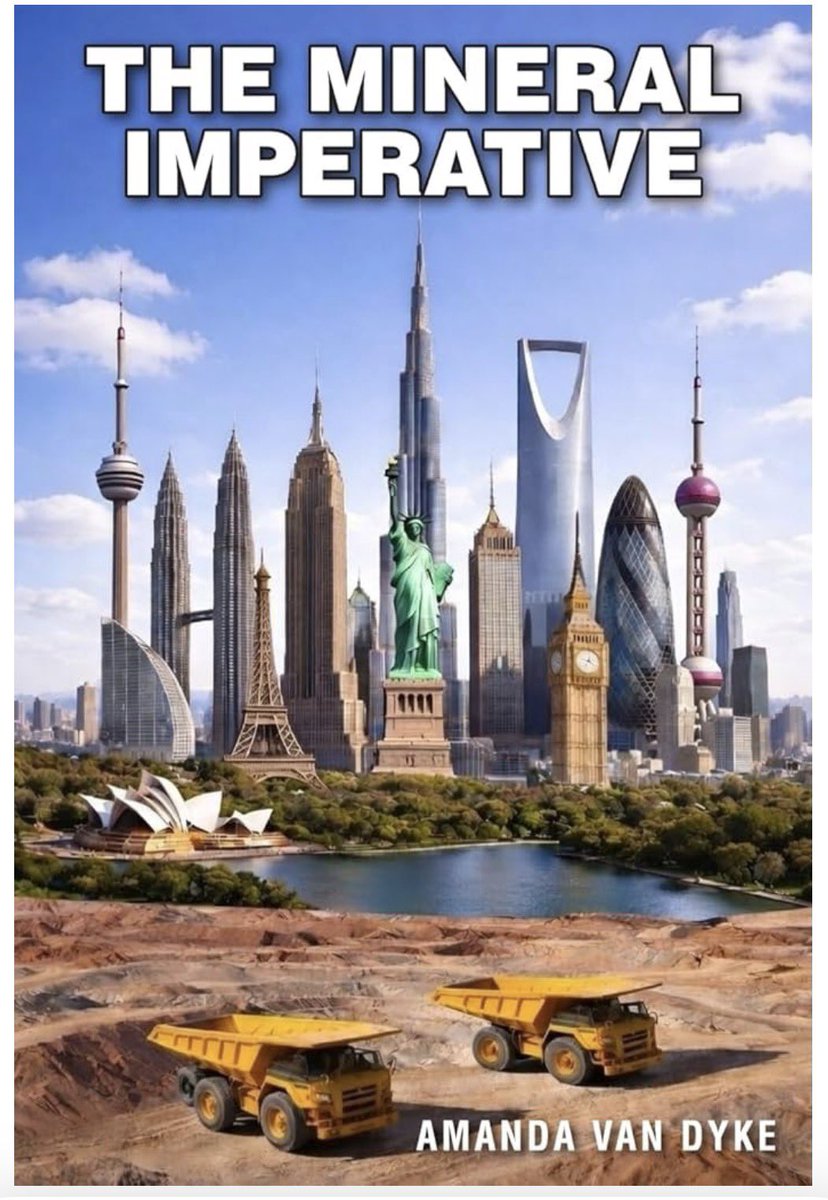
My book the Mineral Imperative is now available in audiobook (I recorded it myself!) kindle and paperback formats on Amazon. Please leave reviews! Back cover Summary below. Minerals are not mere inputs to the global economy, they are its bedrock, its physical foundation, and that foundation is under strain. The world is approaching a tipping point. Rapid global economic development, rising incomes, urbanisation, electrification, and the accelerating deployment of advanced technologies are driving mineral demand to levels the modern mining system was never designed to meet. Yet political, economic, and technological elites continue to treat resource availability as a given, assuming that higher prices, financial capital, or innovation alone can conjure supply when it is needed. The Mineral Imperative exposes why that assumption is dangerously wrong. Drawing on twenty-five years of experience across mining, finance, and industrial policy, Amanda van Dyke shows how declining ore grades, long development timelines, geopolitical fragmentation, and chronic underinvestment have collided to create a structural supply crisis. Theoretical reserves are not the same as economically viable supply, and despite rising prices, global mining output is failing to grow at a pace capable of sustaining current trajectories, let alone future ambitions for electrification, digitalisation, and energy transition. This book reveals the widening gap between mineral demand and mineral reality. It dissects the weaknesses embedded in Western supply chains, charts the rise of new mineral powers, and explains why mining, on its current path, cannot scale fast enough to prevent scarcity and volatility from becoming the new normal. Clear-eyed, urgent, and deeply researched, The Mineral Imperative is a call to abandon complacency and confront the material limits shaping the twenty-first century. It argues that avoiding chronic shortages will require a fundamental shift in how societies value, permit, finance, and partner with mining. This is a book about the world as it truly is, and the hard choices required to secure the one we are trying to build.
Amanda van Dyke tweet media
English
2
4
12
598