Jason Hirschman

2.4K posts

Jason Hirschman banner
Jason Hirschman

Jason Hirschman

@EightTrack180

Seeking undiscovered future high ROIC companies. Stock discussion is not investment advice.

Las Vegas / Boston / Amsterdam Katılım Haziran 2012
1.1K Takip Edilen17.4K Takipçiler
Sabitlenmiş Tweet
Jason Hirschman
Jason Hirschman@EightTrack180·
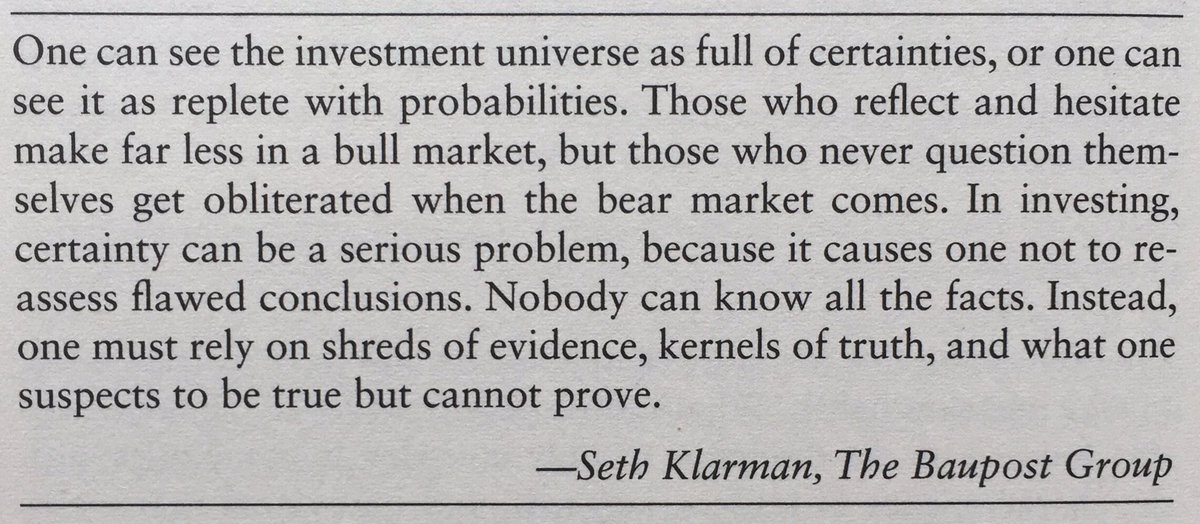
Truer words were probably never written.
Jason Hirschman tweet media
English
3
106
486
0
Jason Hirschman
Jason Hirschman@EightTrack180·
@iancassel $AMNF is a key ingredient in the most long-term, durable segment of SaaS (Spaghetti as a Service).
English
0
0
23
2K
Ian Cassel
Ian Cassel@iancassel·
US leader in pesto sauce with 32% operating margins $AMNF Not AI or a trillion dollar TAM, but dominating niche markets can be very profitable.
Ian Cassel tweet media
English
12
12
301
83.9K
Jason Hirschman
Jason Hirschman@EightTrack180·
@IJW121 I always wanted to be compared to Baghdad Bob - thanks!
English
0
0
1
146
𝙸𝙹𝚆🐢
𝙸𝙹𝚆🐢@IJW121·
@EightTrack180 You could work for one of our establishment propaganda newspapers with your apologetic tone for the incompetent ingrates that run this country.
𝙸𝙹𝚆🐢 tweet media
English
1
0
0
119
Jason Hirschman
Jason Hirschman@EightTrack180·
There's been a lot of X digital ink spilt bemoaning the new "unrealized capital gains" tax in the Netherlands. I've seen silly phrases such as "economic suicide." As someone who spends a good amount of time in the Netherlands, here's an alternative take.
Balaji@balajis

LIQUIDATION CONTAGION Wealth taxes are even worse than you think. Any asset held by Californian billionaires or Dutch citizens is now at risk of experiencing forced liquidation pressure. So: it’s not just that you don’t want to hold assets as a Dutchman. You also don’t want a Dutchman to hold your assets. Because the logic of forced liquidation is contagion. Let’s think it through. (1) First, suppose there is an asset with a total market cap of $10,000, with 10 shares total, of which 1 share each is held by 10 different holders, all in the Netherlands. To simplify the math, assume the Dutch holders bought those shares at par, or close to $0. (2) Now suppose today is the unrealized cap gains tax day, and the share price is $1,000 per share. Each Dutch guy is hit with a 36% tax, and owes $360. The first guy sells his one share, gets $1,000, and pays $360 in tax while retaining $640. (3) But the first guy’s sale reduces the market price to $960 per share. So when the second guy sells, he only retains $600 after paying $360 in tax. (4) Now assume that by the 7th guy, all the selling has pushed the share price to collapse to $200 per share. This is a very reasonable scenario if 60% of the cap table has suddenly been dumped. Indeed it might go much lower. (5) At $200 per share, the 7th guy actually has to go into debt to pay the tax as he owes $360. He sells his one share, pays all $200 of the proceeds in tax. And still owes $160 more in tax. (6) The 8th, 9th, and 10th guys are even more screwed. By the time they sell, the price will likely have crashed to $100 per share or less. As with the 7th guy, even 100% liquidation will not cover their tax burden. (7) So we immediately see many negative things about the Dutch unrealized cap gains tax bill. (a) First, it will cause large simultaneous forced liquidations. Everyone must sell 36% of their stake near the same time. (b) Second, it may be literally impossible to pay if a critical mass of the cap table is all subject to it at the same time. In the example above it was 100% Dutch holders, but has it been just 60% the result would have been much the same: a collapse in the share price. (c) Third, that means it would be disastrous to have too many Dutch citizens (or Californian billionaires!) on the cap table. Their forced sales will crash your share price. (d) So, you might have to start mass blocking those resident in wealth-taxing jurisdictions from investing in your companies. (e) This in turn makes the poor Western European guy even poorer, as he gets locked out of high growth assets. To be clear: I really do feel bad for the formerly Flying Dutchmen, now Crying Dutchmen. They invented much of modern capitalism. They founded New Amsterdam, now New York. They’ve punched way above their weight. I wish them only the best. Nevertheless…they should prepare for the worst. This may be a tough century for Western Europe. The first ones out might get to freedom, while the slowest may be stuck behind a new Iron Curtain, spending a century paying off the debts their states incurred over the last century. Because the long run fruits of Western Keynesianism are the same as Soviet Communism, in the sense of wealth seizure and pauperization. I mean, if you knew the future, you wouldn’t want to co-own a farm with a Russian in 1916. For similar reasons, you might not want to co-own a share of stock with Dutch national in 2026. Or with anyone in a seizure-curious jurisdiction…which unfortunately includes much of Western Europe, Canada, and Blue America. You instead want assets that are not held by those subject to forced liquidations. Now, I grant that this is an unusual way to rank assets…Dutch holders considered harmful?!? Yet it might sadly be necessary to minimize your exposure to liquidation contagion. PS: guess which crucial stock is most held by the Dutch? ASML. So: this unrealized cap gains tax may not literally be a communist plot, but it would have the same effect.

English
3
5
43
19.3K
Jason Hirschman
Jason Hirschman@EightTrack180·
Nordrest $NREST is still fairly illiquid (<20,000 shares trading daily at now SEK 300/share.) Dividend in 2026 (based on 2025 results) increasing to SEK 8.50/share from SEK 5. Add in SEK/USD strength ... I'll take it!
English
0
0
9
1.6K
Jason Hirschman
Jason Hirschman@EightTrack180·
I pitched Nordrest at @evfcfaddict's September 2024 Woodstock online pitch session (see below). Fortunately, additional research allowed me to downgrade my MRE segment concerns.
Jason Hirschman tweet mediaJason Hirschman tweet media
English
1
0
9
2.2K
Jason Hirschman
Jason Hirschman@EightTrack180·
$NREST Nordrest Q4/25 very strong due in part to substantial organic growth in Defense (includes MRE) and Orifo (MRE ingredients) acquisition. What's great about Nordrest is that unusual combo of low-ish margins + modest working capital generates excellent economics.
Jason Hirschman tweet media
English
1
2
30
4.3K
Jason Hirschman
Jason Hirschman@EightTrack180·
@thewritser Agree that Belastingdienst is understaffed. Still waiting for tax refund on a Box 3 return filed under the "transitional" regime for last year in which the WOZ property value did not increase but we had to submit payment under the assumed increase calculation.
English
0
0
1
249
Writser
Writser@thewritser·
@EightTrack180 One thing I would add is that the tax agency (belastingdienst) is so understaffed that I doubt the first proposal will be implemented in 2028. And I severely doubt the 'realized gains' proposal will be implemented in 2029. Tax reforms have been 'a few years out' for a decade.
English
2
0
0
232
Jason Hirschman
Jason Hirschman@EightTrack180·
@walnutavevalue No impact unless own real estate domiciled in Netherlands or are a Dutch resident/citizen.
English
1
0
1
257
Jason Hirschman
Jason Hirschman@EightTrack180·
Yes, it would be better if the Netherlands moved NOW to a Box 3 realized cap gains tax. But the Dutch are not the first to kick a can down the road. This is not economic suicide. Indeed, I think in 2029, Box 3 taxes will be better & fairer for all - incl. equity investors.
English
8
0
12
2.1K
Jason Hirschman
Jason Hirschman@EightTrack180·
I certainly understand why crypto investors are particularly annoyed. The 2028 law, as currently written, is terribly harsh on high volatile assets. But perhaps the Dutch economy can survive with fewer crypto sardine traders. 🤷‍♂️
English
1
0
7
2K