
Elliot Parker

81 posts

Elliot Parker banner
Elliot Parker

Elliot Parker

@ElliotP789

COO @ethena_labs. Systematic Trader. Former @tradeparadigm @DeribitExchange

Katılım Haziran 2021
191 Takip Edilen431 Takipçiler
Elliot Parker retweetledi
Haseeb >|<
Haseeb >|<@hosseeb·
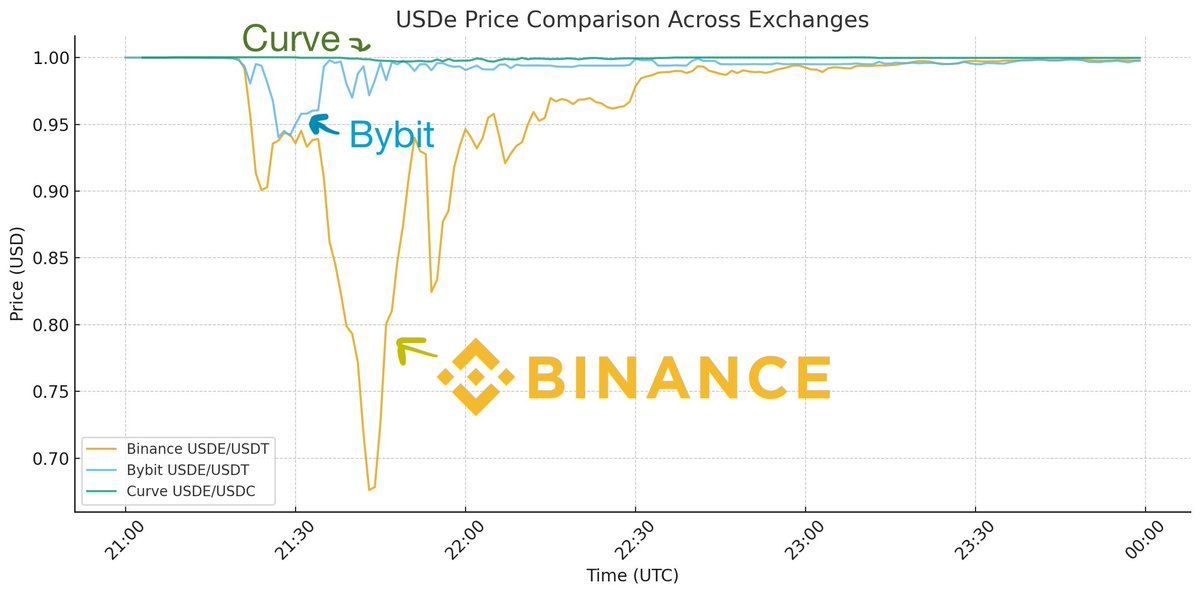
With all respect to Star, this story is candidly ridiculous. Star is trying to claim that the root cause of 10/10 was Binance creating an Ethena yield campaign, causing USDe to get overleveraged from traders looping it on Binance, which eventually unwound because of a small price move. The problems with this story: 1) The timing of this story doesn't line up. BTC bottomed a full 30 minutes before USDe price was affected on Binance. So USDe clearly can't have *caused* the liquidation cascade. This is clearly misplacing cause and effect. 2) USDe price diverged ONLY on Binance, it did not diverge on other venues. But the liquidation spiral was happening everywhere. So if the USDe "depeg" did not propagate across the market, it can't explain how *every single exchange* saw huge wipeouts. This is very much unlike Terra, which depegged everywhere and caused the same damage across every venue. So maybe you could hedge Star's argument by saying "OK, maybe Ethena didn't *cause* 10/10, but it amplified it." But even as an amplifier, USDe fails the test because it didn't propagate cross-exchange. We know what a good explanation of a crash looks like—Terra, 3AC, FTX, all had global balance sheet effects that were felt everywhere. USDe did not do that, it was a Binance order book isolated event. 3) This begs the question: why is Star "revealing" this now, months later? Star does not produce any new evidence for this theory that people didn't already know and analyze to death. All of the order book data has been public for 4+ months and suddenly he claims this? This feels more like Star is picking a fight with CZ and using this simple story as a pretext to make it sound like CZ was in on it, or caused 10/10 through his own irresponsibility. Look, the reality is, there's no simple story explaining 10/10 that survives scrutiny. I don't have one either. If there was a simple story that could explain 10/10, there would already be widespread agreement about what caused it, like the agreement around the 3AC or FTX crashes. The best story to explain 10/10 is, to my mind: * Trump spooked markets with tariff threats on a Friday evening * This caused markets to sell off dramatically because crypto was the only thing to trade * Flurry of activity caused Binance APIs to go down, causing huge price dislocations and preventing market makers from balancing inventory across exchanges. This caused huge liquidations that could not get filled, but liquidation engines keep firing regardless, and all this got amplified by ADLs initiating everywhere and breaking hedges and risk management * This caused MMs to get wiped out, and they were unable to pick up the pieces—MMs need APIs to rebalance inventory, and without MMs, there were no buyers of last resort for many alts. Retail was not going to step in on a chaotic Friday evening to buy stuff * Crypto liquidation mechanisms are not designed to be self-stabilizing the way that TradFi mechanisms are (circuit breakers, etc.), crypto liquidations are designed purely to minimize insolvency risk * Altcoin prices are extremely path dependent, and we ended up in a bad path That's my story. It's not a very satisfying one, but neither is this "Binance + Ethena did it" story. A better root cause explanation is "APIs went down at the worst possible time," but that doesn't really sound so dastardly. Where simple stories do not suffice, unfortunately you have to choose a complicated one. And I think this complicated story is the best one for what actually happened on 10/10. Thankfully, the history of crypto is a long series of these "bad things happened, and later the market recovered." In the long run, I'm not worried that 10/10 permanently broke the market. Just that prices are path-dependent, retail + MMs got hurt bad on 10/10, and will need time to recover.
Haseeb >|< tweet mediaHaseeb >|< tweet media
Star_OKX@star_okx

No complexity. No accident. 10/10 was caused by irresponsible marketing campaigns by certain companies. On October 10, tens of billions of dollars were liquidated. As CEO of OKX, we observed clearly that the crypto market’s microstructure fundamentally changed after that day. Many industry participants believe the damage was more severe than the FTX collapse. Since then, there has been extensive discussion about why it happened and how to prevent a recurrence. The root causes are not difficult to identify. ⸻ What actually happened 1.Binance launched a temporary user-acquisition campaign offering 12% APY on USDe, while allowing USDe to be used as collateral with the same treatment as USDT and USDC, and without effective limits. 2.USDe is a tokenized hedge fund product. Ethena raises capital via a so-called “stablecoin,” deploys it into index arbitrage and algorithmic trading strategies, and tokenizes the resulting fund. The token can then be deposited on exchanges to earn yield. 3.USDe is fundamentally different from products such as BlackRock BUIDL and Franklin Templeton BENJI, which are tokenized money market funds with low-risk profiles. USDe, by contrast, embeds hedge-fund-level risk. This difference is structural, not cosmetic. 4.Binance users were encouraged to convert USDT and USDC into USDe to earn attractive yields, without sufficient emphasis on the underlying risks. From a user’s perspective, trading with USDe appeared no different from trading with traditional stablecoins—while the actual risk profile was materially higher. 5.Risk escalated further as users: •converted USDT/USDC into USDe, •used USDe as collateral to borrow USDT, •converted the borrowed USDT back into USDe, •and repeated the cycle. This leverage loop produced artificial APYs of 24%, 36%, and even 70%+, widely perceived as “low risk” simply because they were offered by a major platform. Systemic risk accumulated rapidly across the global crypto market. 6.At that point, even a small market shock was sufficient to trigger a collapse. When volatility hit, USDe depegged quickly. Cascading liquidations followed, and weaknesses in risk management around assets such as WETH and BNSOL further amplified the crash. Some tokens briefly traded near zero. The damage to global users and companies—including OKX customers—was severe, and recovery will take time. ⸻ Why this matters I am discussing the root cause, not assigning blame or launching an attack on Binance. Speaking openly about systemic risks is sometimes uncomfortable, but it is necessary if the industry is to mature responsibly. I expect there may be significant misinformation and coordinated FUD directed at OKX in the near future. Even so, speaking honestly about systemic risk is the right thing to do—and we will continue to do so. As the largest global platform, Binance has outsized influence—and corresponding responsibility—as an industry leader. Long-term trust in crypto cannot be built on short-term yield games, excessive leverage, or marketing practices that obscure risk. The industry needs leaders who prioritize market stability, transparency, and responsible innovation—not a winner-take-all mentality where criticism is treated as hostility. Crypto is still early. What we choose to normalize today will determine whether this industry earns lasting trust—or repeats the same mistakes again.

English
329
143
1.2K
807.6K
Elliot Parker retweetledi
G | Ethena
G | Ethena@gdog97_·
We want simple explanations and scapegoats but unfortunately this is just factually incorrect. Data below shows clearly USDe had a price discrepancy on Binance orderbooks a full 30 minutes *after* BTC had bottomed from the crash. Either you are wrong or this is the first "root cause" which happened after an event takes place. You have a large audience who trusts what you say. Spend 5 minutes looking at the data before. Do better.
G | Ethena tweet media
Star_OKX@star_okx

No complexity. No accident. 10/10 was caused by irresponsible marketing campaigns by certain companies. On October 10, tens of billions of dollars were liquidated. As CEO of OKX, we observed clearly that the crypto market’s microstructure fundamentally changed after that day. Many industry participants believe the damage was more severe than the FTX collapse. Since then, there has been extensive discussion about why it happened and how to prevent a recurrence. The root causes are not difficult to identify. ⸻ What actually happened 1.Binance launched a temporary user-acquisition campaign offering 12% APY on USDe, while allowing USDe to be used as collateral with the same treatment as USDT and USDC, and without effective limits. 2.USDe is a tokenized hedge fund product. Ethena raises capital via a so-called “stablecoin,” deploys it into index arbitrage and algorithmic trading strategies, and tokenizes the resulting fund. The token can then be deposited on exchanges to earn yield. 3.USDe is fundamentally different from products such as BlackRock BUIDL and Franklin Templeton BENJI, which are tokenized money market funds with low-risk profiles. USDe, by contrast, embeds hedge-fund-level risk. This difference is structural, not cosmetic. 4.Binance users were encouraged to convert USDT and USDC into USDe to earn attractive yields, without sufficient emphasis on the underlying risks. From a user’s perspective, trading with USDe appeared no different from trading with traditional stablecoins—while the actual risk profile was materially higher. 5.Risk escalated further as users: •converted USDT/USDC into USDe, •used USDe as collateral to borrow USDT, •converted the borrowed USDT back into USDe, •and repeated the cycle. This leverage loop produced artificial APYs of 24%, 36%, and even 70%+, widely perceived as “low risk” simply because they were offered by a major platform. Systemic risk accumulated rapidly across the global crypto market. 6.At that point, even a small market shock was sufficient to trigger a collapse. When volatility hit, USDe depegged quickly. Cascading liquidations followed, and weaknesses in risk management around assets such as WETH and BNSOL further amplified the crash. Some tokens briefly traded near zero. The damage to global users and companies—including OKX customers—was severe, and recovery will take time. ⸻ Why this matters I am discussing the root cause, not assigning blame or launching an attack on Binance. Speaking openly about systemic risks is sometimes uncomfortable, but it is necessary if the industry is to mature responsibly. I expect there may be significant misinformation and coordinated FUD directed at OKX in the near future. Even so, speaking honestly about systemic risk is the right thing to do—and we will continue to do so. As the largest global platform, Binance has outsized influence—and corresponding responsibility—as an industry leader. Long-term trust in crypto cannot be built on short-term yield games, excessive leverage, or marketing practices that obscure risk. The industry needs leaders who prioritize market stability, transparency, and responsible innovation—not a winner-take-all mentality where criticism is treated as hostility. Crypto is still early. What we choose to normalize today will determine whether this industry earns lasting trust—or repeats the same mistakes again.

English
156
93
759
303.6K
Elliot Parker retweetledi
G | Ethena
G | Ethena@gdog97_·
While we share these suggestions privately with any partner we work with across both DeFi and CeFi, want to surface this publicly so there is zero doubt going forward on what we view as appropriate oracle design and risk management for USDe:
G | Ethena tweet media
English
203
209
1.3K
1.1M
Elliot Parker retweetledi
Ethena
Ethena@ethena·
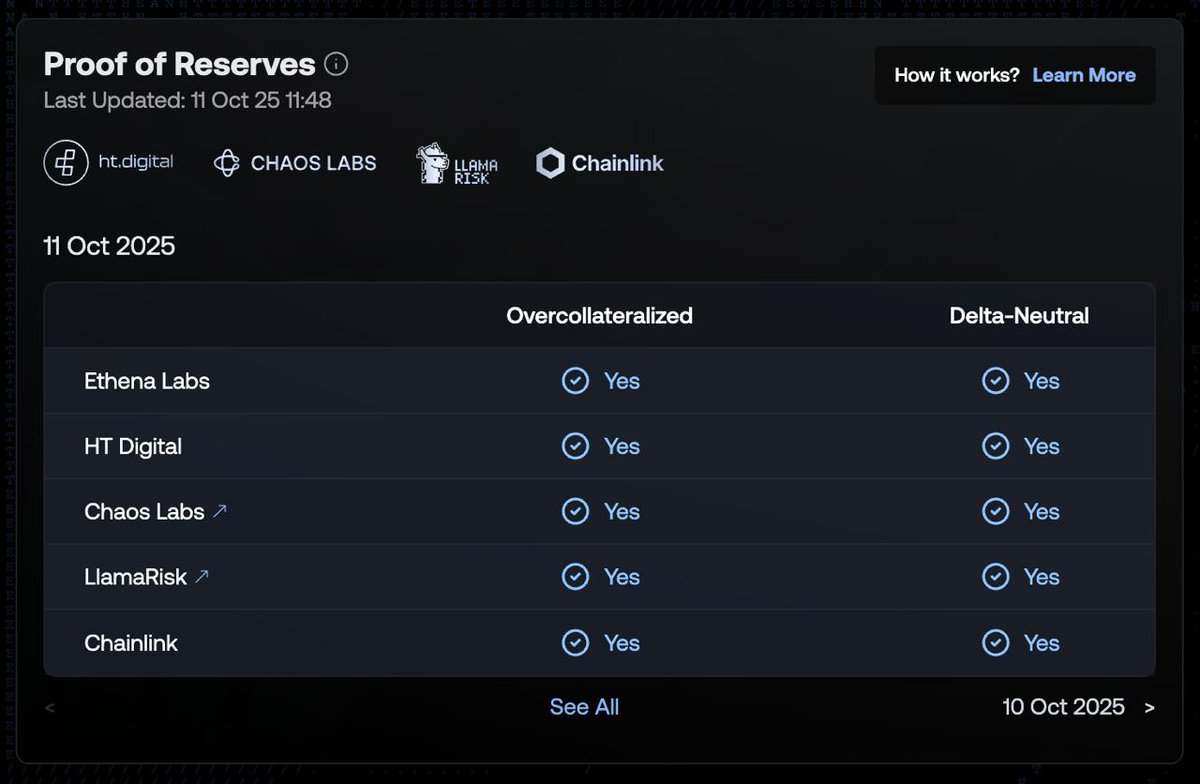
USDe Proof of Reserves are typically provided on a weekly basis by 3rd party independent attestors including leading firms such as Chaos Labs, Chainlink, Llama Risk and Harris & Trotter. On request from the community, we have provided a Proof of Reserves outside of the regular cadence following the market events in the last 24hrs which have been linked below this message. Each of these independent 3rd parties have confirmed USDe remains overcollateralised by approximately ~$66m. Maximum transparency.
Ethena tweet media
English
168
224
1.5K
410.5K
Elliot Parker retweetledi
Ethena
Ethena@ethena·
USDe on Binance has crossed $2b in 4 days since USDe Earn went live
English
25
55
520
55.8K
Elliot Parker retweetledi
Tom Wan
Tom Wan@tomwanhh·
USDe has hit $600M on Binance, just 1 day after announcing 12% APR. This showcases the huge growth potential for USDe as it can tap into the distribution power of the world's leading exchange in both spot and perps and with over 280M users worldwide. $1B on Binance inevitable.
Tom Wan tweet media
English
25
26
296
48.1K
Elliot Parker retweetledi
Ethena
Ethena@ethena·
Nothing can stop me i'm all the way up
English
45
76
792
68.4K
Elliot Parker retweetledi
Ethena
Ethena@ethena·
We are excited to announce one of our most important integrations to date Ethena has partnered with Binance to embed USDe across its entire platform of 280m+ users and $190b+ in assets including: • USDe reward bearing collateral for futures and perpetuals trading • Direct integration with Binance Earn • USDe spot pairs With more to come in the following weeks Details below:
English
91
223
1.4K
419.2K
Elliot Parker retweetledi
Ethena
Ethena@ethena·
Introducing MegaUSD: USDm, built with @megaeth on the Ethena Stablecoin-as-a-Service stack MegaUSD will be backed by USDtb, which holds its reserves primarily in Blackrock BUIDL USDm will operate as MegaETH's native stablecoin, underpinning major native applications MegaEthena 🐇
MegaETH@megaeth

Introducing MegaUSD (USDm), the native stablecoin of MegaETH. Built in collaboration with @ethena. $USDM aligns incentives across stakeholders, letting users and apps enjoy the lowest fees possible while routing scalable value back to MegaETH.

English
105
160
1.1K
316.6K
Elliot Parker retweetledi
Ethena
Ethena@ethena·
Have a great weekend
English
41
92
726
57.2K
Elliot Parker retweetledi
Ethena
Ethena@ethena·
ZXX
53
85
750
40.2K
Elliot Parker retweetledi
G | Ethena
G | Ethena@gdog97_·
Feel more confident that USDe will become a $50b+ asset in the next 3yrs than if you had asked me if we would get to $10b when we first launched. To date we have minted & redeemed $18b+ in supply returning $450m+ in cash rewards to (s)USDe users without a single basis point of loss. Hard to put into words how grateful we are for every single dollar that has helped to bootstrap us to this milestone. Without you Ethena would be nothing; and I would be no one.
Ethena@ethena

everyone wants to know what we'd say if we didn't reach $10b supply i guess we'll never know

English
233
123
1.1K
274.5K
Elliot Parker retweetledi
Ethena
Ethena@ethena·
everyone wants to know what we'd say if we didn't reach $10b supply i guess we'll never know
English
128
182
1.3K
331.8K
Elliot Parker retweetledi
Ethena
Ethena@ethena·
Introducing Liquid Leverage, a new Ethena integration on money markets enabled by partners, launching first on @aave 👻 Users can now deposit 50% sUSDe & 50% USDe into Aave and earn promotional rewards for USDe (currently ~12% APY), in addition to the normal USDe lending rate and sUSDe's native APY
Ethena tweet media
English
61
166
1.1K
315.2K
Elliot Parker retweetledi
Ethena
Ethena@ethena·
Ethena is set to become the first stablecoin developer whose product has a clear path to full compliance with the U.S. GENIUS Act Through our partnership with @Anchorage, the only federally chartered crypto bank, USDtb will move onshore to become a U.S. federally regulated payment stablecoin
English
139
272
1.5K
538.7K