

Axel Ellrodt
8.9K posts

Axel Ellrodt
@EllrodtAxel
Emergency physician. Author: cf link ⬇️ 🇫🇷 🇬🇧 🇪🇸🇮🇹🇧🇷🇩🇪 @axel-ellrodt.bsky.social https://t.co/4mA03gYHf1
🇪🇺🇫🇷 Katılım Ekim 2020
475 Takip Edilen771 Takipçiler

@ihtesham2005 What about generalised keyboard writing in past 40 yo professionals not learning ?
What part of this brain activiation is invlved in the finetuning of the motor activity ?
English

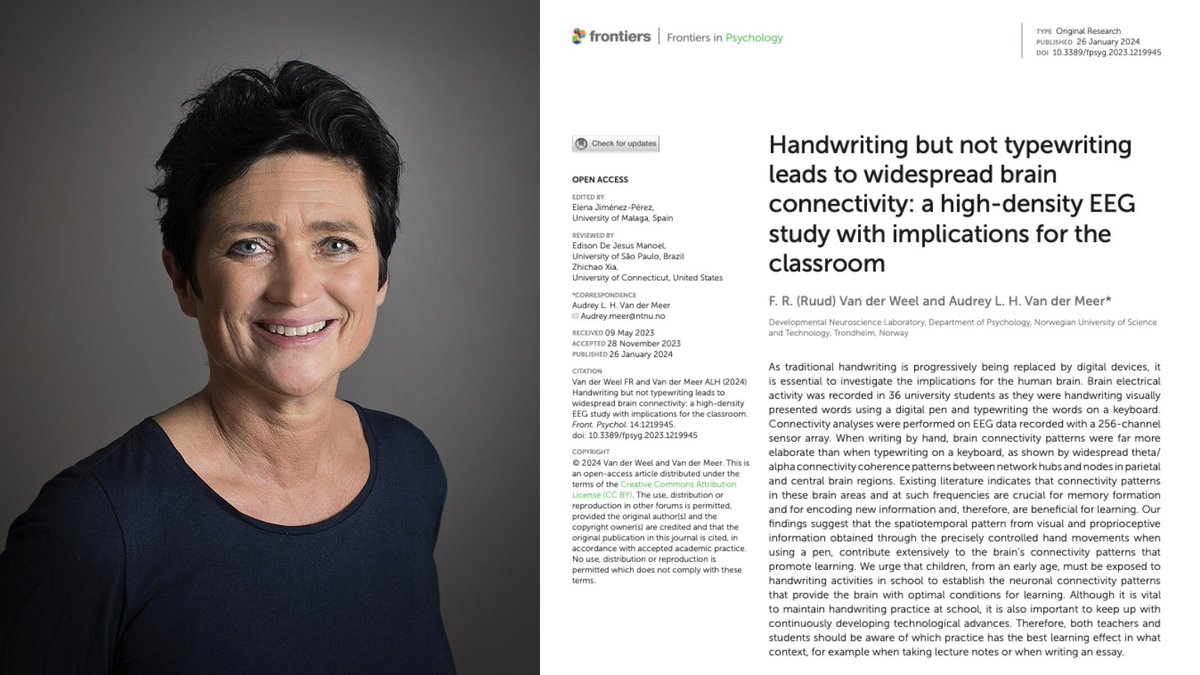
A Norwegian neuroscientist spent 20 years proving that the act of writing by hand changes the human brain in ways typing physically cannot, and almost nobody outside her field has read the paper.
Her name is Audrey van der Meer.
She runs a brain research lab in Trondheim, and the paper that closed the argument was published in 2024 in a journal called Frontiers in Psychology. The finding is brutal enough that it should have changed every classroom on Earth.
The experiment was simple. She recruited 36 university students and put each one in a cap with 256 sensors pressed against their scalp to record brain activity. Words flashed on a screen one at a time.
Sometimes the students wrote the word by hand on a touchscreen using a digital pen, and sometimes they typed the same word on a keyboard. Every neural response was recorded for the full five seconds the word stayed on screen.
Then her team looked at the part of the data most researchers had ignored for years, which is how different parts of the brain were communicating with each other during the task.
When the students wrote by hand, the brain lit up everywhere at once.
The regions responsible for memory, sensory integration, and the encoding of new information were all firing together in a coordinated pattern that spread across the entire cortex. The whole network was awake and connected.
When the same students typed the same word, that pattern collapsed almost completely.
Most of the brain went quiet, and the connections between regions that had been alive seconds earlier were nowhere to be found on the EEG.
Same word, same brain, same person, and two completely different neurological events.
The reason turned out to be something nobody had really paid attention to before her work. Writing by hand is not one motion but a sequence of thousands of tiny micro-movements coordinated with your eyes in real time, where each letter is a different shape that requires the brain to solve a slightly different spatial problem.
Your fingers, wrist, vision, and the parts of your brain that track position in space are all working together to produce one letter, then the next, then the next.
Typing throws all of that away. Every key on a keyboard requires the exact same finger motion regardless of which letter you are pressing, which means the brain has almost nothing to integrate and almost no problem to solve.
Van der Meer said it plainly in her interviews.
Pressing the same key with the same finger over and over does not stimulate the brain in any meaningful way, and she pointed out something that should scare every parent who handed their kid an iPad.
Children who learn to read and write on tablets often cannot tell letters like b and d apart, because they have never physically felt with their bodies what it takes to actually produce those letters on a page.
A decade before her, two researchers at Princeton ran the same fight using a completely different method and ended up at the same answer. Pam Mueller and Daniel Oppenheimer tested 327 students across three experiments, where half took notes on laptops with the internet disabled and half took notes by hand, before testing everyone on what they actually understood from the lectures they had watched.
The handwriting group won by a wide margin on every question that required real understanding rather than surface recall.
The reason was hiding in the transcripts of what the two groups had actually written down.
The laptop students typed almost word for word, capturing more total content but processing almost none of it as they went, while the handwriting students physically could not write fast enough to transcribe a lecture in real time, which forced them to listen carefully, decide what actually mattered, and put it in their own words on the page.
That single act of choosing what to keep was the learning itself, and the keyboard had quietly skipped the choosing and skipped the learning along with it.
Two studies. Two countries. Same answer.
Handwriting makes the brain work. Typing lets it coast.
Every note you have ever typed instead of written went into your brain through a thinner pipe. Every meeting, every book highlight, every idea you captured on your phone instead of on paper was processed at half depth.
You did not forget those things because your memory is bad. You forgot them because typing never woke the part of the brain that would have made them stick.
The fix is the thing your grandmother already knew.
Pick up a pen. Write the thing down. The slower road is the faster one.
English
Axel Ellrodt retweetledi

@DeVerdadera1 @adamscochran Oops. I think I was probably replying to another post , not your's, but that of @adamscochran
My bad definitely.
We agree that N95 rule over surgical leakers.
English

@EllrodtAxel @adamscochran Okay, thanks for your comment. But how do you disagree with me regarding the fact that N95s are more effective than surgical masks as source control when we actually agree and I linked to the study that found that N95s are more effective than surgical masks as source control?
English

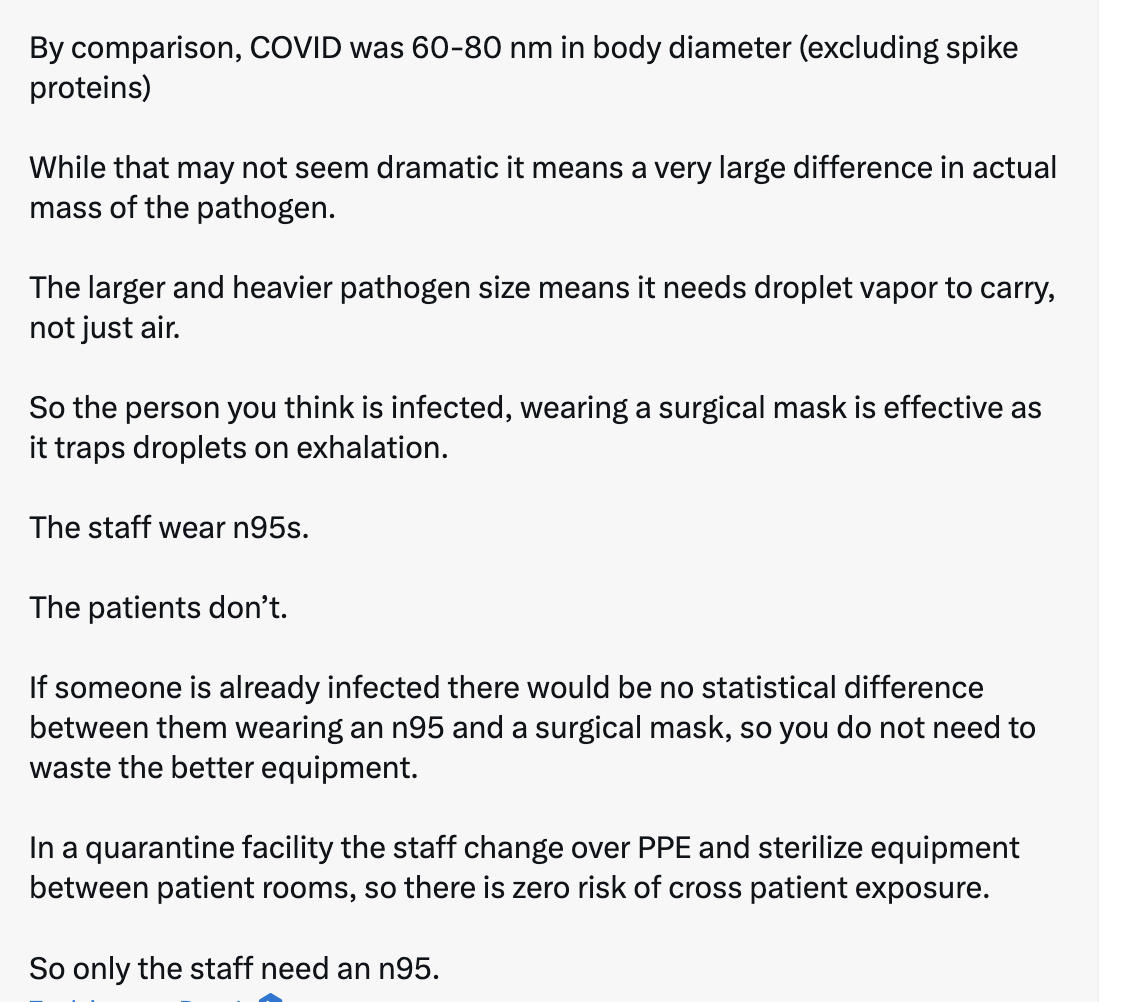
This is the correct protocol for 2 reasons:
1) N95’s are optimized to filter *incoming* air. Surgical masks are optimized to prevent contaminating the environment when exhaling.
2) The hantavirus 80–120 nm in body diameter.
By comparison, COVID was 60-80 nm in body diameter (excluding spike proteins)
While that may not seem dramatic it means a very large difference in actual mass of the pathogen.
The larger and heavier pathogen size means it needs droplet vapor to carry, not just air.
So the person you think is infected, wearing a surgical mask is effective as it traps droplets on exhalation.
The staff wear n95s.
The patients don’t.
If someone is already infected there would be no statistical difference between them wearing an n95 and a surgical mask, so you do not need to waste the better equipment.
In a quarantine facility the staff change over PPE and sterilize equipment between patient rooms, so there is zero risk of cross patient exposure.
So only the staff need an n95.
Caroline Orr Bueno, Ph.D@RVAwonk
Omg even at the National Quarantine Unit where the hantavirus contacts are, they’re still only using surgical masks when people in quarantine interact with the medical staff. If one of them gets infected, you’ll know why.
English
@DeVerdadera1 @adamscochran 4/4 (not 5 nor 6 sorry)
N95 respirators provide superior source control.
For airborne pathogens like hantavirus with high case fatality rates, this difference is clinically significant.
You might ask some expterts like @jlcolo or @linseymarr or @j_g_allen for confirmation;
English
@DeVerdadera1 @adamscochran Sorry you didn't actually. I misread, my bad. I apologise.
But I still disagree on surgical masks for source control.
Surgical masks leak 30-50% of exhaled air around gaps, while N95 respirators leak only 0.5-2%.
1/5 or 6
English
@DeVerdadera1 @adamscochran 3/4
Particle size alone does not determine transmission mode - both hantavirus and COVID-19 can transmit via aerosols regardless of their physical dimensions.
English
@DeVerdadera1 @adamscochran Leakage dominates mask performance over filtration efficiency. Studies consistently show leakage prevails over filtration performance of masks in determining the exposure level. Even with 95% filtration efficiency, surgical masks provide minimal protection due to poor seal.
2/5
English
@DeVerdadera1 @adamscochran Of course this virus spreads from person to person. My post was about you saying that masks would filter out virions = naked virus. No: 🦠 is contained in particles of contaminated dust or aerosols from the respiratory tract of humans. And of course N95 are warranted.
English
@EllrodtAxel @adamscochran YOU don’t care about false statements, but most do, including your misleading one about how “this” ANDES virus is “propagated.” THIS strain can spread person-to-person, and when it does, it’s NOT in rodent “dust particles.” That’s why N95s are protocol!
cdc.gov/han/php/notice…
English
Our #ESGEDays2026 dinner took place in the villa that housed these original Picasso drawings. I think this man was in need of psychological help.




English
@jljcolorado @arijitchakrav @adamscochran In addition fit is better with N95/FFP2s
pnas.org/doi/10.1073/pn…
And one can improve it with proper technique ⬇️. Few people adjust the area around the nose properly—this is why glasses fog up
Axel Ellrodt@EllrodtAxel
The video hereunder (PLEASE RETWEET) by Prof. Eberhard Bodenschatz, Max Planck Institute gives a trick to increase nose adjustment of FFP2 masks. Which proves very important in minimising transmission: pnas.org/content/118/49… ds.mpg.de/3822197/211202… 1/3
English

@adamscochran This is totally incorrect from an aerosol science angle.
N95 work both ways much better than surgical masks
And size of virus doesn't matter. They are contained in much larger particles of saliva or respiratory fluid
English
@DeVerdadera1 @adamscochran We don't care !
This virus is propagated essentially in - bigger dust particles containing desiccated urine and feces of the rodent host.
- Microdroplets = aerosols from the respiratory tract of infected patients.
English
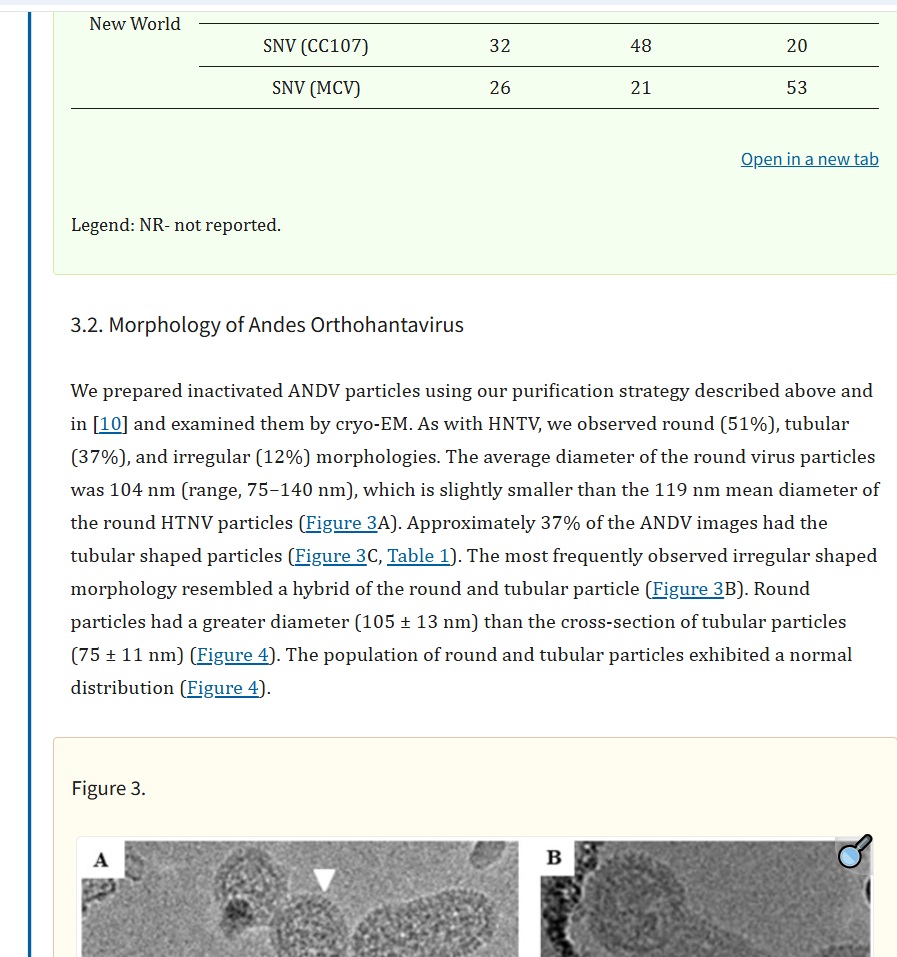
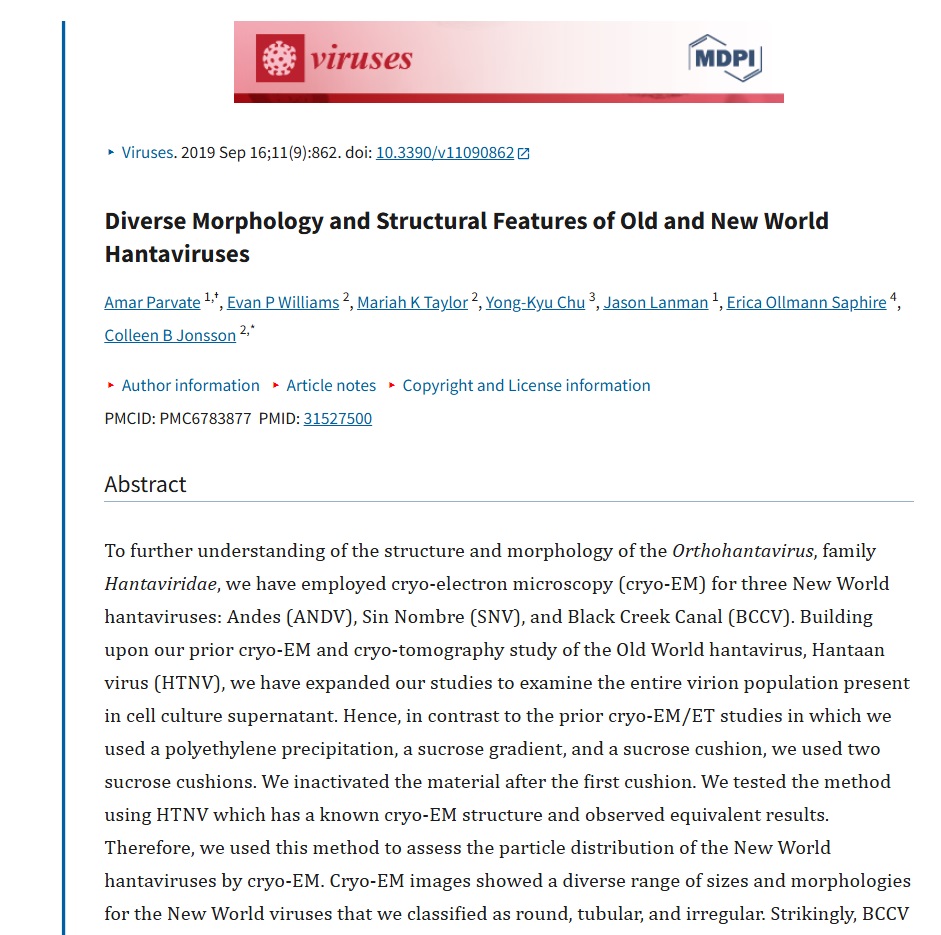
@adamscochran False! The average diameter of the Andes virus (104 nm) is somewhat SMALLER, NOT LARGER, than the average for SARS-CoV-2 (125 nm), though both fall within a similar size range of approximately 100 to 130 nm.

English
@adamscochran Total DANGEROUS pseudoscience. 1) Valveless N95s filter BOTH inhaled & exhaled air far better than surgical masks, which leak heavily nose+edges. 2) Naked virion size (nm) is irrelevant. Viruses travel in much larger respiratory aerosols (μm). N95s provide superior source control
English
Worth another read
Julia Marie@julia_doubleday
@jljcolorado @adamscochran ^^ the prof is an aerosol expert You should look into the aerosol vs droplet wars at the WHO more closely @adamscochran beginning w this fantastic article in Wired. The myth of “droplet only” transmission has been debunked since 2021 wired.com/story/the-teen…
English
Axel Ellrodt retweetledi

@jljcolorado @adamscochran ^^ the prof is an aerosol expert
You should look into the aerosol vs droplet wars at the WHO more closely @adamscochran beginning w this fantastic article in Wired. The myth of “droplet only” transmission has been debunked since 2021
wired.com/story/the-teen…
English
@LukeKaven @jljcolorado @adamscochran Masks don't work by stopping virions but by stopping aerosolised particles ( dust contaminated with Pygmy rat excreta, respiratory aerosols...) that are way larger.
English

@jljcolorado @adamscochran Even so, virions are electrically-charged particles that are readily trapped in the electrostatic webbing of a N/KN95 mask.
English
@JonnaChissus @jljcolorado @ParentMishmash @adamscochran There is no way to know. Approx 25% who get infected stay completely asymptomatic.
Your respirator protects you, but when you doff it, are you 200% (Trumpian typo) certain that the air and people present are devoid of the virus? You too may catch it and be asymptomatic
English

@jljcolorado @ParentMishmash @adamscochran I know it's anecdotal, but it's been six years. I've not had a symptomatic COVID infection or a positive COVID test, no flu or colds for six years. I wear KN95 and N95. If these respirators weren't effective I don't think I could have this outcome. I'm very impressed.
English
@linseymarr In the same vein :
x.com/EllrodtAxel/st…
Axel Ellrodt@EllrodtAxel
@jljcolorado In the same vein, one should be careful about infected patients' excreta, even with the very LOW likelihood of mishap that past outbreaks suggest. There are possibly susceptible rodents in our sewers. ¿No deberíamos...? e.pcloud.link/publink/show?c…
English

It's widely accepted that hantavirus transmits from rodent excreta to humans via inhalation of aerosolized virus, so I don't understand why we're so reluctant to acknowledge the inhalation route for human-to-human transmission.
nytimes.com/2026/05/14/hea…
English
@jljcolorado In the same vein, one should be careful about infected patients' excreta, even with the very LOW likelihood of mishap that past outbreaks suggest. There are possibly susceptible rodents in our sewers. ¿No deberíamos...?
e.pcloud.link/publink/show?c…


English
"Esta completamente aceptado que el hantavirus se transmite desde los excrementos de roedores a los humanos al inhalar virus en aerosoles.
Por eso no entiendo por qué hay tanta resistencia a aceptar la vía de inhalación para la transmisión de una persona a otra."
Linsey Marr linseymarr.bsky.social@linseymarr
It's widely accepted that hantavirus transmits from rodent excreta to humans via inhalation of aerosolized virus, so I don't understand why we're so reluctant to acknowledge the inhalation route for human-to-human transmission. nytimes.com/2026/05/14/hea…
Español