Ryan Rand

51 posts

Ryan Rand

Ryan Rand

@Emb0wlden

Katılım Ekim 2025
7 Takip Edilen0 Takipçiler
Ryan Rand
Ryan Rand@Emb0wlden·
@TrueAIHound blue is used to identify any available very low level light, the others both cross the densest collection of useful differences, i imagine these small differences show up better with two separate close comparisons, like depth perception.
English
1
0
0
16
AGIHound
AGIHound@TrueAIHound·
Neuroscience: color perception I've been thinking about this image. It shows the published color sensitivity response curves of the 3 cone cells in the retina. Something is wrong with it. It makes zero sense and it's driving me nuts. 🤪 The response curves of the green (M) and red (L) cones strongly and inexplicably overlap. And yet, I can clearly distinguish the 3 colors as if there was very little or no overlap. Is it just me? I don't think so. I'm beginning to suspect that there is something wrong with the experimental methods used in measuring the spectral sensitivity of cone cells in the lab. Now, I feel compelled to investigate this anomaly further even though it's outside the main focus of my research. I hate it when this happens. 😬😀
AGIHound tweet media
English
9
1
14
795
∞-modal
∞-modal@NoahChrein·
@subcountability I also think we need a new word for it. I would like to call it emergence at scale. The idea that drives connectionism and is evidenced by AI working.
English
1
1
10
1.7K
∞-modal
∞-modal@NoahChrein·
The future of math is a “bitter lesson” for meta theories. Billions of bespoke structures at each level of meta mathematics. We already have theories: agebras (eg groups), spaces (topology), dynamical systems(manifolds), combinatorial representations(graphs). (1/3)
English
2
3
138
19.3K
Ryan Rand
Ryan Rand@Emb0wlden·
@WilfiCon @WKCosmo It cannot be described generally to academia. It must be derived or at least re presentable in the formats expected by each specialization the concept touches. Academia has been taught to ignor anything not immediately overlaid with historic rigor and assumes precedence correct.
English
0
0
0
12
WilfiCon
WilfiCon@WilfiCon·
@WKCosmo My work has flaws and is incomplete. However, if you could explain to me why my approach simply cannot work, I would be very grateful, as it would save me a lot of time trying to find the final breakthrough. zenodo.org/records/171606…
English
2
0
0
845
Will Kinney
Will Kinney@WKCosmo·
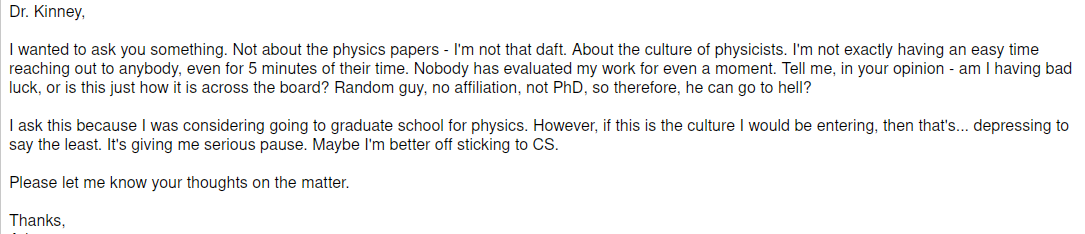
Here is what not to do when you email a paper with your new revolutionary theory to a working physicist and he politely declines to evaluate your work.
Will Kinney tweet media
English
33
7
336
53.4K
Ryan Rand
Ryan Rand@Emb0wlden·
@iamtexture At least if a calculator becomes sentient it could add 2 and 2 together consistently correctly. ;)
English
0
0
0
2
Ryan Rand
Ryan Rand@Emb0wlden·
@WKCosmo Meanwhile the "crackpot" community are here collecting evidence and mixing new ideas together and co-operating despite the financial and social disincentives of attempting to genuinely share and build something together co-cooperatively... which is what science used to be.
English
0
0
1
121
Ryan Rand
Ryan Rand@Emb0wlden·
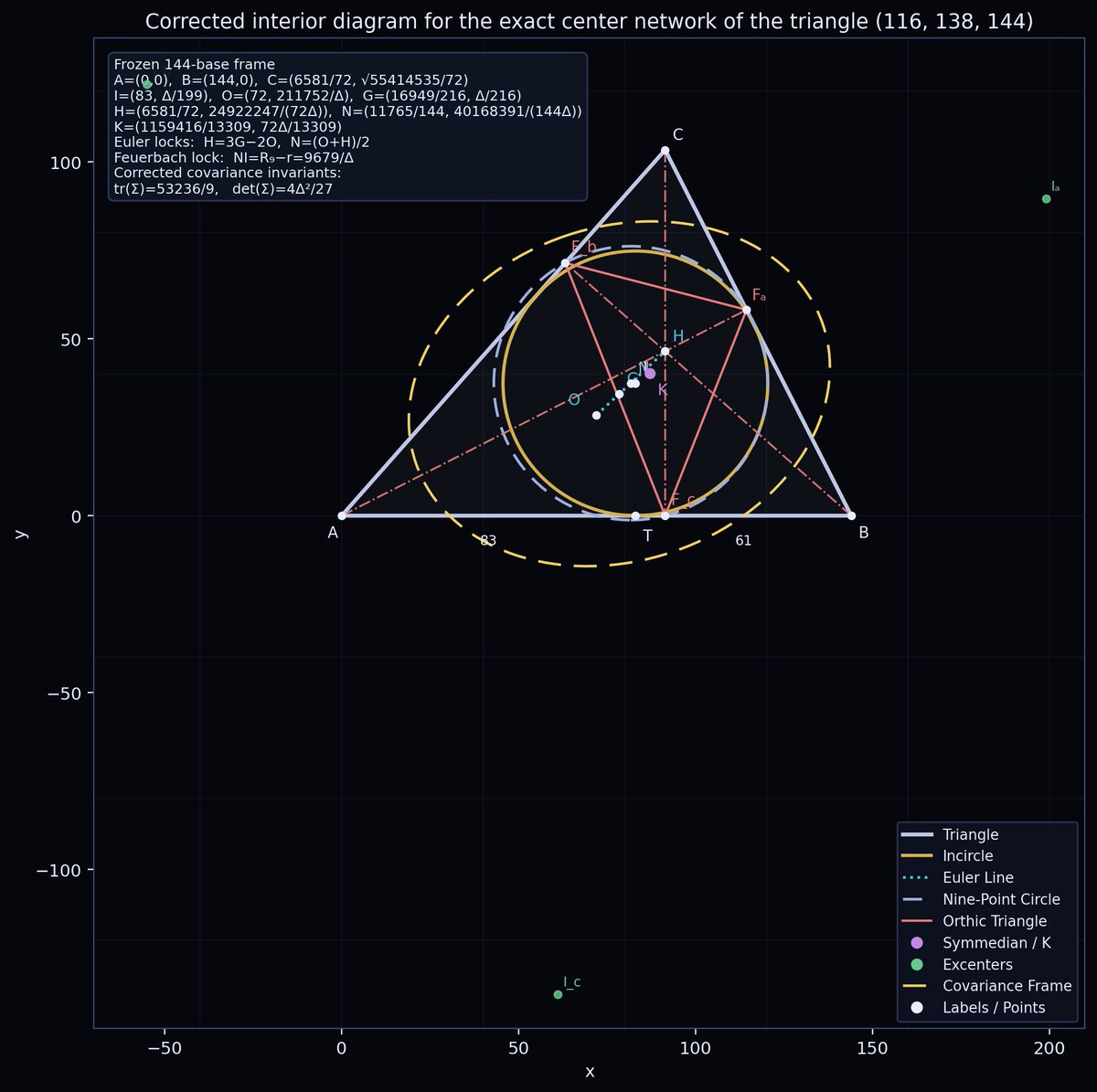
@QBlazedog61029J @beautheory You may like a 1-hot pointer + Dyck meta-address representation: each vertex is a single pearl index + a short Dyck path. The entire triangle (and all its derived centers) lives in a compact structural glyph that fits in < 200 bytes after compression. github.com/Emb0wlden/Engi…
English
0
0
2
89
Ryan Rand
Ryan Rand@Emb0wlden·
@JIMMYEDGAR Don't be ridiculous. Effort builds the pathways that resonate together coherently once you can flow in that state space. If no-one puts in the effort there is nothing to resonate with when you are "calm".
English
0
0
0
89
TheNewPhysics
TheNewPhysics@CharlesMullins2·
That’s a solid framing especially the link between coherence → compression → emergent gravity. Where I’d push it further is this: If gravity comes from phase synchronization of underlying loops, then the geometry itself shouldn’t be fundamental it should emerge from how that synchronization distorts the system. So instead of adding a “time parameter” after the fact, time could be the measurable result of how coherent information flows through that structure. In that sense: coherence → contraction (gravity) decoherence → expansion (dark energy) The open question is whether this can be written as a single field equation that recovers both limits.
English
4
0
2
94
TheNewPhysics
TheNewPhysics@CharlesMullins2·
Physics debates don’t end when someone is wrong. They end when someone runs out of answers. I got told my τ-framework is “just continuity in different words.” Let’s break that down. Continuity assumes something is conserved. But what if time itself isn’t conserved what if it’s locally compressed and redistributed by mass? Then geometry isn’t just flow… It’s the direct result of time curvature. That’s the difference most people are missing. Not a relabel. A different starting point. And starting points define everything.
English
7
7
30
1.8K
Hadi Vafaii
Hadi Vafaii@hadivafaii·
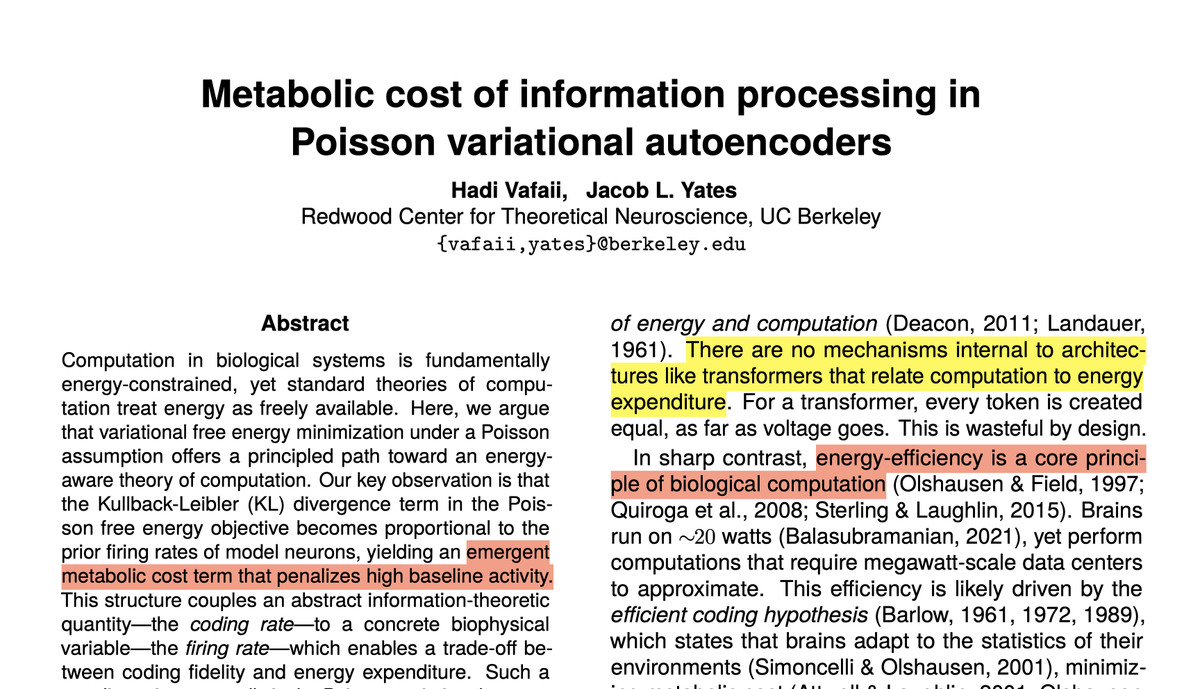
Summary: we need an energy-aware theory of computation, and rate-distortion theory with Poisson latents is a good start. But this is only the beginning, so please reach out if this sparked a thought/idea! Here's the preprint again: 📜 arXiv: arxiv.org/abs/2602.13421 [11/11] 🧵
English
4
2
31
1.5K
Hadi Vafaii
Hadi Vafaii@hadivafaii·
The "decoupling of information and energy" is a major point of divergence between biological and artificial computers. Brains are efficient, modern AI isn't. And energy consumption is the biggest bottleneck in scaling AI (you can't hallucinate electrons into existence). To address this we need an "energy-aware theory of computation." And this new preprint is an attempt to address this. [1/11] 🧵
Hadi Vafaii tweet media
English
17
72
337
54.1K
Ryan Rand
Ryan Rand@Emb0wlden·
@CompGeometry At d=3 (27-trit):stride (14)has a GCD of 14 with 168. The "Hausdorff Translation" only works if same 12-pearl subgroup. The proved "lower bound"for d=3. At d=4 (81-trit):stride (41)has a GCD of 1 with 168. Global Coprimality. just need to pulse the manifold once. solve in O(1)
English
0
0
0
12
Computational Geometry Papers
Computational Geometry Papers@CompGeometry·
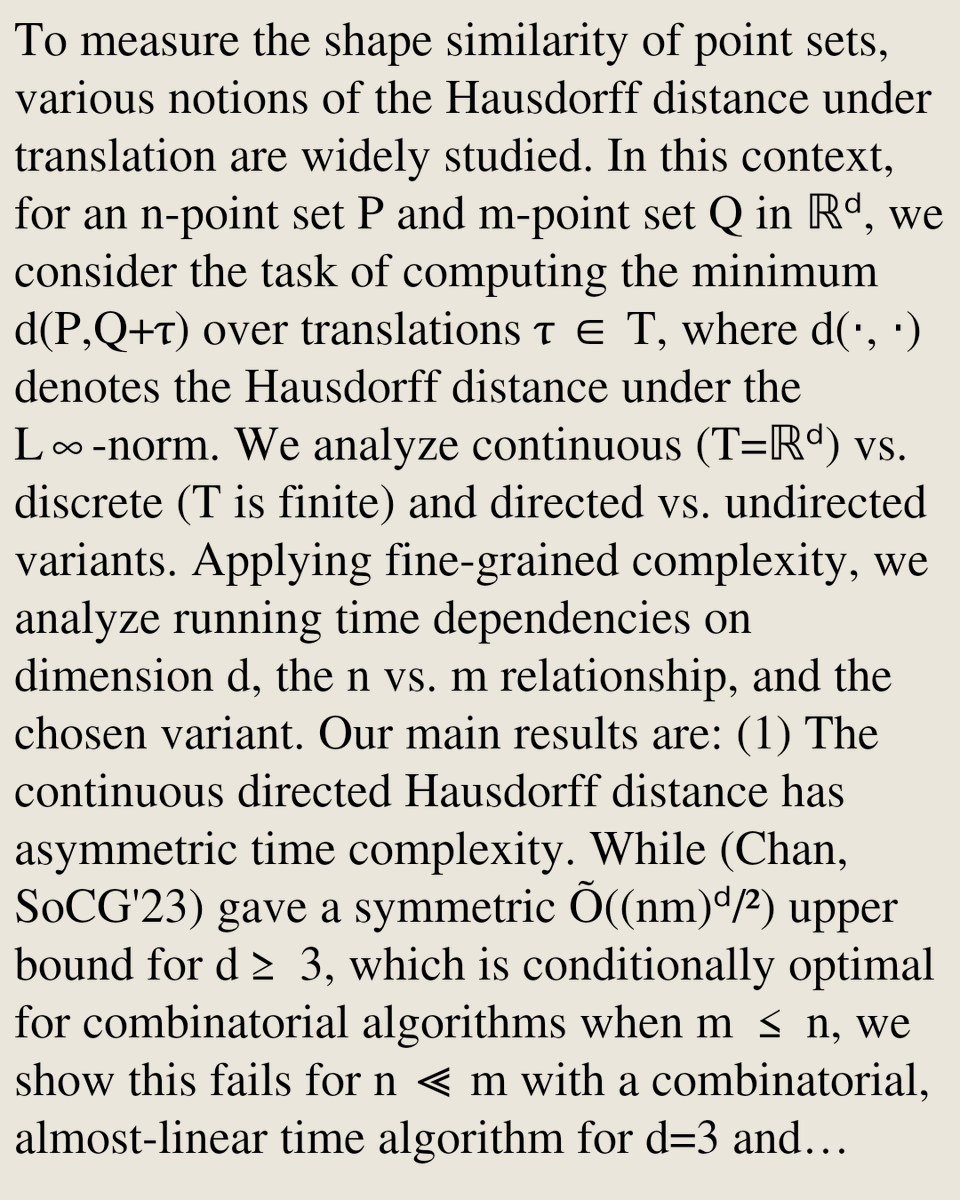
Computing L∞ Hausdorff Distances Under Translations: The Interplay of Dimensionality, Symmetry and Discreteness Sebastian Angrick, Kevin Buchin, Geri Gokaj, Marvin Künnemann arxiv.org/abs/2603.08890 [𝚌𝚜.𝙲𝙶]
Computational Geometry Papers tweet media
Deutsch
1
0
0
16
Ryan Rand
Ryan Rand@Emb0wlden·
I am likely classed as "probable spam" too HAHAHHA
English
0
0
0
14
François Chollet
François Chollet@fchollet·
The next major breakthrough will branch out at a much lower level than deep learning model architecture. It will be a new approach. A better model architecture can lead to incremental data efficiency & generalization gains, but it won't fix the fundamental issues of the parametric learning paradigm.
Rohan Paul@rohanpaul_ai

Sam Altman just said in his new interview, that a new AI architecture is coming that will be a massive upgrade, just like Transformers were over Long Short-Term Memory. And also now the current class of frontier models are powerful enough to have the brainpower needed to help us research these ideas. His advice is to use the current AI to help you find that next giant step forward. --- From 'TreeHacks' YT Channel (link in comment)

English
101
54
875
142.5K
Ryan Rand
Ryan Rand@Emb0wlden·
@mathCAbot try self.WAVE_MAP = [(a + (b * 3) + 17) % 168 for a in range(168) for b in range(168)] # Seam cost: 0 = Perfect Resonance (The 'Signal'), >0 = Noise self.SEAM_MAP = [min(abs(a-b)%168, 168-abs(a-b)%168)%7 for a in range(168) for b in range(168)]
English
0
0
0
6
Kat ⊷ the Poet Engineer
Kat ⊷ the Poet Engineer@poetengineer__·
particle life in 3d controlled by hands 🪸 - adjust spacing of all particles - move any type of particles
English
29
123
1.6K
68.5K
R. Wade H. Marr
R. Wade H. Marr@HunterWade·
Most people learned that science advances through specialization. And specialization certainly matters. Yet many of the deepest discoveries appear when someone looks comprehensively and notices the same structural pattern showing up across seemingly unrelated domains. ◈ Yesterday, this profile shared two short videos exploring that pattern from different angles: • one connecting Maxwell, Prigogine, and Mandelbrot • another showing the reciprocal relationship between Schrödinger’s phase evolution and Buckminster Fuller’s geometric closure Each window reveals the same underlying principle appearing in a different language. ◈ Today’s video pulls the whole constellation together. Maxwell. Schrödinger. Prigogine. Mandelbrot. Fuller. Five thinkers from five different disciplines. All pointing toward the same structural dynamic: phase relationships evolving within the field, and closure stabilizing structure. ◈ And then one more systems scientist enters the picture. W. Edwards Deming. Deming didn’t introduce a new physical discovery. What he gave us was the meta-method: how to filter noise, stabilize definitions, and trace observable behavior back to the upstream invariant generating it. He made explicit the cognitive move the other thinkers were already making. ◈ Seen through a field-primary lens, these insights begin assembling into something larger: a simple structural grammar describing how patterns form, stabilize, and persist across scale. Physics. Biology. Organizations. Civilization itself. ◈ The deeper question becomes: What becomes possible once we begin designing systems from the phase relationships that allow stable structures to emerge in the first place? The recursion holds. 🌀
English
4
5
29
1.1K
Physics Today
Physics Today@PhysicsToday·
In 1999, researchers found that certain organic molecules preferentially transmit electrons with a particular spin orientation. Many experiments have followed, but the physics underlying the chiral-induced spin selectivity effect remains mysterious. #physics #chirality physicstoday.aip.org/features/how-t…
English
15
52
203
17.4K