
Emily Grey

982 posts

Emily Grey banner
Emily Grey

Emily Grey

@EmilyGreyPSSD

Post-SSRI Sexual Dysfunction for 6 years. Struggling with physical and cognitive symptoms. Raising awareness and building community with other PSSD sufferers

Canada Katılım Kasım 2023
230 Takip Edilen547 Takipçiler
Sabitlenmiş Tweet
Emily Grey
Emily Grey@EmilyGreyPSSD·
After 6 years of debilitating Post-SSRI Sexual Dysfunction (PSSD), it is good to finally see detailed mainstream coverage. Thank you Daniel Bergner for your sensitive and well-researched piece. nytimes.com/2025/11/12/mag…
English
9
21
91
7.2K
Iatrogenic Awareness
Iatrogenic Awareness@iatrogenicaware·
Being critical of SSRIs does not equal disbelief of mental health conditions, and people need to stop conflating the two. Depression is viscerally painful, but SSRIs can irreversibly harm a human being. Two things can be true.
English
5
10
52
1.1K
Emily Grey retweetledi
Brenda Velasquez
Brenda Velasquez@laganja_bee·
Absolutely nobody understands what we’re going through except us. I try and try to explain it to my family and friends, but there’s no empathy. They just tell me to be more positive and stop thinking about it #PSSD #anhedonia #severecognitiveproblems
English
4
12
47
1.2K
Emily Grey
Emily Grey@EmilyGreyPSSD·
@oncebluegreen @TrumpFan24_ He just described getting disabled by a medication and all you can say is "well some other people like them." What do you get out of commenting that? Can you explain the thought process to me?
English
0
0
0
14
Blue
Blue@oncebluegreen·
@TrumpFan24_ There are so many available and it can take a while to find the best match. SSRIs can be life changing for some.
English
1
0
1
247
Trump 2024
Trump 2024@TrumpFan24_·
Never been suicidal but have had anxiety for years. Took an SSRI for THREE WEEKS over 6 years ago and have been suicidal everyday since because it took away all emotions and pleasure permanently. The condition is called PSSD and it’s torture. Keep reading below….
English
6
13
89
5.2K
Emily Grey
Emily Grey@EmilyGreyPSSD·
@esquire For me, this "side effect" has persisted for 7 years off the medication. It's ruined my life. Many more stories like mine: pssdnetwork.org
English
0
5
17
325
vittorio
vittorio@IterIntellectus·
when you look into them, SSRIs are truly insane and it's baffling that they are even legal knowing how bad they are every person responsible for pushing these on millions of people without any reason other than making money should be in jail
J͎Λ͎Y͎@TakeThiamine

x.com/i/article/2029…

English
80
214
2.2K
169.6K
Emily Grey retweetledi
Katie Collingwood
Katie Collingwood@KatieRColl·
I'm nearly 35. At this age, I expected I would have built a life. Instead, I'm in my childhood bedroom, wishing I was able to cry at the tragedy of my emotions and sexuality being cut off - all because my doctor gave me a pill that took away those luxuries more than a decade ago. #PSSD #SSRIs
English
28
50
395
55.3K
Max Hopkins
Max Hopkins@Max_is_lost·
@MeghanEMurphy There are side effects and risks to all medications and really pretty much all things ever. How we decide if something is safe for someone is by doing a risk benefit assessment, are the benefits worth the possible risks and for many people who are helped by ssri’s the benefits do
English
1
0
5
185
Emily Grey
Emily Grey@EmilyGreyPSSD·
@SobonBet @MeghanEMurphy Your personal experience does not negate the fact there are risks and some people experience horrible ongoing effects. Genuinely what is the point of your comment? Only your story matters?
English
0
0
4
55
Bet Sobon
Bet Sobon@SobonBet·
@MeghanEMurphy I take it and don't have any side effects. Don't use blanket statements when you don't know the facts.
English
3
0
4
248
Louie 🍊
Louie 🍊@nqlouie84994·
@IterIntellectus We need research to figure out what SSRIs do on a granular level. Not this vague idea of inhibiting serotonin reuptake but like the full scope of what they do and why some people are permanently damaged. We need to reverse this damage
English
2
0
11
693
Emily Grey retweetledi
Nick
Nick@TrueContext·
The antidepressant industry has a hidden scandal that's ruining lives: Post-SSRI Sexual Dysfunction (PSSD); persistent genital numbness, total loss of libido, erectile dysfunction, pleasureless orgasms, emotional blunting, and anhedonia that can last years or forever after stopping the meds. SSRIs are prescribed like candy for depression, anxiety, even to teens, with side effects hitting 30-80% during use. But for some, the damage doesn't reverse. Europe added warnings in 2019, Canada/Australia followed, yet the FDA still refuses. No black-box label, no real acknowledgment, despite petitions and lawsuits dismissed on technicalities. Recent developments: NYT highlighted how SSRIs may disrupt teen sexual development, with some reporting lifelong effects. Brain tests like EEG/LDAEP now predict orgasmic dysfunction risk with high accuracy, showing potential for pre-screening. PSSD Network funds research at Univ. of Milan, Toronto, Howard rat models, brain gene studies, phase 1/2 investigations into neurobiology. Doctors like Irwin Goldstein and Josef Witt-Doerring call it "castrating people" and "destroying the soul," with emotional/cognitive blunting feeling like a lobotomy. Vets in the VA get slammed with polypharmacy "cocktails," compounding trauma. Civilians face trial and error prescribing without informed consent. This is iatrogenic harm, doctors causing injury while claiming to help. Will AI expose it? Tools already predict side effects and analyze patterns from reports/social media, but pharma influence, biased data, and ethics boards will likely throttle full transparency. Hiding continues because the market is billions. Profits over people. Compensation for PSSD victims? Other SSRI harms (birth defects, suicides) settled for billions, but PSSD lacks major class actions yet. Advocacy is growing; recognition could open doors, but it's an uphill fight. We need: Mandatory persistent effect warnings Independent research funding Shift to non-drug therapies Accountability for overprescribing Stop treating humans like guinea pigs. If you've been affected, check pssdnetwork.org for support and research. Truth doesn't stay buried forever. Share if you've seen this or know someone who has. What do you think, will the system ever admit it? #PSSD #SSRI #AntidepressantHarms #Overmedication #MentalHealthTruth
English
1
3
17
508
Emily Grey
Emily Grey@EmilyGreyPSSD·
@LisAustinX THANK YOU for writing about this. PSSD ruined my life.
English
0
0
10
127
LisAustin
LisAustin@LisAustinX·
🚨 Post-SSRI Sexual Dysfunction (PSSD): An Under-Recognized Risk the Medical Community Must Confront👇 There is a condition called Post-SSRI Sexual Dysfunction (PSSD) where sexual, emotional, and cognitive symptoms persist long after antidepressants are discontinued. For some individuals, these symptoms begin during SSRI or SNRI treatment and do not resolve after stopping the medication. This is not about temporary side effects. It’s about persistent dysfunction after discontinuation. What has been documented in case reports and patient registries: • Reduced or absent libido • Erectile dysfunction or genital anesthesia • Decreased orgasm intensity or inability to orgasm • Emotional blunting • Anhedonia (loss of pleasure) • Brain fog and cognitive slowing European regulators, including the EMA, have acknowledged reports of persistent sexual dysfunction after SSRI discontinuation. Peer-reviewed case reports describing PSSD exist in medical literature, though prevalence remains uncertain and under-studied. Why this matters mechanistically: SSRIs increase serotonin signaling. Serotonin modulates dopamine. Dopamine governs reward, motivation, pleasure, and sexual response. Chronic serotonergic alteration may, in susceptible individuals, contribute to downstream changes in dopamine sensitivity, receptor regulation, or gene expression patterns. The exact mechanism remains under investigation but the biological plausibility is real. For many patients, SSRIs provide short-term symptom relief. But relief is not the same as resolution. True mental health resilience often requires long-term behavioral restructuring: • Cognitive reframing • Trauma processing • Lifestyle correction • Nervous system regulation • Exercise and metabolic optimization • Purpose and social integration Medications can suppress symptoms. But sustainable recovery typically involves adaptive neural rewiring through experience and behavioral change. The critical issue is informed consent. Patients deserve to know: • The potential benefits • The potential risks • The uncertainty surrounding long-term outcomes • The lack of definitive treatment protocols for persistent dysfunction Could the endocannabinoid system (ECS) play a role in recovery? The ECS regulates reward processing, mood stability, stress response, neuroinflammation, and synaptic plasticity. Cannabinoids interact with dopaminergic pathways and may influence emotional responsiveness and motivational circuitry. Preclinical studies suggest cannabinoids may: • Modulate dopamine signaling • Reduce neuroinflammation • Enhance synaptic plasticity • Improve anxiety and emotional regulation Clinical research specifically studying cannabinoids for PSSD remains limited, but mechanistic overlap warrants investigation. The path forward is not denial. It is data. Patients reporting persistent dysfunction deserve: • Rigorous research • Transparent acknowledgment • Development of restorative therapies • Ethical, evidence-based care PSSD is not widely discussed but it is increasingly reported. Awareness precedes investigation. Investigation precedes solutions. Medicine advances when uncomfortable questions are examined, not dismissed. #PSSD #PostSSRISexualDysfunction #Neurobiology #MentalHealthResearch #PatientAdvocacy
PSSD Network | Post-SSRI Sexual Dysfunction@PSSDNetwork

“There’s something called PSSD, where you can get a permanent neurological disorder, even just from taking it once. It’s happened from people taking it short term, and it doesn’t stop once you stop the drug.” @DanielleGansky mentions PSSD in an interview with @CaraCastronuova.

English
5
7
31
1.9K
Brenda Velasquez
Brenda Velasquez@laganja_bee·
Is this even real life how can I be positive?!! No help at all from doctors he told me it was hard to deal with me because I asked him to help me doesn't even care or knows about this condition #pssd #adhnedonia
English
3
1
16
537
Brenda Velasquez
Brenda Velasquez@laganja_bee·
@EmilyGreyPSSD No I didn't Emily I showed him what I have in my phone but I will I have another appointment with him soon I'm going to prepare myself well
English
1
0
0
41
Erik Livingston
Erik Livingston@ErikLivingsto10·
@NumbNotDumb99 They're just selfish and obnoxious people who feel the need to make the topic about them. It's probably a result of them fearing that they could also end up in this state. By diminishing and denying our suffering their dance with the devil can be more comfortable.
English
3
0
4
151
Molly | PSSD
Molly | PSSD@NumbNotDumb99·
I don’t see the point of people who are on psych meds commenting on pssd videos or post saying something like ‘well I have zero side effects and been on x years so I’m fine’. Little do they know meds can turn on them at any point and upon cessation and cause catastrophic effects.
English
5
3
58
1.7K
A Midwestern Doctor
A Midwestern Doctor@MidwesternDoc·
59% of antidepressant users develop sexual dysfunction (often permanently) yet doctors don't warn them to prevent patients declining the drugs Here I reveal common hidden SSRI side effects like bipolar or suicide and the safe natural cures for depression midwesterndoctor.com/p/what-everyon…
English
27
284
735
45.5K
Emily Grey
Emily Grey@EmilyGreyPSSD·
And another.
The Vellness@thevellness

@cyclite My genitals got numbed after a few days on Prozac. The doctor was surprised it "worked" fast, as he believed the effects would take a few weeks. After 5 years, my genitals are still as numbed as when on the medicine. PLEASE inform the general public about it

English
0
1
26
646
Emily Grey
Emily Grey@EmilyGreyPSSD·
There’s no incentive for the industry to perform this research of their own accord. And for pharmacovigilance programs to pick up a signal there needs to be established terminology and a baseline level of knowledge among both patients and physicians, which is a goal of the community’s advocacy. This is the old “you need published research to be taken seriously but you need to be taken seriously to get published research” trap. At this point I have to assume the intent is just to shut us up. We’ve actually been having increasing success as a community in getting both prevalence and animal data published, which you can find on multiple advocacy sites. But that’s not the point is it? Tired of rehashing these same circular arguments with people who at base are motivated to delegitimize. Blocking.
English
0
0
0
33
Sandiz
Sandiz@Sandiz523461·
It doesn’t have to be either silence or alarm. Population-level data comes from structured pharmacovigilance systems, registry studies, long-term follow-up cohorts, and properly designed epidemiological research. Patient reports absolutely matter, they’re often the starting point. But turning signals into established prevalence or causality requires methodology, not amplification alone. Raising awareness and demanding better research is reasonable. Presenting worst-case framing as established risk before incidence is known is where we disagree.
English
2
0
1
79
Emily Grey
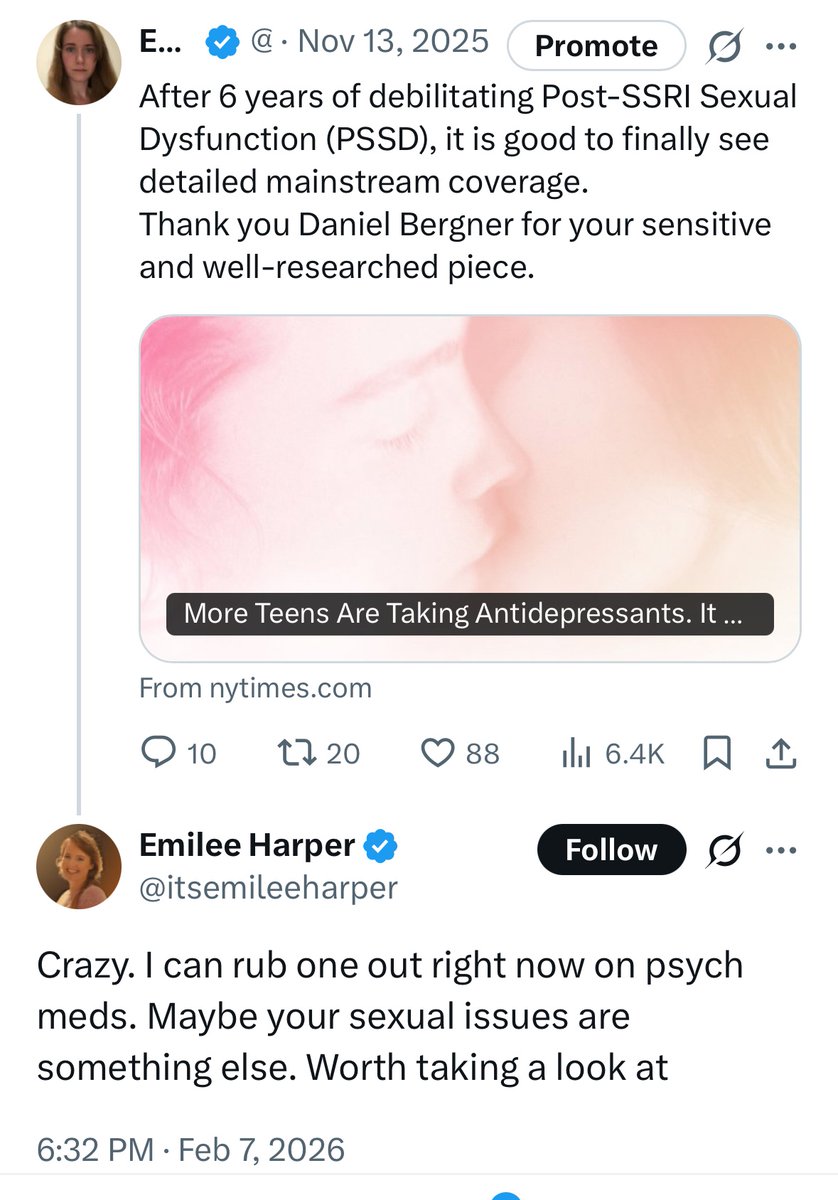
Emily Grey@EmilyGreyPSSD·
I’m glad record of these comments exist because otherwise I might have a harder time getting people to understand the vileness that PSSD sufferers have to deal with.
Emily Grey tweet media
English
11
7
106
2.4K
Nick
Nick@TrueContext·
I'm recovering. I think. I'm not sure, all I know is I have felt some serious changes and my mind is all over the place. 10 months in on a serious treatment plan with a serious medical team 100% behind me. I'm so very thankful to have them. @selahwellness
English
2
0
3
180