

VS Oqitens Terbing
63 posts




$AMD needs above this 522 fib to try today. Then there's a gap at 529

English
For the record.
Reviving U.S. shipbuilding and the merchant marine is one of the most strategically coherent – and least discussed – pillars of President Trump’s America First agenda. It directly fuses industrial policy with national security. For decades, Washington tolerated the erosion of the maritime industrial base, outsourcing hulls, relying on foreign flag carriers, and assuming shipping was a cheap, abundant global public good. That assumption no longer holds in an era of sanctions warfare, contested sea lanes, and weaponized supply chains.
Bringing shipbuilding back onshore and energizing the merchant marine does three things at once. It rebuilds heavy industrial capacity and skilled labor, anchors long-term capital expenditure in ports and yards, and restores credible sealift for the U.S. military without depending on foreign-owned tonnage. It also reframes shipping from a purely commercial line item into a core instrument of economic sovereignty: control your ships and you control your logistics; lose your logistics and you lose your leverage.
Critics will call this protectionism or industrial nostalgia. They miss the point. Maritime strength is not about sentimentality, it is about strategic redundancy in a world where chokepoints, not tariffs, increasingly decide who remains a great power.
Rapid Response 47@RapidResponse47
Jamie Dimon: "We're sitting in the Philadelphia Navy Yard. They built ships here that won the Revolutionary War, that helped win World War II. The arsenal of democracy has been reignited... there's 16,000 workers here. That number may very well double over the next 5 years."
English
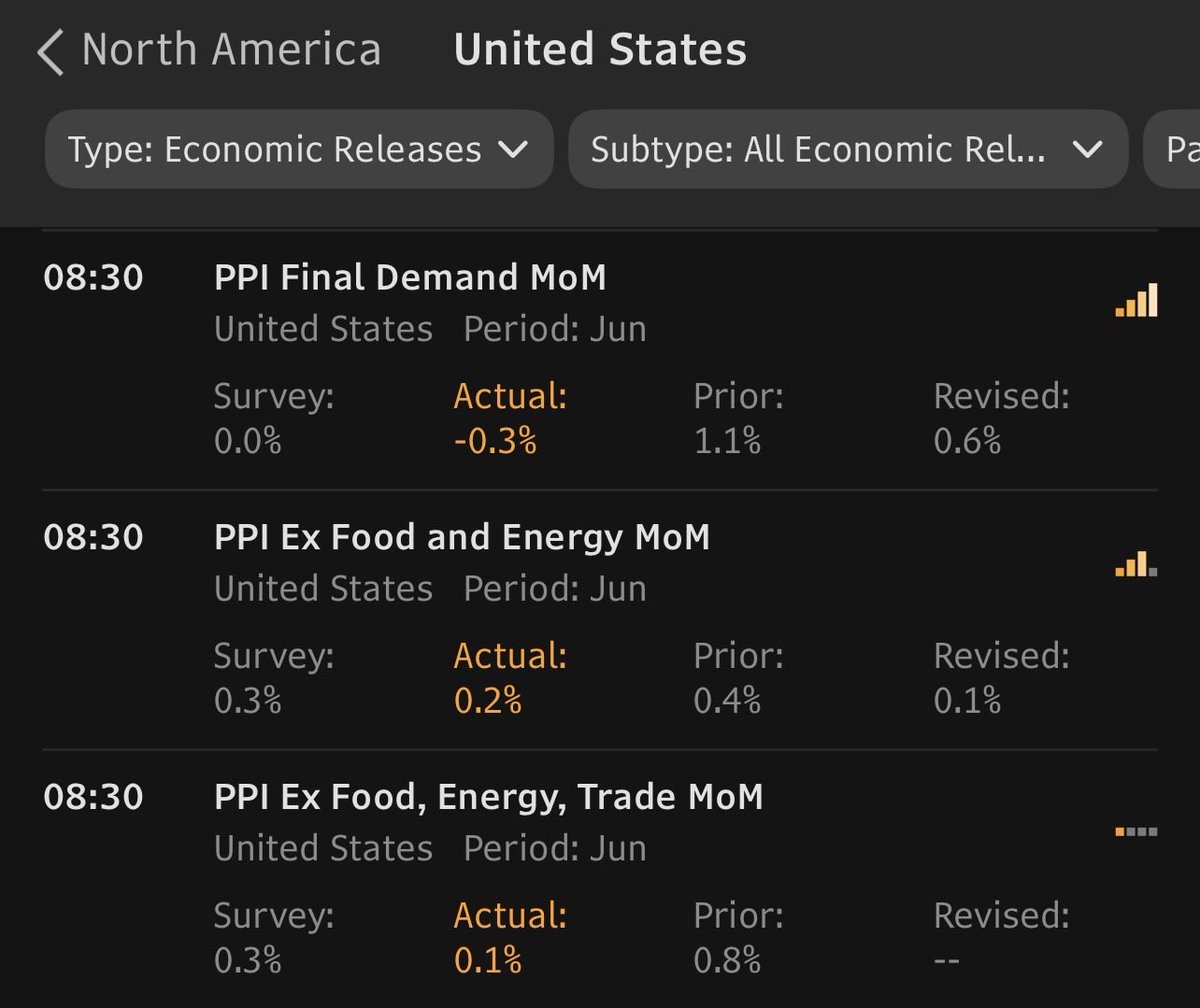
What will the Inflation Doomers complain about now.
PPI -0.3%
Remember consensus on Wall St a few weeks ago was for Rate Hikes!!
Can’t make this stuff up.
Big revision down as well from prior month. 👇
English
The Clarity Act
Bitcoin is not just an asset; it is the backbone of a new financial system where contracts, payments, and ownership live on‑chain, displacing today’s intermediary‑heavy architecture.
We now hear almost daily how hard Washington is working to pass the CLARITY Act; as Shakespeare put it, “the lady doth protest too much, methinks,” and the louder the town crier in D.C., the more it sounds like self‑justification rather than strategy.
The bill is a bullish hinge point: by wiring digital assets into the core US market framework, it drags institutions onto crypto rails and makes it harder for D.C. to pretend Bitcoin is a side show rather than emerging collateral and, eventually, de facto legal tender.
The risk is that America stops at market structure. The US has never lacked innovation; it has repeatedly failed to weaponize it. Blockchain is following the script: instead of treating open networks as the next layer of dollar power, Washington is busy protecting legacy banks while live capital migrates.
China has drawn a different lesson, visible not in Beijing but in Hong Kong. The city is being rebuilt as a tightly regulated sandbox for exchanges, stablecoins, and tokenized assets – a place where global money can plug into Chinese‑aligned standards. As Scott Bessent likes to say, “standards are strategy.”
And as Machiavelli warned, elites are quick to confuse the defense of their own position with the defense of the republic. By hesitating to set Bitcoin‑friendly standards at home, Washington is effectively outsourcing the role of global digital‑asset capital to Hong Kong.
English
Warsh’s Fed. A Fed That No Longer Fears Growth.
Warsh’s Fed Is a Return to Volcker, Greenspan, and the Real Economy
“In six weeks we have caused, I think, a sea change in new thinking.”
Kevin Warsh’s testimony made clear the Federal Reserve is moving away from the Bernanke-era framework and back toward something older, and more durable, a Volcker–Greenspan Fed anchored in the real economy, not numerical precision.
Warsh did not abandon the 2 percent inflation target.
He reframed it. Invoking Volcker, he defined price stability as a condition, when inflation fades from public concern, rather than a number to be constantly engineered. That shift widens the Fed’s lens beyond narrow inflation metrics to include expectations, productivity, and economic capacity.
This is a return to classic supply side economics at the Fed.
Just as important was what he left unsaid. There was no defense of the model-driven, forward-guidance-heavy regime that has dominated the past 15 years. Instead, Warsh emphasized credibility, discretion, and accountability, hallmarks of an earlier Fed that treated policy as judgment, not formula.
At the center of this shift is a different view of growth.
For years, the Fed has implicitly treated strong growth as a risk, something to restrain before it fuels inflation. Warsh’s emphasis on the real economy suggests the opposite.
Growth, driven by productivity and investment, is not the problem, it is the solution. Price stability is not achieved by suppressing demand to fit a model, but by allowing supply to expand alongside it.
That distinction is critical. It implies a Fed less inclined to choke off expansions preemptively and more willing to let the economy run, so long as inflation expectations remain anchored.
Warsh’s message is that the Fed will restore price stability after five years of misses, but not through mechanical rate increases alone. Credibility, not just policy settings, is the binding constraint.
For markets, the implications are clear. A Fed that communicates less and reacts with more discretion will carry higher uncertainty and a higher term premium.
But it also reduces the risk of over-tightening in response to transitory data. One soft inflation print is not victory, and one strong growth print is not a threat.
The through line is unmistakable.
This is a shift away from a narrow, model-driven Fed toward one grounded in real economic performance, supply-side expansion, and institutional credibility. The Real Economy matters. Growth is no longer the enemy.
The era of treating growth as inflation’s enemy is ending. What comes next is a Fed that, once again, sees growth as the foundation of stability.
Bloomberg TV@BloombergTV
Federal Reserve Chairman Kevin Warsh says he is focused on the central bank's 2% inflation target during testimony before the House Financial Services Committee bloom.bg/44yt88i
English
Many of my Twitter followers have already joined my WhatsApp
FREE TO JOIN My Real-time trading alerts and investment strategies Market forecast analysis
Reply with "2026" to my WhatsApp number +12792262580 to join for free
I POST ALL TRADES FOR FREE
🔗wa.me/12792262580/?t…
English
New semester vibes! Fresh notebooks, excited classmates, and a whole semester of growth ahead Let’s crush this term together!

English
New semester, new chapters, fresh starts! Let’s chase those goals, learn something new, and make this term unforgettable. Ready
English