
EnlightenedStockTrading
3.5K posts

EnlightenedStockTrading
@EnlightenStock
We mentor analytical people who trade stocks and are erratic, discretionary & uncertain transform into consistent, confident & rules based traders.
Australia Katılım Şubat 2016
385 Takip Edilen1.1K Takipçiler
Attention RealTest users:
We have launched full automation for Crypto trading with RealTest (Amibroker and others also covered).
•Automatic daily data downloads
•Full data history
•Order generation
•Order management
•Easy setup
•Manage multiple systems and accounts from one platform
•Support for Binance / Kraken / Kucoin / ByBit
Check out QuantConsole.com
#realtest
#crypto
#tradingautomation
#trading
English
@StoicTA Trying to catch everything is a disaster that will lead to massive overtrading and huge drawdowns. All you need is a portfolio of systems that catches some good moves in a range of different market conditions… don’t worry about trying to catch everything move.
English

if you keep getting tilted after missing the first move, the problem is probably not entries.
it is expectation
you expected the market to give you the same clean trade again
it may not...
your job is not to catch everything
your job is to protect your capital
English
@bettersystrader My view is that a proven, backtested trading system should define every action you take in the market. This way all of those micro decisions and emotional impulses can be eliminated quickly and easily in favour of one macro decision to just follow the system.
English

Most traders can tell you exactly when they entered a trade. Few can tell you what they planned to do at every point after.
Matt Zimberg spent 25 years at Optimus Futures watching the full range of trader behavior.
The clearest pattern separating successful traders from unsuccessful ones:
How many of the relevant decisions were made before the trade versus in the moment under pressure.
He maps out the full scope of decisions every trade requires: what market to trade, what size to take, where the stop goes, what the invalidation condition is (the point where what you thought was happening clearly isn't), how you'll handle a partial move in your favor, what you'll do if it gaps against you, when the thesis has expired without a result.
Most traders have clear answers on one or two of these.
The rest get made in real time, when the account is at risk and the clock is running.
Decisions made under pressure are worse than decisions made in advance.
That's not a psychological observation.
It's a structural problem that documentation fixes.
The traders Matt watched succeed weren't more disciplined in the moment.
They had fewer decisions left to make in the moment.
English
The 2026 Australian Budget just changed how investment income is taxed.
3 changes. Some cost you more. One is actually good news for systematic traders.
💠Negative gearing on established property: gone for new purchases
💠The 50% CGT discount: replaced
💠Discretionary trust income splitting: closed
If you trade stocks or hold investments in a trust or company, this affects you.
Full breakdown + questions to take to your accountant:
linkedin.com/pulse/2026-aus… via @LinkedIn
English
Regime filters are one of the best tools we have for smoothing individual systems in real time. Worth using. But they're lagging by design.
The second tool, the one most systematic traders skip, works at the portfolio level and shows you what's missing.
Full article on Substack 👇
open.substack.com/pub/enlightene…
English
Having trading systems that do all of these things for you makes a huge difference.
It is so easy for our biases and emotions to creep in, but if we have systems that respond to the market irrespective of what we think or feel then we are much closer to the goal of responding objectively to what the market does rather than responding to what we feel as a result of what the market did.
Trading systems make life so much easier (and more consistent)
English

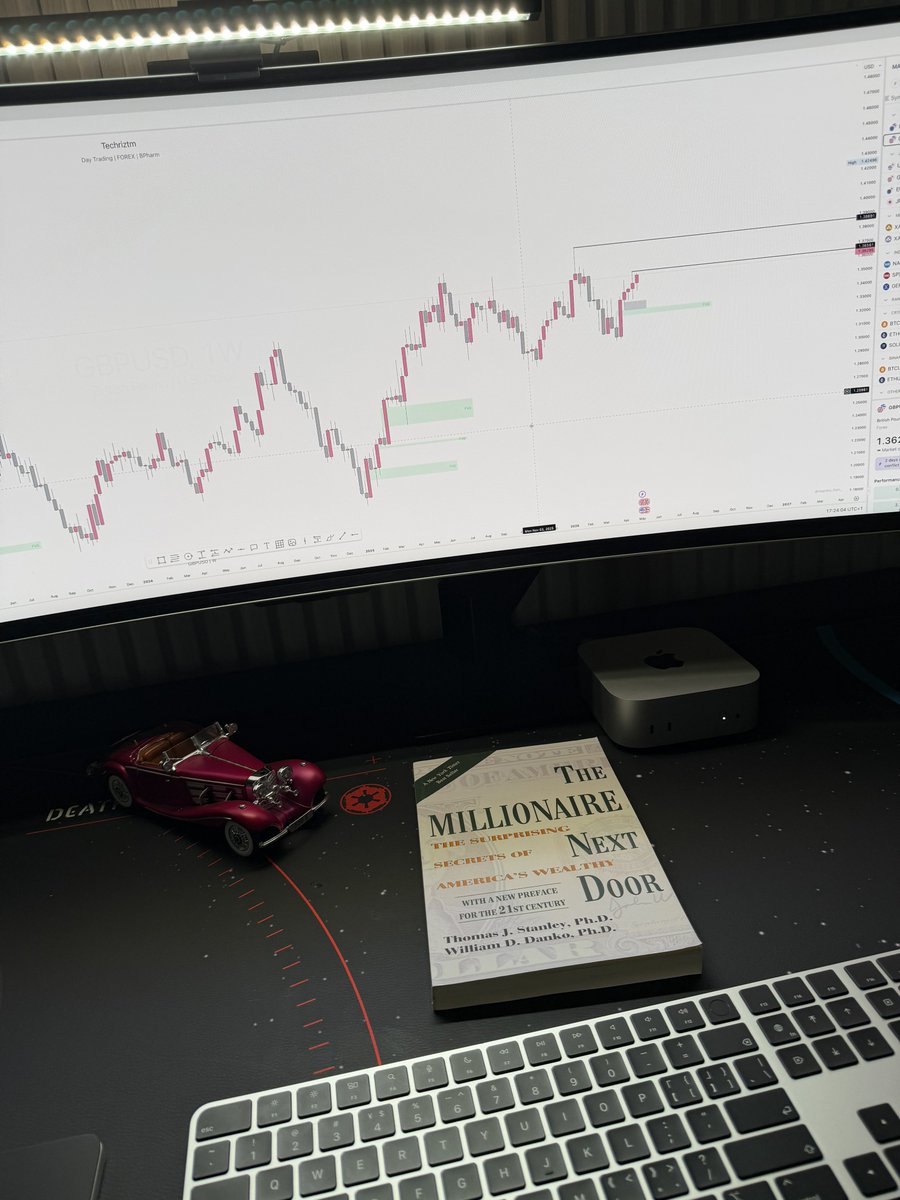
As this new trading week begins in few hours.
Read this‼️
Stop approaching the market with the mindset of “how much can I make?”
Start asking yourself:
“What is price trying to do?”
That single shift changes everything.
Most traders enter the week already biased.
Already emotional.
Already looking for buys or sells before the market even opens.
And that is exactly why they keep getting trapped.
The market is not obligated to respect your prediction.
It only respects liquidity, positioning and timing.
Some of you spend more time looking for entries than actually studying delivery and market behavior.
A clean chart means nothing if you cannot understand why price is moving.
This week, pay attention to these things:
• Where liquidity is resting
• Which highs/lows remain untouched
• How price reacts after taking liquidity
• Whether momentum is actually supporting direction
• And most importantly… if the market is even worth trading yet
You do not need to trade Monday aggressively.
Sometimes the smartest thing you can do early in the week is observe.
A lot of traders destroy their week in the first 24 hours because they feel pressured to “start strong.”
Patience is also a position.
Protect your capital.
Protect your psychology.
And stop treating every candle like an opportunity.
How many of you actually sat down and studied this weekend? 💜📈

English
The Fastest Way to Improve a Trading System Might Surprise You.
Your system might already work, just not on the market you are looking at. Discover how just one simple question can dramatically improve your trading performance fast.
open.substack.com/pub/enlightene…
English

Being up 300% in a year doesn't earn you special status -- not to the person who matters most.
Jim Roppel bragged to Bill O'Neill at the Ronald Reagan Library. O'Neill's reply: "We all put our pants on one leg at a time." One sentence. Permanent recalibration.
Humility outlasts every hot streak.
English
I 100% agree traders need to stop predicting and start preparing for any outcome. Most traders are addicted to prediction because it feels like skill… mostly it is luck… make enough predictions and some will be right.
Just like make enough bets at the casino and some will win. That doesn’t make gambling profitable!
In my mind better preparation means having trading systems that tell you exactly what trades to take, how to size them, when to enter and when to exit. Plus backtesting those systems so that we have absolute confidence to follow them.
Even better preparation is having a diversified portfolio of systems / strategies that make money from a variety of different market conditions.
English

Most traders don't need BETTER predictions.
They need BETTER preparation.
Prediction puts PRESSURE on you.
Preparation builds YOUR standards.
Stop trying to know the future.
Start preparing for ANY outcome.
English
The uncomfortable follow-up to this is panic after two losses sometimes means weak psychology, but more often it means the strategy was never validated well enough to deserve confidence in the first place.
You can’t fully trust an edge you haven’t proven... and you can’t prove an edge without rigorous backtesting.
One of my ‘secret’ techniques is every time an emotional reaction to a strategy comes up, I isolate the thing that caused it, and convert it to a rule to backtest so I can see if it helps or hurts performance… do this enough and there are no emotional reactions left and all that remains is absolute confidence.
English

You say you trust your strategy.
But if you panic after two losses,
hesitate on the next setup,
or increase size impulsively…
... then you trust your feelings and impressions more than your edge.
English
These are huge issues for so many traders!
I find in many traders I speak to that lack of confidence in the strategy leads to a lot of the problems (exp skipping trades, revenge trades, missing stops etc). Deeper Backtesting to build rock solid confidence in the strategy often makes these problems go away.
Of course journaling still requires discipline… but is 100% worth doing - makes the world of difference!
English

Man to Man:
You say you're serious about trading.
But you skip journaling.
You revenge trade.
You move your stop loss.
That's not a strategy problem.
That's a discipline problem.
Fix that first.
English
I would broaden this statement and say, just don’t talk about your trading with non-traders. There is zero upside and everything you hear will be noise. This is an easy way to improve your psychology.
Of course, finding a community that understands what you are doing and can challenge you is a solid idea.
Most people just don’t understand trading though!
English
Trading Law:
Never tell your friends you are learning to trade.
Wait until you are profitable.
English
This sort of institutional memory is hard to come by without decades in the game… for newer traders the next best thing is Backtesting strategies on as much data as possible.
Many traders talk about how the markets have changed and so only backtest their ideas on recent data (post 2000 is common in stocks for example)… and while I agree that makes sense for parameter tuning, Backtesting on the full history to ensure you capture all of the historical crazy moves is a critical step for risk management.
The markets can do crazy things but they are rare, so we need to look at as much history as possible to ensure our strategies survive when they happen!
English

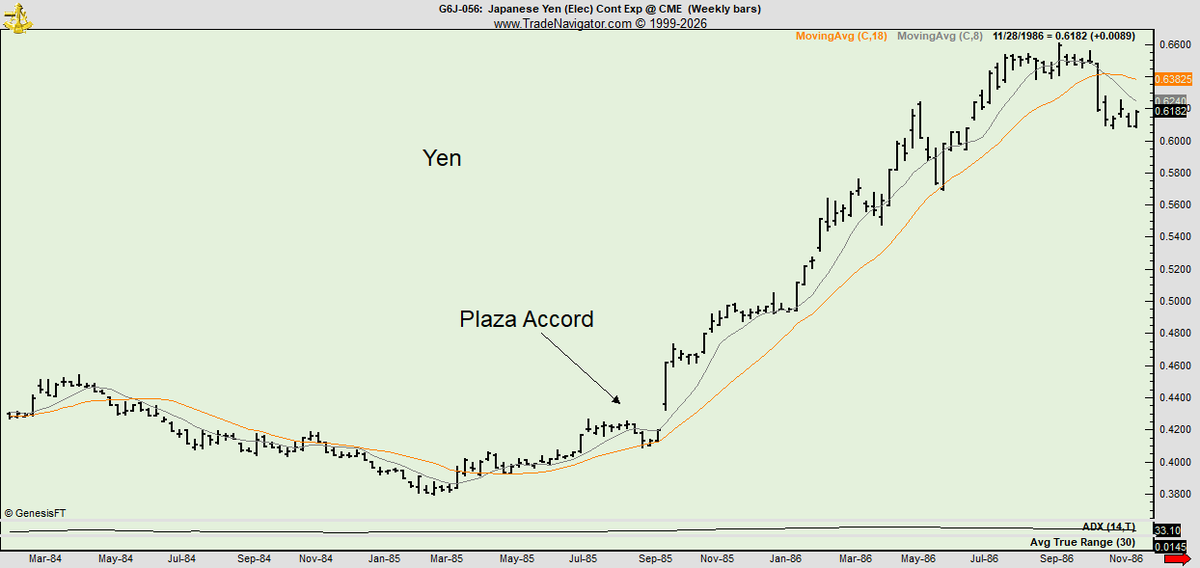
Comment on the Japanese Yen
It helps to have institutional memory
The last major intervention by Central Banks to prop up foreign currency units against the USD was in Sep 1985 -- it was the Plaza Accord. I remember it well. I was trading the Yen back then.
This was the bottom of Yen -- has not been back there since $JPY
The announcement created huge up gaps that remain unfilled (so much for fading gaps -- fading gaps has always been a dumb idea in my mind
I bot the gap up as a H&S bottom was completed. There were huge gaps in all currencies. CHF gapped up by more than 200 points. I am interested in being long Yen
English
Check out the latest article in my newsletter: How to Use AI for Stock Trading (And Why Most Traders Are Doing It Wrong)
linkedin.com/pulse/how-use-…
English
English

English

@hojay_067 @vmcc_one @ChairmanOlo One other thought is constantly adding, even small amounts of capital to the account to build it up makes a huge difference… provided of course that they keep the risk low and don’t blow the account. Compounding profits and savings in the account makes a huge difference.
English
@EnlightenStock @vmcc_one @ChairmanOlo Exactly bro, it’s small-account dilemma
mostly newbies sitting on $5–$100), risking true 0.5–1% means you’re putting $0.05–$1 on a trade.
After fees and slippage in crypto, that’s basically pointless, they can’t even enter a decent position. Psssh
English
One of my trading systems early in my journey was out of the market for 9 months… that took some ‘do nothing tenacity’ I can tell you! It was the right call for that system. But what I did wrong back then was I didn’t have a diversified portfolio of strategies so the level of activity was too low for my personality.
What is your view on adjusting the systems / number of systems etc to generate the right level of activity for the individual trader?
All this presupposes of course that each strategy / system is followed and the trader is doing the ‘waiting’ that the strategy requires ;-)
English

The hidden edge in trading: doing nothing
“One of the best rules anybody can learn about investing is to do nothing, unless there is something to do.” - Jim Rogers
He’s right.
In trading, patience isn’t just a virtue, it’s an edge.
Often, the highest-value action is no action at all.
Most traders can’t handle that.
The market opens and suddenly they *need* to act.
They chase trades, cut winners early, hold losers… all because they feel the urge to be productive.
But trading isn’t about action.
It’s all about waiting and striking when it actually matters.
If you need constant action, you’re in the wrong game.
What works is simple: discipline, patience, consistency.
If you can learn to “do nothing” when nothing is there…
You’ll save yourself money, time, and energy.
When you feel the urge to act, question the story in your head.
Not whether it’s true but whether it’s useful.
If it’s not helpful, drop it.
This isn’t easy. It takes awareness and control.
But without it, you won’t last in this game.
Stay aligned with your rules. Play the long-term.
That’s how you win.

English
@hojay_067 @vmcc_one @ChairmanOlo Oh yes, with small amounts of capital it is tough to keep the risk levels low… how do you suggest they balance the risk of blowing the account with the need to grow capital fast with a small account? This is a tricky balance I think!
English
@EnlightenStock @vmcc_one @ChairmanOlo Woah, excellent take from you man.
I go with your idea of 0.5 or 1-2% years per trade when using high liquidity of about $1k to $10k & above.
But i know my audience, ( in the sense that most are newbies who might be using low liquidity of about $5- $100 thereabouts)
English
The solitude piece is real and almost nobody talks about it honestly. When I quit my job to trade full time in 2012, it took only about 6-9 months and I was bored lonely and depressed.
One thing worth adding: trusting “the process” only works if the process is actually trustworthy. A lot of traders sit in silence and grind through the isolation, then eventually discover the strategy never had an edge to begin with.
That is why I believe backtest-able trading systems are the foundation of trading success. If you can objectively backtest the strategy and the risk levels then the discipline to follow the process and stick with it becomes a lot easier in my experience.
Character alone doesn’t create profitability. But it might be what keeps you around long enough to build something that does!
Well done, great post
English

The hardest part of trading is not the strategy.
It's sitting alone in a room, making decisions that affect your future, with no boss telling you what to do, no one validating your choices, and no safety net if you're wrong.
That's why most people quit. Not because the market beat them. Because the solitude did.
No one is there to tell you that you are on the right path. No one validates your process. No one say “keep going, you’re close.”
The market will show you exactly who you are. Your patience. Your greed. Your fear. Your discipline. Your ego. Everything you hide from the world, the chart will expose.
You cannot be a great trader and a weak person. The market won’t allow it. It will find your weakness and exploit it until you fix it or quit.
The ones who survive are not the smartest. They’re the ones who learned to sit in silence, trust their process, and keep building, even when nobody was watching.
Character is built in silence. Always has been. Always will be.
English