Eric Blevins
563 posts

@EricJBlevins
Sports Law Program Mgr., Tulane Center for Sport. Thoughts are my own on sports & the law.


We'll find out how much the CSC's arbitration win over Nebraska players really means after this hearing. There are two arguments before the court, and the players need to win both. The CSC only needs to win one: 1. Do disputes over CSC decisions belong in arbitration? The NCAA has a strong argument that scrutinizing the CSC's rejection of Nebraska/PlayFly NIL deals is solely up to an arbitrator because that's what the parties agreed in the settlement. It wouldn't be surprising if the court simply said, "if you've got a problem with a CSC decision, take it to an arbitrator." And the arbitrator already gave a strong ruling in the CSC's favor. This would avoid the players' substantive argument altogether, be a huge boost to the CSC generally. 2. What is an "Associated Entity?" If the players get past #1, their substantive argument is that PlayFly and similar MMR's shouldn't be considered "Associated Entities." It's a defined settlement term and the parties argue over how to interpret it. If a court agrees that they're not, then PlayFly/MMR deals aren't subject to any CSC review whatsoever. The CSC's arbitration win is basically wiped out, and it's a full green light for schools and MMRs to ramp up these arrangements. But if the court agrees that MMRs can be Associated Entities, expect the CSC to invalidate many other similar deals at other schools.


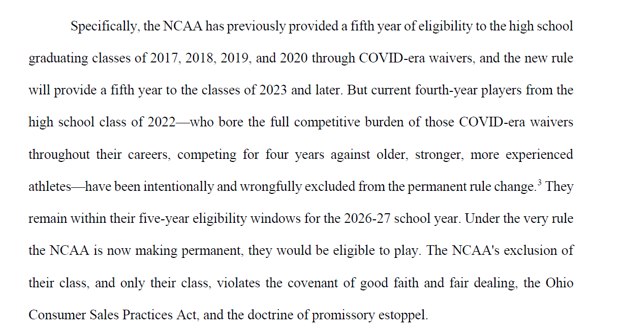
Does the NCAA need a SCORE Act antitrust exemption to protect its proposed new 5-year age eligibility rule? Maybe not. An NCAA eligibility win late last month (Ortega v. NCAA) didn't get much attention, but the court's opinion is a roadmap for how the NCAA could win an antitrust argument over the new eligibility rule. The key is in the excerpts below. Courts have long given the NCAA leeway with rules designed to differentiate college sports from the pros. The Ortega court agreed that the NCAA's 5-year eligibility rule could have enough of this benefit to pass antitrust scrutiny. The NCAA probably would need some hard evidence (surveys, etc.) that fans want college athletes to be genuine college students, but this is what a winning argument could look like. To be clear, it's not a slam dunk and this issue could truly go either way.