
Sabitlenmiş Tweet

Espresso ☕️
3.8K posts

@EspressoSys
Real-time settlement and sub-second finality for custom, sovereign chains. Built for enterprises that demand performance and control in a multi-chain world. ☕️




BITCOIN RAILS #69: ZERO-KNOWLEDGE PROOFS FOR POST-QUANTUM BITCOIN | with Benedikt Bünz 🔗 YOUTUBE: youtu.be/v8-4HWz5jV0 🌿 SPOTIFY: open.spotify.com/episode/4vy3UJ… While many Bitcoiners remain hopeful the network will embrace zero-knowledge proofs for protocol-level use cases, practical adoption has remained limited outside of BitVM and a handful of experimental proposals. Most of the world’s ZKP research has circled around Ethereum and other ecosystems, where significant resources have been dedicated to advancing these systems, particularly for scaling and privacy applications. One of the most notable contributors to this research is @benediktbuenz — professor of cryptography at NYU and collaborator of @danboneh, who together inarguably form one of the strongest blockchain-applied cryptography teams in the world. The pair recently announced they’ll be leading the new post-quantum cryptography unit @lclhostresearch — the first dedicated PQ research effort within a major Bitcoin development organization. With Benedikt leading the charge on the use of zero-knowledge proofs for post-quantum mitigation, the question emerges: will the post-quantum transition be the catalyst to finally bring zero-knowledge proofs to Bitcoin's core protocol? In more detail, Benedikt and I discuss: - Why ZKPs haven’t been widely adopted by the Bitcoin technical community — and why the threat of quantum computers may change that posture going forward - How ZKPs could be used for signature batching to address larger post-quantum signatures in Bitcoin’s post-quantum era - Why Bitcoiners will likely prioritize hash-based signatures as an initial post-quantum scheme — rather than more efficient but less proven alternatives (e.g., lattice-based) - How ZKPs have evolved over the last decade and may finally be ready for Bitcoin’s strict requirements around trust assumptions - Why Benedikt and Dan are teaming up with @lclhostresearch to create the first post-quantum cryptography unit within a major Bitcoin development organization + what they hope to accomplish This episode of Bitcoin Rails is brought to you by: LayerTwo Labs @LayerTwoLabs — developing research, software, and technologies for scaling Bitcoin via the integration of Drivechains (BIP 300/301) Hashi on @SuiNetwork — a primitive for executing Bitcoin DeFi transactions, without having to trust a federated bridge or other centralized entity BitBox @BitBoxSwiss — an open-source Bitcoin-only hardware wallet, with smooth UX and no compromises on security. Check out Bitbox [dot] swiss and use code BITCOINRAILS to get a discount TIMESTAMPS: 00:00 — Intro 00:22 — Benedikt's background 04:10 — How Benedikt got into Bitcoin and cryptography 07:42 — First ZK project: proving exchange solvency after Mt. Gox 16:01 — ZK proofs explained 27:43 — How security gets popular & ZK proofs in Bitcoin 35:49 — Other applications of ZK proofs for Bitcoin 40:15 — Why ZK proofs haven't been adopted in Bitcoin 50:46 — Why the Bitcoin post-quantum transition needs ZK proofs 01:07:00 — Cryptographic agility and why lattices win 01:18:00 — The size problem and how SNARKs solve it 01:33:57 — Proving a Bitcoin block in a laptop in 1.5 seconds 01:37:12 — Bitcoin as the primary quantum target 01:40:47 — ZK proofs for seed phrase recovery

Ben Fisch (@benafisch) assistant professor of computer science at #YaleEngineering, has won a National Science Foundation (@NSF) CAREER Award for his work on cryptographic systems that ensure data confidentiality and computational accuracy. 🔗Learn more: bit.ly/4aGqj8C


Celo has taken the lead again as the most used Ethereum L2 by DAUs. Let's go!




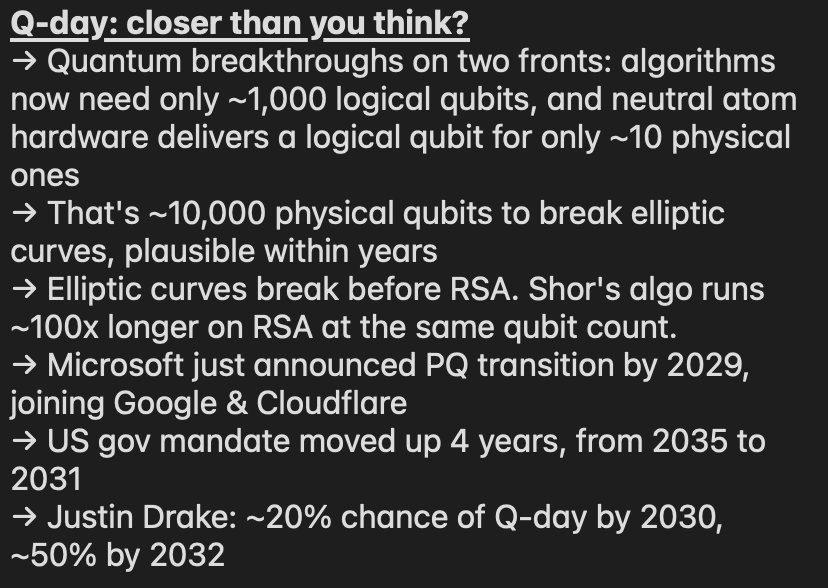
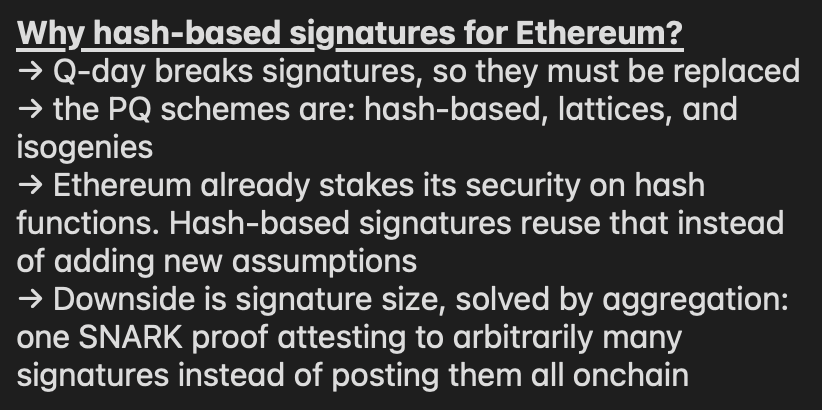
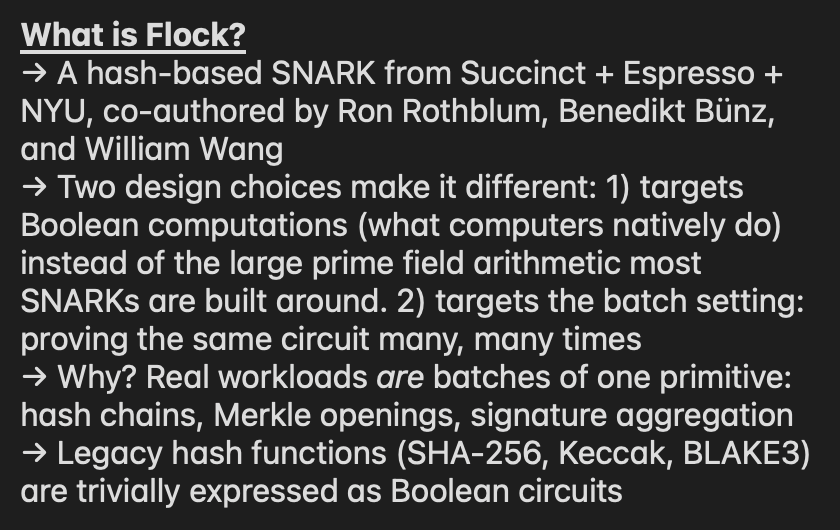


Flock: Fast SNARK Proving for Post Quantum Crypto x.com/i/spaces/1Dxle…
