Ethos

13.7K posts

Ethos

Ethos

@Ethos335

🇻🇦, Cajun Supremacist, Post-Liberal, Theocratic Absolute Monarchist, Husband, Father.

Katılım Ekim 2020
272 Takip Edilen120 Takipçiler
Ethos
Ethos@Ethos335·
@_nomadic_soul Things are getting worse by nearly every metric. But you can look at the decline of birth rates as the largest example.
English
2
0
0
22
DrMonteCristo
DrMonteCristo@Dr_Monte_Cristo·
@Ethos335 @austinemarie777 @TaylorRMarshall Again, I think you will find plenty of information on this matter in Fr. Gabriel Lavery's posts. Please do a search. He has written quite a bit. Your concerns are valid but there are answers for them.
English
1
0
0
8
AugustineMary
AugustineMary@austinemarie777·
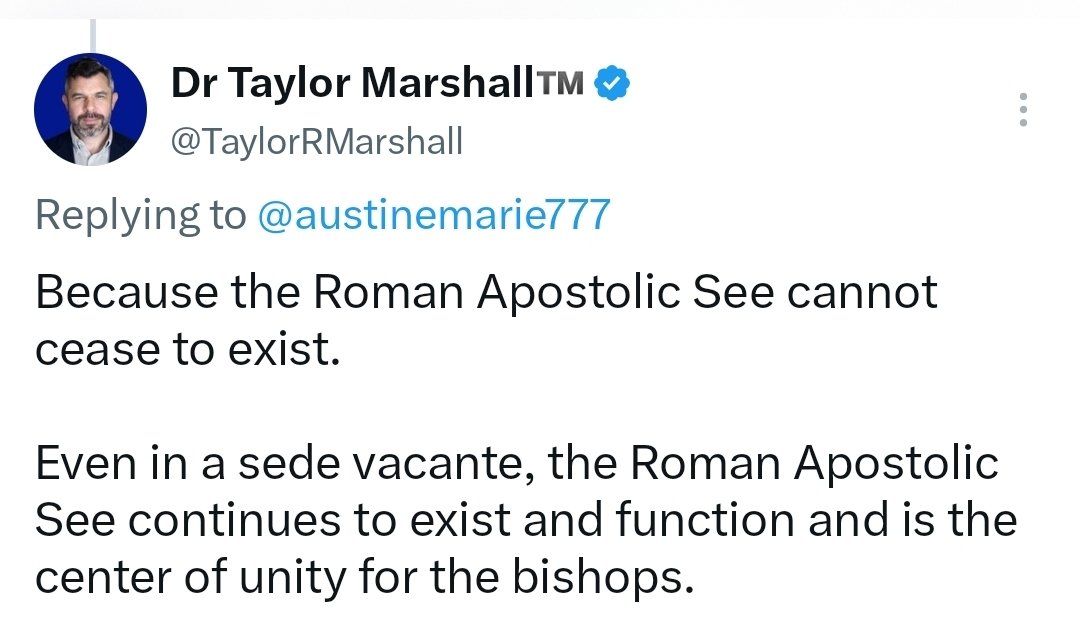
Dear Dr Taylor Marshall @TaylorRMarshall, I humbly asked you: What's the most important reason why you're not sedevacantist, that is, a Roman Catholic fully detached from the Conciliar-Synodal Church headed by Leo XIV? And you kindly responded: Because the Roman Apostolic See cannot cease to exist. Even in a sede vacante, the Roman Apostolic See continues to exist and function and is the center of unity for the bishops. x.com/i/status/20419… My Reaction I have observed your posts for a while. You definitely have a deep appreciation of the Catholic Faith. You definitely see the loss of faith on a global scale, the continued fostering of this misfortune by those who should be the shepherds of the Church, defending her against all errors and heresies. By the virtue faith you possess, you recognise the errors and heresies and reject them. I appreciate the difficulty of sedevacantism you candidly expressed. It is Catholic dogma that the Apostolic See is perpetual. It cannot cease to exist. Yet, if sedevacantists are correct that the Apostolic See has been vacant for almost seven devades now, how has the papacy not ceased? This is really a very serious objection, one that keeps many intelligent and pious SSPX clergy in their position. Yet, it has an almost unbelievably straightforward resolution which, if you understand clearly, will fill you with so much joy and remove all the contradictions and inconsistencies your fine intellect has been forced to sustain for love of the Church. Let's start. 1. The longest interregnum before now lasted 33 months (what a number). Sedevacantists argue there has been an interregnum for at least 755 months now. Please kindly note that if God could permit a 33-month interregnum, he could also permit 755 months and more. There is nothing in divine or ecclesiastical law that limits the possible length of a papal interregnum. 2. Yet, even though an unusually long papal interregnum is not incompatible with divine or ecclesiastical law, not incompatible with the visibility and indefectibility of the Church, nevertheless, the papacy must morally continue throughout the interregnum, it cannot be said to have been extinguished, to cease to exist. 3. Yes. But how does the papacy continue during a papal interregnum, how is the Church not altered in her divine constitution whenever she is without her visible head? The answer is straightforward: so long as the legitimate means of designating a successor to the papacy remain in the Church, the power of the Church exercised by the Pope does not die (or cease to exist) anytime the Pope dies. St. Antoninus of Florence in his Summa Sacrae Theologiae (Part III, tit. XXI, n.3) confirms this, following Augustine Trionfo of Ancona: Whether, when the Pope is dead, his power remains in the College of Cardinals? Such power remains in the Church and in the College of Cardinals as regards that which is material in the papacy. Because when the Pope is dead, the College can, through election, determine the person for the papacy, that it be this man or that man. Hence, just as the root produces the tree, through which it produces flowers and fruit, so the College makes the Pope, who possesses jurisdiction and its administration in the Church. Therefore, the power of the Church does not die when the Pope dies as regards jurisdiction—which is, as it were, the formal element in the papacy—but remains in Christ. Nor does the power of the Church die when the Pope dies as regards the election and determination of the person—which is, as it were, something material—but remains in the College of Cardinals. Part 2 continued in comments.
AugustineMary tweet media
English
10
6
58
19.2K
Ethos
Ethos@Ethos335·
@_nomadic_soul Only in the sense that we couldn't even exist without women
English
0
0
0
2
Ethos
Ethos@Ethos335·
@austinemarie777 @Dr_Monte_Cristo @TaylorRMarshall Interregnum in 1270. But those bishops were later confirmed by the next Pope. I don't know if they would have been considered validly ordained bishop before then or if they were just filling in temporarily. Would they be eligible to elect a pope, I don't know.
English
1
0
0
45
Ethos
Ethos@Ethos335·
@austinemarie777 @Dr_Monte_Cristo @TaylorRMarshall By valid bishops I mean bishops who have been appointed to their position by the Pope. As opposed to people claiming to be bishops but who aren't. I'm not indicating any subcategory of bishops.
English
1
0
1
16
AugustineMary
AugustineMary@austinemarie777·
Please, what do you mean by "valid bishops"? Do you mean valid bishops with jurisdiction over dioceses, that is, residential bishops? Because there are several categories of "valid bishops" in the Church. - Vicars Apostolic are valid bishops with jurisdiction over mission territories. - Vicars Capitular could be valid bishops with temporary jurisdiction over dioceses. - Vicars General could be valid bishops with jurisdiction derived from the residential bishop who appointed them. - Auxiliary bishops are valid bishops with specific jurisdiction committed to them by the residential bishop. - Other titular bishops are members of dioceses or clerical-exempt religious institutes with no jurisdiction committed to them. Where have you drawn the line?
English
1
0
0
14
Ethos
Ethos@Ethos335·
@austinemarie777 @Dr_Monte_Cristo @TaylorRMarshall I dont actually see how that solves the problem. It would essentially mean we still have some valid priests. Which I don't think was ever in question, but we'd still have no valid bishops. If you're having priests elect the Pope sans bishops or cardinals I think that's farfetched
English
1
0
0
41
Ethos
Ethos@Ethos335·
@austinemarie777 @Dr_Monte_Cristo @TaylorRMarshall Vicars apostolic appointed by the last pope have the exact same issue as with bishops. They would have to be at minimum Nonagenarian. As for incardinated clergy, you could theoretically have clergy who were appointed to their positions by the last generation of valid bishops. But
English
1
0
0
32
Ethos
Ethos@Ethos335·
@Dr_Monte_Cristo @austinemarie777 @TaylorRMarshall That is exactly my argument. If there has been a 70 year interregnum then it is necessarily true that there are no valid bishops because there is no pope to appoint them. It is impossible for the Church to continue with no valid bishops and therefore no way to elect a new pope
English
2
0
0
21
Ethos
Ethos@Ethos335·
@austinemarie777 @Dr_Monte_Cristo @TaylorRMarshall Additionally you mention vicars general, vicars apostolic, and incardinated clergy, but these appointments also either require valid bishops or a valid pope to exist, so would be in the same predicament.
English
1
0
1
34
Ethos
Ethos@Ethos335·
@austinemarie777 @Dr_Monte_Cristo @TaylorRMarshall Claiming it must be possible doesnt actually make it possible. A 33 month interregnum is no issue because you have bishops and cardinals who were ordained before the interregnum. 70 years is not possible because every single validly ordained bishop and cardinal is dead.
English
1
0
0
57