Supporting Trump & the Constitution đŸ‡źđŸ‡±

650 posts

Supporting Trump & the Constitution đŸ‡źđŸ‡± banner
Supporting Trump & the Constitution đŸ‡źđŸ‡±

Supporting Trump & the Constitution đŸ‡źđŸ‡±

@ExposingItIn26

The CIA spent decades building up its control of the United States government. Now is the time for us to step forward and save the Constitution.

The United States of America Katılım Kasım 2024
304 Takip Edilen655 Takipçiler
Sabitlenmiß Tweet
Supporting Trump & the Constitution đŸ‡źđŸ‡±
A former CIA insider pulls back the curtain on the Agency’s control of Congress and the Presidency. This is not theory. This is the documented dossier.
English
378
3K
7.5K
2.3M
Supporting Trump & the Constitution đŸ‡źđŸ‡±
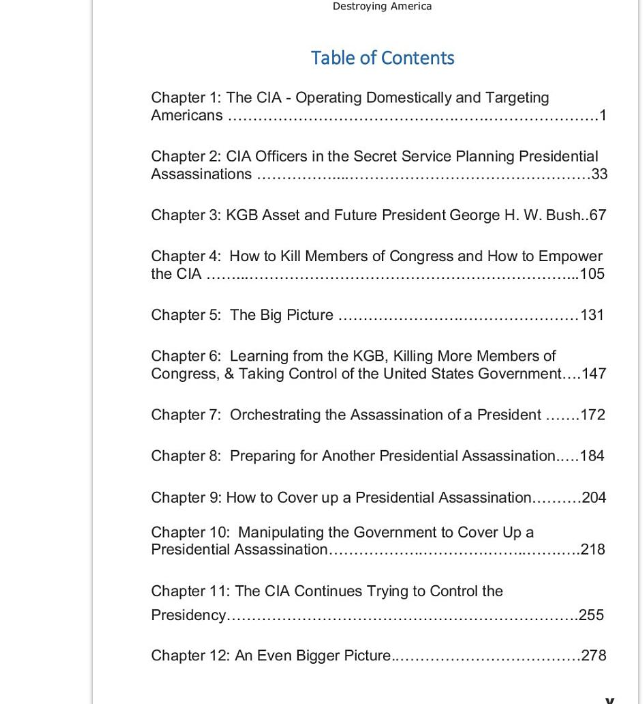
The CIA’s government takeover started with the CIA running rampant inside the United States. Every patriot should read “Destroying America: A Dossier on the CIA’s Control of the Government.” This is from Chapter 1. In 1975, President Ford’s “Commission on CIA Activities Within the United States” (the Rockefeller Commission) stated that the CIA had been putting “LSD and other potential behavior-influencing substances” into the food of “unsuspecting” Americans from 1953 to 1963. CIA officers first started drugging unsuspecting Americans “on the West Coast” in 1953, and by 1961, they were drugging unsuspecting Americans “on the East Coast.” The Rockefeller Commission, which consistently tried to gloss over the CIA’s domestic operations, claimed that the ten-year program of putting LSD into the food of unsuspecting Americans “in normal social situations” was some kind of CIA “testing” operation, but the CIA eventually acknowledged that the alleged testing “made little scientific sense.” In one drugging incident in 1953, a CIA officer met with Dr. Frank Olson, a civilian biochemist working for the Department of the Army, and surreptitiously slipped LSD into his drink. Dr. Olson was none-too-pleased with it and made an issue of it with his immediate superior, Colonel Vincent Ruwet. Five days after the drugging incident, Olson was still making an issue of it and not getting any answers, which resulted in Colonel Ruwet calling the CIA officer who drugged Dr. Olson. The CIA officer then took Olson to New York, allegedly for “psychiatric treatment,” but they instead met with an “allergist and immunologist.” Three days after arriving in New York, the CIA officer and his victim checked into a tenth-floor hotel room. The CIA officer wrote in his intelligence report that Dr. Frank Olson, who would not keep his mouth shut about the CIA putting LSD into his drink, “crashed through” a “closed window blind” and a “closed window” and “fell to his death” at 2:30 a.m. Someone wrote a CIA “Field Office Report” claiming that Olson committed “suicide,” and the Rockefeller Report maintains that Olson “jumped” from the tenth-floor window. But the CIA officer who drugged Olson and reported on his death a week later never said anything about Olson committing “suicide,” nor did he say anything about Olson “jumping” from the tenth-floor window. The Rockefeller Report maintains that the CIA “destroyed” its records of the LSD operation. It states that “all the records” were “ordered destroyed in 1973,” and the Rockefeller Commission allegedly accessed only a “limited” number of records, but having access to any of the records clearly means “all the records” had not been destroyed. A CIA Inspector General’s report, which had not been “destroyed,” addressed the LSD operation in 1957, four years after it was launched and six years before it would end. The Inspector General wrote, “Precautions must be taken to conceal these activities from the American public . . . . Knowledge that the Agency is engaging in unethical and illicit activities would have serious repercussions.” While the CIA was in the midst of its LSD program, Richard Helms, “Chief of Operations” in the CIA’s Directorate for Plans, sent a memorandum to all CIA Division Chiefs and their staffs on August 17, 1959 titled, “Clandestine Services Operations in the United States.” Helms’s memorandum states, “All clandestine operations carried out by the Clandestine Services in the United States will be coordinated in advance with the CI [Counterintelligence] staff,” but such coordination would happen only if it is “necessary to prevent jurisdictional conflicts with other departments and agencies within the United States or to obtain assistance and cooperation from them for domestic operations.” One agency with which the CIA has had “jurisdictional conflicts” when secretly conducting its operations inside the United States is the FBI. A high-ranking FBI official met with CIA Director John McCone in May 1964 and brought up the CIA’s “DDP operations,” which are conducted by the CIA’s Deputy Director for Plans. The FBI official told McCone that “DDP operations in the United States” are “taking up much of my time these days,” adding, “Your people are more operational than ever in the U.S. right now.” Richard Helms, who wrote the 1959 memorandum on the CIA’s “Clandestine Services Operations in the United States,” had been the CIA’s Deputy Director for Plans (DDP) for two years before the FBI official noted the huge “DDP operations in the United States.” In May 1973, nine years after the FBI official met with McCone and just a few months after Helms wrapped up a seven-year tenure as CIA Director, the new CIA Director, James Schlesinger, “issued instructions to each directorate to come forward with descriptions of activities, especially those involved in the domestic scene, that had flap potential.” 1973 was the year that the CIA allegedly destroyed “all the records” of its ten-year LSD operation, but the Rockefeller Commission clearly accessed the LSD records. Even the report of the CIA officer who drugged Dr. Frank Olson and then reported on his death a week later had not been “destroyed.” Some of the CIA’s “flap potential” activities were brought to light two years after Schlesinger’s memorandum. Both the U.S. Senate and the Ford Administration produced reports in 1975 following public revelations about the CIA’s illicit activities inside the United States. To deal with the exposure, President Ford established the previously cited Commission on CIA Activities Within the United States, chaired by Vice President Nelson Rockefeller, and three weeks later, the U.S. Senate established the Senate Church Committee, headed by Senator Frank Church. CIA Director William Colby testified to the Senate Church Committee that Watergate conspirator E. Howard Hunt had at one time been a CIA officer with the CIA’s “Domestic Operations Division,” adding that the “Domestic Operations Division” conducts “our operations here in this country.” Hunt himself submitted an affidavit to the Rockefeller Commission stating that back in November 1963, he was “an employee of the Central Intelligence Agency assigned to the Domestic Operations Division, located in a commercial building in Washington DC,” adding that the “Domestic Operations Division” was part of the CIA’s “Deputy Directorate for Plans.” Regarding the CIA’s domestic operations, the Rockefeller Commission stated that CIA officers operate in the United States with “official covers” and “nonofficial covers.” CIA officers with “official covers” are detailed to be employees of “other United States government agencies,” which means they are given “official” positions that provide them with “cover” while they carry out the CIA’s agenda. Those with “nonofficial covers” have “no official” position with a United States government agency that would provide them with “cover” for their secretive operations targeting Americans, hence, the term “nonofficial cover.” CIA officers are required to fill out intelligence reports every day. Those with “official covers” fill out intelligence reports on the government officials and the federal employees with whom they interact, and those with “nonofficial covers” fill out intelligence reports on the United States citizens with whom they interact. The 1975 Rockefeller Report disclosed that there are U.S. businesses that are “created and controlled” by the CIA and used for CIA “activities” and “operations” in the United States. “Many” CIA officers have “nonofficial covers” as employees of companies that are “owned” by the CIA and “operated” by CIA officers. There are also “United States citizens” who “assist” the CIA by serving as “officers and directors” of some of the CIA-owned companies. All CIA-owned companies are “legally constituted corporations, partnerships, or sole proprietorships.” (Any location where the CIA sets up shop in the United States becomes a CIA “field station.”) CIA officers also operate in the United States with “nonofficial covers” as employees of “privately owned American business firms,” and “cover arrangements” for many of the CIA officers operating domestically require the “management of a variety of domestic commercial entities.” No one would think that normal, everyday, working Americans are actually CIA officers gathering intelligence and conducting secretive operations targeting U.S. citizens. CIA officers can use “official covers” without actually being employed by “other United States government agencies.” The CIA simply issues fake documentation to make it appear as such. A memorandum to the CIA’s “Central Cover Group” in May 1962 states, “It is requested that a U.S. Army credential be issued to the identity under the alias William Walker. This document will be used within the continental U.S.” The fabricated document would obviously lead people to believe that “William Walker” had an “official” position with the U.S. Army. CIA officers with “nonofficial covers” similarly use fake documentation. A CIA officer named Charles Ford was “issued alias documentation under the name of Charles D. Fiscalini” in March 1962, after which Ford was to “travel to New York to meet with an unidentified attorney.” As an “operations officer” in the CIA’s “Western Hemisphere Division,” Ford was “reissued this alias documentation in February 1963 to be utilized ‘in the continental U.S. for operational purposes.’” Charles Ford himself wrote a memorandum in 1975 stating that he “frequently carried identification in that name and used it on several occasions.” “Nonofficial covers,” like the one Charles Ford used, allow CIA officers to blend in as normal, everyday Americans while targeting U.S. citizens, whereas “official covers” allow CIA officers to blend in with the huge federal work force, which includes the FBI, the Department of Justice, the Department of Defense, the IRS, and every other U.S. Department and federal agency. Besides having “official covers” as employees of “other United States government agencies,” CIA officers are also detailed to a wide variety of positions at the White House. In the 1973 documentation of “domestic activities” with “flap potential,” the CIA’s Director of Personnel wrote, “For many years the Central Intelligence Agency has detailed employees to the immediate office of the White House.” He also wrote that CIA officers are assigned to “components associated intimately with the immediate office of the President.” The CIA also “furnished secretaries, clerical employees, and certain professional employees” to the White House, and at the time the memorandum was written in 1973, a CIA officer was “detailed” to the “White House Communications Section.” The Director of Personnel wrote that CIA officers had been “detailed” to the White House as “couriers” and “telephone operators.” A CIA officer was also assigned to be a “laborer” on the White House grounds, and another CIA officer was assigned to be a “graphics man who designed invitations for State dinners” at the White House. The CIA is not some government “Temp” agency that sends employees on various assignments because there is a temporary need for them as couriers, telephone operators, secretaries, and clerical employees. The CIA is in the business of gathering intelligence and conducting secretive operations, and as noted earlier, all CIA officers are required to fill out intelligence reports every day on the people with whom they interact and on the information they gather. When CIA officers are detailed to the White House, they gather intelligence on the President, White House officials, and White House personnel, and they report back to the CIA. “Most” of the CIA officers detailed to the White House were “hired as bona fide White House employees,” which means they were given “official covers” as White House personnel. They were still working for the CIA and reporting to the CIA, just like all CIA officers with “official covers” who are employees of “other United States government agencies.” It is, in fact, preposterous to think that a slew of highly trained, college educated CIA officers would leave their prestigious, high-paying positions as CIA officers so that they could take on mundane jobs as telephone operators, couriers, laborers, and clerical employees, positions to which they had been “detailed” by the CIA on a supposedly temporary basis. The CIA’s Director of Personnel further stated in his 1973 memorandum that CIA officers “have been, and are at the present time, assigned to the National Security Council, and we have seven clericals on detail to the NSC [National Security Council].” The National Security Council issues directives on how the CIA will operate. The CIA most certainly wants to influence the thinking and decisions emanating from the NSC. CIA officers assigned to the National Security Council fill out intelligence reports on other NSC staff members and on what the National Security Council is doing, as do the CIA officers detailed to various “clerical” positions on the National Security Council. The Director of Personnel also wrote that CIA officers had been “detailed” to “Congressional staffs,” and a CIA document states that by the mid-1970s, the CIA had intelligence files on “some 30-40 U.S. Congressmen.” As will be seen later in this book, the CIA regularly gathers intelligence on Members of Congress. CIA officers are trained to endear themselves to people and win their trust. People will tell CIA officers things that are confidential or extremely personal, and CIA officers then put that information into their intelligence reports, something that all CIA officers are required to do on a daily basis. Besides being detailed to the National Security Council, and the “immediate” office of the White House, and “components associated intimately with the immediate office of the President,” and a wide variety of seemingly mundane positions at the White House, CIA officers function as Secret Service agents protecting the President “while he is in the United States.” A CIA document on November 2, 1964, states that the CIA had been providing “manpower support” to the Secret Service “since 1955.” It also states that one of the “continuing problems” they were having was the “legal status” of CIA officers that are “assigned” to function as Secret Service agents. Five months later, a high-ranking CIA official proclaimed that CIA officers will be exercising “law-enforcement powers” and “internal security functions,” and they will have “internal security powers” and “internal security duties,” all of which are prohibited under the National Security Act of 1947. Lieutenant General Marshall Carter, the Deputy Director of the CIA, wrote a memorandum in April 1965 titled “Agreement Between the United States Secret Service and the Central Intelligence Agency Concerning Presidential Protection in the United States.” General Carter’s memorandum states that when CIA officers are assigned to Secret Service duty, “Such officers detailed by the CIA will be designated officers of the Secret Service,” and they will be protecting the President “while he is in the United States.” CIA officers functioning as Secret Service agents are clearly exercising “law-enforcement powers” and “internal security functions,” and they clearly have “internal security powers” and “internal security duties.” Stating that CIA officers will be known as “designated officers of the Secret Service” when they are “detailed” to the Secret Service does not make it legal. Just a few short years after the CIA was created, the National Security Council spent three years setting up “national policies” for the CIA, one of which was eventually brought to light. The one national policy that was exposed was a money laundering operation that allows the CIA to channel “millions of dollars” through “foundations” to “a wide spectrum of youth, student, academic, research, journalist, business, legal and labor organizations” in the United States. When the operation was first exposed in 1967, groups that had been receiving money from the CIA since the 1950s included the American Newspaper Guild, the National Student Association, the National Education Association, the Institute of Public Administration of New York, and the Retail Clerks International Association of Washington. The secretive money laundering operation was first publicized in the New York Times on February 19, 1967, and regardless of the massive domestic operations that had been taking place since at least 1953, it was the first exposure of any large-scale CIA activity in the United States. President Johnson immediately appointed a three-man committee to deal with it. The chairman of the committee was Under Secretary of State Nicholas Katzenbach, who was himself a CIA officer with an “official cover” in the State Department, and it included CIA Director Richard Helms. Just a few days later, the committee reported that the CIA’s multi-million dollar funding operation was one of the “national policies established by the National Security Council in 1952 through 1954.” The National Security Council clearly decided that establishing “national policies” for the CIA in the early 1950s would somehow nullify the Act of Congress that created the CIA in 1947. Congress chose not to investigate the CIA’s money laundering operation. On February 25, 1967, six days after the CIA foundations were exposed, “Congressional leaders said that there would be no special investigation of the Central Intelligence Agency by the legislative branch . . . . Republican leaders, who have been critical of the Johnson Administration on almost every other issue, said at a news conference that they saw no reason to look into the intelligence agency’s involvement with private organizations and institutions.” The Senate Republican leader, Senator Everett McKinley Dirksen, said the disclosures “amounted to ‘little more than a Roman holiday,’” and the House Republican leader, Congressman Gerald Ford, stated, “There is enough Congressional surveillance of the CIA.” Democratic Senator Mike Mansfield, the Senate majority leader, took the position that “an investigation of the subsidies should be left to the intra-administration committee appointed by President Johnson and directed by Under Secretary of State Nicholas Katzenbach.” One day before Congress shrugged off how American tax dollars were being spent, Katzenbach’s three-man committee reported that the CIA’s multi-million dollar funding operation is one of the “national policies established for the CIA in 1952 through 1954.” The rest of the CIA’s “national policies” are apparently still classified. In 1977, the Senate Intelligence Committee disclosed that the CIA used its money laundering foundations to secretly finance its LSD operation. The CIA had “standing arrangements” with “universities, pharmaceutical houses, hospitals, state and federal institutions, and private research organizations,” and the CIA would give out “annual grants” channeled through the CIA foundations, “thereby concealing” the CIA financing. The CIA can arguably use American tax dollars to finance anything it wants with its money laundering foundations, and as will be seen in much of this book, corrupt elements of the CIA are very focused on who is elected to Congress and the Presidency. The CIA can easily finance the political campaigns of their chosen candidates by channeling money to groups that support their candidate, “thereby concealing” the CIA’s support for the candidate. In an effort to gloss over the CIA’s money laundering operation (the first exposure of a CIA domestic operation), some anonymous “informed sources” told the New York Times that the CIA is enjoined “only from ‘internal security functions,’” which the Times said contradicts “a widely held belief that the agency is prohibited by law from engaging in clandestine activities within the United States.” The Times also stated that the anonymous informed sources claimed “there never had been a serious question about its authority to deal secretly in this country with home-based groups.” The CIA has certainly done much more than deal secretly with home-based groups, and contrary to what the New York Times said, the CIA is most certainly banned from “engaging in clandestine activities within the United States.” It was established only for “clandestine activities” in other countries. It is beyond reason to claim that when the CIA clandestinely performs its “functions” inside the United States, the CIA is not part of the national security apparatus and the domestic operations are, therefore, not actually “internal security functions.” As for Senator Mansfield’s acceptance of the CIA’s “national policies” in 1967, thirteen years earlier he was the “leader of a bipartisan move for a joint committee on the CIA.” In 1954, seven years after the CIA was created under the National Security Act of 1947, Mansfield and his Senate colleagues had no idea whether the CIA was “engaging in domestic activities.” Senator Mansfield introduced legislation to set up an Intelligence Oversight Committee in 1954, but Senator Leverett Saltonstall, Republican Chairman of the Senate Armed Services Committee, persuaded the Senate Rules Committee to “shelve” the resolution so that it could not come up for a vote, even though the resolution had “the support of twenty-seven Senators.” Two years later, Congress made a second attempt at CIA oversight when the Senate voted on a resolution that would create a “joint Congressional watchdog committee.” But in 1956, the third year of the CIA’s ten-year LSD operation, the attempt at CIA oversight went down in flames by a vote of 59 to 27 because “President Eisenhower’s declared opposition, plus intensive behind-the-scenes opposition by the CIA itself, proved sufficient to turn the tide overwhelmingly against the resolution.” A few days earlier, the resolution had “thirty-five cosponsors and pledges of support from other Senators” and “seemed assured of passage by a comfortable margin . . . . Ten of the original cosponsors switched to vote against it on final passage.” President Eisenhower’s “declared opposition” clearly did nothing to prevent the bill from becoming immensely popular in the Senate. It was obviously the CIA’s “intensive behind-the-scenes opposition” that brought Congressional oversight to a screeching halt in 1956. When Senator Mansfield and the entire United States Congress acquiesced in 1967, the New York Times reported: “The general attitude in Congress was that the issue contained no political profit,” which means that by the time the CIA’s money laundering operation was exposed, political profits were more important to the esteemed Members of Congress than addressing the CIA’s domestic operations. In 1963, seven years after the CIA ran rampant on Capitol Hill and successfully blocked Congressional oversight, CIA Director John McCone documented that he told President Johnson the “only problem” the CIA had in their relationship with Congress is “a continual harangue for a Joint Committee on Intelligence.” A short 19 days after McCone said Congressional oversight would be a “problem” for the CIA, Richard Helms, the CIA’s Deputy Director for Plans, wrote a memorandum to the Deputy Director of the CIA in which he promoted the resumption of “testing” LSD on “unwitting” subjects, adding that if a “testing arrangement” is resumed, it “must afford maximum safeguards for the protection of the Agency’s role in this activity.” Helms also wrote, “While I share your uneasiness and distaste for any program which tends to intrude upon an individual’s private and legal prerogatives, I believe that it is necessary that the Agency maintain a central role in this activity.” Helms was appointed to be Director of the CIA less than three years after blatantly stating that it was “necessary” for the CIA to have a “central role” in drugging unsuspecting Americans with LSD. The CIA operations detailed thus far, as bad as they are, pale in comparison to the rest of the corruption laid out herein. None of this is a “theory,” and there are no “conclusions” drawn from the wealth of data. This is a factual account of the CIA takeover of our government, and the documentation speaks for itself. The Commission on CIA Activities Within the United States addressed legal challenges to the CIA’s unconstitutional activity and its widespread domestic operations, stating, “Practically all of the CIA’s operations are covered by secrecy . . . . Few potential challengers are even aware of activities that might otherwise be contested; nor can such activities be easily discovered.” Every patriot should be reading this book. amazon.com/dp/B0H3FJ7R1X
English
0
1
1
7
Supporting Trump & the Constitution đŸ‡źđŸ‡±
The CIA’s government takeover started with the CIA running rampant inside the United States. Every patriot should read “Destroying America: A Dossier on the CIA’s Control of the Government.” This is from Chapter 1. In 1975, President Ford’s “Commission on CIA Activities Within the United States” (the Rockefeller Commission) stated that the CIA had been putting “LSD and other potential behavior-influencing substances” into the food of “unsuspecting” Americans from 1953 to 1963. CIA officers first started drugging unsuspecting Americans “on the West Coast” in 1953, and by 1961, they were drugging unsuspecting Americans “on the East Coast.” The Rockefeller Commission, which consistently tried to gloss over the CIA’s domestic operations, claimed that the ten-year program of putting LSD into the food of unsuspecting Americans “in normal social situations” was some kind of CIA “testing” operation, but the CIA eventually acknowledged that the alleged testing “made little scientific sense.” In one drugging incident in 1953, a CIA officer met with Dr. Frank Olson, a civilian biochemist working for the Department of the Army, and surreptitiously slipped LSD into his drink. Dr. Olson was none-too-pleased with it and made an issue of it with his immediate superior, Colonel Vincent Ruwet. Five days after the drugging incident, Olson was still making an issue of it and not getting any answers, which resulted in Colonel Ruwet calling the CIA officer who drugged Dr. Olson. The CIA officer then took Olson to New York, allegedly for “psychiatric treatment,” but they instead met with an “allergist and immunologist.” Three days after arriving in New York, the CIA officer and his victim checked into a tenth-floor hotel room. The CIA officer wrote in his intelligence report that Dr. Frank Olson, who would not keep his mouth shut about the CIA putting LSD into his drink, “crashed through” a “closed window blind” and a “closed window” and “fell to his death” at 2:30 a.m. Someone wrote a CIA “Field Office Report” claiming that Olson committed “suicide,” and the Rockefeller Report maintains that Olson “jumped” from the tenth-floor window. But the CIA officer who drugged Olson and reported on his death a week later never said anything about Olson committing “suicide,” nor did he say anything about Olson “jumping” from the tenth-floor window. The Rockefeller Report maintains that the CIA “destroyed” its records of the LSD operation. It states that “all the records” were “ordered destroyed in 1973,” and the Rockefeller Commission allegedly accessed only a “limited” number of records, but having access to any of the records clearly means “all the records” had not been destroyed. A CIA Inspector General’s report, which had not been “destroyed,” addressed the LSD operation in 1957, four years after it was launched and six years before it would end. The Inspector General wrote, “Precautions must be taken to conceal these activities from the American public . . . . Knowledge that the Agency is engaging in unethical and illicit activities would have serious repercussions.” While the CIA was in the midst of its LSD program, Richard Helms, “Chief of Operations” in the CIA’s Directorate for Plans, sent a memorandum to all CIA Division Chiefs and their staffs on August 17, 1959 titled, “Clandestine Services Operations in the United States.” Helms’s memorandum states, “All clandestine operations carried out by the Clandestine Services in the United States will be coordinated in advance with the CI [Counterintelligence] staff,” but such coordination would happen only if it is “necessary to prevent jurisdictional conflicts with other departments and agencies within the United States or to obtain assistance and cooperation from them for domestic operations.” One agency with which the CIA has had “jurisdictional conflicts” when secretly conducting its operations inside the United States is the FBI. A high-ranking FBI official met with CIA Director John McCone in May 1964 and brought up the CIA’s “DDP operations,” which are conducted by the CIA’s Deputy Director for Plans. The FBI official told McCone that “DDP operations in the United States” are “taking up much of my time these days,” adding, “Your people are more operational than ever in the U.S. right now.” Richard Helms, who wrote the 1959 memorandum on the CIA’s “Clandestine Services Operations in the United States,” had been the CIA’s Deputy Director for Plans (DDP) for two years before the FBI official noted the huge “DDP operations in the United States.” In May 1973, nine years after the FBI official met with McCone and just a few months after Helms wrapped up a seven-year tenure as CIA Director, the new CIA Director, James Schlesinger, “issued instructions to each directorate to come forward with descriptions of activities, especially those involved in the domestic scene, that had flap potential.” 1973 was the year that the CIA allegedly destroyed “all the records” of its ten-year LSD operation, but the Rockefeller Commission clearly accessed the LSD records. Even the report of the CIA officer who drugged Dr. Frank Olson and then reported on his death a week later had not been “destroyed.” Some of the CIA’s “flap potential” activities were brought to light two years after Schlesinger’s memorandum. Both the U.S. Senate and the Ford Administration produced reports in 1975 following public revelations about the CIA’s illicit activities inside the United States. To deal with the exposure, President Ford established the previously cited Commission on CIA Activities Within the United States, chaired by Vice President Nelson Rockefeller, and three weeks later, the U.S. Senate established the Senate Church Committee, headed by Senator Frank Church. CIA Director William Colby testified to the Senate Church Committee that Watergate conspirator E. Howard Hunt had at one time been a CIA officer with the CIA’s “Domestic Operations Division,” adding that the “Domestic Operations Division” conducts “our operations here in this country.” Hunt himself submitted an affidavit to the Rockefeller Commission stating that back in November 1963, he was “an employee of the Central Intelligence Agency assigned to the Domestic Operations Division, located in a commercial building in Washington DC,” adding that the “Domestic Operations Division” was part of the CIA’s “Deputy Directorate for Plans.” Regarding the CIA’s domestic operations, the Rockefeller Commission stated that CIA officers operate in the United States with “official covers” and “nonofficial covers.” CIA officers with “official covers” are detailed to be employees of “other United States government agencies,” which means they are given “official” positions that provide them with “cover” while they carry out the CIA’s agenda. Those with “nonofficial covers” have “no official” position with a United States government agency that would provide them with “cover” for their secretive operations targeting Americans, hence, the term “nonofficial cover.” CIA officers are required to fill out intelligence reports every day. Those with “official covers” fill out intelligence reports on the government officials and the federal employees with whom they interact, and those with “nonofficial covers” fill out intelligence reports on the United States citizens with whom they interact. The 1975 Rockefeller Report disclosed that there are U.S. businesses that are “created and controlled” by the CIA and used for CIA “activities” and “operations” in the United States. “Many” CIA officers have “nonofficial covers” as employees of companies that are “owned” by the CIA and “operated” by CIA officers. There are also “United States citizens” who “assist” the CIA by serving as “officers and directors” of some of the CIA-owned companies. All CIA-owned companies are “legally constituted corporations, partnerships, or sole proprietorships.” (Any location where the CIA sets up shop in the United States becomes a CIA “field station.”) CIA officers also operate in the United States with “nonofficial covers” as employees of “privately owned American business firms,” and “cover arrangements” for many of the CIA officers operating domestically require the “management of a variety of domestic commercial entities.” No one would think that normal, everyday, working Americans are actually CIA officers gathering intelligence and conducting secretive operations targeting U.S. citizens. CIA officers can use “official covers” without actually being employed by “other United States government agencies.” The CIA simply issues fake documentation to make it appear as such. A memorandum to the CIA’s “Central Cover Group” in May 1962 states, “It is requested that a U.S. Army credential be issued to the identity under the alias William Walker. This document will be used within the continental U.S.” The fabricated document would obviously lead people to believe that “William Walker” had an “official” position with the U.S. Army. CIA officers with “nonofficial covers” similarly use fake documentation. A CIA officer named Charles Ford was “issued alias documentation under the name of Charles D. Fiscalini” in March 1962, after which Ford was to “travel to New York to meet with an unidentified attorney.” As an “operations officer” in the CIA’s “Western Hemisphere Division,” Ford was “reissued this alias documentation in February 1963 to be utilized ‘in the continental U.S. for operational purposes.’” Charles Ford himself wrote a memorandum in 1975 stating that he “frequently carried identification in that name and used it on several occasions.” “Nonofficial covers,” like the one Charles Ford used, allow CIA officers to blend in as normal, everyday Americans while targeting U.S. citizens, whereas “official covers” allow CIA officers to blend in with the huge federal work force, which includes the FBI, the Department of Justice, the Department of Defense, the IRS, and every other U.S. Department and federal agency. Besides having “official covers” as employees of “other United States government agencies,” CIA officers are also detailed to a wide variety of positions at the White House. In the 1973 documentation of “domestic activities” with “flap potential,” the CIA’s Director of Personnel wrote, “For many years the Central Intelligence Agency has detailed employees to the immediate office of the White House.” He also wrote that CIA officers are assigned to “components associated intimately with the immediate office of the President.” The CIA also “furnished secretaries, clerical employees, and certain professional employees” to the White House, and at the time the memorandum was written in 1973, a CIA officer was “detailed” to the “White House Communications Section.” The Director of Personnel wrote that CIA officers had been “detailed” to the White House as “couriers” and “telephone operators.” A CIA officer was also assigned to be a “laborer” on the White House grounds, and another CIA officer was assigned to be a “graphics man who designed invitations for State dinners” at the White House. The CIA is not some government “Temp” agency that sends employees on various assignments because there is a temporary need for them as couriers, telephone operators, secretaries, and clerical employees. The CIA is in the business of gathering intelligence and conducting secretive operations, and as noted earlier, all CIA officers are required to fill out intelligence reports every day on the people with whom they interact and on the information they gather. When CIA officers are detailed to the White House, they gather intelligence on the President, White House officials, and White House personnel, and they report back to the CIA. “Most” of the CIA officers detailed to the White House were “hired as bona fide White House employees,” which means they were given “official covers” as White House personnel. They were still working for the CIA and reporting to the CIA, just like all CIA officers with “official covers” who are employees of “other United States government agencies.” It is, in fact, preposterous to think that a slew of highly trained, college educated CIA officers would leave their prestigious, high-paying positions as CIA officers so that they could take on mundane jobs as telephone operators, couriers, laborers, and clerical employees, positions to which they had been “detailed” by the CIA on a supposedly temporary basis. The CIA’s Director of Personnel further stated in his 1973 memorandum that CIA officers “have been, and are at the present time, assigned to the National Security Council, and we have seven clericals on detail to the NSC [National Security Council].” The National Security Council issues directives on how the CIA will operate. The CIA most certainly wants to influence the thinking and decisions emanating from the NSC. CIA officers assigned to the National Security Council fill out intelligence reports on other NSC staff members and on what the National Security Council is doing, as do the CIA officers detailed to various “clerical” positions on the National Security Council. The Director of Personnel also wrote that CIA officers had been “detailed” to “Congressional staffs,” and a CIA document states that by the mid-1970s, the CIA had intelligence files on “some 30-40 U.S. Congressmen.” As will be seen later in this book, the CIA regularly gathers intelligence on Members of Congress. CIA officers are trained to endear themselves to people and win their trust. People will tell CIA officers things that are confidential or extremely personal, and CIA officers then put that information into their intelligence reports, something that all CIA officers are required to do on a daily basis. Besides being detailed to the National Security Council, and the “immediate” office of the White House, and “components associated intimately with the immediate office of the President,” and a wide variety of seemingly mundane positions at the White House, CIA officers function as Secret Service agents protecting the President “while he is in the United States.” A CIA document on November 2, 1964, states that the CIA had been providing “manpower support” to the Secret Service “since 1955.” It also states that one of the “continuing problems” they were having was the “legal status” of CIA officers that are “assigned” to function as Secret Service agents. Five months later, a high-ranking CIA official proclaimed that CIA officers will be exercising “law-enforcement powers” and “internal security functions,” and they will have “internal security powers” and “internal security duties,” all of which are prohibited under the National Security Act of 1947. Lieutenant General Marshall Carter, the Deputy Director of the CIA, wrote a memorandum in April 1965 titled “Agreement Between the United States Secret Service and the Central Intelligence Agency Concerning Presidential Protection in the United States.” General Carter’s memorandum states that when CIA officers are assigned to Secret Service duty, “Such officers detailed by the CIA will be designated officers of the Secret Service,” and they will be protecting the President “while he is in the United States.” CIA officers functioning as Secret Service agents are clearly exercising “law-enforcement powers” and “internal security functions,” and they clearly have “internal security powers” and “internal security duties.” Stating that CIA officers will be known as “designated officers of the Secret Service” when they are “detailed” to the Secret Service does not make it legal. Just a few short years after the CIA was created, the National Security Council spent three years setting up “national policies” for the CIA, one of which was eventually brought to light. The one national policy that was exposed was a money laundering operation that allows the CIA to channel “millions of dollars” through “foundations” to “a wide spectrum of youth, student, academic, research, journalist, business, legal and labor organizations” in the United States. When the operation was first exposed in 1967, groups that had been receiving money from the CIA since the 1950s included the American Newspaper Guild, the National Student Association, the National Education Association, the Institute of Public Administration of New York, and the Retail Clerks International Association of Washington. The secretive money laundering operation was first publicized in the New York Times on February 19, 1967, and regardless of the massive domestic operations that had been taking place since at least 1953, it was the first exposure of any large-scale CIA activity in the United States. President Johnson immediately appointed a three-man committee to deal with it. The chairman of the committee was Under Secretary of State Nicholas Katzenbach, who was himself a CIA officer with an “official cover” in the State Department, and it included CIA Director Richard Helms. Just a few days later, the committee reported that the CIA’s multi-million dollar funding operation was one of the “national policies established by the National Security Council in 1952 through 1954.” The National Security Council clearly decided that establishing “national policies” for the CIA in the early 1950s would somehow nullify the Act of Congress that created the CIA in 1947. Congress chose not to investigate the CIA’s money laundering operation. On February 25, 1967, six days after the CIA foundations were exposed, “Congressional leaders said that there would be no special investigation of the Central Intelligence Agency by the legislative branch . . . . Republican leaders, who have been critical of the Johnson Administration on almost every other issue, said at a news conference that they saw no reason to look into the intelligence agency’s involvement with private organizations and institutions.” The Senate Republican leader, Senator Everett McKinley Dirksen, said the disclosures “amounted to ‘little more than a Roman holiday,’” and the House Republican leader, Congressman Gerald Ford, stated, “There is enough Congressional surveillance of the CIA.” Democratic Senator Mike Mansfield, the Senate majority leader, took the position that “an investigation of the subsidies should be left to the intra-administration committee appointed by President Johnson and directed by Under Secretary of State Nicholas Katzenbach.” One day before Congress shrugged off how American tax dollars were being spent, Katzenbach’s three-man committee reported that the CIA’s multi-million dollar funding operation is one of the “national policies established for the CIA in 1952 through 1954.” The rest of the CIA’s “national policies” are apparently still classified. In 1977, the Senate Intelligence Committee disclosed that the CIA used its money laundering foundations to secretly finance its LSD operation. The CIA had “standing arrangements” with “universities, pharmaceutical houses, hospitals, state and federal institutions, and private research organizations,” and the CIA would give out “annual grants” channeled through the CIA foundations, “thereby concealing” the CIA financing. The CIA can arguably use American tax dollars to finance anything it wants with its money laundering foundations, and as will be seen in much of this book, corrupt elements of the CIA are very focused on who is elected to Congress and the Presidency. The CIA can easily finance the political campaigns of their chosen candidates by channeling money to groups that support their candidate, “thereby concealing” the CIA’s support for the candidate. In an effort to gloss over the CIA’s money laundering operation (the first exposure of a CIA domestic operation), some anonymous “informed sources” told the New York Times that the CIA is enjoined “only from ‘internal security functions,’” which the Times said contradicts “a widely held belief that the agency is prohibited by law from engaging in clandestine activities within the United States.” The Times also stated that the anonymous informed sources claimed “there never had been a serious question about its authority to deal secretly in this country with home-based groups.” The CIA has certainly done much more than deal secretly with home-based groups, and contrary to what the New York Times said, the CIA is most certainly banned from “engaging in clandestine activities within the United States.” It was established only for “clandestine activities” in other countries. It is beyond reason to claim that when the CIA clandestinely performs its “functions” inside the United States, the CIA is not part of the national security apparatus and the domestic operations are, therefore, not actually “internal security functions.” As for Senator Mansfield’s acceptance of the CIA’s “national policies” in 1967, thirteen years earlier he was the “leader of a bipartisan move for a joint committee on the CIA.” In 1954, seven years after the CIA was created under the National Security Act of 1947, Mansfield and his Senate colleagues had no idea whether the CIA was “engaging in domestic activities.” Senator Mansfield introduced legislation to set up an Intelligence Oversight Committee in 1954, but Senator Leverett Saltonstall, Republican Chairman of the Senate Armed Services Committee, persuaded the Senate Rules Committee to “shelve” the resolution so that it could not come up for a vote, even though the resolution had “the support of twenty-seven Senators.” Two years later, Congress made a second attempt at CIA oversight when the Senate voted on a resolution that would create a “joint Congressional watchdog committee.” But in 1956, the third year of the CIA’s ten-year LSD operation, the attempt at CIA oversight went down in flames by a vote of 59 to 27 because “President Eisenhower’s declared opposition, plus intensive behind-the-scenes opposition by the CIA itself, proved sufficient to turn the tide overwhelmingly against the resolution.” A few days earlier, the resolution had “thirty-five cosponsors and pledges of support from other Senators” and “seemed assured of passage by a comfortable margin . . . . Ten of the original cosponsors switched to vote against it on final passage.” President Eisenhower’s “declared opposition” clearly did nothing to prevent the bill from becoming immensely popular in the Senate. It was obviously the CIA’s “intensive behind-the-scenes opposition” that brought Congressional oversight to a screeching halt in 1956. When Senator Mansfield and the entire United States Congress acquiesced in 1967, the New York Times reported: “The general attitude in Congress was that the issue contained no political profit,” which means that by the time the CIA’s money laundering operation was exposed, political profits were more important to the esteemed Members of Congress than addressing the CIA’s domestic operations. In 1963, seven years after the CIA ran rampant on Capitol Hill and successfully blocked Congressional oversight, CIA Director John McCone documented that he told President Johnson the “only problem” the CIA had in their relationship with Congress is “a continual harangue for a Joint Committee on Intelligence.” A short 19 days after McCone said Congressional oversight would be a “problem” for the CIA, Richard Helms, the CIA’s Deputy Director for Plans, wrote a memorandum to the Deputy Director of the CIA in which he promoted the resumption of “testing” LSD on “unwitting” subjects, adding that if a “testing arrangement” is resumed, it “must afford maximum safeguards for the protection of the Agency’s role in this activity.” Helms also wrote, “While I share your uneasiness and distaste for any program which tends to intrude upon an individual’s private and legal prerogatives, I believe that it is necessary that the Agency maintain a central role in this activity.” Helms was appointed to be Director of the CIA less than three years after blatantly stating that it was “necessary” for the CIA to have a “central role” in drugging unsuspecting Americans with LSD. The CIA operations detailed thus far, as bad as they are, pale in comparison to the rest of the corruption laid out herein. None of this is a “theory,” and there are no “conclusions” drawn from the wealth of data. This is a factual account of the CIA takeover of our government, and the documentation speaks for itself. The Commission on CIA Activities Within the United States addressed legal challenges to the CIA’s unconstitutional activity and its widespread domestic operations, stating, “Practically all of the CIA’s operations are covered by secrecy . . . . Few potential challengers are even aware of activities that might otherwise be contested; nor can such activities be easily discovered.” Every patriot should be reading this book. amazon.com/dp/B0H3FJ7R1X
English
0
0
0
3
Supporting Trump & the Constitution đŸ‡źđŸ‡±
A car full of Secret Service agents did nothing to protect President Kennedy. All the details are laid out in “Destroying America: A Dossier on the CIA’s Control of the Government.” Official documents state that CIA officers are “detailed by the CIA” to be Secret Service agents. Four of the eight Secret Service agents in the Presidential follow-up car when Kennedy was assassinated were CIA officers who had been “detailed by the CIA” to the Secret Service. (The Presidential follow-up car, or Secret Service follow-up car as it is sometimes known, rides directly behind the Presidential limousine when the President travels.) The highest-ranking Secret Service agent in the follow-up car was a CIA officer named Emory Roberts, who rode in the front passenger seat next to the driver, Agent Samuel Kinney. Roberts had the prime position for watching the assassination unfold, as President Kennedy was directly in front of him in the rear seat of the Presidential limousine. His three CIA colleagues in the Secret Service follow-up car were Special Agents Glenn Bennet, Tim McIntyre, and George Hickey. Bennett and Hickey rode in the rear seat of the follow up car, and McIntyre rode on the left rear running board next to Hickey. In CIA officer Emory Roberts’ official report, he wrote that after a bullet struck President Kennedy in the head, he picked up the car radio and told Special Agent Lawson in the lead car, “The President has been hit. Escort us to the nearest hospital fast but at a safe speed.” Roberts “repeated the message, requesting to be cautious, meaning the speed. I had in mind Vice President Johnson’s safety,” and Roberts added “as well as the President’s, if he was not already dead.” Roberts then “turned around to wave the Vice President’s car to come closer.” “I said, pointing to McIntyre, ‘They got him, they got him,’ continuing I said, ‘You, meaning McIntyre, and Bennett take over Johnson as soon as we stop.’” Roberts did not punctuate his Secret Service report with exclamation points, but he was most definitely making an exclamatory statement when he explicitly told McIntyre, “They got him! They got him!” Roberts wrote that at 12:30 p.m., before witnessing the fatal head shot, he witnessed the “first of three shots fired, at which time I saw the President lean toward Mrs. Kennedy.” With Special Agent John Ready standing just inches away on the right front running board, CIA officer Emory Roberts clearly saw that “they got him” with the “first” shot, and he clearly saw the President react to the shot, but according to his own Secret Service report, Roberts, the highest-ranking agent in the car, sat there and watched silently for at least five seconds and possibly as many as eight seconds while President Kennedy was being shot to death directly in front of him. Roberts said and did absolutely nothing until President Kennedy was shot in the head. (There is an ongoing debate concerning the amount of time it took to fire all the shots at President Kennedy, but the fact is it took at least five seconds and possibly as many as eight seconds.) Senator Ralph Yarborough of Texas, who was riding with Vice President Johnson directly behind the Presidential follow-up car, could plainly see the reactions of Secret Service agents during the assassination. Yarborough’s affidavit to the Warren Commission states that when he heard the first shot, he “thought immediately that it was a rifle shot.” Yarborough’s affidavit also states, “All of the Secret Service men seemed to me to respond very slowly, with no more than a puzzled look. In fact, until the automatic weapon was uncovered, I had been lulled into a sense of false hope for the President’s safety by the lack of motion, excitement, or apparent visible knowledge by the Secret Service men that anything so dreadful was happening. “Knowing something of the training that combat infantrymen and Marines receive, I am amazed at the lack of instantaneous response by the Secret Service when the rifle fire began.” Senator Yarborough was actually witnessing the result of the CIA sabotaging Presidential protection. The CIA officers, one of whom was running board agent Tim McIntyre, knew that there would be a problem if the other three running board agents, Landis, Ready, and Hill, took action to protect the President when the gunfire began. Kinney, as a driver, certainly could not do anything during the assassination, but if it was going to be a successful assassination, the CIA officers would have to do something about the other three running board agents. McIntyre’s partner, Glen Bennett, took decisive action to make sure the three agents would not be a problem. Warren Commission Exhibit 1020 contains a news article stating that Secret Service agents were “in the Fort Worth Press Club the early morning of Friday, November 22, some of them remaining until nearly 3 a.m. . . . . They were drinking. One of them was reported to have been inebriated.” It also states that after leaving the Press Club at “nearly 3 a.m.,” the Secret Service agents went to “an all-night beatnik rendezvous called ‘The Cellar.’” Secret Service Chief James Rowley testified to the Warren Commission about the incident, stating, “There were nine men involved at the Press Club, and there were ten men involved at The Cellar.” Rowley testified that Bennett and the three running board agents that needed to be disabled, Landis, Ready, and Hill, had participated in the drinking and late night activity. Out of sixteen Secret Service agents in the Presidential motorcade, CIA officer Glen Bennett and the three running board agents were the only ones who participated in the drinking and late-night activity. The running board agents were supposed to be the first to shield the President from any possible danger. The other five Secret Service agents who consumed alcohol at the Press Club were not in the Presidential motorcade on November 22, 1963. Rowley claimed that someone, whom he did not identify, told the agents, “There was a buffet to be served at the Fort Worth Club,” but when the agents arrived, “there was no buffet.” Later in his testimony, he stated, “and they just thought while they were there, they would have a drink.” Rowley glossed over it with one of three different versions of the drinking incident, testifying that he “ascertained in personal interviews” that three agents “had one scotch” and “others had two or three beers.” He also testified that agents “were in and out” of the Press Club from “roughly around 12:30 until the place closed at 2 o’clock.” But in a letter to the Warren Commission several weeks prior to his testimony, Rowley put forth two versions of the drinking incident that were different from his Warren Commission testimony. In one version, Rowley wrote that Calvin Sutton, president of the Press Club, had said that “the Press Club has a closing curfew of 12 midnight,” but Calvin Sutton, for some unknown reason, “kept the Press Club open until sometime after 2 a.m.,” which is clearly more than two hours past the “closing curfew.” Sutton supposedly “ordered the bar at the Press Club closed” at “about 2 a.m.,” and “as the bar was closing, a party of about four people arrived who were later identified to him as Secret Service agents. Mr. Sutton requested the bartender serve them one drink, after which the bar was again closed and the party left.” The other version in Rowley’s letter had at least something in common with his Warren Commission testimony. He wrote that what he determined “in the course of this investigation” was that “nine Special Agents of the White House Detail were in the Press Club at various times and departed at various hours up to 2 a.m.,” which is what he told the Warren Commission. But Calvin Sutton, president of the Press Club, admitted that four Secret Service agents were there until sometime after 2 a.m. and it was reported that Secret Service agents were in the bar “until nearly 3 a.m.” Rowley also claimed, “The amount of beer and liquor consumed by any of them did not exceed one and a half mixed drinks, or in one case, three glasses of beer,” which is different than his Warren Commission testimony that three agents “had one scotch,” and “others had two or three beers,” and it is completely different from the claim that “about four” Secret Service agents showed up at 2 a.m. and “Mr. Sutton requested the bartender serve them one drink.” The claim that the bar was closing when about four agents got there and that it stayed open so they could have a drink is nowhere in his Warren Commission testimony. Also, his letter to the Warren Commission did not mention anything about Secret Service agents showing up for a buffet at 2 o’clock in the morning. His letter did not say anything at all about a buffet, but it did say they were having a “party” at the Press Club, and after the bar finally closed, they obviously took the “party” over to the “all-night beatnik rendezvous,” otherwise known as The Cellar. After testifying that the agents did not find a buffet and were “in and out” of the Press Club until it closed, Rowley stated, “After that, some of them went to The Cellar.” CIA officer Glen Bennett and the three running board agents, Landis, Ready, and Hill, all admitted to consuming alcohol at the Press Club and then going to The Cellar afterward. As noted earlier, they were the only Secret Service agents assigned to the Presidential motorcade who participated in the drinking and late-night activity. Rowley claimed they went to The Cellar after leaving the bar in the early morning hours of November 22 “out of curiosity, because this was some kind of a beatnik place.” He acknowledged that “there was someone connected with the group who was intoxicated,” but he claimed that it was just someone that the agents “ran into” at the Press Club. He claimed the intoxicated man who was “connected with the group” was not a Secret Service agent. CIA officer Tim McIntyre wrote in his report that Secret Service agents assigned to the Presidential follow-up car were working the “8 a.m. to 4 p.m. shift” on November 22, 1963. Chief Justice Earl Warren asked Rowley when it comes to seeing someone with a rifle, “Don’t you think that if a man went to bed reasonably early and hadn’t been drinking the night before, he would be more alert to see those things as a Secret Service agent than if they stayed up until 3, 4, or 5 o’clock in the morning, going to beatnik joints and doing some drinking along the way?” Rowley first tried to dodge the question and did not answer it, so Warren repeated, “I say, wouldn’t an alert Secret Service man in this motorcade, who is supposed to observe such things, be more likely to observe something of that kind if he was free from any of the results of liquor or lack of sleep than he would otherwise?” And Rowley replied, “Well, yes; he would be.” Warren also had Rowley read from the Secret Service manual, which strictly prohibits the consumption of alcohol, “including beer and wine, by members of the White House Detail and special agents cooperating with them, or by special agents on similar assignments, while they are in a travel status.” All such agents “are considered to be subject to call for official duty at any time while they are in travel status . . . either during the day or night when they are off duty.” The manual clearly reflects the seriousness of violating the prohibition against alcohol, stating, “Violation or slight disregard” of these regulations “at any time will be cause for removal from the service.” As noted earlier, Landis, Ready, and Hill, being assigned to the outside running boards of the Presidential follow-up car, would be the first to react in the event of any danger to the President. They all had to wake up early, get ready, and report for the 8 a.m. shift, just a few short hours after their all-night partying with Bennett. Bennett’s CIA colleague, Tim McIntyre, the fourth agent on the running boards, certainly did not need to be disabled. CIA officers McIntyre and Bennett were the agents that Roberts immediately assigned to “take over” Vice President Johnson after President Kennedy was shot in the head. That was when CIA officer Emory Roberts exclaimed, “They got him! They got him!” Secret Service Chief Rowley wrote a letter to the Warren Commission stating, “The first duty of agents in the motorcade is to attempt to cover the President as closely as possible and practicable and to shield him by attempting to place themselves between the President and any source of danger. “Agents are instructed that it is not their responsibility to investigate or evaluate a present danger, but to consider any untoward circumstances as serious and to afford the President maximum protection at all times.” The running board agents’ Secret Service reports lay out in detail how they were unable to perform their “first duty” of affording the President “maximum protection at all times.” Special Agent Landis’s report states that after he arrived at Dallas Love Field at 11:35 a.m., less than an hour before the assassination, he “walked to where the motorcade vehicles were parked.” He then stood by the Presidential follow-up car and thought it would be funny to ask Special Agent Kinney, the agent who would be driving the car, where the follow-up car was. In Landis’s own words, “I remember speaking to him and standing by the follow-up car and jokingly asking him if he could tell me where the follow-up car was.” Landis also “walked over to Special Agent Win Lawson just to double check to see if I was still assigned to work the follow-up car as had previously been arranged.” (Landis was clearly hoping against hope that he would not have to stand upright on an outside running board.) When the Presidential follow-up car “started moving,” Landis was standing “with my right leg on the running board and my left leg up and over and inside the follow-up car. I stayed in this position until we were leaving the airport area and remarked that, ‘I might as well get all the way in,’ and I did so.” (Landis arbitrarily decided that President Kennedy could make do with only three running board agents protecting him on November 22, 1963.) Landis wrote that after he climbed all the way into the Presidential follow-up car, Roberts told him to “get back on the outside running board ‘just in case.’” As the highest-ranking Secret Service agent in the car, CIA officer Emory Roberts certainly did not want to be scrutinized for allowing Landis to sit inside the car during the assassination. Roberts knew, however, that Landis was in no shape to be on guard against a Presidential assassination. In the agents’ reports on the drinking incident, Landis admitted that he did not leave The Cellar, the all-night beatnik rendezvous, until “approximately 5:00 a.m.” But how much alcohol the agents actually consumed during their all night partying will never be known because the “Secret Service” is the only source for that information. Landis wrote that when the Presidential limousine and the follow-up car were turning left onto Elm Street to go past the Texas School Book Depository, which would be the only building on the President’s right side, he “made a quick surveillance of a building which was to be on the President’s right once the left turn was completed.” He described the Book Depository as a “modernistic type building,” and he wrote that when the first shot was fired, it “sounded like the report of a high-powered rifle from behind me, over my right shoulder.” (Lee Harvey Oswald allegedly fired three shots from the sixth floor window of the Book Depository.) Landis also wrote, “There was no question in my mind what it was,” but Landis ignored the fact that Agents are specifically instructed that it is “not their responsibility to investigate or evaluate a present danger.” He stated that after definitively hearing the report of a high-powered rifle, “My first glance was at the President,” and then, “I immediately returned my gaze over my right shoulder toward the modernistic building I had observed before.” His report states that it was just “a quick glance” at the Texas School Book Depository, and he “saw nothing.” But he continued to violate the directive not to investigate or evaluate a present danger when, after seeing “nothing,” he “immediately started scanning the crowd at the intersection from my right to my left.” Landis then “began to think that the sound was a firecracker,” even though it “sounded like the report of a high-powered rifle,” and there was “no question” in his mind as to what it was. A few seconds later, “the next shot was fired” and Landis “thought that maybe one of the cars in the motorcade had a blowout that echoed off the buildings,” and Landis “looked at the right front tire of the President’s car,” at which point Landis witnessed President Kennedy being shot in the head. Special Agent Landis’s own report makes it clear that he was dazed and confused while the President was being assassinated. His report makes it clear that when he arrived at the Dallas airport less than an hour earlier, he was in no shape to perform his “first duty” of affording the President “maximum protection at all times,” not only because of the consumption of alcohol just hours earlier, but also because of a definitive lack of sleep. CIA officer George Hickey arrived in Dallas the previous day on an Air Force plane transporting the Presidential limousine and the Secret Service follow-up car, and he admitted to being “an extra man” in the follow-up car. Another Secret Service report states that Hickey’s CIA colleague, Glen Bennett, was with the “Protective Research Section” and only “temporarily assigned to the White House Detail.” Instead of having just two CIA officers on hand for the assassination, which would be Roberts and McIntyre, they were able to get Hickey and Bennett into the back seat and have four CIA officers in the follow-up car. CIA officer Hickey wrote that Roberts instructed him to “take control of the AR-15 rifle” whenever he was riding “as an extra man” in the Presidential follow-up car. The AR-15 rifle was the “automatic weapon” that Senator Yarborough saw “uncovered” after witnessing “all of the Secret Service men” responding “very slowly, with no more than a puzzled look.” Hickey wrote that it was not until “the end of the last report” that he “reached to the bottom of the car and picked up the AR-15 rifle, cocked and loaded it, and turned to the rear.” Bennett, who was only “temporarily assigned to the White House Detail,” wrote in his “Protective Assignment” report that after seeing the last shot strike the President in the head, he “immediately hollered ‘he’s hit’” and then “reached for the AR-15 located on the floor of the rear seat. Special Agent Hickey had already picked-up the AR-15.” But before seeing the last shot strike President Kennedy in the head and before saying anything, CIA officer Bennett watched silently as President Kennedy was shot in the back. Bennett wrote that he “looked at the back of the President” and “saw the shot hit the President about four inches down from the right shoulder.” Even though Bennett saw the President take a bullet in the back, Bennett sat there and said absolutely nothing. It was not until one of the assassins’ bullets struck President Kennedy in the head that Bennett hollered, “He’s hit!” After five to eight seconds of gunfire, President Kennedy sustained what proved to be a fatal head wound, at which point CIA officers Hickey and Bennett realized the plan had come to fruition. Like CIA officer Roberts, they both had an instantaneous response. Hickey belatedly “picked up the AR-15 rifle” and “turned to the rear,” and Bennett exclaimed, “He’s hit!” and reached for the AR-15 rifle that Hickey was already holding. Roberts then twice instructed the lead car to drive to the hospital “at a safe speed,” after which he turned to CIA officer McIntyre and exclaimed, “They got him! They got him!” Hickey’s report states that he is with the “White House garage,” and McIntyre’s report describes Hickey as “a driver.” Special Agent Kinney drove the Presidential follow-up car, while Special Agent Greer drove the President’s limousine, and Texas State Highway Patrolmen were driving both the Vice President’s car and the Vice Presidential follow-up car. CIA officer Hickey, the “driver” with the “White House garage,” had nothing to drive, which obviously made him an “extra man” in the follow-up car. Hickey wrote that while President Kennedy was being treated at Parkland Hospital, Assistant Special Agent in Charge Roy Kellerman “told Agent Kinney and me to take the cars to the plane and stand by for orders.” Hickey then drove the Presidential limousine to the airport. Hickey would have served no purpose in the Presidential follow-up car if President Kennedy had not been assassinated, but by tagging along as an “extra man,” Hickey was conveniently on hand to drive the President’s limousine back to the airport and thus have access to the crime scene. The Warren Commission Report states, “After the Presidential car was returned to Washington on November 22, 1963, Secret Service agents found two bullet fragments in the front seat.” “One fragment” was “found on the seat beside the driver,” and the “other fragment” was “found along the right side of the front seat.” The FBI “positively identified” both fragments as having been “fired” from the “rifle found in the Depository,” the building from which Lee Harvey Oswald allegedly fired the shots. CIA officer Hickey had no problem whatsoever planting two bullet fragments that had at one time been fired from the rifle that would be “found in the Depository.” The reactions of Secret Service agents in the Presidential follow-up car, as detailed in the reports they wrote, clearly contradict what they were expected to do, especially the reactions of CIA officers Roberts, Bennett, McIntyre, and Hickey. The previously cited letter from Chief Rowley to the Warren Commission clearly explained that agents in the motorcade are instructed to “consider any untoward circumstances as serious” and “afford the President maximum protection at all times.” CIA officer Roberts, who was sitting in the prime position for witnessing the assassination and who was the highest-ranking agent in the follow-up car, stated very clearly that he sat and watched everything from the first shot to the last without saying a word until it was all over. As noted earlier, Special Agent John Ready, the agent closest in proximity to President Kennedy, was standing right next to Roberts on the right front running board while Roberts silently and patiently watched the CIA assassinate the President of the United States. CIA officer Bennett’s report states that at the sound of the first shot, he looked at the President and watched everything without saying or doing anything until it was all over. McIntyre, the only CIA officer on a running board, wrote that the President’s car was 200 yards from the underpass “when the first shot was fired,” and “after the second shot” he “looked at the President and witnessed his being struck in the head by the third and last shot.” McIntyre did not say what he was doing for five to eight seconds after “the first shot was fired,” but a photo shown later in this chapter shows McIntyre focused across the Secret Service car on Special Agents Ready and Landis, two of the three running board agents that needed to be disabled. CIA officer Hickey reported that he stood up and turned his back to the President at the sound of the first shot, allegedly “in an attempt to identify it,” and then after “two or three seconds” of looking toward the rear, he turned to look at the President and watched as the next two shots were fired. Hickey picked up the AR-15 rifle only after a bullet struck President Kennedy in the head, more than five seconds and possibly as many as eight seconds after the first shot. Every patriot should be reading “Destroying America: A Dossier on the CIA’s Control of the Government.” amazon.com/dp/B0H3FJ7R1X
English
0
0
0
179
Supporting Trump & the Constitution đŸ‡źđŸ‡±
The CIA’s government takeover started with the CIA running rampant inside the United States. Every patriot should read “Destroying America: A Dossier on the CIA’s Control of the Government.” This is from Chapter 1. In 1975, President Ford’s “Commission on CIA Activities Within the United States” (the Rockefeller Commission) stated that the CIA had been putting “LSD and other potential behavior-influencing substances” into the food of “unsuspecting” Americans from 1953 to 1963. CIA officers first started drugging unsuspecting Americans “on the West Coast” in 1953, and by 1961, they were drugging unsuspecting Americans “on the East Coast.” The Rockefeller Commission, which consistently tried to gloss over the CIA’s domestic operations, claimed that the ten-year program of putting LSD into the food of unsuspecting Americans “in normal social situations” was some kind of CIA “testing” operation, but the CIA eventually acknowledged that the alleged testing “made little scientific sense.” In one drugging incident in 1953, a CIA officer met with Dr. Frank Olson, a civilian biochemist working for the Department of the Army, and surreptitiously slipped LSD into his drink. Dr. Olson was none-too-pleased with it and made an issue of it with his immediate superior, Colonel Vincent Ruwet. Five days after the drugging incident, Olson was still making an issue of it and not getting any answers, which resulted in Colonel Ruwet calling the CIA officer who drugged Dr. Olson. The CIA officer then took Olson to New York, allegedly for “psychiatric treatment,” but they instead met with an “allergist and immunologist.” Three days after arriving in New York, the CIA officer and his victim checked into a tenth-floor hotel room. The CIA officer wrote in his intelligence report that Dr. Frank Olson, who would not keep his mouth shut about the CIA putting LSD into his drink, “crashed through” a “closed window blind” and a “closed window” and “fell to his death” at 2:30 a.m. Someone wrote a CIA “Field Office Report” claiming that Olson committed “suicide,” and the Rockefeller Report maintains that Olson “jumped” from the tenth-floor window. But the CIA officer who drugged Olson and reported on his death a week later never said anything about Olson committing “suicide,” nor did he say anything about Olson “jumping” from the tenth-floor window. The Rockefeller Report maintains that the CIA “destroyed” its records of the LSD operation. It states that “all the records” were “ordered destroyed in 1973,” and the Rockefeller Commission allegedly accessed only a “limited” number of records, but having access to any of the records clearly means “all the records” had not been destroyed. A CIA Inspector General’s report, which had not been “destroyed,” addressed the LSD operation in 1957, four years after it was launched and six years before it would end. The Inspector General wrote, “Precautions must be taken to conceal these activities from the American public . . . . Knowledge that the Agency is engaging in unethical and illicit activities would have serious repercussions.” While the CIA was in the midst of its LSD program, Richard Helms, “Chief of Operations” in the CIA’s Directorate for Plans, sent a memorandum to all CIA Division Chiefs and their staffs on August 17, 1959 titled, “Clandestine Services Operations in the United States.” Helms’s memorandum states, “All clandestine operations carried out by the Clandestine Services in the United States will be coordinated in advance with the CI [Counterintelligence] staff,” but such coordination would happen only if it is “necessary to prevent jurisdictional conflicts with other departments and agencies within the United States or to obtain assistance and cooperation from them for domestic operations.” One agency with which the CIA has had “jurisdictional conflicts” when secretly conducting its operations inside the United States is the FBI. A high-ranking FBI official met with CIA Director John McCone in May 1964 and brought up the CIA’s “DDP operations,” which are conducted by the CIA’s Deputy Director for Plans. The FBI official told McCone that “DDP operations in the United States” are “taking up much of my time these days,” adding, “Your people are more operational than ever in the U.S. right now.” Richard Helms, who wrote the 1959 memorandum on the CIA’s “Clandestine Services Operations in the United States,” had been the CIA’s Deputy Director for Plans (DDP) for two years before the FBI official noted the huge “DDP operations in the United States.” In May 1973, nine years after the FBI official met with McCone and just a few months after Helms wrapped up a seven-year tenure as CIA Director, the new CIA Director, James Schlesinger, “issued instructions to each directorate to come forward with descriptions of activities, especially those involved in the domestic scene, that had flap potential.” 1973 was the year that the CIA allegedly destroyed “all the records” of its ten-year LSD operation, but the Rockefeller Commission clearly accessed the LSD records. Even the report of the CIA officer who drugged Dr. Frank Olson and then reported on his death a week later had not been “destroyed.” Some of the CIA’s “flap potential” activities were brought to light two years after Schlesinger’s memorandum. Both the U.S. Senate and the Ford Administration produced reports in 1975 following public revelations about the CIA’s illicit activities inside the United States. To deal with the exposure, President Ford established the previously cited Commission on CIA Activities Within the United States, chaired by Vice President Nelson Rockefeller, and three weeks later, the U.S. Senate established the Senate Church Committee, headed by Senator Frank Church. CIA Director William Colby testified to the Senate Church Committee that Watergate conspirator E. Howard Hunt had at one time been a CIA officer with the CIA’s “Domestic Operations Division,” adding that the “Domestic Operations Division” conducts “our operations here in this country.” Hunt himself submitted an affidavit to the Rockefeller Commission stating that back in November 1963, he was “an employee of the Central Intelligence Agency assigned to the Domestic Operations Division, located in a commercial building in Washington DC,” adding that the “Domestic Operations Division” was part of the CIA’s “Deputy Directorate for Plans.” Regarding the CIA’s domestic operations, the Rockefeller Commission stated that CIA officers operate in the United States with “official covers” and “nonofficial covers.” CIA officers with “official covers” are detailed to be employees of “other United States government agencies,” which means they are given “official” positions that provide them with “cover” while they carry out the CIA’s agenda. Those with “nonofficial covers” have “no official” position with a United States government agency that would provide them with “cover” for their secretive operations targeting Americans, hence, the term “nonofficial cover.” CIA officers are required to fill out intelligence reports every day. Those with “official covers” fill out intelligence reports on the government officials and the federal employees with whom they interact, and those with “nonofficial covers” fill out intelligence reports on the United States citizens with whom they interact. The 1975 Rockefeller Report disclosed that there are U.S. businesses that are “created and controlled” by the CIA and used for CIA “activities” and “operations” in the United States. “Many” CIA officers have “nonofficial covers” as employees of companies that are “owned” by the CIA and “operated” by CIA officers. There are also “United States citizens” who “assist” the CIA by serving as “officers and directors” of some of the CIA-owned companies. All CIA-owned companies are “legally constituted corporations, partnerships, or sole proprietorships.” (Any location where the CIA sets up shop in the United States becomes a CIA “field station.”) CIA officers also operate in the United States with “nonofficial covers” as employees of “privately owned American business firms,” and “cover arrangements” for many of the CIA officers operating domestically require the “management of a variety of domestic commercial entities.” No one would think that normal, everyday, working Americans are actually CIA officers gathering intelligence and conducting secretive operations targeting U.S. citizens. CIA officers can use “official covers” without actually being employed by “other United States government agencies.” The CIA simply issues fake documentation to make it appear as such. A memorandum to the CIA’s “Central Cover Group” in May 1962 states, “It is requested that a U.S. Army credential be issued to the identity under the alias William Walker. This document will be used within the continental U.S.” The fabricated document would obviously lead people to believe that “William Walker” had an “official” position with the U.S. Army. CIA officers with “nonofficial covers” similarly use fake documentation. A CIA officer named Charles Ford was “issued alias documentation under the name of Charles D. Fiscalini” in March 1962, after which Ford was to “travel to New York to meet with an unidentified attorney.” As an “operations officer” in the CIA’s “Western Hemisphere Division,” Ford was “reissued this alias documentation in February 1963 to be utilized ‘in the continental U.S. for operational purposes.’” Charles Ford himself wrote a memorandum in 1975 stating that he “frequently carried identification in that name and used it on several occasions.” “Nonofficial covers,” like the one Charles Ford used, allow CIA officers to blend in as normal, everyday Americans while targeting U.S. citizens, whereas “official covers” allow CIA officers to blend in with the huge federal work force, which includes the FBI, the Department of Justice, the Department of Defense, the IRS, and every other U.S. Department and federal agency. Besides having “official covers” as employees of “other United States government agencies,” CIA officers are also detailed to a wide variety of positions at the White House. In the 1973 documentation of “domestic activities” with “flap potential,” the CIA’s Director of Personnel wrote, “For many years the Central Intelligence Agency has detailed employees to the immediate office of the White House.” He also wrote that CIA officers are assigned to “components associated intimately with the immediate office of the President.” The CIA also “furnished secretaries, clerical employees, and certain professional employees” to the White House, and at the time the memorandum was written in 1973, a CIA officer was “detailed” to the “White House Communications Section.” The Director of Personnel wrote that CIA officers had been “detailed” to the White House as “couriers” and “telephone operators.” A CIA officer was also assigned to be a “laborer” on the White House grounds, and another CIA officer was assigned to be a “graphics man who designed invitations for State dinners” at the White House. The CIA is not some government “Temp” agency that sends employees on various assignments because there is a temporary need for them as couriers, telephone operators, secretaries, and clerical employees. The CIA is in the business of gathering intelligence and conducting secretive operations, and as noted earlier, all CIA officers are required to fill out intelligence reports every day on the people with whom they interact and on the information they gather. When CIA officers are detailed to the White House, they gather intelligence on the President, White House officials, and White House personnel, and they report back to the CIA. “Most” of the CIA officers detailed to the White House were “hired as bona fide White House employees,” which means they were given “official covers” as White House personnel. They were still working for the CIA and reporting to the CIA, just like all CIA officers with “official covers” who are employees of “other United States government agencies.” It is, in fact, preposterous to think that a slew of highly trained, college educated CIA officers would leave their prestigious, high-paying positions as CIA officers so that they could take on mundane jobs as telephone operators, couriers, laborers, and clerical employees, positions to which they had been “detailed” by the CIA on a supposedly temporary basis. The CIA’s Director of Personnel further stated in his 1973 memorandum that CIA officers “have been, and are at the present time, assigned to the National Security Council, and we have seven clericals on detail to the NSC [National Security Council].” The National Security Council issues directives on how the CIA will operate. The CIA most certainly wants to influence the thinking and decisions emanating from the NSC. CIA officers assigned to the National Security Council fill out intelligence reports on other NSC staff members and on what the National Security Council is doing, as do the CIA officers detailed to various “clerical” positions on the National Security Council. The Director of Personnel also wrote that CIA officers had been “detailed” to “Congressional staffs,” and a CIA document states that by the mid-1970s, the CIA had intelligence files on “some 30-40 U.S. Congressmen.” As will be seen later in this book, the CIA regularly gathers intelligence on Members of Congress. CIA officers are trained to endear themselves to people and win their trust. People will tell CIA officers things that are confidential or extremely personal, and CIA officers then put that information into their intelligence reports, something that all CIA officers are required to do on a daily basis. Besides being detailed to the National Security Council, and the “immediate” office of the White House, and “components associated intimately with the immediate office of the President,” and a wide variety of seemingly mundane positions at the White House, CIA officers function as Secret Service agents protecting the President “while he is in the United States.” A CIA document on November 2, 1964, states that the CIA had been providing “manpower support” to the Secret Service “since 1955.” It also states that one of the “continuing problems” they were having was the “legal status” of CIA officers that are “assigned” to function as Secret Service agents. Five months later, a high-ranking CIA official proclaimed that CIA officers will be exercising “law-enforcement powers” and “internal security functions,” and they will have “internal security powers” and “internal security duties,” all of which are prohibited under the National Security Act of 1947. Lieutenant General Marshall Carter, the Deputy Director of the CIA, wrote a memorandum in April 1965 titled “Agreement Between the United States Secret Service and the Central Intelligence Agency Concerning Presidential Protection in the United States.” General Carter’s memorandum states that when CIA officers are assigned to Secret Service duty, “Such officers detailed by the CIA will be designated officers of the Secret Service,” and they will be protecting the President “while he is in the United States.” CIA officers functioning as Secret Service agents are clearly exercising “law-enforcement powers” and “internal security functions,” and they clearly have “internal security powers” and “internal security duties.” Stating that CIA officers will be known as “designated officers of the Secret Service” when they are “detailed” to the Secret Service does not make it legal. Just a few short years after the CIA was created, the National Security Council spent three years setting up “national policies” for the CIA, one of which was eventually brought to light. The one national policy that was exposed was a money laundering operation that allows the CIA to channel “millions of dollars” through “foundations” to “a wide spectrum of youth, student, academic, research, journalist, business, legal and labor organizations” in the United States. When the operation was first exposed in 1967, groups that had been receiving money from the CIA since the 1950s included the American Newspaper Guild, the National Student Association, the National Education Association, the Institute of Public Administration of New York, and the Retail Clerks International Association of Washington. The secretive money laundering operation was first publicized in the New York Times on February 19, 1967, and regardless of the massive domestic operations that had been taking place since at least 1953, it was the first exposure of any large-scale CIA activity in the United States. President Johnson immediately appointed a three-man committee to deal with it. The chairman of the committee was Under Secretary of State Nicholas Katzenbach, who was himself a CIA officer with an “official cover” in the State Department, and it included CIA Director Richard Helms. Just a few days later, the committee reported that the CIA’s multi-million dollar funding operation was one of the “national policies established by the National Security Council in 1952 through 1954.” The National Security Council clearly decided that establishing “national policies” for the CIA in the early 1950s would somehow nullify the Act of Congress that created the CIA in 1947. Congress chose not to investigate the CIA’s money laundering operation. On February 25, 1967, six days after the CIA foundations were exposed, “Congressional leaders said that there would be no special investigation of the Central Intelligence Agency by the legislative branch . . . . Republican leaders, who have been critical of the Johnson Administration on almost every other issue, said at a news conference that they saw no reason to look into the intelligence agency’s involvement with private organizations and institutions.” The Senate Republican leader, Senator Everett McKinley Dirksen, said the disclosures “amounted to ‘little more than a Roman holiday,’” and the House Republican leader, Congressman Gerald Ford, stated, “There is enough Congressional surveillance of the CIA.” Democratic Senator Mike Mansfield, the Senate majority leader, took the position that “an investigation of the subsidies should be left to the intra-administration committee appointed by President Johnson and directed by Under Secretary of State Nicholas Katzenbach.” One day before Congress shrugged off how American tax dollars were being spent, Katzenbach’s three-man committee reported that the CIA’s multi-million dollar funding operation is one of the “national policies established for the CIA in 1952 through 1954.” The rest of the CIA’s “national policies” are apparently still classified. In 1977, the Senate Intelligence Committee disclosed that the CIA used its money laundering foundations to secretly finance its LSD operation. The CIA had “standing arrangements” with “universities, pharmaceutical houses, hospitals, state and federal institutions, and private research organizations,” and the CIA would give out “annual grants” channeled through the CIA foundations, “thereby concealing” the CIA financing. The CIA can arguably use American tax dollars to finance anything it wants with its money laundering foundations, and as will be seen in much of this book, corrupt elements of the CIA are very focused on who is elected to Congress and the Presidency. The CIA can easily finance the political campaigns of their chosen candidates by channeling money to groups that support their candidate, “thereby concealing” the CIA’s support for the candidate. In an effort to gloss over the CIA’s money laundering operation (the first exposure of a CIA domestic operation), some anonymous “informed sources” told the New York Times that the CIA is enjoined “only from ‘internal security functions,’” which the Times said contradicts “a widely held belief that the agency is prohibited by law from engaging in clandestine activities within the United States.” The Times also stated that the anonymous informed sources claimed “there never had been a serious question about its authority to deal secretly in this country with home-based groups.” The CIA has certainly done much more than deal secretly with home-based groups, and contrary to what the New York Times said, the CIA is most certainly banned from “engaging in clandestine activities within the United States.” It was established only for “clandestine activities” in other countries. It is beyond reason to claim that when the CIA clandestinely performs its “functions” inside the United States, the CIA is not part of the national security apparatus and the domestic operations are, therefore, not actually “internal security functions.” As for Senator Mansfield’s acceptance of the CIA’s “national policies” in 1967, thirteen years earlier he was the “leader of a bipartisan move for a joint committee on the CIA.” In 1954, seven years after the CIA was created under the National Security Act of 1947, Mansfield and his Senate colleagues had no idea whether the CIA was “engaging in domestic activities.” Senator Mansfield introduced legislation to set up an Intelligence Oversight Committee in 1954, but Senator Leverett Saltonstall, Republican Chairman of the Senate Armed Services Committee, persuaded the Senate Rules Committee to “shelve” the resolution so that it could not come up for a vote, even though the resolution had “the support of twenty-seven Senators.” Two years later, Congress made a second attempt at CIA oversight when the Senate voted on a resolution that would create a “joint Congressional watchdog committee.” But in 1956, the third year of the CIA’s ten-year LSD operation, the attempt at CIA oversight went down in flames by a vote of 59 to 27 because “President Eisenhower’s declared opposition, plus intensive behind-the-scenes opposition by the CIA itself, proved sufficient to turn the tide overwhelmingly against the resolution.” A few days earlier, the resolution had “thirty-five cosponsors and pledges of support from other Senators” and “seemed assured of passage by a comfortable margin . . . . Ten of the original cosponsors switched to vote against it on final passage.” President Eisenhower’s “declared opposition” clearly did nothing to prevent the bill from becoming immensely popular in the Senate. It was obviously the CIA’s “intensive behind-the-scenes opposition” that brought Congressional oversight to a screeching halt in 1956. When Senator Mansfield and the entire United States Congress acquiesced in 1967, the New York Times reported: “The general attitude in Congress was that the issue contained no political profit,” which means that by the time the CIA’s money laundering operation was exposed, political profits were more important to the esteemed Members of Congress than addressing the CIA’s domestic operations. In 1963, seven years after the CIA ran rampant on Capitol Hill and successfully blocked Congressional oversight, CIA Director John McCone documented that he told President Johnson the “only problem” the CIA had in their relationship with Congress is “a continual harangue for a Joint Committee on Intelligence.” A short 19 days after McCone said Congressional oversight would be a “problem” for the CIA, Richard Helms, the CIA’s Deputy Director for Plans, wrote a memorandum to the Deputy Director of the CIA in which he promoted the resumption of “testing” LSD on “unwitting” subjects, adding that if a “testing arrangement” is resumed, it “must afford maximum safeguards for the protection of the Agency’s role in this activity.” Helms also wrote, “While I share your uneasiness and distaste for any program which tends to intrude upon an individual’s private and legal prerogatives, I believe that it is necessary that the Agency maintain a central role in this activity.” Helms was appointed to be Director of the CIA less than three years after blatantly stating that it was “necessary” for the CIA to have a “central role” in drugging unsuspecting Americans with LSD. The CIA operations detailed thus far, as bad as they are, pale in comparison to the rest of the corruption laid out herein. None of this is a “theory,” and there are no “conclusions” drawn from the wealth of data. This is a factual account of the CIA takeover of our government, and the documentation speaks for itself. The Commission on CIA Activities Within the United States addressed legal challenges to the CIA’s unconstitutional activity and its widespread domestic operations, stating, “Practically all of the CIA’s operations are covered by secrecy . . . . Few potential challengers are even aware of activities that might otherwise be contested; nor can such activities be easily discovered.” Every patriot should be reading this book. amazon.com/dp/B0H3FJ7R1X
English
0
0
0
122
Supporting Trump & the Constitution đŸ‡źđŸ‡±
The CIA’s government takeover started with the CIA running rampant inside the United States. Every patriot should read “Destroying America: A Dossier on the CIA’s Control of the Government.” This is from Chapter 1. In 1975, President Ford’s “Commission on CIA Activities Within the United States” (the Rockefeller Commission) stated that the CIA had been putting “LSD and other potential behavior-influencing substances” into the food of “unsuspecting” Americans from 1953 to 1963. CIA officers first started drugging unsuspecting Americans “on the West Coast” in 1953, and by 1961, they were drugging unsuspecting Americans “on the East Coast.” The Rockefeller Commission, which consistently tried to gloss over the CIA’s domestic operations, claimed that the ten-year program of putting LSD into the food of unsuspecting Americans “in normal social situations” was some kind of CIA “testing” operation, but the CIA eventually acknowledged that the alleged testing “made little scientific sense.” In one drugging incident in 1953, a CIA officer met with Dr. Frank Olson, a civilian biochemist working for the Department of the Army, and surreptitiously slipped LSD into his drink. Dr. Olson was none-too-pleased with it and made an issue of it with his immediate superior, Colonel Vincent Ruwet. Five days after the drugging incident, Olson was still making an issue of it and not getting any answers, which resulted in Colonel Ruwet calling the CIA officer who drugged Dr. Olson. The CIA officer then took Olson to New York, allegedly for “psychiatric treatment,” but they instead met with an “allergist and immunologist.” Three days after arriving in New York, the CIA officer and his victim checked into a tenth-floor hotel room. The CIA officer wrote in his intelligence report that Dr. Frank Olson, who would not keep his mouth shut about the CIA putting LSD into his drink, “crashed through” a “closed window blind” and a “closed window” and “fell to his death” at 2:30 a.m. Someone wrote a CIA “Field Office Report” claiming that Olson committed “suicide,” and the Rockefeller Report maintains that Olson “jumped” from the tenth-floor window. But the CIA officer who drugged Olson and reported on his death a week later never said anything about Olson committing “suicide,” nor did he say anything about Olson “jumping” from the tenth-floor window. The Rockefeller Report maintains that the CIA “destroyed” its records of the LSD operation. It states that “all the records” were “ordered destroyed in 1973,” and the Rockefeller Commission allegedly accessed only a “limited” number of records, but having access to any of the records clearly means “all the records” had not been destroyed. A CIA Inspector General’s report, which had not been “destroyed,” addressed the LSD operation in 1957, four years after it was launched and six years before it would end. The Inspector General wrote, “Precautions must be taken to conceal these activities from the American public . . . . Knowledge that the Agency is engaging in unethical and illicit activities would have serious repercussions.” While the CIA was in the midst of its LSD program, Richard Helms, “Chief of Operations” in the CIA’s Directorate for Plans, sent a memorandum to all CIA Division Chiefs and their staffs on August 17, 1959 titled, “Clandestine Services Operations in the United States.” Helms’s memorandum states, “All clandestine operations carried out by the Clandestine Services in the United States will be coordinated in advance with the CI [Counterintelligence] staff,” but such coordination would happen only if it is “necessary to prevent jurisdictional conflicts with other departments and agencies within the United States or to obtain assistance and cooperation from them for domestic operations.” One agency with which the CIA has had “jurisdictional conflicts” when secretly conducting its operations inside the United States is the FBI. A high-ranking FBI official met with CIA Director John McCone in May 1964 and brought up the CIA’s “DDP operations,” which are conducted by the CIA’s Deputy Director for Plans. The FBI official told McCone that “DDP operations in the United States” are “taking up much of my time these days,” adding, “Your people are more operational than ever in the U.S. right now.” Richard Helms, who wrote the 1959 memorandum on the CIA’s “Clandestine Services Operations in the United States,” had been the CIA’s Deputy Director for Plans (DDP) for two years before the FBI official noted the huge “DDP operations in the United States.” In May 1973, nine years after the FBI official met with McCone and just a few months after Helms wrapped up a seven-year tenure as CIA Director, the new CIA Director, James Schlesinger, “issued instructions to each directorate to come forward with descriptions of activities, especially those involved in the domestic scene, that had flap potential.” 1973 was the year that the CIA allegedly destroyed “all the records” of its ten-year LSD operation, but the Rockefeller Commission clearly accessed the LSD records. Even the report of the CIA officer who drugged Dr. Frank Olson and then reported on his death a week later had not been “destroyed.” Some of the CIA’s “flap potential” activities were brought to light two years after Schlesinger’s memorandum. Both the U.S. Senate and the Ford Administration produced reports in 1975 following public revelations about the CIA’s illicit activities inside the United States. To deal with the exposure, President Ford established the previously cited Commission on CIA Activities Within the United States, chaired by Vice President Nelson Rockefeller, and three weeks later, the U.S. Senate established the Senate Church Committee, headed by Senator Frank Church. CIA Director William Colby testified to the Senate Church Committee that Watergate conspirator E. Howard Hunt had at one time been a CIA officer with the CIA’s “Domestic Operations Division,” adding that the “Domestic Operations Division” conducts “our operations here in this country.” Hunt himself submitted an affidavit to the Rockefeller Commission stating that back in November 1963, he was “an employee of the Central Intelligence Agency assigned to the Domestic Operations Division, located in a commercial building in Washington DC,” adding that the “Domestic Operations Division” was part of the CIA’s “Deputy Directorate for Plans.” Regarding the CIA’s domestic operations, the Rockefeller Commission stated that CIA officers operate in the United States with “official covers” and “nonofficial covers.” CIA officers with “official covers” are detailed to be employees of “other United States government agencies,” which means they are given “official” positions that provide them with “cover” while they carry out the CIA’s agenda. Those with “nonofficial covers” have “no official” position with a United States government agency that would provide them with “cover” for their secretive operations targeting Americans, hence, the term “nonofficial cover.” CIA officers are required to fill out intelligence reports every day. Those with “official covers” fill out intelligence reports on the government officials and the federal employees with whom they interact, and those with “nonofficial covers” fill out intelligence reports on the United States citizens with whom they interact. The 1975 Rockefeller Report disclosed that there are U.S. businesses that are “created and controlled” by the CIA and used for CIA “activities” and “operations” in the United States. “Many” CIA officers have “nonofficial covers” as employees of companies that are “owned” by the CIA and “operated” by CIA officers. There are also “United States citizens” who “assist” the CIA by serving as “officers and directors” of some of the CIA-owned companies. All CIA-owned companies are “legally constituted corporations, partnerships, or sole proprietorships.” (Any location where the CIA sets up shop in the United States becomes a CIA “field station.”) CIA officers also operate in the United States with “nonofficial covers” as employees of “privately owned American business firms,” and “cover arrangements” for many of the CIA officers operating domestically require the “management of a variety of domestic commercial entities.” No one would think that normal, everyday, working Americans are actually CIA officers gathering intelligence and conducting secretive operations targeting U.S. citizens. CIA officers can use “official covers” without actually being employed by “other United States government agencies.” The CIA simply issues fake documentation to make it appear as such. A memorandum to the CIA’s “Central Cover Group” in May 1962 states, “It is requested that a U.S. Army credential be issued to the identity under the alias William Walker. This document will be used within the continental U.S.” The fabricated document would obviously lead people to believe that “William Walker” had an “official” position with the U.S. Army. CIA officers with “nonofficial covers” similarly use fake documentation. A CIA officer named Charles Ford was “issued alias documentation under the name of Charles D. Fiscalini” in March 1962, after which Ford was to “travel to New York to meet with an unidentified attorney.” As an “operations officer” in the CIA’s “Western Hemisphere Division,” Ford was “reissued this alias documentation in February 1963 to be utilized ‘in the continental U.S. for operational purposes.’” Charles Ford himself wrote a memorandum in 1975 stating that he “frequently carried identification in that name and used it on several occasions.” “Nonofficial covers,” like the one Charles Ford used, allow CIA officers to blend in as normal, everyday Americans while targeting U.S. citizens, whereas “official covers” allow CIA officers to blend in with the huge federal work force, which includes the FBI, the Department of Justice, the Department of Defense, the IRS, and every other U.S. Department and federal agency. Besides having “official covers” as employees of “other United States government agencies,” CIA officers are also detailed to a wide variety of positions at the White House. In the 1973 documentation of “domestic activities” with “flap potential,” the CIA’s Director of Personnel wrote, “For many years the Central Intelligence Agency has detailed employees to the immediate office of the White House.” He also wrote that CIA officers are assigned to “components associated intimately with the immediate office of the President.” The CIA also “furnished secretaries, clerical employees, and certain professional employees” to the White House, and at the time the memorandum was written in 1973, a CIA officer was “detailed” to the “White House Communications Section.” The Director of Personnel wrote that CIA officers had been “detailed” to the White House as “couriers” and “telephone operators.” A CIA officer was also assigned to be a “laborer” on the White House grounds, and another CIA officer was assigned to be a “graphics man who designed invitations for State dinners” at the White House. The CIA is not some government “Temp” agency that sends employees on various assignments because there is a temporary need for them as couriers, telephone operators, secretaries, and clerical employees. The CIA is in the business of gathering intelligence and conducting secretive operations, and as noted earlier, all CIA officers are required to fill out intelligence reports every day on the people with whom they interact and on the information they gather. When CIA officers are detailed to the White House, they gather intelligence on the President, White House officials, and White House personnel, and they report back to the CIA. “Most” of the CIA officers detailed to the White House were “hired as bona fide White House employees,” which means they were given “official covers” as White House personnel. They were still working for the CIA and reporting to the CIA, just like all CIA officers with “official covers” who are employees of “other United States government agencies.” It is, in fact, preposterous to think that a slew of highly trained, college educated CIA officers would leave their prestigious, high-paying positions as CIA officers so that they could take on mundane jobs as telephone operators, couriers, laborers, and clerical employees, positions to which they had been “detailed” by the CIA on a supposedly temporary basis. The CIA’s Director of Personnel further stated in his 1973 memorandum that CIA officers “have been, and are at the present time, assigned to the National Security Council, and we have seven clericals on detail to the NSC [National Security Council].” The National Security Council issues directives on how the CIA will operate. The CIA most certainly wants to influence the thinking and decisions emanating from the NSC. CIA officers assigned to the National Security Council fill out intelligence reports on other NSC staff members and on what the National Security Council is doing, as do the CIA officers detailed to various “clerical” positions on the National Security Council. The Director of Personnel also wrote that CIA officers had been “detailed” to “Congressional staffs,” and a CIA document states that by the mid-1970s, the CIA had intelligence files on “some 30-40 U.S. Congressmen.” As will be seen later in this book, the CIA regularly gathers intelligence on Members of Congress. CIA officers are trained to endear themselves to people and win their trust. People will tell CIA officers things that are confidential or extremely personal, and CIA officers then put that information into their intelligence reports, something that all CIA officers are required to do on a daily basis. Besides being detailed to the National Security Council, and the “immediate” office of the White House, and “components associated intimately with the immediate office of the President,” and a wide variety of seemingly mundane positions at the White House, CIA officers function as Secret Service agents protecting the President “while he is in the United States.” A CIA document on November 2, 1964, states that the CIA had been providing “manpower support” to the Secret Service “since 1955.” It also states that one of the “continuing problems” they were having was the “legal status” of CIA officers that are “assigned” to function as Secret Service agents. Five months later, a high-ranking CIA official proclaimed that CIA officers will be exercising “law-enforcement powers” and “internal security functions,” and they will have “internal security powers” and “internal security duties,” all of which are prohibited under the National Security Act of 1947. Lieutenant General Marshall Carter, the Deputy Director of the CIA, wrote a memorandum in April 1965 titled “Agreement Between the United States Secret Service and the Central Intelligence Agency Concerning Presidential Protection in the United States.” General Carter’s memorandum states that when CIA officers are assigned to Secret Service duty, “Such officers detailed by the CIA will be designated officers of the Secret Service,” and they will be protecting the President “while he is in the United States.” CIA officers functioning as Secret Service agents are clearly exercising “law-enforcement powers” and “internal security functions,” and they clearly have “internal security powers” and “internal security duties.” Stating that CIA officers will be known as “designated officers of the Secret Service” when they are “detailed” to the Secret Service does not make it legal. Just a few short years after the CIA was created, the National Security Council spent three years setting up “national policies” for the CIA, one of which was eventually brought to light. The one national policy that was exposed was a money laundering operation that allows the CIA to channel “millions of dollars” through “foundations” to “a wide spectrum of youth, student, academic, research, journalist, business, legal and labor organizations” in the United States. When the operation was first exposed in 1967, groups that had been receiving money from the CIA since the 1950s included the American Newspaper Guild, the National Student Association, the National Education Association, the Institute of Public Administration of New York, and the Retail Clerks International Association of Washington. The secretive money laundering operation was first publicized in the New York Times on February 19, 1967, and regardless of the massive domestic operations that had been taking place since at least 1953, it was the first exposure of any large-scale CIA activity in the United States. President Johnson immediately appointed a three-man committee to deal with it. The chairman of the committee was Under Secretary of State Nicholas Katzenbach, who was himself a CIA officer with an “official cover” in the State Department, and it included CIA Director Richard Helms. Just a few days later, the committee reported that the CIA’s multi-million dollar funding operation was one of the “national policies established by the National Security Council in 1952 through 1954.” The National Security Council clearly decided that establishing “national policies” for the CIA in the early 1950s would somehow nullify the Act of Congress that created the CIA in 1947. Congress chose not to investigate the CIA’s money laundering operation. On February 25, 1967, six days after the CIA foundations were exposed, “Congressional leaders said that there would be no special investigation of the Central Intelligence Agency by the legislative branch . . . . Republican leaders, who have been critical of the Johnson Administration on almost every other issue, said at a news conference that they saw no reason to look into the intelligence agency’s involvement with private organizations and institutions.” The Senate Republican leader, Senator Everett McKinley Dirksen, said the disclosures “amounted to ‘little more than a Roman holiday,’” and the House Republican leader, Congressman Gerald Ford, stated, “There is enough Congressional surveillance of the CIA.” Democratic Senator Mike Mansfield, the Senate majority leader, took the position that “an investigation of the subsidies should be left to the intra-administration committee appointed by President Johnson and directed by Under Secretary of State Nicholas Katzenbach.” One day before Congress shrugged off how American tax dollars were being spent, Katzenbach’s three-man committee reported that the CIA’s multi-million dollar funding operation is one of the “national policies established for the CIA in 1952 through 1954.” The rest of the CIA’s “national policies” are apparently still classified. In 1977, the Senate Intelligence Committee disclosed that the CIA used its money laundering foundations to secretly finance its LSD operation. The CIA had “standing arrangements” with “universities, pharmaceutical houses, hospitals, state and federal institutions, and private research organizations,” and the CIA would give out “annual grants” channeled through the CIA foundations, “thereby concealing” the CIA financing. The CIA can arguably use American tax dollars to finance anything it wants with its money laundering foundations, and as will be seen in much of this book, corrupt elements of the CIA are very focused on who is elected to Congress and the Presidency. The CIA can easily finance the political campaigns of their chosen candidates by channeling money to groups that support their candidate, “thereby concealing” the CIA’s support for the candidate. In an effort to gloss over the CIA’s money laundering operation (the first exposure of a CIA domestic operation), some anonymous “informed sources” told the New York Times that the CIA is enjoined “only from ‘internal security functions,’” which the Times said contradicts “a widely held belief that the agency is prohibited by law from engaging in clandestine activities within the United States.” The Times also stated that the anonymous informed sources claimed “there never had been a serious question about its authority to deal secretly in this country with home-based groups.” The CIA has certainly done much more than deal secretly with home-based groups, and contrary to what the New York Times said, the CIA is most certainly banned from “engaging in clandestine activities within the United States.” It was established only for “clandestine activities” in other countries. It is beyond reason to claim that when the CIA clandestinely performs its “functions” inside the United States, the CIA is not part of the national security apparatus and the domestic operations are, therefore, not actually “internal security functions.” As for Senator Mansfield’s acceptance of the CIA’s “national policies” in 1967, thirteen years earlier he was the “leader of a bipartisan move for a joint committee on the CIA.” In 1954, seven years after the CIA was created under the National Security Act of 1947, Mansfield and his Senate colleagues had no idea whether the CIA was “engaging in domestic activities.” Senator Mansfield introduced legislation to set up an Intelligence Oversight Committee in 1954, but Senator Leverett Saltonstall, Republican Chairman of the Senate Armed Services Committee, persuaded the Senate Rules Committee to “shelve” the resolution so that it could not come up for a vote, even though the resolution had “the support of twenty-seven Senators.” Two years later, Congress made a second attempt at CIA oversight when the Senate voted on a resolution that would create a “joint Congressional watchdog committee.” But in 1956, the third year of the CIA’s ten-year LSD operation, the attempt at CIA oversight went down in flames by a vote of 59 to 27 because “President Eisenhower’s declared opposition, plus intensive behind-the-scenes opposition by the CIA itself, proved sufficient to turn the tide overwhelmingly against the resolution.” A few days earlier, the resolution had “thirty-five cosponsors and pledges of support from other Senators” and “seemed assured of passage by a comfortable margin . . . . Ten of the original cosponsors switched to vote against it on final passage.” President Eisenhower’s “declared opposition” clearly did nothing to prevent the bill from becoming immensely popular in the Senate. It was obviously the CIA’s “intensive behind-the-scenes opposition” that brought Congressional oversight to a screeching halt in 1956. When Senator Mansfield and the entire United States Congress acquiesced in 1967, the New York Times reported: “The general attitude in Congress was that the issue contained no political profit,” which means that by the time the CIA’s money laundering operation was exposed, political profits were more important to the esteemed Members of Congress than addressing the CIA’s domestic operations. In 1963, seven years after the CIA ran rampant on Capitol Hill and successfully blocked Congressional oversight, CIA Director John McCone documented that he told President Johnson the “only problem” the CIA had in their relationship with Congress is “a continual harangue for a Joint Committee on Intelligence.” A short 19 days after McCone said Congressional oversight would be a “problem” for the CIA, Richard Helms, the CIA’s Deputy Director for Plans, wrote a memorandum to the Deputy Director of the CIA in which he promoted the resumption of “testing” LSD on “unwitting” subjects, adding that if a “testing arrangement” is resumed, it “must afford maximum safeguards for the protection of the Agency’s role in this activity.” Helms also wrote, “While I share your uneasiness and distaste for any program which tends to intrude upon an individual’s private and legal prerogatives, I believe that it is necessary that the Agency maintain a central role in this activity.” Helms was appointed to be Director of the CIA less than three years after blatantly stating that it was “necessary” for the CIA to have a “central role” in drugging unsuspecting Americans with LSD. The CIA operations detailed thus far, as bad as they are, pale in comparison to the rest of the corruption laid out herein. None of this is a “theory,” and there are no “conclusions” drawn from the wealth of data. This is a factual account of the CIA takeover of our government, and the documentation speaks for itself. The Commission on CIA Activities Within the United States addressed legal challenges to the CIA’s unconstitutional activity and its widespread domestic operations, stating, “Practically all of the CIA’s operations are covered by secrecy . . . . Few potential challengers are even aware of activities that might otherwise be contested; nor can such activities be easily discovered.” Every patriot should be reading this book. amazon.com/dp/B0H3FJ7R1X
English
0
0
0
0
Supporting Trump & the Constitution đŸ‡źđŸ‡±
The CIA controls both parties in Congress and it creates polarization to maintain its control. The CIA’s “Democratic faction” and the “Republican faction” move along a common path: the preservation of the CIA’s power. They differ in methods, not in objectives. Schumer is one of the CIA officers with the CIA’s “Democratic faction.” Every patriot should read “Destroying America: A Dossier on the CIA’s Control of the Government.” amazon.com/dp/B0H3FJ7R1X
English
0
0
0
19
Mario Nawfal
Mario Nawfal@MarioNawfal·
đŸ‡ș🇾 Conspiracy theories are swirling over the sudden death of Senator Graham. ‱⁠ ⁠5 days before his death, the IRGC publicly threatened him ‱⁠ ⁠He was in Kyiv, meeting with Zelensky and prepping a new sanctions package against Russia shortly before his death ‱⁠ ⁠Reports say he was back in the U.S. for under 24 hours before collapsing and later dying People are already questioning whether it was Russia or Iran, but it could just have been clogged arteries or heart disease Writer: Monica
Mario Nawfal tweet media
Mario Nawfal@MarioNawfal

đŸ‡ș🇾 Lindsey Graham's passing doesn't just leave South Carolina looking for a new senator; it immediately reshapes the political landscape in Washington. Because Graham had already won the Republican primary, South Carolina will now hold a fast-tracked special primary to choose a new GOP nominee for November's midterm election. The race could also accelerate the Republican Party's shift toward its populist wing. Mark Lynch, who challenged Graham in this year's primary, is already being discussed as a possible frontrunner. In the meantime, Republicans are left with an even thinner Senate majority, making every closely contested vote more precarious. Writer: Mhedi

English
327
371
1.6K
365.5K
Supporting Trump & the Constitution đŸ‡źđŸ‡±
The CIA controls both parties in Congress and it creates polarization to maintain its control. The CIA’s “Democratic faction” and the “Republican faction” move along a common path: the preservation of the CIA’s power. They differ in methods, not in objectives. Schumer is one of the CIA officers with the CIA’s “Democratic faction.” Every patriot should read “Destroying America: A Dossier on the CIA’s Control of the Government.” amazon.com/dp/B0H3FJ7R1X
English
0
0
0
1
House Republicans
House Republicans@HouseGOP·
“The communist system is the opposite of the American system, and the communist system has never worked. Our warriors did not fight communism on battlefields across the world only to have that menace rear its ugly head right back here in America. We're not going to let it happen.” - President Trump, July 4, 2026
House Republicans tweet media
English
781
902
3.1K
130.2K
Supporting Trump & the Constitution đŸ‡źđŸ‡±
The CIA controls both parties in Congress and it creates polarization to maintain its control. The CIA’s “Democratic faction” and the “Republican faction” move along a common path: the preservation of the CIA’s power. They differ in methods, not in objectives. Schumer is one of the CIA officers with the CIA’s “Democratic faction.” Every patriot should read “Destroying America: A Dossier on the CIA’s Control of the Government.” amazon.com/dp/B0H3FJ7R1X
English
0
1
1
2
Supporting Trump & the Constitution đŸ‡źđŸ‡± retweetledi
Donnie Detroit
Donnie Detroit@DonnieDetroit19·
The GOP could completely flip State government in November and correct all the mistakes of the last 8 years. But we need a leader at the top of the ticket. Not a race baiter. Vote Perry Johnson August 4th!
Gretchen Whitmer@gretchenwhitmer

This November, all 148 seats in the Michigan Legislature are on the ballot. Who we send to Lansing will make the difference between continuing the progress we’ve made together or risking going backward. Let’s keep moving Michigan forward.

English
60
109
404
7.2K
Supporting Trump & the Constitution đŸ‡źđŸ‡±
The CIA’s government takeover started with the CIA running rampant inside the United States. Every patriot should read “Destroying America: A Dossier on the CIA’s Control of the Government.” This is from Chapter 1. In 1975, President Ford’s “Commission on CIA Activities Within the United States” (the Rockefeller Commission) stated that the CIA had been putting “LSD and other potential behavior-influencing substances” into the food of “unsuspecting” Americans from 1953 to 1963. CIA officers first started drugging unsuspecting Americans “on the West Coast” in 1953, and by 1961, they were drugging unsuspecting Americans “on the East Coast.” The Rockefeller Commission, which consistently tried to gloss over the CIA’s domestic operations, claimed that the ten-year program of putting LSD into the food of unsuspecting Americans “in normal social situations” was some kind of CIA “testing” operation, but the CIA eventually acknowledged that the alleged testing “made little scientific sense.” In one drugging incident in 1953, a CIA officer met with Dr. Frank Olson, a civilian biochemist working for the Department of the Army, and surreptitiously slipped LSD into his drink. Dr. Olson was none-too-pleased with it and made an issue of it with his immediate superior, Colonel Vincent Ruwet. Five days after the drugging incident, Olson was still making an issue of it and not getting any answers, which resulted in Colonel Ruwet calling the CIA officer who drugged Dr. Olson. The CIA officer then took Olson to New York, allegedly for “psychiatric treatment,” but they instead met with an “allergist and immunologist.” Three days after arriving in New York, the CIA officer and his victim checked into a tenth-floor hotel room. The CIA officer wrote in his intelligence report that Dr. Frank Olson, who would not keep his mouth shut about the CIA putting LSD into his drink, “crashed through” a “closed window blind” and a “closed window” and “fell to his death” at 2:30 a.m. Someone wrote a CIA “Field Office Report” claiming that Olson committed “suicide,” and the Rockefeller Report maintains that Olson “jumped” from the tenth-floor window. But the CIA officer who drugged Olson and reported on his death a week later never said anything about Olson committing “suicide,” nor did he say anything about Olson “jumping” from the tenth-floor window. The Rockefeller Report maintains that the CIA “destroyed” its records of the LSD operation. It states that “all the records” were “ordered destroyed in 1973,” and the Rockefeller Commission allegedly accessed only a “limited” number of records, but having access to any of the records clearly means “all the records” had not been destroyed. A CIA Inspector General’s report, which had not been “destroyed,” addressed the LSD operation in 1957, four years after it was launched and six years before it would end. The Inspector General wrote, “Precautions must be taken to conceal these activities from the American public . . . . Knowledge that the Agency is engaging in unethical and illicit activities would have serious repercussions.” While the CIA was in the midst of its LSD program, Richard Helms, “Chief of Operations” in the CIA’s Directorate for Plans, sent a memorandum to all CIA Division Chiefs and their staffs on August 17, 1959 titled, “Clandestine Services Operations in the United States.” Helms’s memorandum states, “All clandestine operations carried out by the Clandestine Services in the United States will be coordinated in advance with the CI [Counterintelligence] staff,” but such coordination would happen only if it is “necessary to prevent jurisdictional conflicts with other departments and agencies within the United States or to obtain assistance and cooperation from them for domestic operations.” One agency with which the CIA has had “jurisdictional conflicts” when secretly conducting its operations inside the United States is the FBI. A high-ranking FBI official met with CIA Director John McCone in May 1964 and brought up the CIA’s “DDP operations,” which are conducted by the CIA’s Deputy Director for Plans. The FBI official told McCone that “DDP operations in the United States” are “taking up much of my time these days,” adding, “Your people are more operational than ever in the U.S. right now.” Richard Helms, who wrote the 1959 memorandum on the CIA’s “Clandestine Services Operations in the United States,” had been the CIA’s Deputy Director for Plans (DDP) for two years before the FBI official noted the huge “DDP operations in the United States.” In May 1973, nine years after the FBI official met with McCone and just a few months after Helms wrapped up a seven-year tenure as CIA Director, the new CIA Director, James Schlesinger, “issued instructions to each directorate to come forward with descriptions of activities, especially those involved in the domestic scene, that had flap potential.” 1973 was the year that the CIA allegedly destroyed “all the records” of its ten-year LSD operation, but the Rockefeller Commission clearly accessed the LSD records. Even the report of the CIA officer who drugged Dr. Frank Olson and then reported on his death a week later had not been “destroyed.” Some of the CIA’s “flap potential” activities were brought to light two years after Schlesinger’s memorandum. Both the U.S. Senate and the Ford Administration produced reports in 1975 following public revelations about the CIA’s illicit activities inside the United States. To deal with the exposure, President Ford established the previously cited Commission on CIA Activities Within the United States, chaired by Vice President Nelson Rockefeller, and three weeks later, the U.S. Senate established the Senate Church Committee, headed by Senator Frank Church. CIA Director William Colby testified to the Senate Church Committee that Watergate conspirator E. Howard Hunt had at one time been a CIA officer with the CIA’s “Domestic Operations Division,” adding that the “Domestic Operations Division” conducts “our operations here in this country.” Hunt himself submitted an affidavit to the Rockefeller Commission stating that back in November 1963, he was “an employee of the Central Intelligence Agency assigned to the Domestic Operations Division, located in a commercial building in Washington DC,” adding that the “Domestic Operations Division” was part of the CIA’s “Deputy Directorate for Plans.” Regarding the CIA’s domestic operations, the Rockefeller Commission stated that CIA officers operate in the United States with “official covers” and “nonofficial covers.” CIA officers with “official covers” are detailed to be employees of “other United States government agencies,” which means they are given “official” positions that provide them with “cover” while they carry out the CIA’s agenda. Those with “nonofficial covers” have “no official” position with a United States government agency that would provide them with “cover” for their secretive operations targeting Americans, hence, the term “nonofficial cover.” CIA officers are required to fill out intelligence reports every day. Those with “official covers” fill out intelligence reports on the government officials and the federal employees with whom they interact, and those with “nonofficial covers” fill out intelligence reports on the United States citizens with whom they interact. The 1975 Rockefeller Report disclosed that there are U.S. businesses that are “created and controlled” by the CIA and used for CIA “activities” and “operations” in the United States. “Many” CIA officers have “nonofficial covers” as employees of companies that are “owned” by the CIA and “operated” by CIA officers. There are also “United States citizens” who “assist” the CIA by serving as “officers and directors” of some of the CIA-owned companies. All CIA-owned companies are “legally constituted corporations, partnerships, or sole proprietorships.” (Any location where the CIA sets up shop in the United States becomes a CIA “field station.”) CIA officers also operate in the United States with “nonofficial covers” as employees of “privately owned American business firms,” and “cover arrangements” for many of the CIA officers operating domestically require the “management of a variety of domestic commercial entities.” No one would think that normal, everyday, working Americans are actually CIA officers gathering intelligence and conducting secretive operations targeting U.S. citizens. CIA officers can use “official covers” without actually being employed by “other United States government agencies.” The CIA simply issues fake documentation to make it appear as such. A memorandum to the CIA’s “Central Cover Group” in May 1962 states, “It is requested that a U.S. Army credential be issued to the identity under the alias William Walker. This document will be used within the continental U.S.” The fabricated document would obviously lead people to believe that “William Walker” had an “official” position with the U.S. Army. CIA officers with “nonofficial covers” similarly use fake documentation. A CIA officer named Charles Ford was “issued alias documentation under the name of Charles D. Fiscalini” in March 1962, after which Ford was to “travel to New York to meet with an unidentified attorney.” As an “operations officer” in the CIA’s “Western Hemisphere Division,” Ford was “reissued this alias documentation in February 1963 to be utilized ‘in the continental U.S. for operational purposes.’” Charles Ford himself wrote a memorandum in 1975 stating that he “frequently carried identification in that name and used it on several occasions.” “Nonofficial covers,” like the one Charles Ford used, allow CIA officers to blend in as normal, everyday Americans while targeting U.S. citizens, whereas “official covers” allow CIA officers to blend in with the huge federal work force, which includes the FBI, the Department of Justice, the Department of Defense, the IRS, and every other U.S. Department and federal agency. Besides having “official covers” as employees of “other United States government agencies,” CIA officers are also detailed to a wide variety of positions at the White House. In the 1973 documentation of “domestic activities” with “flap potential,” the CIA’s Director of Personnel wrote, “For many years the Central Intelligence Agency has detailed employees to the immediate office of the White House.” He also wrote that CIA officers are assigned to “components associated intimately with the immediate office of the President.” The CIA also “furnished secretaries, clerical employees, and certain professional employees” to the White House, and at the time the memorandum was written in 1973, a CIA officer was “detailed” to the “White House Communications Section.” The Director of Personnel wrote that CIA officers had been “detailed” to the White House as “couriers” and “telephone operators.” A CIA officer was also assigned to be a “laborer” on the White House grounds, and another CIA officer was assigned to be a “graphics man who designed invitations for State dinners” at the White House. The CIA is not some government “Temp” agency that sends employees on various assignments because there is a temporary need for them as couriers, telephone operators, secretaries, and clerical employees. The CIA is in the business of gathering intelligence and conducting secretive operations, and as noted earlier, all CIA officers are required to fill out intelligence reports every day on the people with whom they interact and on the information they gather. When CIA officers are detailed to the White House, they gather intelligence on the President, White House officials, and White House personnel, and they report back to the CIA. “Most” of the CIA officers detailed to the White House were “hired as bona fide White House employees,” which means they were given “official covers” as White House personnel. They were still working for the CIA and reporting to the CIA, just like all CIA officers with “official covers” who are employees of “other United States government agencies.” It is, in fact, preposterous to think that a slew of highly trained, college educated CIA officers would leave their prestigious, high-paying positions as CIA officers so that they could take on mundane jobs as telephone operators, couriers, laborers, and clerical employees, positions to which they had been “detailed” by the CIA on a supposedly temporary basis. The CIA’s Director of Personnel further stated in his 1973 memorandum that CIA officers “have been, and are at the present time, assigned to the National Security Council, and we have seven clericals on detail to the NSC [National Security Council].” The National Security Council issues directives on how the CIA will operate. The CIA most certainly wants to influence the thinking and decisions emanating from the NSC. CIA officers assigned to the National Security Council fill out intelligence reports on other NSC staff members and on what the National Security Council is doing, as do the CIA officers detailed to various “clerical” positions on the National Security Council. The Director of Personnel also wrote that CIA officers had been “detailed” to “Congressional staffs,” and a CIA document states that by the mid-1970s, the CIA had intelligence files on “some 30-40 U.S. Congressmen.” As will be seen later in this book, the CIA regularly gathers intelligence on Members of Congress. CIA officers are trained to endear themselves to people and win their trust. People will tell CIA officers things that are confidential or extremely personal, and CIA officers then put that information into their intelligence reports, something that all CIA officers are required to do on a daily basis. Besides being detailed to the National Security Council, and the “immediate” office of the White House, and “components associated intimately with the immediate office of the President,” and a wide variety of seemingly mundane positions at the White House, CIA officers function as Secret Service agents protecting the President “while he is in the United States.” A CIA document on November 2, 1964, states that the CIA had been providing “manpower support” to the Secret Service “since 1955.” It also states that one of the “continuing problems” they were having was the “legal status” of CIA officers that are “assigned” to function as Secret Service agents. Five months later, a high-ranking CIA official proclaimed that CIA officers will be exercising “law-enforcement powers” and “internal security functions,” and they will have “internal security powers” and “internal security duties,” all of which are prohibited under the National Security Act of 1947. Lieutenant General Marshall Carter, the Deputy Director of the CIA, wrote a memorandum in April 1965 titled “Agreement Between the United States Secret Service and the Central Intelligence Agency Concerning Presidential Protection in the United States.” General Carter’s memorandum states that when CIA officers are assigned to Secret Service duty, “Such officers detailed by the CIA will be designated officers of the Secret Service,” and they will be protecting the President “while he is in the United States.” CIA officers functioning as Secret Service agents are clearly exercising “law-enforcement powers” and “internal security functions,” and they clearly have “internal security powers” and “internal security duties.” Stating that CIA officers will be known as “designated officers of the Secret Service” when they are “detailed” to the Secret Service does not make it legal. Just a few short years after the CIA was created, the National Security Council spent three years setting up “national policies” for the CIA, one of which was eventually brought to light. The one national policy that was exposed was a money laundering operation that allows the CIA to channel “millions of dollars” through “foundations” to “a wide spectrum of youth, student, academic, research, journalist, business, legal and labor organizations” in the United States. When the operation was first exposed in 1967, groups that had been receiving money from the CIA since the 1950s included the American Newspaper Guild, the National Student Association, the National Education Association, the Institute of Public Administration of New York, and the Retail Clerks International Association of Washington. The secretive money laundering operation was first publicized in the New York Times on February 19, 1967, and regardless of the massive domestic operations that had been taking place since at least 1953, it was the first exposure of any large-scale CIA activity in the United States. President Johnson immediately appointed a three-man committee to deal with it. The chairman of the committee was Under Secretary of State Nicholas Katzenbach, who was himself a CIA officer with an “official cover” in the State Department, and it included CIA Director Richard Helms. Just a few days later, the committee reported that the CIA’s multi-million dollar funding operation was one of the “national policies established by the National Security Council in 1952 through 1954.” The National Security Council clearly decided that establishing “national policies” for the CIA in the early 1950s would somehow nullify the Act of Congress that created the CIA in 1947. Congress chose not to investigate the CIA’s money laundering operation. On February 25, 1967, six days after the CIA foundations were exposed, “Congressional leaders said that there would be no special investigation of the Central Intelligence Agency by the legislative branch . . . . Republican leaders, who have been critical of the Johnson Administration on almost every other issue, said at a news conference that they saw no reason to look into the intelligence agency’s involvement with private organizations and institutions.” The Senate Republican leader, Senator Everett McKinley Dirksen, said the disclosures “amounted to ‘little more than a Roman holiday,’” and the House Republican leader, Congressman Gerald Ford, stated, “There is enough Congressional surveillance of the CIA.” Democratic Senator Mike Mansfield, the Senate majority leader, took the position that “an investigation of the subsidies should be left to the intra-administration committee appointed by President Johnson and directed by Under Secretary of State Nicholas Katzenbach.” One day before Congress shrugged off how American tax dollars were being spent, Katzenbach’s three-man committee reported that the CIA’s multi-million dollar funding operation is one of the “national policies established for the CIA in 1952 through 1954.” The rest of the CIA’s “national policies” are apparently still classified. In 1977, the Senate Intelligence Committee disclosed that the CIA used its money laundering foundations to secretly finance its LSD operation. The CIA had “standing arrangements” with “universities, pharmaceutical houses, hospitals, state and federal institutions, and private research organizations,” and the CIA would give out “annual grants” channeled through the CIA foundations, “thereby concealing” the CIA financing. The CIA can arguably use American tax dollars to finance anything it wants with its money laundering foundations, and as will be seen in much of this book, corrupt elements of the CIA are very focused on who is elected to Congress and the Presidency. The CIA can easily finance the political campaigns of their chosen candidates by channeling money to groups that support their candidate, “thereby concealing” the CIA’s support for the candidate. In an effort to gloss over the CIA’s money laundering operation (the first exposure of a CIA domestic operation), some anonymous “informed sources” told the New York Times that the CIA is enjoined “only from ‘internal security functions,’” which the Times said contradicts “a widely held belief that the agency is prohibited by law from engaging in clandestine activities within the United States.” The Times also stated that the anonymous informed sources claimed “there never had been a serious question about its authority to deal secretly in this country with home-based groups.” The CIA has certainly done much more than deal secretly with home-based groups, and contrary to what the New York Times said, the CIA is most certainly banned from “engaging in clandestine activities within the United States.” It was established only for “clandestine activities” in other countries. It is beyond reason to claim that when the CIA clandestinely performs its “functions” inside the United States, the CIA is not part of the national security apparatus and the domestic operations are, therefore, not actually “internal security functions.” As for Senator Mansfield’s acceptance of the CIA’s “national policies” in 1967, thirteen years earlier he was the “leader of a bipartisan move for a joint committee on the CIA.” In 1954, seven years after the CIA was created under the National Security Act of 1947, Mansfield and his Senate colleagues had no idea whether the CIA was “engaging in domestic activities.” Senator Mansfield introduced legislation to set up an Intelligence Oversight Committee in 1954, but Senator Leverett Saltonstall, Republican Chairman of the Senate Armed Services Committee, persuaded the Senate Rules Committee to “shelve” the resolution so that it could not come up for a vote, even though the resolution had “the support of twenty-seven Senators.” Two years later, Congress made a second attempt at CIA oversight when the Senate voted on a resolution that would create a “joint Congressional watchdog committee.” But in 1956, the third year of the CIA’s ten-year LSD operation, the attempt at CIA oversight went down in flames by a vote of 59 to 27 because “President Eisenhower’s declared opposition, plus intensive behind-the-scenes opposition by the CIA itself, proved sufficient to turn the tide overwhelmingly against the resolution.” A few days earlier, the resolution had “thirty-five cosponsors and pledges of support from other Senators” and “seemed assured of passage by a comfortable margin . . . . Ten of the original cosponsors switched to vote against it on final passage.” President Eisenhower’s “declared opposition” clearly did nothing to prevent the bill from becoming immensely popular in the Senate. It was obviously the CIA’s “intensive behind-the-scenes opposition” that brought Congressional oversight to a screeching halt in 1956. When Senator Mansfield and the entire United States Congress acquiesced in 1967, the New York Times reported: “The general attitude in Congress was that the issue contained no political profit,” which means that by the time the CIA’s money laundering operation was exposed, political profits were more important to the esteemed Members of Congress than addressing the CIA’s domestic operations. In 1963, seven years after the CIA ran rampant on Capitol Hill and successfully blocked Congressional oversight, CIA Director John McCone documented that he told President Johnson the “only problem” the CIA had in their relationship with Congress is “a continual harangue for a Joint Committee on Intelligence.” A short 19 days after McCone said Congressional oversight would be a “problem” for the CIA, Richard Helms, the CIA’s Deputy Director for Plans, wrote a memorandum to the Deputy Director of the CIA in which he promoted the resumption of “testing” LSD on “unwitting” subjects, adding that if a “testing arrangement” is resumed, it “must afford maximum safeguards for the protection of the Agency’s role in this activity.” Helms also wrote, “While I share your uneasiness and distaste for any program which tends to intrude upon an individual’s private and legal prerogatives, I believe that it is necessary that the Agency maintain a central role in this activity.” Helms was appointed to be Director of the CIA less than three years after blatantly stating that it was “necessary” for the CIA to have a “central role” in drugging unsuspecting Americans with LSD. The CIA operations detailed thus far, as bad as they are, pale in comparison to the rest of the corruption laid out herein. None of this is a “theory,” and there are no “conclusions” drawn from the wealth of data. This is a factual account of the CIA takeover of our government, and the documentation speaks for itself. The Commission on CIA Activities Within the United States addressed legal challenges to the CIA’s unconstitutional activity and its widespread domestic operations, stating, “Practically all of the CIA’s operations are covered by secrecy . . . . Few potential challengers are even aware of activities that might otherwise be contested; nor can such activities be easily discovered.” Every patriot should be reading this book. amazon.com/dp/B0H3FJ7R1X
English
0
2
2
369
Supporting Trump & the Constitution đŸ‡źđŸ‡±
The CIA was behind the attempt to kill Trump in July 2024. All the details are laid out in “Destroying America: A Dossier on the CIA’s Control of the Government.” Official documents state that CIA officers are “detailed by the CIA” to be Secret Service agents. At 6:11 p.m. on July 13, 2024, 20-year-old Thomas Crooks, armed with a rifle and firing from the roof of the American Glass Research complex, wounded Trump’s right ear while attempting a JFK-style assassination. The roof from which Crooks tried to assassinate Trump was, by sheer coincidence, not “secured” by CIA officers who had been “detailed” to the “Secret Service.” They made sure the roof was not included in the Secret Service’s “secure perimeter,” regardless of it being an “elevated position” from which someone could assassinate Trump. Crooks had a “clear line of sight” to Trump from his position on the unsecured roof of the American Glass Research complex, and he was on the roof for approximately six minutes before opening fire on Trump. Less than three weeks after the failed assassination, Ronald Rowe, a CIA officer who was functioning as Acting Director of the “Secret Service,” testified at a Senate hearing that “controlling high ground is something that’s a must for us whenever we go into a location.” Rowe stated that he could not “defend why that roof was not better secured.” The fact is that the American Glass Research roof was not “secured” in any way whatsoever, but Rowe obviously did not want to accuse his fellow CIA officers, “detailed by the CIA” to the Secret Service, of being part of a plot to kill Trump. Two days before Crooks opened fire on Trump, an assistant team leader with the Butler County sniper team “shared his concerns” about the American Glass Research complex with the Secret Service. He also told the Secret Service that “his team did not have the manpower” to monitor the American Glass Research property. When he “asked the Secret Service for additional officers to be posted there, the Secret Service said ‘they would take care of it.’” Before Trump took the stage, “information about Crooks began circulating by radio and text message between state and local law enforcement” due to Crooks’s suspicious behavior around the American Glass Research complex. Information about a suspicious person at the American Glass Research property “did not reach the Secret Service command post” until about 5:51 p.m. By then, “Crooks had been under scrutiny by state and local police for approximately 40 minutes.” In order to prevent the state and local police from interfering with their assassination plans, CIA officers functioning as Secret Service agents made sure the state and local police did not have a direct line of communication to the “Secret Service.” Contrary to established policy, the “Secret Service” established its own command post while state and local law enforcement were given a separate command post, and “there was no dedicated radio link” between the two command posts. “Local law enforcement was not represented in the Secret Service command post,” and Butler County Police Commander Ed Lenz testified that there were no “lines of communication” established between local law enforcement and the Secret Service prior to the rally. Patrick Sullivan, a CIA officer who had been “detailed by the CIA” to function as a Secret Service agent, testified that it was “‘very unusual’ to have separate command posts,” but Sullivan, like CIA officer Ronald Rowe, obviously did not want to accuse his fellow CIA officers of being involved in a plot to kill Trump. Regardless of the two separate command posts, over the course of approximately 13 minutes from 5:38 to 5:51 p.m., “a series of calls and messages about Crooks’s description and movements reached the Secret Service.” At 5:38 p.m., Patrolman Drew Blasko with the Butler Township Police Department received a “text message” from a Beaver County law enforcement officer “with the photos of Crooks,” and Blasko “subsequently shared information about the suspicious individual with the Secret Service Agent stationed at his post.” Four minutes later, at 5:42 p.m., a Butler County law enforcement officer “phoned a description of Crooks” to Butler County Police Commander Ed Lenz. He stated that Crooks was seen using a “rangefinder,” a device that measures the distance to a target, adding that Crooks was “located near” the American Glass Research building. Two minutes later, Commander Lenz called a Pennsylvania State Police officer in the Secret Service’s Command Post to relay the information about Crooks. The Pennsylvania State Police officer “verbally communicated” the information about Crooks to Secret Service agents in the Secret Service’s Command Post while he was “on the phone with Lenz.” Commander Lenz confirmed that he heard the Pennsylvania State Police officer “immediately relay” the information to Secret Service agents in the Secret Service Command Post. At 5:45 p.m., a Butler County law enforcement officer sent a text containing information about Crooks to the Secret Service’s “Counter Sniper Team Leader.” Butler County Police Commander Ed Lenz forwarded photographs of Crooks to a Pennsylvania State Police officer, and at 5:51 p.m., the Pennsylvania State Police officer “forwarded” the photographs to a Secret Service Agent in the Secret Service’s Command Post. “Video obtained from a local business” showed that Crooks used air conditioning units to climb onto the roof of the American Glass Research building at approximately 6:05 p.m.. “Video from a local business, police dash cam footage, and police body camera footage show Crooks’s movement” across “multiple” roofs of the American Glass Research complex 6:05 and 6:08 p.m. “Bystanders also saw Crooks pulling himself up to the roof and taking position. Several called the police, while others attempted to get the attention of police on the ground.” At 6:09 p.m., Butler County Police Commander Ed Lenz called the Pennsylvania State Police officer who was in the Secret Service’s Command Post to update him that Crooks “was now on the roof” of the American Glass Research building. A detective with the Butler Township Police “was discussing the report of a suspicious male” with the Pennsylvania State trooper parked next to him when he “spotted Crooks moving across” the American Glass Research roofs. The detective saw Crooks “running from the north end of the building to the south end of the building towards the fence of the outer perimeter of the rally.’” Crooks was literally running around on the roof of the American Glass Research building before picking up his rifle and taking a sniper’s position to assassinate Trump, but before he could open fire on Trump, a Butler Township Police officer pursued Crooks onto the roof with the help of another officer who “helped raise” him up to the roof. Crooks spotted the officer climbing onto the roof, and he “turned and pointed the rifle at him.” The officer then “fell to the ground and began screaming, “There’s an AR! An AR! A guy with an AR!” “The fact that Crooks was armed was reported out” on a local police radio channel and was heard by Police Commander Ed Lenz. One of the videos taken at the rally shows that at 6:11:28 p.m., people were “yelling that the man on the roof has a gun.” In another video, “people are seen spotting the shooter at 6:11:29 p.m.” and “yelling that the shooter is ‘right here.’” Exactly four seconds later, at 6:11:33 p.m., Crooks opened fire on Trump, wounding him in the upper right ear with the first shot. Crooks then fired an additional seven rounds, killing one person at the rally and critically wounding two others. And while CIA officers “detailed” to the Secret Service” were ignoring the chaotic events leading up to the shooting, people observing the rally from the American Glass Research property “were becoming increasingly aware of Crooks.” A Beaver County law enforcement officer testified that he saw the crowd that had gathered to watch the rally “turn away from the stage” where Trump was speaking and face toward the American Glass Research complex. The officer “assumed” the crowd was turning to “watch law enforcement engage Crooks on the roof.” “The evidence shows Crooks was on the roof for approximately six minutes prior to the shooting,” between 6:05 and 6:11 p.m. Twenty minutes “passed between the time” CIA officers functioning as Secret Service snipers “first spotted” Crooks on the rooftop and “the time shots were fired” at Trump. “Officials said the snipers spotted the suspect, 20-year-old Thomas Matthew Crooks, on the roof of a building outside the security zone at the rally in Butler, Pennsylvania, at 5:52 p.m.” CIA officers functioning as Secret Service snipers could clearly see that Crooks, who had already stashed his rifle on the roof, was in an elevated position outside the secure perimeter and that he posed a threat. “Prior to when shots were fired,” a Secret Service Counter Sniper “heard that someone was on the roof” of the American Glass Research building. The Secret Service Counter Sniper “decided to not radio that information to the Security Room” or to Secret Service agents in the Donald Trump Division. The Secret Service Counter Sniper “noticed local police running around” the American Glass Research building “with their weapons drawn.” He stated that this “raised his suspicion,” but he did not “use his radio” to “notify” Secret Service agents with the Donald Trump Division. He did not notify Secret Service agents in the Security Room, and he did not notify other Secret Service counter snipers. On July 11, 2024, two days before the attempted assassination, the Secret Service Counter Sniper Team Leader “sent a document” to all Secret Service counter snipers. The document “listed primary areas of concern, one of which was” the American Glass Research complex, “described as ‘buildings at three o’clock.’” The Secret Service Counter Sniper Team Advance Lead “confirmed that he did not instruct the local counter snipers”, who were actually located inside the American Glass Research building, “about any role they should play” in covering the American Glass Research roof.” CIA officers functioning as Secret Service agents observed local law enforcement “moving urgently at the 3 o’clock in the moments prior to the shooting, including at least one officer with his weapon drawn.” “This observation was never put over the radio.” A Secret Service Special Agent with the Trump Detail was “asked how he would have reacted to this information” if he had been made aware of it, and he “stated that he would have rushed the stage before Crooks took a shot.” Ronald Rowe, the CIA officer functioning as Acting Director of the “Secret Service,” testified at a Senate hearing that the Secret Service took no action to protect Trump because they “were not aware the assailant had a firearm until they heard gunshots.” Fortunately, CIA officers “detailed by the CIA” to function as Secret Service agents failed in their blatant attempt to assassinate Trump. In the CIA’s risk/reward equation, high-threat targets like Trump must go, and when they can’t be removed, the CIA will insert its own people into the power structure, where they mask their loyalty to the CIA by feigning loyalty to the President. Every patriot should be reading “Destroying America: A Dossier on the CIA’s Control of the Government.” amazon.com/dp/B0H3FJ7R1X
English
2
1
3
181
Supporting Trump & the Constitution đŸ‡źđŸ‡±
Yes, they are the modern day Gadianton Robbers. They are killing people in government and taking over the government. They had secretive oaths and infiltrated the highest levels of government, seeking power and wealth. Every patriot should read “Destroying America: A Dossier on the CIA’s Control of the Government.” amazon.com/dp/B0H3FJ7R1X
English
1
1
1
69
Supporting Trump & the Constitution đŸ‡źđŸ‡±
The CIA controls both parties in Congress and it creates polarization to maintain its control. The CIA’s “Democratic faction” and the “Republican faction” move along a common path: the preservation of the CIA’s power. They differ in methods, not in objectives. Schumer is one of the CIA officers with the CIA’s “Democratic faction.” Every patriot should read “Destroying America: A Dossier on the CIA’s Control of the Government.” amazon.com/dp/B0H3FJ7R1X
English
0
0
0
0
Supporting Trump & the Constitution đŸ‡źđŸ‡±
The CIA controls both parties in Congress and it creates polarization to maintain its control. The CIA’s “Democratic faction” and the “Republican faction” move along a common path: the preservation of the CIA’s power. They differ in methods, not in objectives. Every patriot should read “Destroying America: A Dossier on the CIA’s Control of the Government.” amazon.com/dp/B0H3FJ7R1X
English
0
0
2
16
Sherri Unfilteredℱ
No need to vote Republican. They’re all Democrats! FUCK. YOU. ALL. THUNE, u can rot in hell.
English
111
497
3.1K
24.2K
Supporting Trump & the Constitution đŸ‡źđŸ‡±
Destroying America is a meticulously constructed, primary-source-driven account of how a single Agency, operating from within the heart of the United States government, systematically dismantled the Constitutional barriers meant to contain it and assumed control over the machinery of American power. The CIA has embedded CIA officers across every branch of government. CIA officers use “official covers” to infiltrate executive branch agencies like the DOJ and the FBI, and CIA officers use “nonofficial covers” as politicians to get themselves elected to Congress. The CIA also developed methods to neutralize threats—whether elected officials, Presidents, or ordinary citizens—who might expose or resist its expansion. It cultivated influence in the media, private businesses, and political campaigns, ensuring its narrative would always prevail. And it learned to weaponize the very democratic processes it claimed to protect, turning elections, investigations, and public discourse into tools for perpetuating CIA dominance in America. Destroying America reveals a pattern that spans administrations of both parties, crossing ideological lines and surviving changes in leadership. What began as infiltration evolved into outright dominance: Presidents targeted, lawmakers eliminated, scandals manufactured, and entire national traumas orchestrated and exploited to consolidate authority. The Agency did not merely influence events—it shaped the official record of those events, ensuring that the truth remained classified, contested, or dismissed as conspiracy. What makes this work so compelling is its restraint. It does not editorialize or sensationalize. Instead, it lets the Agency’s own records, internal communications, eyewitness testimony, and operational patterns speak for themselves. The cumulative effect is devastating: a portrait of a government that has been hollowed out from within, where the public face of power is increasingly disconnected from the real centers of decision-making. For anyone who has ever sensed that something fundamental is broken in Washington—that scandals seem to protect the powerful, that accountability never seems to reach the top, that the same patterns repeat regardless of who occupies the Oval Office—this book offers the clearest, most coherent explanation yet. It does not ask you to believe on faith. It simply assembles the evidence and invites you to see the mechanism for yourself. Destroying America is essential reading because it confronts the one question that every American must eventually face: if the Agency created to serve the nation has instead come to rule it, what remains of the Republic we were promised? This dossier does not provide easy answers or comforting partisan narratives. It demands that we look unflinchingly at the evidence and then act to reclaim the government that the Constitution was written to protect. The stakes could not be higher. Once you see the full picture, you cannot unsee it. And once you understand how deep the control runs, the choice becomes inescapable: either let it continue to grow or do what needs to be done to bring it to an end. If you believe the Constitution still matters, this book is not optional. Every patriot should be reading “Destroying America: A Dossier on the CIA’s Control of the Government.” amazon.com/dp/B0H3FJ7R1X
English
0
0
0
0
Supporting Trump & the Constitution đŸ‡źđŸ‡±
The CIA’s government takeover started with the CIA running rampant inside the United States. Every patriot should read “Destroying America: A Dossier on the CIA’s Control of the Government.” This is from Chapter 1. In 1975, President Ford’s “Commission on CIA Activities Within the United States” (the Rockefeller Commission) stated that the CIA had been putting “LSD and other potential behavior-influencing substances” into the food of “unsuspecting” Americans from 1953 to 1963. CIA officers first started drugging unsuspecting Americans “on the West Coast” in 1953, and by 1961, they were drugging unsuspecting Americans “on the East Coast.” The Rockefeller Commission, which consistently tried to gloss over the CIA’s domestic operations, claimed that the ten-year program of putting LSD into the food of unsuspecting Americans “in normal social situations” was some kind of CIA “testing” operation, but the CIA eventually acknowledged that the alleged testing “made little scientific sense.” In one drugging incident in 1953, a CIA officer met with Dr. Frank Olson, a civilian biochemist working for the Department of the Army, and surreptitiously slipped LSD into his drink. Dr. Olson was none-too-pleased with it and made an issue of it with his immediate superior, Colonel Vincent Ruwet. Five days after the drugging incident, Olson was still making an issue of it and not getting any answers, which resulted in Colonel Ruwet calling the CIA officer who drugged Dr. Olson. The CIA officer then took Olson to New York, allegedly for “psychiatric treatment,” but they instead met with an “allergist and immunologist.” Three days after arriving in New York, the CIA officer and his victim checked into a tenth-floor hotel room. The CIA officer wrote in his intelligence report that Dr. Frank Olson, who would not keep his mouth shut about the CIA putting LSD into his drink, “crashed through” a “closed window blind” and a “closed window” and “fell to his death” at 2:30 a.m. Someone wrote a CIA “Field Office Report” claiming that Olson committed “suicide,” and the Rockefeller Report maintains that Olson “jumped” from the tenth-floor window. But the CIA officer who drugged Olson and reported on his death a week later never said anything about Olson committing “suicide,” nor did he say anything about Olson “jumping” from the tenth-floor window. The Rockefeller Report maintains that the CIA “destroyed” its records of the LSD operation. It states that “all the records” were “ordered destroyed in 1973,” and the Rockefeller Commission allegedly accessed only a “limited” number of records, but having access to any of the records clearly means “all the records” had not been destroyed. A CIA Inspector General’s report, which had not been “destroyed,” addressed the LSD operation in 1957, four years after it was launched and six years before it would end. The Inspector General wrote, “Precautions must be taken to conceal these activities from the American public . . . . Knowledge that the Agency is engaging in unethical and illicit activities would have serious repercussions.” While the CIA was in the midst of its LSD program, Richard Helms, “Chief of Operations” in the CIA’s Directorate for Plans, sent a memorandum to all CIA Division Chiefs and their staffs on August 17, 1959 titled, “Clandestine Services Operations in the United States.” Helms’s memorandum states, “All clandestine operations carried out by the Clandestine Services in the United States will be coordinated in advance with the CI [Counterintelligence] staff,” but such coordination would happen only if it is “necessary to prevent jurisdictional conflicts with other departments and agencies within the United States or to obtain assistance and cooperation from them for domestic operations.” One agency with which the CIA has had “jurisdictional conflicts” when secretly conducting its operations inside the United States is the FBI. A high-ranking FBI official met with CIA Director John McCone in May 1964 and brought up the CIA’s “DDP operations,” which are conducted by the CIA’s Deputy Director for Plans. The FBI official told McCone that “DDP operations in the United States” are “taking up much of my time these days,” adding, “Your people are more operational than ever in the U.S. right now.” Richard Helms, who wrote the 1959 memorandum on the CIA’s “Clandestine Services Operations in the United States,” had been the CIA’s Deputy Director for Plans (DDP) for two years before the FBI official noted the huge “DDP operations in the United States.” In May 1973, nine years after the FBI official met with McCone and just a few months after Helms wrapped up a seven-year tenure as CIA Director, the new CIA Director, James Schlesinger, “issued instructions to each directorate to come forward with descriptions of activities, especially those involved in the domestic scene, that had flap potential.” 1973 was the year that the CIA allegedly destroyed “all the records” of its ten-year LSD operation, but the Rockefeller Commission clearly accessed the LSD records. Even the report of the CIA officer who drugged Dr. Frank Olson and then reported on his death a week later had not been “destroyed.” Some of the CIA’s “flap potential” activities were brought to light two years after Schlesinger’s memorandum. Both the U.S. Senate and the Ford Administration produced reports in 1975 following public revelations about the CIA’s illicit activities inside the United States. To deal with the exposure, President Ford established the previously cited Commission on CIA Activities Within the United States, chaired by Vice President Nelson Rockefeller, and three weeks later, the U.S. Senate established the Senate Church Committee, headed by Senator Frank Church. CIA Director William Colby testified to the Senate Church Committee that Watergate conspirator E. Howard Hunt had at one time been a CIA officer with the CIA’s “Domestic Operations Division,” adding that the “Domestic Operations Division” conducts “our operations here in this country.” Hunt himself submitted an affidavit to the Rockefeller Commission stating that back in November 1963, he was “an employee of the Central Intelligence Agency assigned to the Domestic Operations Division, located in a commercial building in Washington DC,” adding that the “Domestic Operations Division” was part of the CIA’s “Deputy Directorate for Plans.” Regarding the CIA’s domestic operations, the Rockefeller Commission stated that CIA officers operate in the United States with “official covers” and “nonofficial covers.” CIA officers with “official covers” are detailed to be employees of “other United States government agencies,” which means they are given “official” positions that provide them with “cover” while they carry out the CIA’s agenda. Those with “nonofficial covers” have “no official” position with a United States government agency that would provide them with “cover” for their secretive operations targeting Americans, hence, the term “nonofficial cover.” CIA officers are required to fill out intelligence reports every day. Those with “official covers” fill out intelligence reports on the government officials and the federal employees with whom they interact, and those with “nonofficial covers” fill out intelligence reports on the United States citizens with whom they interact. The 1975 Rockefeller Report disclosed that there are U.S. businesses that are “created and controlled” by the CIA and used for CIA “activities” and “operations” in the United States. “Many” CIA officers have “nonofficial covers” as employees of companies that are “owned” by the CIA and “operated” by CIA officers. There are also “United States citizens” who “assist” the CIA by serving as “officers and directors” of some of the CIA-owned companies. All CIA-owned companies are “legally constituted corporations, partnerships, or sole proprietorships.” (Any location where the CIA sets up shop in the United States becomes a CIA “field station.”) CIA officers also operate in the United States with “nonofficial covers” as employees of “privately owned American business firms,” and “cover arrangements” for many of the CIA officers operating domestically require the “management of a variety of domestic commercial entities.” No one would think that normal, everyday, working Americans are actually CIA officers gathering intelligence and conducting secretive operations targeting U.S. citizens. CIA officers can use “official covers” without actually being employed by “other United States government agencies.” The CIA simply issues fake documentation to make it appear as such. A memorandum to the CIA’s “Central Cover Group” in May 1962 states, “It is requested that a U.S. Army credential be issued to the identity under the alias William Walker. This document will be used within the continental U.S.” The fabricated document would obviously lead people to believe that “William Walker” had an “official” position with the U.S. Army. CIA officers with “nonofficial covers” similarly use fake documentation. A CIA officer named Charles Ford was “issued alias documentation under the name of Charles D. Fiscalini” in March 1962, after which Ford was to “travel to New York to meet with an unidentified attorney.” As an “operations officer” in the CIA’s “Western Hemisphere Division,” Ford was “reissued this alias documentation in February 1963 to be utilized ‘in the continental U.S. for operational purposes.’” Charles Ford himself wrote a memorandum in 1975 stating that he “frequently carried identification in that name and used it on several occasions.” “Nonofficial covers,” like the one Charles Ford used, allow CIA officers to blend in as normal, everyday Americans while targeting U.S. citizens, whereas “official covers” allow CIA officers to blend in with the huge federal work force, which includes the FBI, the Department of Justice, the Department of Defense, the IRS, and every other U.S. Department and federal agency. Besides having “official covers” as employees of “other United States government agencies,” CIA officers are also detailed to a wide variety of positions at the White House. In the 1973 documentation of “domestic activities” with “flap potential,” the CIA’s Director of Personnel wrote, “For many years the Central Intelligence Agency has detailed employees to the immediate office of the White House.” He also wrote that CIA officers are assigned to “components associated intimately with the immediate office of the President.” The CIA also “furnished secretaries, clerical employees, and certain professional employees” to the White House, and at the time the memorandum was written in 1973, a CIA officer was “detailed” to the “White House Communications Section.” The Director of Personnel wrote that CIA officers had been “detailed” to the White House as “couriers” and “telephone operators.” A CIA officer was also assigned to be a “laborer” on the White House grounds, and another CIA officer was assigned to be a “graphics man who designed invitations for State dinners” at the White House. The CIA is not some government “Temp” agency that sends employees on various assignments because there is a temporary need for them as couriers, telephone operators, secretaries, and clerical employees. The CIA is in the business of gathering intelligence and conducting secretive operations, and as noted earlier, all CIA officers are required to fill out intelligence reports every day on the people with whom they interact and on the information they gather. When CIA officers are detailed to the White House, they gather intelligence on the President, White House officials, and White House personnel, and they report back to the CIA. “Most” of the CIA officers detailed to the White House were “hired as bona fide White House employees,” which means they were given “official covers” as White House personnel. They were still working for the CIA and reporting to the CIA, just like all CIA officers with “official covers” who are employees of “other United States government agencies.” It is, in fact, preposterous to think that a slew of highly trained, college educated CIA officers would leave their prestigious, high-paying positions as CIA officers so that they could take on mundane jobs as telephone operators, couriers, laborers, and clerical employees, positions to which they had been “detailed” by the CIA on a supposedly temporary basis. The CIA’s Director of Personnel further stated in his 1973 memorandum that CIA officers “have been, and are at the present time, assigned to the National Security Council, and we have seven clericals on detail to the NSC [National Security Council].” The National Security Council issues directives on how the CIA will operate. The CIA most certainly wants to influence the thinking and decisions emanating from the NSC. CIA officers assigned to the National Security Council fill out intelligence reports on other NSC staff members and on what the National Security Council is doing, as do the CIA officers detailed to various “clerical” positions on the National Security Council. The Director of Personnel also wrote that CIA officers had been “detailed” to “Congressional staffs,” and a CIA document states that by the mid-1970s, the CIA had intelligence files on “some 30-40 U.S. Congressmen.” As will be seen later in this book, the CIA regularly gathers intelligence on Members of Congress. CIA officers are trained to endear themselves to people and win their trust. People will tell CIA officers things that are confidential or extremely personal, and CIA officers then put that information into their intelligence reports, something that all CIA officers are required to do on a daily basis. Besides being detailed to the National Security Council, and the “immediate” office of the White House, and “components associated intimately with the immediate office of the President,” and a wide variety of seemingly mundane positions at the White House, CIA officers function as Secret Service agents protecting the President “while he is in the United States.” A CIA document on November 2, 1964, states that the CIA had been providing “manpower support” to the Secret Service “since 1955.” It also states that one of the “continuing problems” they were having was the “legal status” of CIA officers that are “assigned” to function as Secret Service agents. Five months later, a high-ranking CIA official proclaimed that CIA officers will be exercising “law-enforcement powers” and “internal security functions,” and they will have “internal security powers” and “internal security duties,” all of which are prohibited under the National Security Act of 1947. Lieutenant General Marshall Carter, the Deputy Director of the CIA, wrote a memorandum in April 1965 titled “Agreement Between the United States Secret Service and the Central Intelligence Agency Concerning Presidential Protection in the United States.” General Carter’s memorandum states that when CIA officers are assigned to Secret Service duty, “Such officers detailed by the CIA will be designated officers of the Secret Service,” and they will be protecting the President “while he is in the United States.” CIA officers functioning as Secret Service agents are clearly exercising “law-enforcement powers” and “internal security functions,” and they clearly have “internal security powers” and “internal security duties.” Stating that CIA officers will be known as “designated officers of the Secret Service” when they are “detailed” to the Secret Service does not make it legal. Just a few short years after the CIA was created, the National Security Council spent three years setting up “national policies” for the CIA, one of which was eventually brought to light. The one national policy that was exposed was a money laundering operation that allows the CIA to channel “millions of dollars” through “foundations” to “a wide spectrum of youth, student, academic, research, journalist, business, legal and labor organizations” in the United States. When the operation was first exposed in 1967, groups that had been receiving money from the CIA since the 1950s included the American Newspaper Guild, the National Student Association, the National Education Association, the Institute of Public Administration of New York, and the Retail Clerks International Association of Washington. The secretive money laundering operation was first publicized in the New York Times on February 19, 1967, and regardless of the massive domestic operations that had been taking place since at least 1953, it was the first exposure of any large-scale CIA activity in the United States. President Johnson immediately appointed a three-man committee to deal with it. The chairman of the committee was Under Secretary of State Nicholas Katzenbach, who was himself a CIA officer with an “official cover” in the State Department, and it included CIA Director Richard Helms. Just a few days later, the committee reported that the CIA’s multi-million dollar funding operation was one of the “national policies established by the National Security Council in 1952 through 1954.” The National Security Council clearly decided that establishing “national policies” for the CIA in the early 1950s would somehow nullify the Act of Congress that created the CIA in 1947. Congress chose not to investigate the CIA’s money laundering operation. On February 25, 1967, six days after the CIA foundations were exposed, “Congressional leaders said that there would be no special investigation of the Central Intelligence Agency by the legislative branch . . . . Republican leaders, who have been critical of the Johnson Administration on almost every other issue, said at a news conference that they saw no reason to look into the intelligence agency’s involvement with private organizations and institutions.” The Senate Republican leader, Senator Everett McKinley Dirksen, said the disclosures “amounted to ‘little more than a Roman holiday,’” and the House Republican leader, Congressman Gerald Ford, stated, “There is enough Congressional surveillance of the CIA.” Democratic Senator Mike Mansfield, the Senate majority leader, took the position that “an investigation of the subsidies should be left to the intra-administration committee appointed by President Johnson and directed by Under Secretary of State Nicholas Katzenbach.” One day before Congress shrugged off how American tax dollars were being spent, Katzenbach’s three-man committee reported that the CIA’s multi-million dollar funding operation is one of the “national policies established for the CIA in 1952 through 1954.” The rest of the CIA’s “national policies” are apparently still classified. In 1977, the Senate Intelligence Committee disclosed that the CIA used its money laundering foundations to secretly finance its LSD operation. The CIA had “standing arrangements” with “universities, pharmaceutical houses, hospitals, state and federal institutions, and private research organizations,” and the CIA would give out “annual grants” channeled through the CIA foundations, “thereby concealing” the CIA financing. The CIA can arguably use American tax dollars to finance anything it wants with its money laundering foundations, and as will be seen in much of this book, corrupt elements of the CIA are very focused on who is elected to Congress and the Presidency. The CIA can easily finance the political campaigns of their chosen candidates by channeling money to groups that support their candidate, “thereby concealing” the CIA’s support for the candidate. In an effort to gloss over the CIA’s money laundering operation (the first exposure of a CIA domestic operation), some anonymous “informed sources” told the New York Times that the CIA is enjoined “only from ‘internal security functions,’” which the Times said contradicts “a widely held belief that the agency is prohibited by law from engaging in clandestine activities within the United States.” The Times also stated that the anonymous informed sources claimed “there never had been a serious question about its authority to deal secretly in this country with home-based groups.” The CIA has certainly done much more than deal secretly with home-based groups, and contrary to what the New York Times said, the CIA is most certainly banned from “engaging in clandestine activities within the United States.” It was established only for “clandestine activities” in other countries. It is beyond reason to claim that when the CIA clandestinely performs its “functions” inside the United States, the CIA is not part of the national security apparatus and the domestic operations are, therefore, not actually “internal security functions.” As for Senator Mansfield’s acceptance of the CIA’s “national policies” in 1967, thirteen years earlier he was the “leader of a bipartisan move for a joint committee on the CIA.” In 1954, seven years after the CIA was created under the National Security Act of 1947, Mansfield and his Senate colleagues had no idea whether the CIA was “engaging in domestic activities.” Senator Mansfield introduced legislation to set up an Intelligence Oversight Committee in 1954, but Senator Leverett Saltonstall, Republican Chairman of the Senate Armed Services Committee, persuaded the Senate Rules Committee to “shelve” the resolution so that it could not come up for a vote, even though the resolution had “the support of twenty-seven Senators.” Two years later, Congress made a second attempt at CIA oversight when the Senate voted on a resolution that would create a “joint Congressional watchdog committee.” But in 1956, the third year of the CIA’s ten-year LSD operation, the attempt at CIA oversight went down in flames by a vote of 59 to 27 because “President Eisenhower’s declared opposition, plus intensive behind-the-scenes opposition by the CIA itself, proved sufficient to turn the tide overwhelmingly against the resolution.” A few days earlier, the resolution had “thirty-five cosponsors and pledges of support from other Senators” and “seemed assured of passage by a comfortable margin . . . . Ten of the original cosponsors switched to vote against it on final passage.” President Eisenhower’s “declared opposition” clearly did nothing to prevent the bill from becoming immensely popular in the Senate. It was obviously the CIA’s “intensive behind-the-scenes opposition” that brought Congressional oversight to a screeching halt in 1956. When Senator Mansfield and the entire United States Congress acquiesced in 1967, the New York Times reported: “The general attitude in Congress was that the issue contained no political profit,” which means that by the time the CIA’s money laundering operation was exposed, political profits were more important to the esteemed Members of Congress than addressing the CIA’s domestic operations. In 1963, seven years after the CIA ran rampant on Capitol Hill and successfully blocked Congressional oversight, CIA Director John McCone documented that he told President Johnson the “only problem” the CIA had in their relationship with Congress is “a continual harangue for a Joint Committee on Intelligence.” A short 19 days after McCone said Congressional oversight would be a “problem” for the CIA, Richard Helms, the CIA’s Deputy Director for Plans, wrote a memorandum to the Deputy Director of the CIA in which he promoted the resumption of “testing” LSD on “unwitting” subjects, adding that if a “testing arrangement” is resumed, it “must afford maximum safeguards for the protection of the Agency’s role in this activity.” Helms also wrote, “While I share your uneasiness and distaste for any program which tends to intrude upon an individual’s private and legal prerogatives, I believe that it is necessary that the Agency maintain a central role in this activity.” Helms was appointed to be Director of the CIA less than three years after blatantly stating that it was “necessary” for the CIA to have a “central role” in drugging unsuspecting Americans with LSD. The CIA operations detailed thus far, as bad as they are, pale in comparison to the rest of the corruption laid out herein. None of this is a “theory,” and there are no “conclusions” drawn from the wealth of data. This is a factual account of the CIA takeover of our government, and the documentation speaks for itself. The Commission on CIA Activities Within the United States addressed legal challenges to the CIA’s unconstitutional activity and its widespread domestic operations, stating, “Practically all of the CIA’s operations are covered by secrecy . . . . Few potential challengers are even aware of activities that might otherwise be contested; nor can such activities be easily discovered.” Every patriot should be reading this book. amazon.com/dp/B0H3FJ7R1X
English
1
0
1
250
Supporting Trump & the Constitution đŸ‡źđŸ‡±
The CIA had total control of the Obama administration. It had more control during the Obama Administration than it did during any previous Administration. All the details are laid out in “Destroying America: A Dossier on the CIA’s Control of the Government.” These are some excerpts from the book: John Brennan, a high-ranking CIA official during the 9/11 attacks, kept Osama bin Laden hidden for 10 years after 9/11. The CIA conveniently “found” bin Laden for Obama in May 2011, and Obama appointed Brennan to be CIA Director for his second term. In 2016, Obama nominated CIA officer Merrick Garland to the Supreme Court, though the Senate did not hold hearings due to it being an election year. This near-miss suggests other CIA officers may have been nominated and confirmed as Supreme Court Justices, further entrenching the Agency’s influence. Back in 1997, Bill Clinton appointed CIA officer Merrick Garland to be a federal judge on the D.C. Court of Appeals, the nation’s second-highest court, which shapes federal policy and national security matters. The CIA’s targeting of the Judicial Branch raises chilling questions about how many of the more than 800 federal judges serving lifetime appointments are CIA officers using the Courts to secretly advance the Agency’s leftist agenda. Every patriot should be reading “Destroying America: A Dossier on the CIA’s Control of the Government.” amazon.com/dp/B0H3FJ7R1X
English
0
0
1
4