Financial History Review

136 posts

Financial History Review

Financial History Review

@FHRjournal

The Review seeks to embrace a broad approach to financial, banking, and monetary history, which appeals to a wide audience of historians and economists.

Katılım Şubat 2023
180 Takip Edilen610 Takipçiler
Financial History Review retweetledi
Finance & History
Finance & History@FinanceHistory1·
Explore the evolution of #Germany 's financial sector post-#Wirtschaftswunder. @KemmererHistory and @bankinghistory dive into the era of ‘Gentlemen’s agreements,’ national sovereignty, and global integration. Did these informal deals shield or advance Germany’s economy? Why wasn’t the Deutsche Mark made a global #reservecurrency? Was limiting #foreigninvestment the right call? This period shaped European integration and monetary power—did Germany get it right? Tune in for the full story. 🎧💡 #FinanceandHistory #eabhPodcast open.spotify.com/episode/0Op33r…
Finance & History tweet media
English
1
1
5
761
Financial History Review
Financial History Review@FHRjournal·
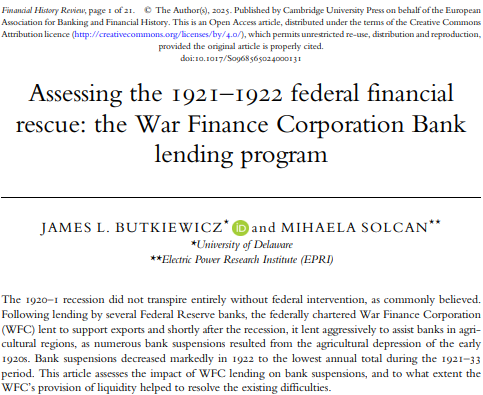
The 1920–21 recession wasn't purely laissez-faire. The War Finance Corporation (WFC) stepped in, lending to support exports & later aiding banks hit by the agricultural crisis. Bank suspensions plummeted in 1922. How much did WFC liquidity help? cambridge.org/core/journals/…
Financial History Review tweet media
English
0
0
0
37
Financial History Review
Financial History Review@FHRjournal·
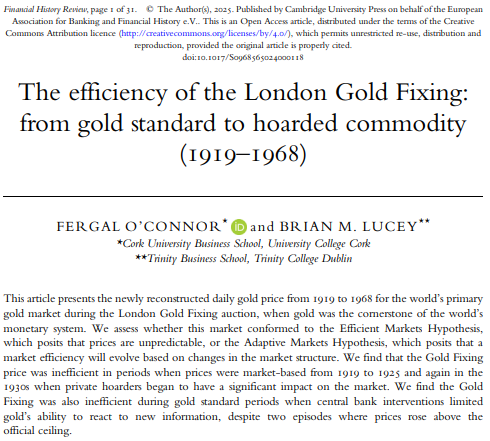
Was gold trading efficient when it was the backbone of the monetary system? New research reconstructs daily London Gold Fixing prices & tests market efficiency: Gold was inefficient when prices were market-driven and under central bank intervention. cambridge.org/core/journals/…
Financial History Review tweet media
English
1
0
0
48
Financial History Review
Financial History Review@FHRjournal·
New papers! The efficiency of the London Gold Fixing Saving for a stormy day? The Jamaican Government Savings Bank and the precautionary savings motive Assessing the 1921–1922 federal financial rescue: the War Finance Corporation Bank lending program cambridge.org/core/journals/…
English
1
0
1
85
Financial History Review retweetledi
Finance & History
Finance & History@FinanceHistory1·
Why Does the U.S. Lead Investment Banking? 🇺🇸💰 In Episode 7.2 of the #eabhPodcast, @CarolineFohlin (Emory) and Hugo Banziger (eabh) explore: 🔹 How did the U.S. outpace Europe? 🔹 Why is its dominance so resilient? 🔹 The impact of mutual funds, regulations, and political networks. Dive into the forces behind U.S. supremacy in global finance. Don't miss it! 🎧 Listen here: open.spotify.com/episode/1XMEaU… #InvestmentBanking #MutualFunds #PensionFunds #InstitutionalInvestors #FinancialHistory #eabh @bankinghistory @GertjanV_
Finance & History tweet media
English
0
1
3
401
Financial History Review
Financial History Review@FHRjournal·
Did policymakers neglect monetary policy? While money supply experiments began in the late '60s, a nonmonetary view of inflation dominated early '70s decision-making—until money targets gained traction later in the decade. cambridge.org/core/journals/…
Financial History Review tweet media
English
0
0
0
58
Financial History Review
Financial History Review@FHRjournal·
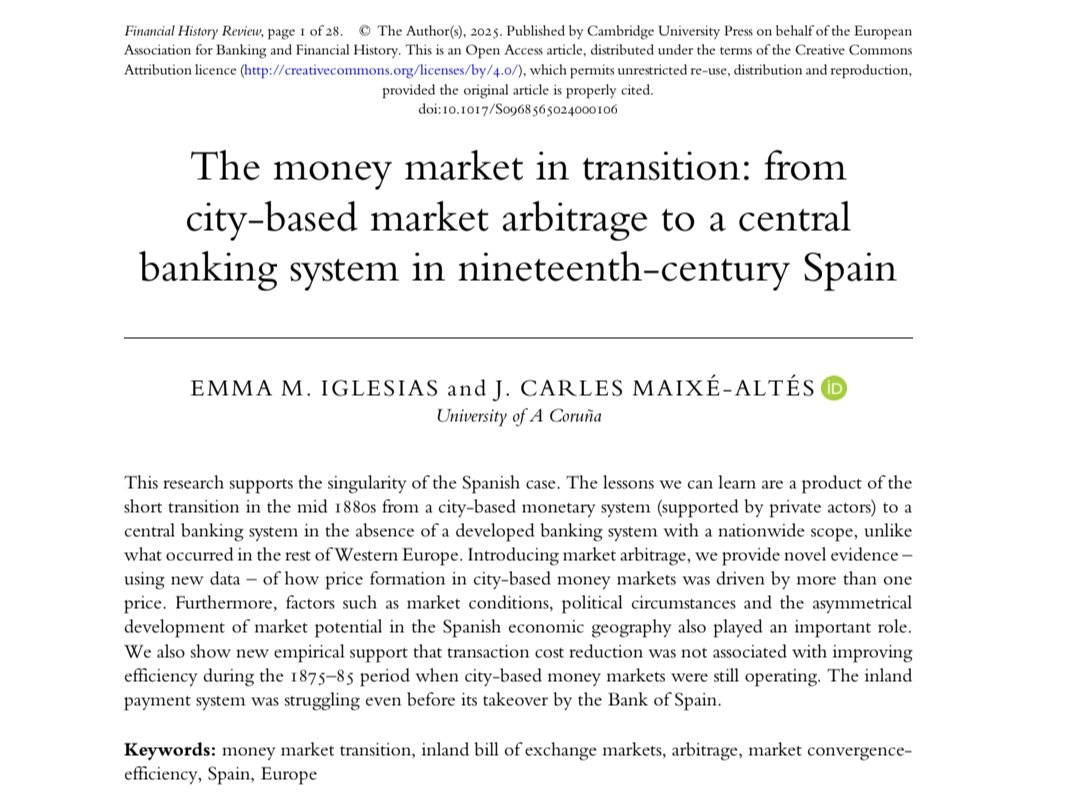
Unlike Western Europe, Spain shifted from city-based money markets to central banking without a nationwide banking system. New data reveals price formation, market asymmetries & why lower transaction costs didn’t mean greater efficiency. cambridge.org/core/journals/…
Financial History Review tweet media
English
1
0
1
62
Financial History Review
Financial History Review@FHRjournal·
We have some cool papers lined up: Democratization & foreign borrowing costs in early globalization Medieval Europe's small change problem 19th-c Spain: city markets → central banking UK inflation in the 1970s: monetary vs. nonmonetary causes A thread 🧵
English
1
0
4
120
Financial History Review retweetledi
Financial History Review
Financial History Review@FHRjournal·
Article published in FHR: "We study the association of shareholder returns with liberalization in government policy during Britain's railway run-up of 1844–5. The findings sustain two main claims". Read more in the paper: cambridge.org/core/journals/…
English
0
1
2
188