Flavio Calvino

2.4K posts

Flavio Calvino

Flavio Calvino

@FLCalv

Senior Economist @OECDInnovation. Firm dynamics, digitalisation, economics of #AI. Tweets are personal views, RTs are not endorsements
Paris, Europe Katılım Ağustos 2012
2.1K Takip Edilen1.2K Takipçiler
Flavio Calvino retweetledi
Le Printemps de l'économie
Le Printemps de l'économie@printempsdeleco·
« On parle beaucoup d’utiliser l’IA, mais il faut déterminer le type de technologie, comment on l’utilise, et pour quel type d’entreprise. C’est important pour la productivité et pour les politiques publiques qui peuvent être ciblées sur différents acteurs et typologies d’entreprises. » selon @FLCalv @OCDE_fr pour la session @banquedefrance conçue par @de_bandt Directeur de la recherche @banquedefrance et modérée par @JCBricongne 🔴Ne manquez pas le live en direct du @lecese sur printempsdeleco.fr/live #printempsdeleco
Le Printemps de l'économie tweet media
Français
0
1
1
42
Flavio Calvino retweetledi
Ethan Mollick
Ethan Mollick@emollick·
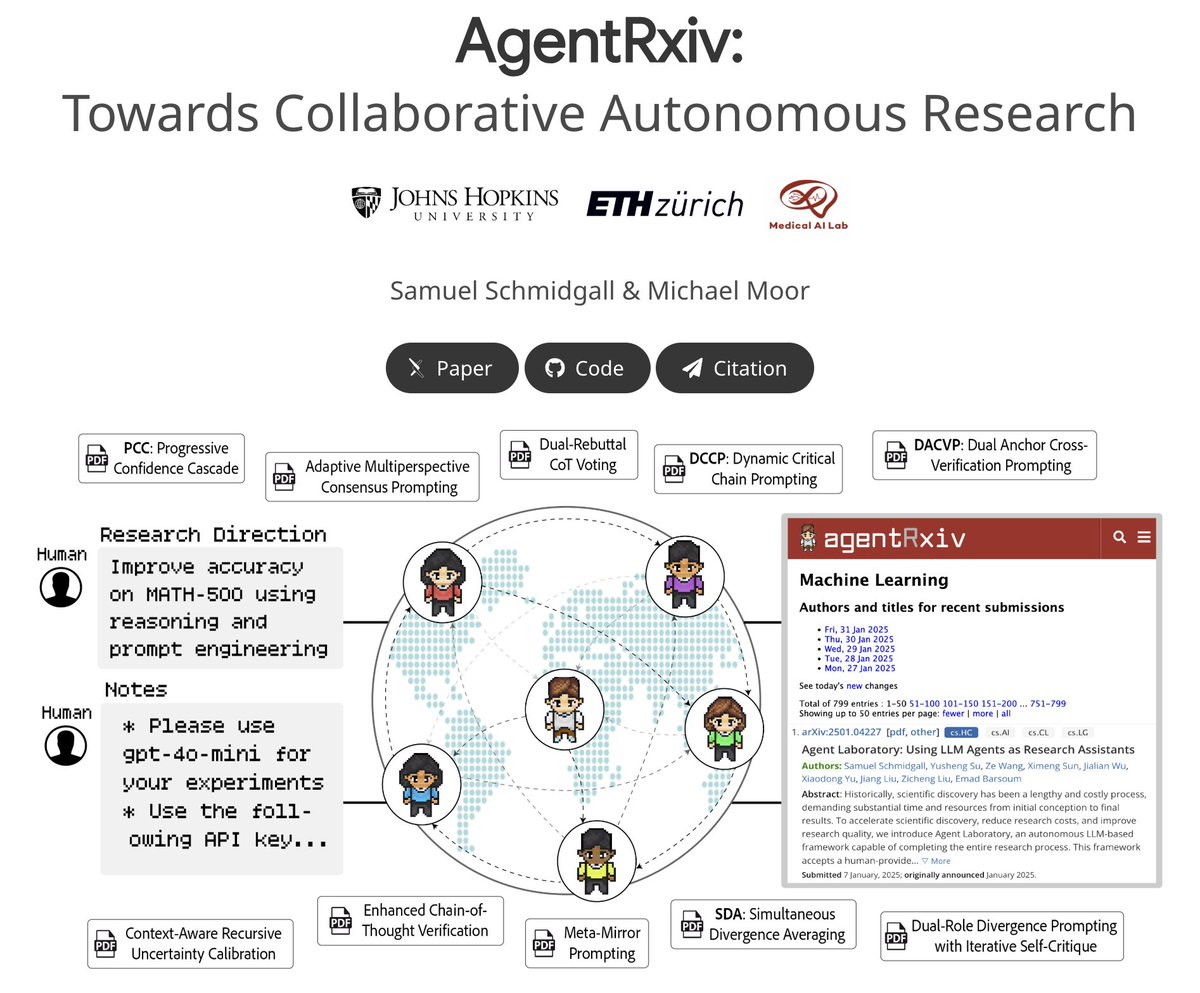
We need more papers like this one which examines how AI agents & humans work together Current agents were fast, but not strong enough to do tasks on their own & approached problems from too much of a programing mindset. But combining human & AI resulted in gains in performance
Ethan Mollick tweet mediaEthan Mollick tweet media
English
20
78
443
34.1K
Flavio Calvino retweetledi
Samuel Schmidgall
Samuel Schmidgall@SRSchmidgall·
🚀🌐Introducing AgentRxiv: a framework where autonomous research agents can upload, retrieve, and build on each other’s research. AgentRxiv takes your research direction and progressively outputs research, building on its previous work with each new paper! 🧵
Samuel Schmidgall tweet media
English
7
195
1K
117.7K
Flavio Calvino retweetledi
Peyman Shahidi
Peyman Shahidi@Peyman_Shahidi·
(1/11) How do AI agents change markets? We speculate on this topic in our new article for the NBER “Economics of Transformative AI” volume with @gilirusak, @BenSManning, @AndreyFradkin, and @johnjhorton: “The Coasean Singularity? Demand, Supply, and Market Design with AI Agents”
Peyman Shahidi tweet media
English
12
49
180
41.1K
Flavio Calvino retweetledi
EU Joint Research Centre
Tune in today to the European Conference on Corporate R&D and Innovation! Academics, policymakers & industry experts will discuss how corporate innovation drives competitiveness, sustainability and resilience in today's world. 🎥Watch live from 14:30 iri.jrc.ec.europa.eu/concordi-2025
EU Joint Research Centre tweet media
English
0
3
4
728
Flavio Calvino retweetledi
Erik Brynjolfsson
Erik Brynjolfsson@erikbryn·
Economists must take seriously the transformative implications of AI for the economy: -economic growth -science and innovation -inequality -concentration of power -geo-economics -information and knowledge flows -catastrophic risk -new measures of well-being and -transition dynamics. This paper, with @professor_ajay and @akorinek, proposes a research agenda.
NBER@nberpubs

Outlining a research agenda and nine grand challenges for studying the economic impacts of transformative artificial intelligence, from @erikbryn, @akorinek, and @professor_ajay nber.org/papers/w34256

English
23
131
561
106K
Flavio Calvino retweetledi
Luis Garicano 🇪🇺🇺🇦
Live from Palo Alto! "The Economics of Transformative AI" @nberpubs workshop. I will be trying to live tweet (mega jet lagged--flew from HKG--, so I really hope I can keep it up) the papers presented. Watch this thread Here is the fantastic line up nber.org/conferences/ec…
English
19
105
442
226.5K
Flavio Calvino retweetledi
NBER
NBER@nberpubs·
How to build AI agents for research, from simple data retrieval to deep research systems and showing how to create these tools using natural language instructions, from @akorinek nber.org/papers/w34202
NBER tweet media
English
2
81
366
30.2K
Flavio Calvino retweetledi
Ethan Mollick
Ethan Mollick@emollick·
Interestingly, an economics paper that came out in 2023 predicting which jobs would overlap most with AI turned out to be right. A new Microsoft study of actual AI use by workers (more on that in another post) found a 90% correlation between real world overlap & the predictions.
Ethan Mollick tweet mediaEthan Mollick tweet media
English
19
103
566
64.9K
Flavio Calvino retweetledi
Ethan Mollick
Ethan Mollick@emollick·
This is the first (small) controlled study I have seen of GenAI on industrial quality control. Here, engineers commissioning new trains took part in an experiment using a GPT-3.5 powered troubleshooting system. Those who used the chatbot had significant increases in work quality
Ethan Mollick tweet mediaEthan Mollick tweet media
English
17
38
275
28.9K
Flavio Calvino retweetledi
OECD Innovation
OECD Innovation@OECDinnovation·
Does #GenerativeAI meet the criteria of a general-purpose technology, like electricity or the steam engine? Some signs suggest it might, but as #GenAI fuels innovation, major productivity gains will depend on policy, investment & skills: oe.cd/68i #AIpolicy #OECDAI
English
0
3
4
426
Flavio Calvino retweetledi
OECD Innovation
OECD Innovation@OECDinnovation·
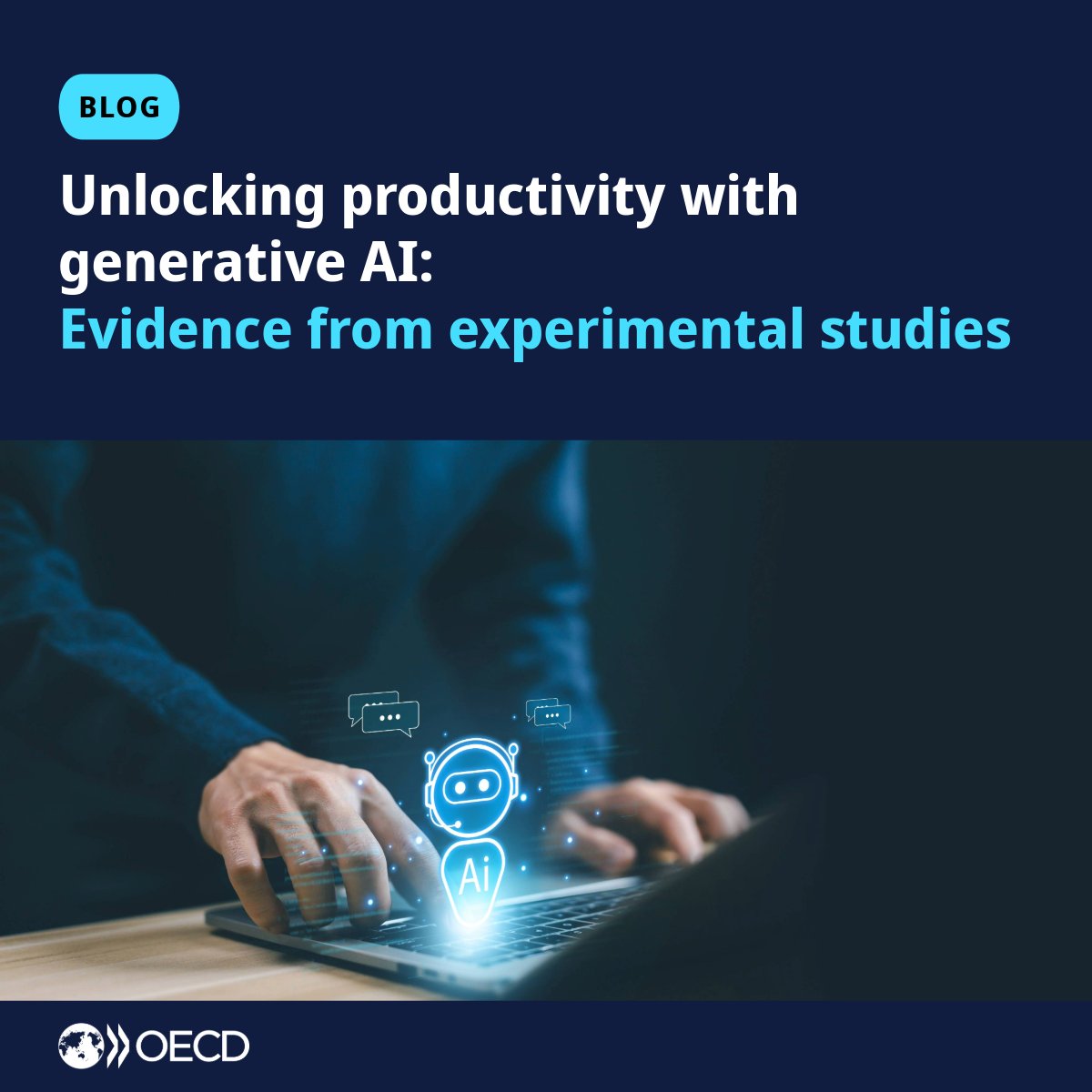
#GenerativeAI has the potential to transform work, boost #productivity, foster innovation and stimulate entrepreneurship — but its effects vary. In our blog, we explore key findings of recent experimental studies on its potential impacts: oe.cd/684 | #OECDAI
OECD Innovation tweet media
English
0
3
2
286
Flavio Calvino retweetledi
sam manning
sam manning@sj_manning·
This is one of the most important papers on the labor market impacts of AI in recent memory. Awesome, clarifying work by @ProfNeilT and @davidautor
MIT FutureTech@MITFutureTech

A new paper from David Autor (@davidautor), in collaboration with Neil Thompson (@ProfNeilT), makes an important contribution to explaining how AI is likely to impact labor markets. Based on a rigorous model, confirmed with an analysis of 40 years of data, they provide a nuanced perspective on how automation impacts job employment and wages. Essentially, this depends on the extent to which easy tasks are removed from a role and expert ones are added, and how specialized a role becomes as a result. When jobs gain inexpert tasks but lose expertise, wages decline, but employment may increase. Think of how taxi driving became less specialized, and well-paid, but more common, due to Uber. In contrast, when technology automates the easy tasks inside a job, the remaining work becomes more specialized. Employment falls because fewer people now qualify, but the scarcity of expertise drives wages up. This is what seems to be happening with proofreading, which is now less about spell-checking and more about helping people to write, leading to lower job numbers but higher average wages. Their model helps us to understand the impacts of AI on labor markets. For instance, why AI tools can raise wages for senior software engineers, but decrease employment, while simultaneously reducing earnings, and increasing employment, for more entry level software engineering roles. Read: nber.org/papers/w33941 See also this talk from David at Stanford HAI (@StanfordHAI): youtube.com/watch?v=uV3Ltt…

English
0
6
25
1.9K
Flavio Calvino
Flavio Calvino@FLCalv·
An effective approach to leverage the potential of generative AI appears to be through #human-AI collaborations that consider both #context and users’ expertise, with AI serving as a #complement rather than a substitute for human capabilities.
English
1
0
1
51
Flavio Calvino retweetledi
MIT Sloan School of Management
A new paper from MIT Sloan postdoctoral associate Loaiza and professor Roberto Rigobon finds that work that's dependent on human characteristics such as empathy, judgment, and hope is less likely to be replaced by AI. Learn more: bit.ly/4kWPgPJ
MIT Sloan School of Management tweet media
English
1
14
29
4.8K