TO ORDER: finishinglinepress.com/product/the-hi…
Part primer on how to model for artists and part art historical imagining, The Higher Call offers an intimate glimpse inside the private world of the art studio. LuLu Johnson uses her degree in art history and her personal experience to give voice to Picasso’s muses and reflect on work as a life model. These fifteen interwoven poems let models step out of the frame to speak of their longing, betrayal, and desire to be seen. The collection explores what it means to give one’s life over to art and asks what price women pay to become immortal. Funny and fearless, lyrical and unflinching, The Higher Call brings art and history to life with musical sensuality. #art#pablopicasso#marietherese#goldenmuse#modeling
LuLu Johnson earned a degree in Art History from Southern Methodist University, and an MFA in Poetry from Georgia State University. In Atlanta, LuLu began modeling for artists in graduate school, and she now resides in Appalachia where she hikes and writes her novels and poems. @lu2johnson
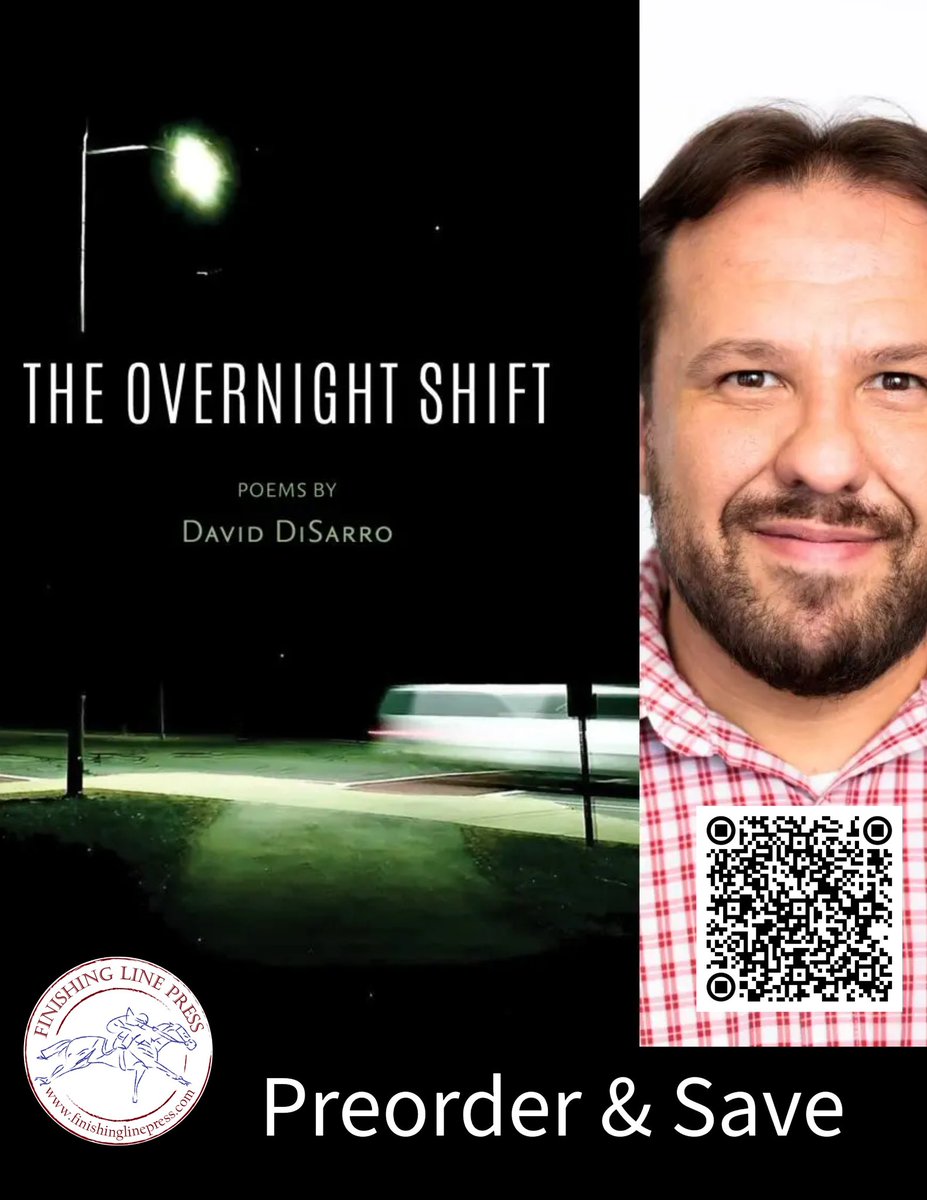
New from Finishing Line Press: The Overnight Shift by David R. DiSarro
On SALE: finishinglinepress.com/product/the-ov…
In his second chapbook collection, The Overnight Shift, David R. DiSarro explores the complexity of human relationships, living on the edge, and those moments caught between exhilaration and monotony. With speakers often described as multifaceted, intense, and longing for human connection, DiSarro presents what fellow poet Sarah A. Chavez has described as “a compelling, quintessentially American working class world” that plays upon themes such as freedom, desire, joy, and disappointment, all while navigating the lives of those “perched on the edge” of the “Post-truth era” in America. Within the stark realities of these poems lies glimmers of hope and a yearning to make sense of a chaotic and often cruel world. With imagery that makes the invisible visible, DiSarro balances clarity with complexity, vitality with heartbreak, and precision with whimsy, as he searches for those places where freedom is not an abstract idea, but a way of life. #Workingclass#Poetry#TheOvernightShift#Freedom#PostTruthEra
David R. DiSarro is currently an Associate Professor of English at Endicott College in Beverly, MA. His work has previously appeared in The Rye Whiskey Review, Neologism Poetry Journal, Bending Genres, The Rome Review, The Hawaii Pacific Review, among others. David’s first published chapbook, I Used to Play in Bands, is available from Finishing Line Press. He currently lives on the North Shore of Massachusetts with his wife, Riley, five children, and two rambunctious dogs.
PRAISE:
“The poems in David DiSarro’s, The Overnight Shift, presents readers with a compelling, quintessentially American, working-class world of viscous dining, drinking, smoking, and the beauty of the natural world cycling between fertility and death. Whether stopped by the side of the road or in a field with dandelions, readers feel the push and pull between freedom and desire to take care of those we love. DiSarro’s speakers are multifaceted and real, navigating joy and disappointment, birth and loss, swaying in the navigation of staying whole. In “The War,” the speaker says, “[n]o one ever tells you / how to deal with surrender” and it’s not clear if these speakers ever uncover that lesson, but they do move forward with tenacity finding moments of beauty, even under the crushing weight of loss and toil.”
~ Sarah A. Chavez, Author of like everything else we loved
“The Overnight Shift is an apt metaphor for life in 21st century America. The vivid imagery in these poems makes the invisible visible, brings it to life in all of its heartbreaking and beautiful intensity.”
~ Timothy Mayers, Author of (Re)Writing Craft
“A characteristic of the best in contemporary poetry is its precision of language, a poetic skill more important now, in the Post-truth era, than perhaps ever before. DiSarro’s The Overnight Shift addresses topics well known to most people who have been in relationships. But the poet’s proficient articulation of those relationships makes us see them as if for the first time. The human connection is vital, and DiSarro makes it that way in his poems. Refresh your life! Read these poems!”
~ Patrick Bizzaro, Author of Fog at the Manassas Battlefield
“David DiSarro could be describing his own stunning book when he writes “we say this/ in whispers/ in the bubble/ of our living rooms,/ in the fragility/ of being witness…” These are loving poems that describe a life that is at once beautiful and perched on the edge of a stark realization: that each day begins with “the gray skull of morning.” The Overnight Shift reveals DiSarro as an amazingly clear poet drawing us a detailed map of a complex heart.”
~ Peter Davis, Author of Band Names and Other Poems
Please share/please repost #FLP#preorder#poetry#booktok
FLP CHAPBOOK OF THE DAY: Spreading the Light by Barbara Sherman
On SALE: finishinglinepress.com/product/spread…
In Spreading the Light Barbara Sherman weaves a world where rocks are full of grace and everything that grows and breathes has something to teach us. Spirits appear in the canyons and clouds, and each day we are alive is both gift and offering. Light spreads from the tender body of snail In the opening poem and transforms slowly across the pages, leaving us with the glow of a flower that blooms in the dark. Part memoir and part nature journal, Sherman’s poetry is a meditation on living in harmony with our natural world. #poetry#nature#desert#inspiration#spiritual#memory#meditation
Barbara Sherman has been dancing with poetry ever since her childhood days in rural Pennsylvania. In her teens she discovered a book of Robert Frost’s poems on her mother’s bookshelf and fell in love. As a young adult, Barbara taught high school English and yoga in Connecticut and raised two children. After moving to Arizona in 1999, Barbara became a docent at The University of Arizona Poetry Center and an avid reader of contemporary verse. As a writer, she finds inspiration in the work of Mary Oliver, W. S. Merwin and Ross Gay. She is also a docent at Tohono Chul Park in Tucson, where she developed interpretive walks pairing poems with plants. These walks highlight the resilience of plants living in a hot, dry climate and what they have to say to us in this changing world. She also facilitates poetry discussions in the Tohono Chul Art Gallery highlighting poems that illuminate the theme of each exhibition. Barbara holds a Master’s Degree from Wesleyan University, Middletown, Connecticut and considers herself a life-long learner. She resides in Oro Valley, Arizona with her husband Ted and two devoted cats.
TO ORDER: finishinglinepress.com/product/the-co…
In The Conjurer Keeps House, Mary Redman invites the reader into the mind of an aging woman to explore life’s joys, sorrows, and discoveries. Her poems display a love of the natural world and immersion in it for the sake of physical and mental health, as well as poetic inspiration. One message of this book is that a mindful attitude toward the present and critical reflection on the past can lead to acceptance and the knowledge that each of us is part of something more significant than any individual life could embody.#poetry#chapbook#aging gracefully #nature#memory sorrow joy discovery reflection mindfulness
Redman is a writer from Indiana. She graduated from Ball State University majoring in Art Education and English, later earning her M.A. in English there, as well. Her teaching career spanned thirty-three years, primarily teaching high school English. After retiring from teaching, Mary worked as a university supervisor for the Schools of Education at both Indiana University Purdue University Indianapolis (IUPUI) and University of Indianapolis (UIndy), where she mentored pre-service teachers. During the same period, she became serious about her writing and since 2015 has published her poems in a variety of literary journals. Mary’s work was nominated once for a Pushcart Prize, and three of her poems were selected for the Indiana Poetry Archive Inverse in 2024. The Conjurer Keeps House will be her first published chapbook. Mary lives and writes in Indianapolis and serves as a docent at the Indianapolis Museum of Art at Newfields. Instagram: @redmanmarye Facebook: @maryelizabethredman@redmanmarye
TO ORDER: finishinglinepress.com/product/habits…
Habits of Light is a poetry collection unified by a sustained meditation on loss, love, destruction, abandonment, forgiveness, longing, and the many registers of “light” that illuminate and fracture human experience. Drawing on journeys of immigration, cultural adaptation, social exclusion, personal grief, and the gradual movement toward self-recognition, the collection consciously pushes creative boundaries to articulate the condition of living with “two feet on two soils.” Through attention to quiet, often overlooked moments, the poems probe the intertwining of emotional life, cultural identity, and existential reflection, seeking to offer readers not resolution, but solace, recognition, and a shared sense of humanity. At once intimate and expansive, Habits of Light situates the personal within themes that resonate broadly, marking it as a significant contribution to contemporary poetry. #patricksylvain, #poetry, #migration, #selfrecognition, #blackpoets
Patrick Sylvain is a Haitian-American educator, poet, writer, social and literary critic, and translator whose work explores Haiti and the Haitian diaspora’s culture, politics, language, and religion. The author of several poetry collections in English and Haitian, Sylvain’s poems have been nominated for the Pushcart Prize and appear in leading journals including Ploughshares, Callaloo, Transition, Prairie Schooner, Agni, American Poetry Review, SpoKe, The Caribbean Writer, and African American Review. @sylvainpoetics
TO ORDER: finishinglinepress.com/product/diffic…
Difficult Music follows the pattern of a traditional orchestral concert, using form to provide a necessary constraint on a neurologically jumpy mind. From an overture that is a series of poems on a variety of interlinked topics, including religion and the environment, to a concerto made up sonnets on living with Tourette’s Syndrome, and on to a symphony—a sequence combining family history, ars poetica, and nature poetry. Together, they show a mind at work in a rich and varied ground, trying to pin down experiences in an ever-changing world. #poetry#music#Tourette’s Syndrome #family#nature
Stephen A. Allen was born and raised in Vermont and currently lives in Michigan. He has an MA from the University of Illinois at Chicago and degrees from Amherst College and the University of Notre Dame. His poetry has appeared most recently in MacQueen’s Quinterly, Modern Haiku, Northern New England Review, and Rattle.
TO ORDER: finishinglinepress.com/product/heirlo…
Heirlooms is a cubist visitation and revisitation of the same memory—something illusive from childhood that still haunts at every angle. In these poems, falsely recalled memory refracts as light, catches in corners of our mind, and plays back infinitely across an aging tv set. Each poem endeavors to recapture an element of that light to turn what was once dark and harmful into something new. What our memory crystallizes in Heirlooms, however, is not the memory itself, which we will forever recall in broken pieces, but the lasting feeling that something softer may yet come. #poetry#childhood#memory
Stephan Antoine Viau is a poet, translator, and reviewer. He earned his MFA in poetry from Louisiana State University. He is the author of two long-form poetry collections, PARADISE (Rockwood Press, 2026) and HEIRLOOMS (Finishing Line Press, 2026), and the poetry chapbook mini, Hole (Malarkey Press, 2026). Work of his has appeared in The Hong Kong Review of Books, The Colorado Review, Matter Press, ABSTRACT, The Word’s Faire, HASH, and New Delta Review, among others. He lives in Maryland with his family.
FLP CHAPBOOK OF THE DAY: Mice Inherit Apocalypse by Emma Johnson-Rivard
On SALE:
finishinglinepress.com/product/mice-i…
mice inherit apocalypse explores the lines between the poetic, the political, and the absurd convergences of the two. Using free verse, the collection considers lines both short and brutal, long and languid, and the stories built from both across a strange, utterly American era. In these times, what will the mice inherit? #politica#inthesetimes#poetry
Emma Johnson-Rivard is a midwestern writer of poetry and weird fiction. As a child, she was diagnosed with Central Auditory Processing Disorder (CAD) and severe dyslexia. Subsequently, she told it was unlikely she would ever learn how to read. It was deemed similarly unlikely that she would ever graduate high school. Several years later, she did just that, before moving onto degrees from Smith College and Hamline University. Born in Minnesota, she currently resides in Ohio, where she is a doctoral student at the University of Cincinnati. Today, she lives with a tortoiseshell cat and a large collection of books. Her poetry has appeared in Backchannels, The Scop Literary and Fine Arts Journal, Lavender Review, Collateral, and many others. Her short fiction has appeared in Strange Horizons, Tales to Terrify, Moon City Review, and others. She can be found @blackcattales on Bluesky and at emmajohnson-rivard.com.
PRAISE:
Mice Inherit Apocalypse confronts collective mortality amidst the absurdities of daily life while insisting on the inching persistence of meaning. In this collection, dreams become “Roses / on the tongue, and under the skin” and words are what will survive us. Plainspoken but crackling with sly, off-kilter observations, Johnson-Rivard’s weaves wit, anxiety, and vulnerability into poems that land with gut-punch clarity.
—Danielle Cadena Deulen
Please share/please repost #flp#booktok#poetry#chapbook
FLP BOOK OF THE DAY: Blue Ionia and other poems by Deanna Benjamin
On SALE: finishinglinepress.com/product/blue-i…
In her debut collection of poems, Deanna Benjamin invites her readers to encounter the Ionian island of Lefkada, Greece. Her poetry stands both in vivid celebration and solemn contemplation of a distant island culture that she has experienced first-hand. Set alongside delicate watercolor sketches by Joni Zavitsanos and intuitive translations by Aliki Barnstone and Liana Sakelliou, Blue Ionia and other poems capture the brushstrokes of hope and grief in the midst of Lefkada’s daily village life. #Greece#culture#watercolor#hope#grief#VillageLife#poetry
Deanna Benjamin writes lyric memoir, poems, and micro-stories. Her most recent creative work appears in Hippocampus Magazine, MacQueen’s Quinterly, The Texas Review, Thimble Literary Magazine, and Willows Wept. Deanna’s flash fiction, “Lilacs” (MacQueen’s Quinterly, September 2025) has been nominated for Best Microfiction2026. She grew up in Houston, Texas, and has lived in Arizona, Georgia, and now Missouri, where she teaches critical and creative writing.
PRAISE:
Blue Ionia calls to all the senses at once—the taste of lemon and salty air; the smell of roasting potatoes with oregano; the sound of distant conversation echoing off ancient walls, of conch shells calling from the past; and of course, the blues of sky and ocean, the wrinkles from sun and smiles. Everything about this book is simplicity and essence with uncluttered drawings and focused poems. A man translates the day. Children wrap around a mother’s legs like grape vines. Wishes are scratched into water. This visceral book transports the reader to a timeless stillness captured in poetry and pastels that sketch a small Greek village.
—Danielle Hanson, author of The Night Is What It Eats
This lovely book brings together the beautiful drawings and watercolors of the landscape and people of artist Joni Zavitsanos’s ancestral Greek homeland with the arresting and evocative poetry of Deanna Benjamin. In the true spirit of the classical tradition, image and word combine to bring the lucky reader closer to understanding what makes modern-day Greece as magical as its ancient counterpart.
—Jennifer Udell, Curator of University Art at Fordham University
Set within the radiant landscape of Lefkada, these luminous poems unfold in “a language of the bluest spectrum,” gathering light as they go. In English and Greek, Deanna Benjamin’s keenly observed portraits of island life shimmer with immediacy and tenderness, alive to memory’s darker currents and to histories of loss and endurance. In a translation of rare grace and precision, Aliki Barnstone and Liana Sakelliou carry these poems across languages with a finely tuned ear for their voices, their people, and their past–offering a Greek lyric presence newly imagined, resonant, and alive.
—Kathleen Crown, Humanities Council, Princeton University
Please share/please repost #booktok#poetry#FLP#book
TO ORDER: finishinglinepress.com/product/cresce…
These are poems about pre-Katrina New Orleans . They are specific to that beautiful city, and were written while in residence some years before the storm. Many of the poems were presented at local readings, or individually published. #poetry#NewOrleans
Poet, writer, artist Su Zi is also the artist-editor behind the chapbook series Red Mare, which further underscores the commitment to the natural world that is consistent is all her work. Previous publications number a dozen or so with outsider and micro-presses, including Danke with Ethel—poems in the form of Tanka: Chirp with Hysterical Books—haiku about observed birds; Flux with Between the Highways—a single long poem about environmental duress
PRAISE:
” The beautiful poems in Crescent are informed by a respectful attentiveness, a scrupulous eye for details that create startling images, and tenderness about love and loss, the universal condition. Su Zi is a poet waiting to give the reader both a moving and cinematic view.”
–Maxine Chernoff @chernoff.maxine
Congratulations to Maya Klauber, on her new book of poetry, “Jellyfish and Grit,” from @FLPress !
Our contributors are family, and we couldn’t be more proud of Maya. She’s amazing! You can pre-order her beautiful new book, here:
finishinglinepress.com/product/jellyf… 🌄
TO ORDER: finishinglinepress.com/product/ghost-…
In Ghost Skin, the poet, as a birder observing ubiquitous crows, a struggling sandpiper, or a caracara far north of its southern home, gives readers a glimpse of the bird world as well as of the intriguing character of birders themselves. She comes at nature with an innate curiosity, whether appreciating a chipmunk’s survival trick with a shed snake skin, recalling a child artist’s simple question about the color of rain, or speculating about a porcupine’s longings in the face of winter and predators. Immersing the reader in her observations and experiences within the setting of nature, she reveals our complicated relationship with the natural world and each other. #poetry#birds#birding#animals#nature environment relationships
Diane Bliss is an avid observer of nature and human nature. Her poetry has appeared in the anthologies Seeing Things 2 (2024), Seeing Things (2020), and Voices from Here 2 (2017), and in The Orchards Poetry Journal, Blueline and Yankee Magazine as well as several other publications. Her poem, “Missing What Isn’t Even Gone,” was awarded an Honorable Mention in the 2025 Allen Ginsberg Poetry Award and will appear in the 2026 Paterson Literary Review. She resides in Middletown, New York. @diane_bliss_author
We are pleased to announce that Molly Fisk will be the final judge for the 2026 New Women’s Voices Competition.
Poet and essayist Molly Fisk is the author of 10 books, most recently Walking Wheel, a novel-in-verse (Red Hen Press, 2026). She sent poets into schools state-wide and edited California Fire & Water, A Climate Crisis Anthology with a Poets Laureate Fellowship from the Academy of American Poets and has been supported by the National Endowment for the Arts and the Corporation for Public Broadcasting. Fisk lives in the Sierra foothills.
To submit: finishinglinepress.submittable.com/submit/356800/…#poetry#contests#women