Florencia S. Airaudo

754 posts

Florencia S. Airaudo banner
Florencia S. Airaudo

Florencia S. Airaudo

@F_Airaudo

Federal Reserve | Monetary and Fiscal policies | International Macro | 🇦🇷🇪🇸🇺🇸 | Views are my own

Washington, DC Katılım Kasım 2020
2K Takip Edilen2.1K Takipçiler
Florencia S. Airaudo retweetledi

Miguel Faria e Castro
Miguel Faria e Castro@mfariacastro·
The St. Louis Fed is looking to recruit research economists with experience in monetary and fiscal policy modeling. Please apply if you work on these topics, or share with your network if you know of someone who does. Must be authorized to work in the US. rb.wd5.myworkdayjobs.com/FRS/job/St-Lou…
English

1
22
67
13.6K
Florencia S. Airaudo retweetledi
Emil Verner
Emil Verner@EmilVerner·
For researchers interested in U.S. banking and finance, we are sharing a new data resource! It contains information on bank balance sheets, bank runs, and bank failures from the 19th century to the present:
Emil Verner tweet media
English
2
143
611
60.2K
Florencia S. Airaudo retweetledi
New York Fed
New York Fed@NewYorkFed·
Today's article summarizes three sections from the 2025 SOMA Annual Report that explain how the Fed managed the transition to ample reserves, why it began ongoing reserve management purchases, and how the public can track future balance sheet changes. nyfed.org/4ssfay7
English
1
3
12
2.7K
Florencia S. Airaudo retweetledi
Nick Timiraos
Nick Timiraos@NickTimiraos·
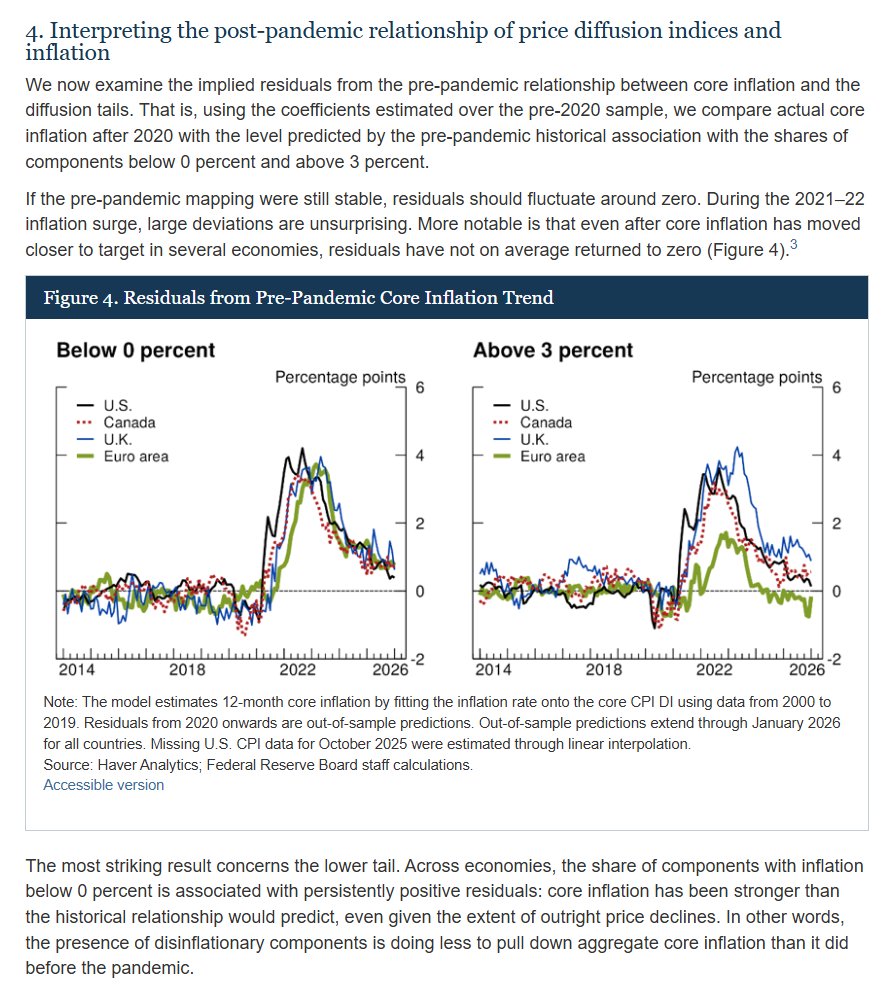
Fed research suggests the inflation engine may be running differently across advanced economies since the pandemic: 1/ More categories continue to see price growth above 3%, with broad-based wage growth in services appearing to be a key driver 2/ Even categories with flat or falling prices aren't pulling the overall number down the way they used to 3/ Pre-pandemic models consistently underpredict current inflation, suggesting the relationship between price dispersion and aggregate inflation may have shifted federalreserve.gov/econres/notes/…
Nick Timiraos tweet media
English
34
128
537
87.3K
Florencia S. Airaudo retweetledi
Ricardo Reis
Ricardo Reis@R2Rsquared·
** Reducing the Fed's balance sheet ** Ten days ago, I was part of a discussion at @BrookingsInst on how to shrink the Fed's balance sheet with Darrell Duffie and @WenxinDu. I tried to lay out the discussion in terms that, hopefully, clarify it to a broader set of economists. Here are the main points: 🧵
English
2
57
219
27K
Florencia S. Airaudo retweetledi
Nick Timiraos
Nick Timiraos@NickTimiraos·
In a speech this morning, Dallas Fed President Lorie Logan delivers a clear defense of the ample-reserves framework at a moment when others (Warsh/Bessent) have implied a course correction would be desirable. In the speech and a far more detailed memo, Logan outlines ways to instead reduce the size of the Fed's balance sheet with regulatory and operational changes that make banks comfortable holding fewer reserves. This isn't terribly surprising given how Logan held key senior roles at the New York Fed during the entire period in which this framework was constructed and fleshed out. But her speech is important because it is easy to see how, as these debates mature, her colleagues will likely be as interested in her views more than possibly any other Fed governor or president. Notably, Logan includes a pointed critique of reserve quotas (or reserve tiering) that some critics of the ample reserves regime have floated a compromise. She frames them as antithetical to free-market principles, using the same libertarian lexicon that the advocates of a smaller balance sheet often deploy. The tension to watch going forward is whether the demand-shifting approaches she outlines as a possible path forward can actually deliver enough balance sheet reduction to satisfy those who want a meaningfully smaller Fed footprint.
Dallas Fed@DallasFed

Dallas Fed President Lorie Logan delivered these remarks at the Eleventh District Banking Conference in Dallas, Texas: dallasfed.org/news/speeches/…

English
13
38
171
81.1K
Florencia S. Airaudo retweetledi
Hanno Lustig
Hanno Lustig@HannoLustig·
Here's yet another way the pandemic was bad for younger generations. Low rates don't make housing more affordable for prospective home buyers, because these push up house prices. The Fed's low rate policies during the pandemic engineered a huge wealth transfer from young, prospective home buyers to older homeowners. This wealth transfer has not been reversed. As rates increased after the pandemic, house prices have not come back down because millions of Americans are locked into their low mortgage rate, and this has limited the supply of new housing on the market. These low rate policies have also given an edge to institutional investors in the housing market who have access to cheap and unlimited leverage. The Housing Affordability Paradox open.substack.com/pub/thetwocent…
English
2
14
61
6.3K
Florencia S. Airaudo retweetledi
International and Monetary Economics Network
Highly relevant! "The payment system puts a floor on the Fed’s balance sheet" by Darrell Duffie. "Even though the quantity of reserve balances has grown by a factor of roughly 200 since 2007, the Fed is now increasing the supply of reserves to keep pace with the increasing demands of the payment system. Under post-GFC liquidity regulations, the Fed has found that it cannot fully rely on GSIBs with temporary needs for extra balances to use the Fed’s on-demand liquidity, including daylight overdrafts, the Discount Window, and Standing Repo Operations. If the Fed were to significantly reduce the size of its balance sheet, the supply of reserve balances would need to be reduced by about the same amount. If this were to be attempted with no changes in the Fed’s operating framework and liquidity regulations, the disruption of monetary policy transmission could be severe. In extreme cases, a liquidity crunch could threaten financial stability." brookings.edu/articles/the-p…
International and Monetary Economics Network tweet media
English
0
5
30
1.9K
Florencia S. Airaudo retweetledi
Tommaso Monacelli
Tommaso Monacelli@monacelt·
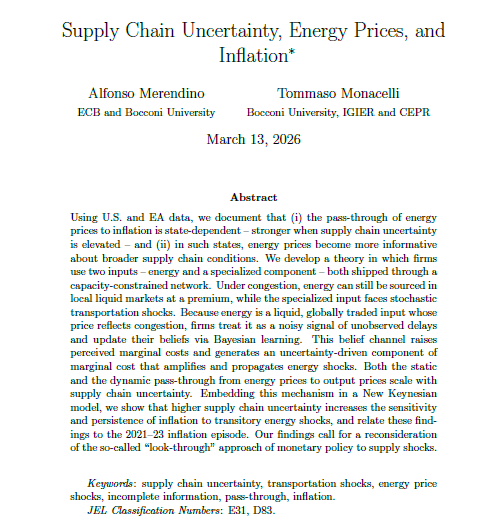
Should monetary policy "look-through" the current energy price shock? ➡️Old debate: energy shocks are "temporary" in nature. Central banks should look them through ➡️We argue in our work that the look-through doctrine does not hold when *supply chain uncertainty * is elevated👇
Tommaso Monacelli tweet media
English
6
50
208
20K
Florencia S. Airaudo retweetledi
Ricardo Reis
Ricardo Reis@R2Rsquared·
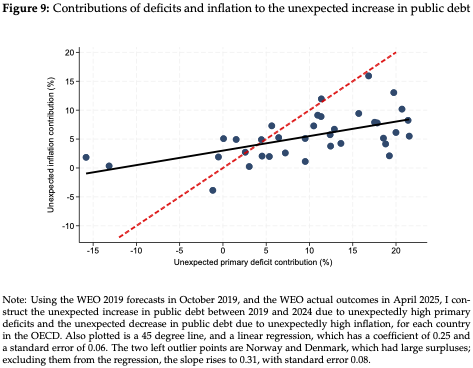
How much did public deficits contribute to the inflation surge of 2021-24? A popular argument notes that inflation rose in the US by almost as much as in other OECD countries. Yet, the US had a large fiscal stimulus in 2021 that most other countries did not. Therefore, the US fiscal stimulus did not contribute to the inflation surge. Is that right? No, it is not. To inspect this claim, you can use expectations data. By virtue of its mandate, the IMF is one of the best forecasters of fiscal variables and all economists pay attention to them. The IMF also forecasts inflation; during 2021-24, it was as right or as wrong as other institutions or surveys. Start from the IMF's forecasts in October of 2019 for the next 5 years of how much public debt would grow and what would be fiscal deficits, interest rates, inflation, and growth rates. Then look at the IMF April 2025 reports of those actual variables. Subtract one from the other and you have how much of the unexpected increase in public debt was due to unexpectedly high deficits, unexpectedly high interest rates, unexpectedly low growth rates and unexpectedly high inflation. The plot compares the unexpected high deficits with the unexpected high inflation terms for OECD countries, using the common units of their impact on the public debt. For countries that ran higher unexpected fiscal deficits, inflation was also unexpectedly higher. Some countries had their stimulus early, others only later. Somer larger, other smaller. Some had more, others less inflation. The accounts of the government let you consistently sum these differences over the 5 years to look beyond timings and to use consistent units. Thinking in terms of surprises and using expectations data allows you to compare countries with very different fiscal trajectories. More generally, in all models and theories of inflation, including fiscal account, expectations are crucial. Using expectations data to inspect them is very informative. Note: as with the initial claim, the plot is a correlation, not a causal statement. Sources: (i) Section 4 in Reis "Why Did Inflation Rise and Fall in 2021-24? Channels and Evidence from Expectations" (ii) This simple exercise is inspired on the analysis of Barro and Bianchi “Fiscal Influences on Inflation in OECD Countries, 2020-23.”
Ricardo Reis tweet media
English
37
151
632
205.3K
Florencia S. Airaudo retweetledi
Martin Castellano
Martin Castellano@mcastellano44·
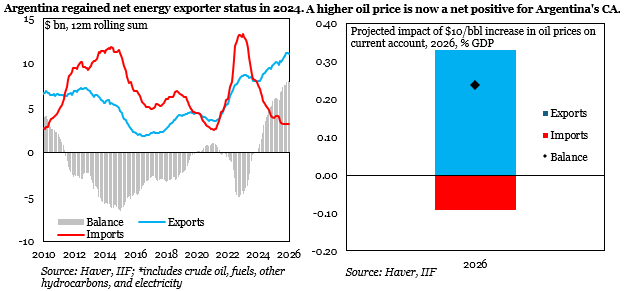
Argentina is back to being a net energy exporter. We estimate each $10 increase in the oil price delivers a hard-currency windfall of $1.7bn (0.25% of GDP). A few years ago, the same shock would have eroded the current account. Now it props it up.
Martin Castellano tweet media
English
19
203
1.1K
74.9K
Florencia S. Airaudo retweetledi
Federal Reserve
Federal Reserve@federalreserve·
Here at the Fed, we are rationally exuberant to celebrate your 100th birthday with you. Happy birthday, Alan Greenspan! youtu.be/lp1sJDa5MsI
YouTube video
YouTube
English
14
68
269
201.1K
Florencia S. Airaudo retweetledi
St. Louis Fed
St. Louis Fed@stlouisfed·
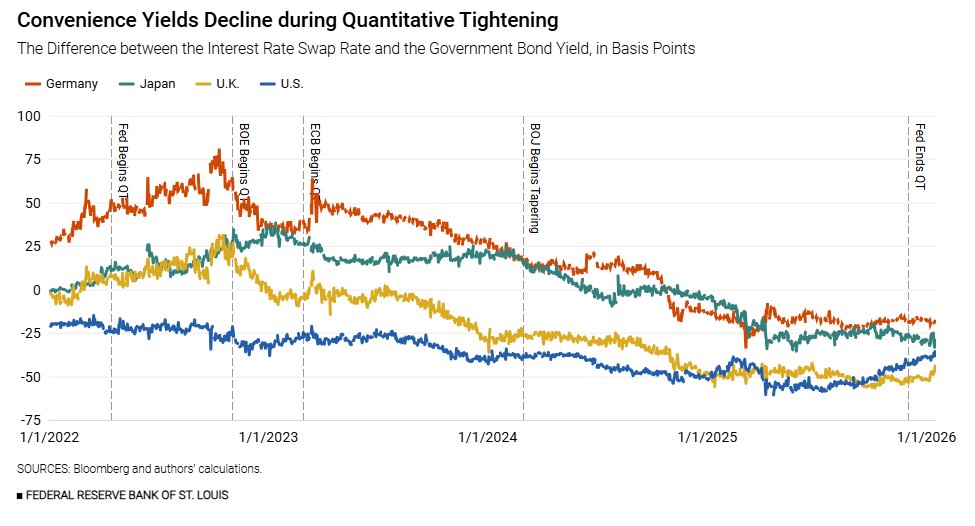
Did quantitative tightening distort the “convenience” yield on government bonds? bit.ly/4bmhYrm
St. Louis Fed tweet media
English
1
5
21
3.5K
Florencia S. Airaudo retweetledi
St. Louis Fed
St. Louis Fed@stlouisfed·
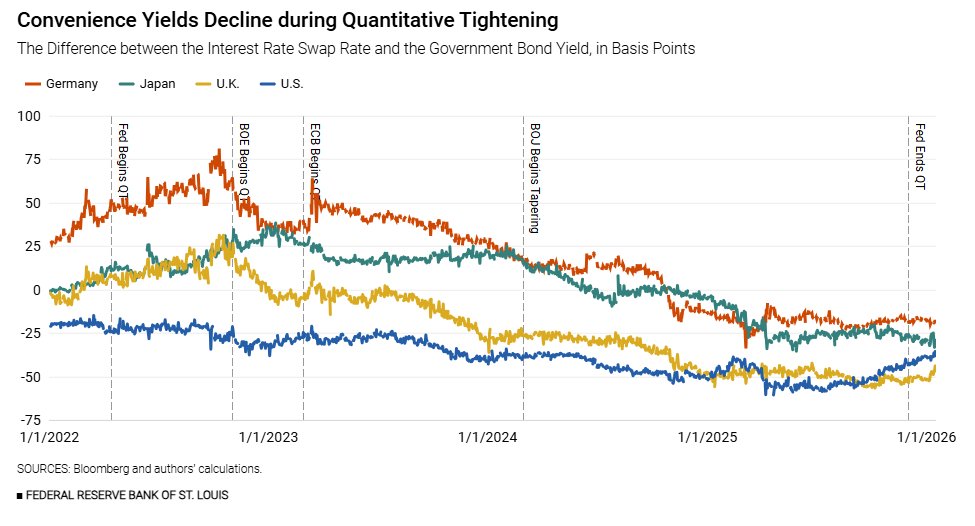
Government bonds offer benefits like liquidity and safety. These benefits are measured in the form of convenience yields, which appear to have eroded in recent years. What’s driving this change? bit.ly/4rJPddT
St. Louis Fed tweet media
English
0
6
12
2.1K
Florencia S. Airaudo retweetledi
Arpit Gupta
Arpit Gupta@arpitrage·
"rising housing costs since 1990 are responsible for 13 million (11%) children not being born, 51% of decrease in fertility from the 2000s to the 2010s, and a 7pp decrease in the share of 20-29 year olds that have started families" by Benjamin Couillard drive.google.com/file/d/1BK6jNy…
Arpit Gupta tweet media
English
21
219
843
112.5K
Florencia S. Airaudo retweetledi
Kurt MIT-shock-man
Kurt MIT-shock-man@SorryToBeKurt·
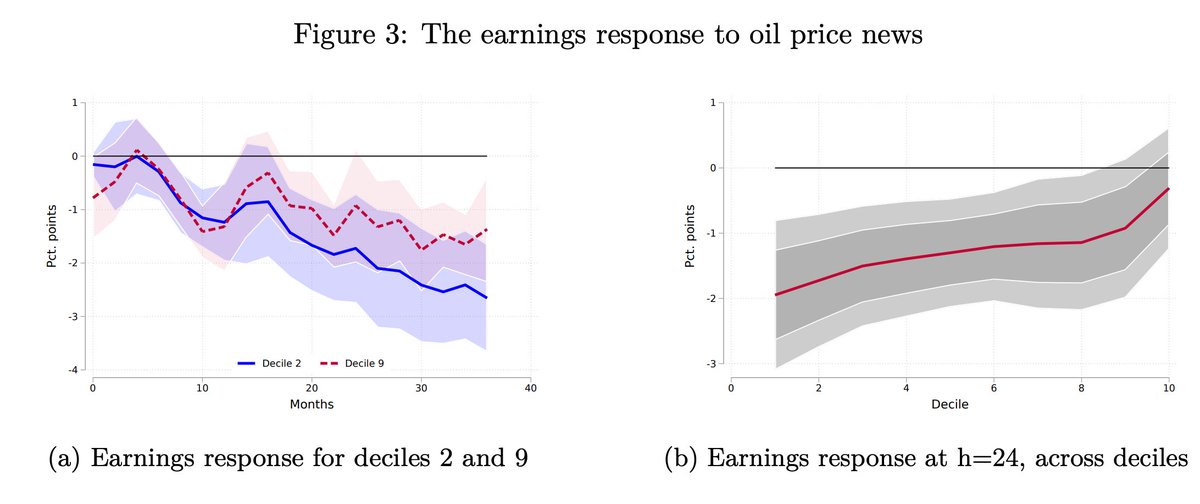
Oil prices just surged 8% in light of recent events. In our recent paper in @IMFEconReview, we study exactly this kind of shock: what happens to workers across the income distribution when oil supply contracts? 🧵
Kurt MIT-shock-man tweet media
English
3
39
162
31.4K
Florencia S. Airaudo retweetledi
Jon Steinsson
Jon Steinsson@JonSteinsson·
I want to take a moment to defend calibration. A common critique of macro by non-macro people centers on the supposed lack of scientific rigor associated with calibration of models. 1/10
English
7
155
694
0
Florencia S. Airaudo retweetledi
St. Louis Fed
St. Louis Fed@stlouisfed·
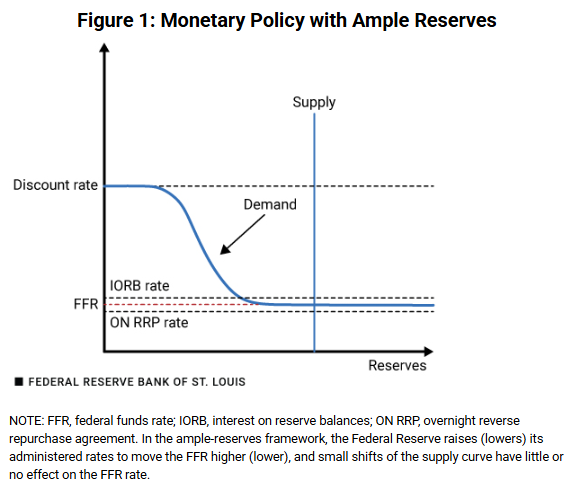
The Federal Reserve uses its balance sheet to help implement monetary policy. What might this look like in an ample-reserves regime? Find out in the new issue of Page One Economics bit.ly/4aGqO1I
St. Louis Fed tweet media
English
1
38
176
19.3K
Florencia S. Airaudo retweetledi
St. Louis Fed
St. Louis Fed@stlouisfed·
How does the Federal Reserve use its balance sheet in a sustainable ample-reserves regime? Our latest Page One Economics article explains bit.ly/46ZAfIn
St. Louis Fed tweet media
English
0
2
6
1.8K