
Everyone is talking about the AI data center buildout. Almost no one is talking about how the data actually gets in and out.
GPUs and capex get the headlines. Every byte of training data and every inference result has to traverse a wireless link somewhere in the chain, and those links are becoming the bottleneck.
Look at where this is heading. @Starcloud_ just raised $170M at a $1.1B valuation to put @nvidia H100s in orbit. @SpaceX 's Project Suncatcher is chasing a million-satellite compute constellation. @Google is pursuing the same thesis. Unlimited solar, the vacuum of space as a heat sink, no land constraints.
But orbital data centers do not work without RF.
Every gigabit of inference output, every petabyte of training data, every command and telemetry packet rides on a power amplifier. Push the link budget hard enough - higher frequency, higher power, tighter SWaP - and silicon falls over.
That is where GaN changes the equation. Higher frequencies, higher voltages, higher power densities. More output power per watt of DC in. Smaller, lighter, and the thermal headroom to survive the environments these missions actually live in.
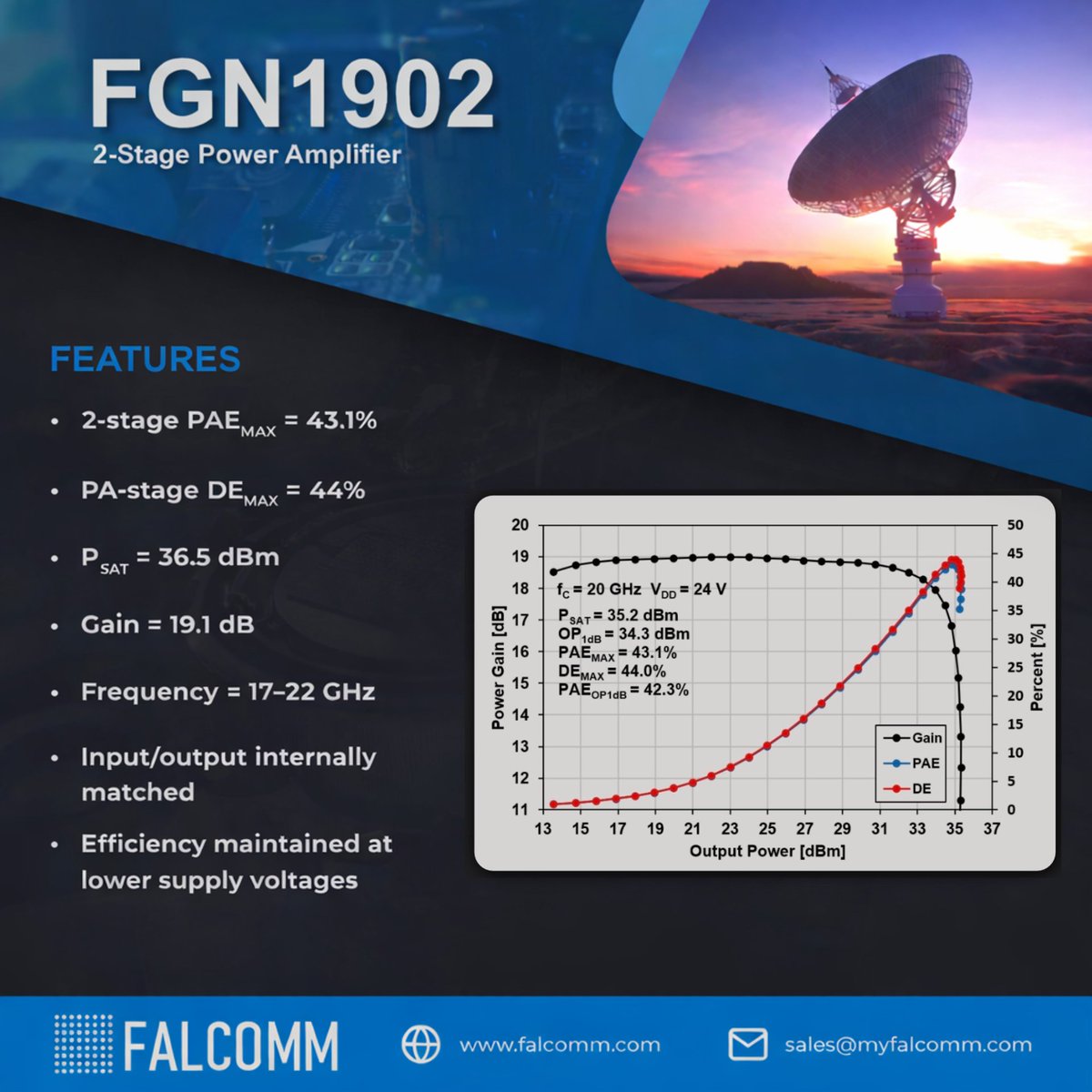
This is what the FGN1902 was built for. High-performance, domestically sourced GaN RF, designed around the constraints that defense, space, and critical infrastructure actually impose on hardware.
Not what looks good on a spec sheet. What holds up when the margin for error is zero.
The AI buildout is moving to orbit. GaN is a serious part of the answer.
#GaN #Semiconductors #SpaceTech #AIInfrastructure #FGN1902 #DefenseTech #Falcomm

English