Felipe Pablo RO retweetledi
Felipe Pablo RO
2.2K posts

Felipe Pablo RO
@Feproor
Mexicano, Ing. Industrial, Inversionista, Asesor Financiero, Músico. Hasta el momento...
León, Guanajuato Katılım Ocak 2011
2.2K Takip Edilen450 Takipçiler
Felipe Pablo RO retweetledi

After a strong market run, the temptation to buy laggards always rises. Don't fall for it!
The highest-probability opportunities right now are in resets and pullbacks in names that have already proven leadership.
That’s where we want to stay focused. Watching a name like $BE to offer something up next week:

English

@i_manage_risk @jfsrev Hi! Could You tell me wich indicator are You using (Bottom Right)
English

Another day of @jfsrev Dist LoD concept saving me from taking a pointless stop.

i manage risk@i_manage_risk
$SATL I will attempt to take this again. Top of the focus list, must break above prior day high first.
English
Felipe Pablo RO retweetledi

We're current working on broker integrations for @Deepvue.
Please reply below with the main broker that you use 👇
English
Felipe Pablo RO retweetledi

Charles Harris has one rule he calls aggressive — always buy the first pullback to the 50-day.
Great leaders almost always find support there at least once. That first test is where the odds stack in your favor.
Most traders wait for confirmation. Harris buys the moment the market gives him the chance
English
Felipe Pablo RO retweetledi

$1,250,000 TRADEIFY EVALUATION GIVEAWAY 🎉
It's time. @Tradesyncer x @Tradeify
We're giving away 25x $50K Select Plan evaluation accounts. Here's all you gotta do:
✅ Follow @Tradesyncer & @Tradeify
✅ Like, Repost & Comment "DONE"
P.S. Tag someone for an extra entry.
Good luck! 💙

English
Felipe Pablo RO retweetledi

Today’s market strength was textbook. This is exactly what markets do during corrections when they get stretched to oversold levels. As I said just recently, "some of the biggest rallies occur during bear markets and corrections." Today was a perfect example.
Traders rushed in after headlines hit that Iran’s president signaled a willingness to end the conflict with the U.S. The Dow exploded higher by 1,125 points. But let’s not confuse cause and effect. The news may have been the trigger, but the market was already set up for a rally. It was oversold and primed. Now comes the part where discipline matters.
We ignore the first few days of a rally attempt. That’s potential noise. What matters is whether the market can follow through and whether leadership begins to emerge and proper setups develop.
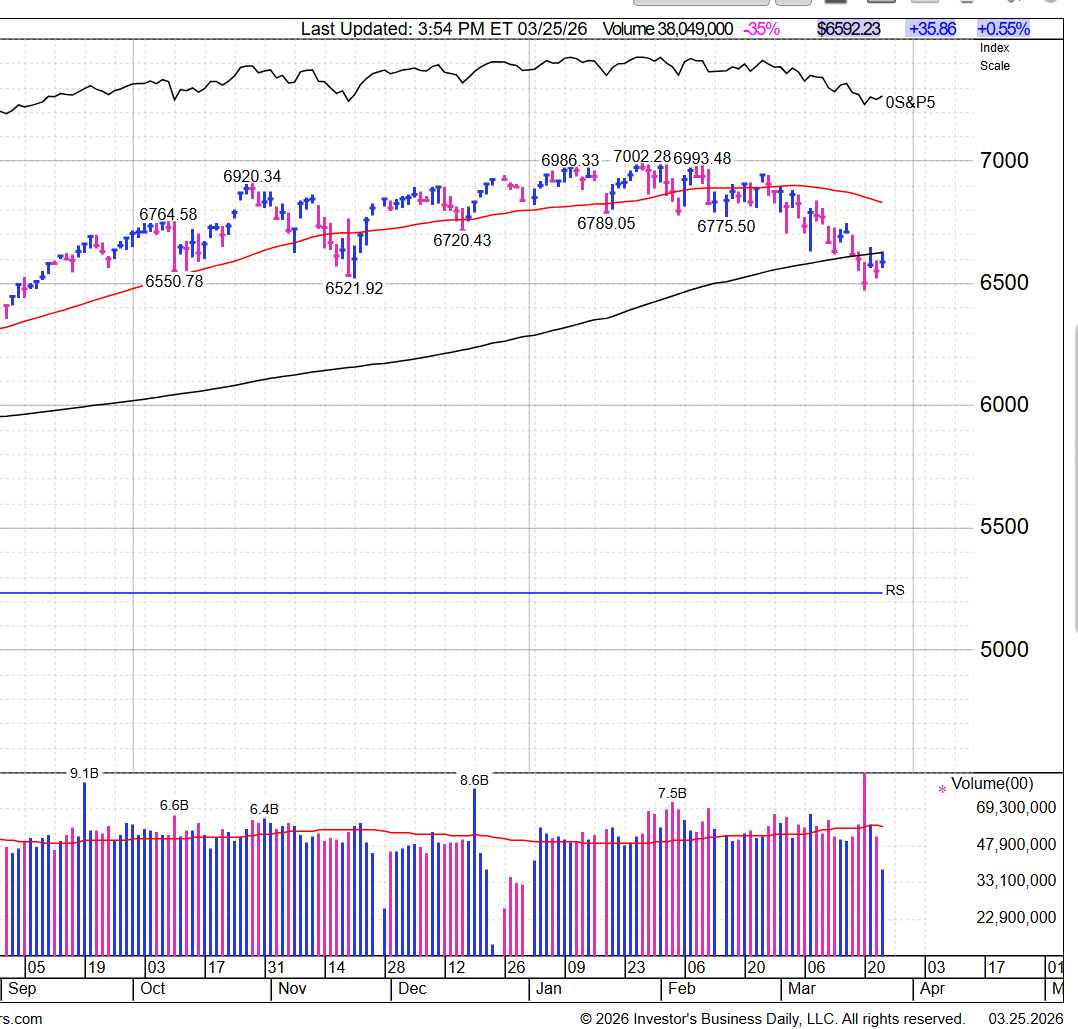
Technically, this is a classic snapback: Indexes that broke below the 200-day are rallying back toward it, while Indexes that held the 200-day are bouncing off it. That’s typical countertrend behavior until proven otherwise.
Expect volatility to remain elevated. That’s not where low-risk money is made, but it's certainly where the risk is. Your job during corrections is simple: identify the stocks showing the best relative strength and the tightest price action. Those are your future leaders when the market finally turns.
On the macro side, nothing has been resolved. Higher crude prices are still a problem. Yesterday’s rally did nothing to materially bring down oil. The bigger issue is still in play and the jury still out. Oil at these levels feeds inflation, pressures growth, and gives the Fed a reason to stay on hold longer. Yields stay elevated in that environment.
To cut through all the noise, I look to the market itself, which has a much better track record of telling us the truth than the politicians, the analysts, the news, and the gurus.
The four steps of the bottoming process are:
1. Oversold – The difference between an ordinary pullback and an oversold condition starts with price, but it does not end there. Poor breadth and and a lack of volume confirmed follow through describe a one-sided market, and one not to trust.
2. Rally – Inevitably, the market bounces from its oversold condition. A high-quality rally is broad-based. A low-quality rally is defined by short covering and driven primarily by the stocks that have declined the most. Again, the character of the rally is important to distinguish. So far, we simply don't have enough data to make a confident determination, so patience is the watch word while we wait.
3. Retest – After the rally, there is almost always a retest. The popular averages approach, and in some cases breach, their oversold lows. The key to a successful retest is less selling pressure, such as fewer stocks below their moving averages, fewer stocks, sectors, and markets making new lows, less total volume, and less downside volume. If the retest fails, the process reverts and we generally start looking for divergences during lower lows. In the event of unexpected news, it is possible for the market to recover in a "V" fashion with no retest. In that case, we look at breadth confirmation and participation.
4. Breadth thrusts – In the final phase, not only do benchmark indices rally sharply with few pullbacks, but they do so with an extremely high percentage of stocks, sectors, and markets participating, or what technical analysts call breadth thrusts. In rare cases, the market has skipped step 3. With strong enough breadth, retests are not necessary. The Covid bottom is an example of a pretty powerful V-shaped recovery.
Bottom line:
This was an oversold rally, sparked by headlines—but not defined by them, and certainly not confirmation of a reliable bottom.
Now we watch:
--Quality of follow-through
--Emergence of leadership
--Market internals and model health
If the rally lacks quality, if economic pressure builds, or if leading stocks begin to deteriorate, then this remains what it likely is—a rally within a correction.
Stay objective. Let the market prove itself. If you are going to trade, do so incrementally.
minervini.com
English
Felipe Pablo RO retweetledi

The market's character is still one of a bear market or cyclical correction; strong open, fade into close and major average living below the 200-day line. Before a reliable bottom can be established, we need to see better price and volume action, including better action from breakout names forming bases.
We are clearly NOT out of the woods yet. The market backdrop is one where sentiment has improved with rising pessimism, but not a full capitulation. The VIX has reached bear warning levels, but remains below true washout extremes. A volatility washout is not required for a bottom, but would add conviction.
Bullish Scenario
--The war ends
--Oil prices recede
--Stagflation concerns ease
--Central banks continuing their easing trajectory
Under this scenario, we would expect:
-A broadening market advance
-Emergence of new leadership from sound bases
-A Follow-Through Day (FTD) on the NYSE and/or NASDAQ confirming institutional buying with little in the way of immediate distribution
-Significant drop in volatility
Bearish Scenario
--The war persists or escalates
--The Strait of Hormuz remains disrupted
--Oil prices make new highs
--Stagflation becomes evident in hard economic data
This would likely result in:
-Limited general market rally attempts with most breakout stocks failing
-Lack of follow-through from breakout names
-Further deterioration in breadth and leadership
-Dearth of setups in buyable position
-Continued elevated volatility and distribution
In that case, sentiment would likely need to reach higher levels of pessimism before a durable market bottom could form. In its absence, and end to the factors that are pressuring the market could cause the market to bottom in less dramatic fashion.

English
Felipe Pablo RO retweetledi

@JohnMuchow Wow! Very interesting and could be very useful John!
English