Nikhil

2.3K posts

Nikhil banner
Nikhil

Nikhil

@FiisibleTrends

Writer · Trader · Amateur Historian | I write about markets, history and everything under the sun. 📩 Weekly newsletter: https://t.co/6RRzyZ8SAn

My Work 👉🏼 Katılım Şubat 2024
148 Takip Edilen1.1K Takipçiler
Sabitlenmiş Tweet
Nikhil
Nikhil@FiisibleTrends·
Introducing The Master Trading Sheet This is a free resource that includes all the basic calculators that every trader and investor must have. You can create more complex calculators but the foundation will always remain this. docs.google.com/spreadsheets/d… What does it have? 1. Portfolio Manager You can input your stock name based on the guidelines and the sheet will help you track the performance of the individual stock as well as the entire portfolio. 2. Position Size Calculator All the good traders use a form of position sizing calculator. It tells you what quantity you should buy based on the account risk you can tolerate. 3. Leverage Calculator Most people have no clue how much leverage they are taking. So, I have created a simple calculator to help them understand how much risk they are taking. I have deliberately kept it next to the Position Size calculator so you can make an instant decision. 4. MTF Calculator MTF is the vice of a bull market. Many people think if only they could have invested more they would have made more. So it's important to know the full story by numbers. Is MTF really good? If yes, in what scenarios? If bad, why is it bad? You take the call. 5. SIP Calculator Although it's available everywhere I wanted to add it here because what's the point of the Master Trading Sheet if I don't put the SIP calculator in here. How to utilize this sheet? I have provided access to everyone. You cannot edit this sheet (obviously). You can create a copy of this sheet in your account and explore it. Although I have made every effort to make the sheet easy to use, some people can have some doubts and I understand that. For those, my DMs are always open. Do not hesitate to drop me a DM :) The only perk of having a low follower count is that I can engage with more people. I hope you find this useful. I'd love to get your feedback. :)
English
4
21
54
9.9K
Nikhil
Nikhil@FiisibleTrends·
This frame hits so hard because it explores an unspoken truth, something everyone feels in their bones but cannot quite articulate. Indian civilisation is the mother of all civilisations. It developed political and educational frameworks, produced political treatises, and created deeply sophisticated religious works. It cultivated a lineage of saints who preserved and transmitted this knowledge through rituals and scriptures. It is the birthplace of a tradition where science, mathematics, and technical inquiry were never in conflict with religion. One could be deeply religious and yet highly accomplished in mathematics and astronomy. It had already grasped the core essence of life and civilisation. Indian culture has no predecessor. That is why there is no true parallel to Indian cultural narratives and moral frameworks anywhere in the world. This is precisely what makes India feel so ancient and mystical. We have stonework that predates every organised religion. Imagine the body of knowledge required to conceive and execute such enduring stone architecture. Many of the religions we see today, in some form, carry echoes of what originated in Hindu thought. This is not an argument from an anthropological lens, of genetic origins or linguistic patterns, but from a deeper civilisational and existential continuity, independent of migration narratives. This subcontinent has witnessed some of the most profound experiments in religion and philosophy, giving rise to Buddhism, Jainism, and numerous other sects, largely without bloodshed. As someone who has been a lifelong student of history, I see India as the mother of civilisation, without parallel.
🤙🏻😎@Ntr1166177

James Cameron also can’t match this frame

English
0
0
1
106
Nikhil
Nikhil@FiisibleTrends·
While I mostly agree with this sentiment, it’s important to consider the commercial angle as well. Not everyone invests this much money to damage Ramayana, especially knowing it would aggravate audiences and put the artists’ careers at risk. Most of the time, people are hired for their professionalism and skill sets, particularly to bring a vision to life on screen. Unless the script explicitly allows them to take liberties, they will not, especially when such large sums of money are at stake. I think Ramayana will turn out well. Not because of Nitesh Tiwari, Shridhar Raghavan, or anyone from Bollywood, but because the investors and executive producers will ensure that no unnecessary risks are taken with the money. They already tried taking liberties with Adipurush, and the outcome speaks for itself. So it is very unlikely that they will repeat the same mistake.
English
3
2
15
4.5K
Rajeev Mantri
Rajeev Mantri@RMantri·
The writer of Ramayana, directed by Nitesh Tiwari, is Shridhar Raghavan. His credits include: War, Pathaan, Jawan, Tiger 3, War 2 (4 films of the trashy and lies-filled “YRF Spy Universe”, a series now likely destroyed and eviscerated by Dhurandhar’s tsunami of truth). Shridhar Raghavan is the brother of Sriram Raghavan - writer / director of Agent Vinod (which asserted global terrorism is a “Zionist and Capitalist” conspiracy) and the recent disaster, Ikkis (which manipulated the story of Param Vir Chakra Arun Khetarpal). These types of sickos are now writing the script of a film on our Ramayan. You can imagine what they will generate. Don’t have high hopes from it.
KBP Reviews@KshitizCritic

The Meltdown started by #Dhurandhar2 will not stop anytime soon, The wave of change has arrived in Bollywood. A Full Fledged Accurate #Ramayana will Burn the Ecosystem completely, Director Nitesh Tiwari has Spend 10 Years on research and writing of Ramayana, Pundits and Rishi have been consulted for accuracy and precision. Get Ready to witness the most accurate and Precise Ramayana ever. Never seen before in Indian Cinema is arriving.

English
77
662
2.9K
169K
Nikhil
Nikhil@FiisibleTrends·
Qullamaggie’s strategy is out in the open for anyone to copy. And yet, people still fail to make money. You don’t see many performers like him. That, in itself, tells you something important: strategies can be copied, but mindset cannot. It also reveals that while strategies matter, they are largely overrated. Any strategy can work if you understand the fundamental relationship between how much you are willing to lose and the potential for gain. This is precisely what reshapes your mindset, the acceptance that every strategy must be judged through this lens. And once you understand that relationship, you must also evaluate whether it is toxic or peaceful. No one wants to stay in a bad relationship, right? It leaves you burned out and dissatisfied. A strategy is no different. You cannot follow something for a decade if it does not align with your personality. That is why mindset is so important, and so often discussed. Your mindset determines the choices you make, both in selecting a strategy and in staying committed to it.
English
0
1
5
154
Nikhil
Nikhil@FiisibleTrends·
It's been a while since I published a newsletter edition. Partly because I've been less active on social media, focusing on other projects. But the current state of the market demands an edition. Not because I'm an expert — (who the fuck is, in markets anyway!) — but because I have a few thoughts worth adding to the noise. As always, if you haven't subscribed yet, you should. Link's in the bio. It hits your inbox at 3:30 PM today.
English
0
0
1
107
Nikhil
Nikhil@FiisibleTrends·
@ihtesham2005 You can learn about a theoretical topic through this technique. But you cannot acquire a skill using this approach. Also, while it gives you a good debating prowess, it doesn’t give you depth.
English
5
0
29
2.9K
Ihtesham Ali
Ihtesham Ali@ihtesham2005·
I accidentally discovered how to compress a semester of learning into 48 hours. A grad student at MIT showed me his NotebookLM setup. I thought he was just organized. Then I watched him pass a qualifying exam on a subject he'd never studied before. Here's exactly what he did: First: he didn't upload a textbook. He uploaded 6 textbooks, 15 research papers, and every lecture transcript he could find on the subject. Then he asked NotebookLM one question: "What are the 5 core mental models that every expert in this field shares?" Not "summarize this." Not "explain this topic." Mental models. The stuff that takes professors years to develop. But the next part is what broke my brain. He followed up with: "Now show me the 3 places where experts in this field fundamentally disagree, and what each side's strongest argument is." In 20 minutes he had a map of the entire intellectual landscape of the field: the debates, the consensus, the open questions. Most students spend a full semester just figuring out what those debates even are. Then he did something I've never seen before. He asked: "Generate 10 questions that would expose whether someone deeply understands this subject versus someone who just memorized facts." He spent the next 6 hours answering those questions using the source material. Every wrong answer triggered a follow-up: "Explain why this is wrong and what I'm missing." By hour 48, he could hold a conversation with his thesis advisor without getting destroyed. The tool didn't change. The questions did. Most people treat NotebookLM like a fancy highlighter. These students are using it like a private tutor who has read everything ever written on the subject. The difference between a semester and 48 hours isn't the amount of content. It's knowing which questions to ask.
Ihtesham Ali tweet media
English
245
2.5K
16.6K
4.8M
Nikhil
Nikhil@FiisibleTrends·
i will debunk some of the popular claims within Islam that are often used to portray it as a “peaceful” religion. (will delete this if required because i would like my throat to remain intact) their prophet began raids on neighbouring tribes, known as qabila. he referred to these expeditions as ghazwa. however, when the time came to raid their fellow tribes in Mecca, the prophet conveniently reframed ghazwa as jihaad, presenting it as a righteous war. the zakat that they speak of so proudly was not always simply about charity. it was a mandatory religious tax. the prophet used to send amil (tax collectors) to gather the compulsory zakat. when the prophet died, many of the people who had converted to Islam refused to continue paying this religious tax. some suggested they would still follow the religion but would not pay money for it. others refused to follow the religion altogether. Abu Bakr, the first khalifa among the four Rashidun caliphs, declared them guilty of ridda (apostasy) and called for an all-out war. this conflict came to be known as the Ridda wars. after the wars, the caliphate mandated zakat regardless of the ruler or the times. later, during the Abbasid period, jurists formalised the rules, including the requirement of paying 2.5% annually, along with additional conditions that are still followed today. the political Islam we see today is, in many ways, an extension of the Ridda wars. by the eighteenth century, according to certain desert preachers, Islam had been “corrupted” by Sufism. so when Ibn Saud, with British support, took control of the Hejaz kingdom, the region of the Arabian peninsula where Mecca and Medina are located, he encountered Muhammad ibn al-Wahhab and struck a deal with him. make me the religious leader, and i will give you political legitimacy. that handshake in 1774 may well have been one of the most consequential handshakes in world history. from this alliance emerged a strict interpretation of Islam known as Wahhabism. in essence, anyone who does not follow the practices of the first three generations of Islam is considered an apostate, even other Muslims. this orientation is often associated with Salafi thought. and apostasy is treated as a crime within this framework. this doctrine became a foundation for what is now called political Islam. many of the phenomena we witness today, terrorism, fundamentalism, and radical preaching, trace ideological roots to this theological current. madrassas often follow similar curricula across regions, and several militant organisations have drawn inspiration from this ideology, including al-Qaeda. to offer perspective, over the past few decades Saudi Arabia has reportedly spent around 90 billion dollars promoting this interpretation of Islam globally. many madrassas and mosques have been influenced by this version. in India alone, the spending has been estimated at around 6500 crores, a substantial amount directed toward religious expansion. this is one reason why you sometimes see children developing hostility toward people they barely understand, because such narratives can be embedded in what they are taught in certain madrassas. many ordinary Muslims have little awareness of the theological debates behind what they are taught. questioning these interpretations is often discouraged because “ijtihad” (independent legal reasoning) is considered closed by some authorities. i could go on, but this should be enough for anyone to see what, in my view, lies beneath the “peaceful” facade.
English
0
0
1
357
saket साकेत ಸಾಕೇತ್ 🇮🇳
The only problem with Hindu understanding of Muslim politics is we attempt to separate the political and religious Islam. In Islam, the worst dimensions of their faith takes shape because religious Islam and political Islam are one and they same. @tmkrishna like most Brahmin Hindus looks at Muslims through Hindu lenses where a Vishwamitra, himself a Kshatriya, reaches out to the State to fight crime instead of picking the arms himself. In Islam, battle of Badra, which was a caravan raid for loot and plunder was led by their Prophet. There was no differentiation between Spiritual and Military leadership. When Krishna questions Characters in Anand Math for looking at every Muslim as an oppressor, he is forgetting that under Islam, there is no division of work, and in its utmost purity, all Muslims are not Bhakt of Allah but soldiers of Islam. This book was written too close to the end of oppressive Muslim rule in Bengal and Bankim would have seen even a Muslim vegetable vendor acting like a soldier of faith. This was before post-partition blood being whitewashed by the Congress.
ThePrintIndia@ThePrintIndia

Vande Mataram in Bankim Chandra’s Anandamath is a violent, anti-Muslim war cry Read this excerpt from TM Krishna @tmkrishna's 'We, the People of India', a @ContextIndia publication #ThePrintPageTurner theprint.in/pageturner/exc…

English
7
172
507
17.8K
Nikhil
Nikhil@FiisibleTrends·
i will debunk some of the popular claims within Islam that are often used to portray it as a “peaceful” religion. (will delete this if required because i would like my throat to remain intact) their prophet began raids on neighbouring tribes, known as qabila. he referred to these expeditions as ghazwa. however, when the time came to raid their fellow tribes in Mecca, the prophet conveniently reframed ghazwa as jihaad, presenting it as a righteous war. the zakat that they speak of so proudly was not always simply about charity. it was a mandatory religious tax. the prophet used to send amil (tax collectors) to gather the compulsory zakat. when the prophet died, many of the people who had converted to Islam refused to continue paying this religious tax. some suggested they would still follow the religion but would not pay money for it. others refused to follow the religion altogether. Abu Bakr, the first khalifa among the four Rashidun caliphs, declared them guilty of ridda (apostasy) and called for an all-out war. this conflict came to be known as the Ridda wars. after the wars, the caliphate mandated zakat regardless of the ruler or the times. later, during the Abbasid period, jurists formalised the rules, including the requirement of paying 2.5% annually, along with additional conditions that are still followed today. the political Islam we see today is, in many ways, an extension of the Ridda wars. by the eighteenth century, according to certain desert preachers, Islam had been “corrupted” by Sufism. so when Ibn Saud, with British support, took control of the Hejaz kingdom, the region of the Arabian peninsula where Mecca and Medina are located, he encountered Muhammad ibn al-Wahhab and struck a deal with him. make me the religious leader, and i will give you political legitimacy. that handshake in 1774 may well have been one of the most consequential handshakes in world history. from this alliance emerged a strict interpretation of Islam known as Wahhabism. in essence, anyone who does not follow the practices of the first three generations of Islam is considered an apostate, even other Muslims. this orientation is often associated with Salafi thought. and apostasy is treated as a crime within this framework. this doctrine became a foundation for what is now called political Islam. many of the phenomena we witness today, terrorism, fundamentalism, and radical preaching, trace ideological roots to this theological current. madrassas often follow similar curricula across regions, and several militant organisations have drawn inspiration from this ideology, including al-Qaeda. to offer perspective, over the past few decades Saudi Arabia has reportedly spent around 90 billion dollars promoting this interpretation of Islam globally. many madrassas and mosques have been influenced by this version. in India alone, the spending has been estimated at around 6500 crores, a substantial amount directed toward religious expansion. this is one reason why you sometimes see children developing hostility toward people they barely understand, because such narratives can be embedded in what they are taught in certain madrassas. many ordinary Muslims have little awareness of the theological debates behind what they are taught. questioning these interpretations is often discouraged because “ijtihad” (independent legal reasoning) is considered closed by some authorities. i could go on, but this should be enough for anyone to see what, in my view, lies beneath the “peaceful” facade.
saket साकेत ಸಾಕೇತ್ 🇮🇳@saket71

The only problem with Hindu understanding of Muslim politics is we attempt to separate the political and religious Islam. In Islam, the worst dimensions of their faith takes shape because religious Islam and political Islam are one and they same. @tmkrishna like most Brahmin Hindus looks at Muslims through Hindu lenses where a Vishwamitra, himself a Kshatriya, reaches out to the State to fight crime instead of picking the arms himself. In Islam, battle of Badra, which was a caravan raid for loot and plunder was led by their Prophet. There was no differentiation between Spiritual and Military leadership. When Krishna questions Characters in Anand Math for looking at every Muslim as an oppressor, he is forgetting that under Islam, there is no division of work, and in its utmost purity, all Muslims are not Bhakt of Allah but soldiers of Islam. This book was written too close to the end of oppressive Muslim rule in Bengal and Bankim would have seen even a Muslim vegetable vendor acting like a soldier of faith. This was before post-partition blood being whitewashed by the Congress.

English
0
0
0
106
Nikhil
Nikhil@FiisibleTrends·
After watching the trailer of Dhurandhar: The Revenge, I am glad they moved Toxic’s release date to June. Otherwise, they would have been annihilated at the box office. I also agree with RGV that the second part will blow us away. From the trailer alone, I am convinced we are in for the ultimate treat from Aditya Dhar. What a beautiful gift to cinema he is. He has Tarantino’s finesse when depicting violence. It blends seamlessly with the plot and never appears vulgar or gratuitously gory. The storyline still appears tight and steadily expanding. When both parts are released, the film will likely become Aditya Dhar’s magnum opus for years to come. And if you are not convinced by Aditya Dhar’s stance throughout the film, you certainly will be when you see the final frame and understand how much he values Anupama Chopra and her kind. All in all, we are witnessing a true masterpiece from a director so deeply in love with his craft and with the masters he learned from that he has elevated that craft to new heights. Of course, Bollywood is finished, but it will not accept defeat. It will inevitably mimic Dhar’s signature violence and musical themes and turn them into crass imitations. They will exhaust his formula to the point that even he may find it difficult to use it effectively in the future. That is the hallmark of people who lack creativity and any sense of grand vision. Either way, I cannot wait for the film to hit the theatres. This is, and will remain, one of the best things to have happened to Indian cinema. #DhurandharTheRevenge
English
0
0
3
179
Nikhil
Nikhil@FiisibleTrends·
If you are someone who does debit spreads, then this is for you. The fixed-point (of spot) spread in options is the worst way to handle volatility. There are people out there on YouTube and on social media who promote creating fixed index point spreads without explaining what to do when the regime shifts from low volatility to higher volatility, or vice versa. If India VIX is around 10–12, a 300-point spread in Nifty will give you approximately 0.25 delta. But if the VIX shoots to 20, the same 300-point spread in Nifty will give you approximately 0.14 delta. That's 44% lower profitability! The obvious advantage is the risk cushion that comes with lower delta. If volatility is higher and it comes with bigger trends, you are effectively losing the opportunity to make big money by sacrificing delta. Do not dictate your spread based on spot points. Instead, check the delta you are comfortable with. If you are comfortable with 0.25 delta, then in higher VIX it might take an 800-point spread in Nifty. In lower VIX, you might even need only a 200-point spread. I am not an expert in credit spreads, but theoretically the concept should apply there as well.
English
0
0
0
105
Nikhil
Nikhil@FiisibleTrends·
the best fights are the ones you don't have. in the Second World War, the US didn't enter the war until provoked. the British, on the other hand, were exhausted, financially and morally, after two wars. in the end, the US acted in its own interests and ended up forging its hegemony over the world. sovereigns don't act on impulses. they act on incentives.
English
0
0
1
93
Hardik Rajgor
Hardik Rajgor@Hardism·
People who wanted India to pursue peace after the Parliament attack, Mumbai train bombings and 26/11; are demanding that India show "spine" in a war between Iran and Israel in international territory. India's only interests in this war are its diaspora in the GCC, and energy supplies flowing through shipping routes. Whoever helps secure both - India will lean on their side. All the moralising, grandstanding, 'aankh dikha denge', being on the 'right side of history', is unserious nonsense that has no meaning or practicality in the real world.
English
29
373
1.3K
33.7K
Nikhil
Nikhil@FiisibleTrends·
india finally enters the world cup final for the fourth time. but since the time we lost to south africa, something has shifted inside me. i am no longer confident that we are right there or that the trophy belongs to us. i don't feel we are invincible. we have some absolutely amazing players in our team, but the team as a collective unit isn't dominating the way it was supposed to. we are there mainly because of heroic performances. we are not firing on all cylinders. i wouldn't be surprised if new zealand takes the trophy this time. they seem more desperate since they aren't the favorites. and the way they defeated south africa feels like this was the exact metamorphosis they needed to truly act like a giant that could lift the trophy. i am glad india reached the finals, considering that at one stage we were unsure whether we would even qualify for the semis. i don't want to be the one who says it out loud, but if god forbid we lose the final, please don't blame the stadium or the ground. everyone is allowed one bad day, which was the case on 19 november 2023. but unlike 19 november, this time i don't feel the team is there yet. the invincibility is shattered. and heroic performances can save a day, not a tournament. you eventually get exposed. still, as a fan i want to be wrong. i have always cheered india and will continue to do so because i don't think we are a bad team, we just aren't performing to the standards that we have set for ourselves. #T20WC2026
English
0
0
2
154
Nikhil
Nikhil@FiisibleTrends·
It gets even weird when one realises that Khamenei was a Shia. And Shias are considered heretics by Sunnis. So right now, they are united by their hatred for zionist regime. To them, it’s like the Crusades when Shias and Sunnis came together to fight a holy war. When they won that war, they fought among themselves. Saudis are hardcore Sunnis and yet are showing restraint because fighting a fellow Muslim regime complicates the very theology they practice. It would have been funny if it wasn’t so dangerous.
English
0
0
1
19
Jayesh Mohta
Jayesh Mohta@mohta_jayesh·
@FiisibleTrends To Muslims, the death of the Ayatollah served as a powerful symbol of martyrdom.
English
1
0
0
19
Nikhil
Nikhil@FiisibleTrends·
The reason the Middle East war appears so brutal to a layman is that they do not understand the absurdity of it all. There is a regime that is essentially suicidal. It is built upon a culture that rewards such tendencies and recruits people who get high on them. With them, you are never really at war with a country or a regime. It is always framed as a religious war. That is how they unite a scattered community. The extreme brainwashing through madrassas has made it almost mandatory for ordinary Muslims across the world to care about all Muslims, regardless of morality or relevance. So it is no wonder that many come out in support of Iran while hating Israel and America. That is their whole basis of existence. That is Wahhabism in its stark, naked form. The war, even if it ends on whatever terms, will continue in the minds of Muslims across the globe. Because for them this is not about geopolitics. It is always about religion and jihad. And therefore, in a way, it becomes mandatory for them to pick a side. A Hindu or a Christian can afford to be objective based on who they believe is in the wrong. But for a Muslim, the decision is already made for them. That decision was made when they entered the madrassa and listened to the khutba on Friday. There are no confused Muslims; you will never find a Muslim who is unsure of which side to pick. They are always sure, they always know who to hate. So for them, as long as the West is not conquered, they will continue to fight what they see as a holy war. This is the absurdity the world is dealing with right now. The Middle East is merely the symptom. The disease lies elsewhere.
English
1
1
2
114
Nikhil
Nikhil@FiisibleTrends·
The two central architectural themes in all Islamic architecture, including their mosques, are pishtaq and iwan. They both are borrowed from Persian architecture. You already mentioned the dome, but the concept of four pillars around the domes— chahar taq— was also borrowed, partly from Byzantine architecture also. The square gardens (chahar bagh)that got so popular in Islamic architecture also borrowed from Persian architecture. The entire Islamic political administration was filled with Persians. In fact, their “golden age” was essentially a translation movement. They translated all the books from Persia, Greek, and India. That translation happened in Jundishapur, an ancient Persian town. By converted Persians, Greeks, and Indians. Even their vocabularies are borrowed from Persian language. No wonder they couldn’t produce anything ever again. It was all a farce (Fars) (pun intended).
English
0
1
3
604
Siavash Safavi
Siavash Safavi@SedSia·
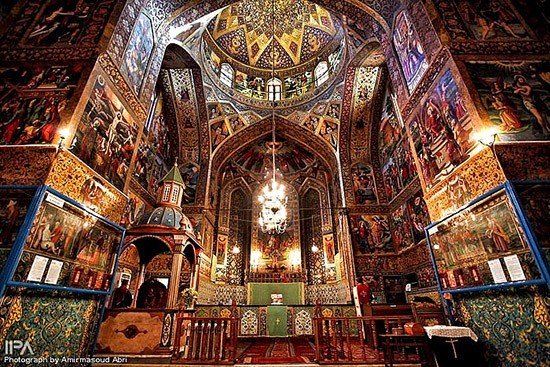
There is no "Islamic" golden age of science. Ibn Khaldun, Arab sociologist: "Only the Persians engaged in the task of preserving knowledge and writing systematic scholarly works. Thus the truth of the Prophet's statement becomes apparent, 'If knowledge was hanging from the highest stars in heaven, the Persians would attain it'..." Ibn Khaldun, the Arab father of sociology, continues: "It is a remarkable fact that with few exceptions, most Muslim scholars…in the intellectual sciences have been non-Arabs. Thus even the founders of (Arabic) grammar were Sibawaih and after him... all of them were of Persian… great jurists were Persians… ." Regarding the Islamic Golden Age of Science, Abbasid Caliph Mamun, who had an Iranian mother, defeated his brother Amin with an Iranian army and became the Caliph. He started the "Translation Movement", and science books from Persia, Greek Egypt, and conquered Roman territories were translated into one language, Arabic, which naturally caused a scientific boom. Not because of Islam, but because of Mamun, who fought the Abbasid nobility tooth and nail and defeated them. Go check the list of Islamic "fathers of sciences". Majority of them are Iranians, and a lot of the rest are Spanish. Kharazmi, Biruni, Avesina (Ibn Sina), Rhazes (Razi), Khayyam, Farabi, Majusi, Tusi, and Farabi, were all Iranians just to name a few. Not Islamic scientists. Most of them were actually labeled as Kafir by Islamists of their time. (If you don't recognize some of these names, add an "al" at the beginning of them and you might.) Also, there is no "Islamic architecture." What you have is Islam appropriating Iranian and Mesopotamian architecture. You see that dome on top of most mosques? That's signature Iranian architecture. And yes, the Taj Mahal is an example of Iranian architecture. The translation movement was immediately stopped by the Abbasids after al-Mamun and its effects died down in a few centuries. There was never another scientific boom in the Islamic world. I have searched every claim I made here and they seem to be well-established facts. I encourage you to research them and tell me if I'm wrong. This is not a flex about history. That's a stupid thing to do. I love my Arab friends and I hate tribalism. My issue is not even with Islam as a personal religion but with Islamism as a political and public force. I do believe in national identity, and I don't like lies, and Islamists have been spreading them for as long as I can remember. Islamists have one identity, Islam, no nationality exists under Islamism. If we are to step forward with open eyes, we have to recognize the false narratives we were fed for generations and know exactly where we come from. Photo on the left: The Armenian Cathedral in Isfahan, Vank. An example of Iranian, and not Islamic, architecture. Photo on the right: Inside the Taj Mahal, designed by an Iranian architect.
Siavash Safavi tweet mediaSiavash Safavi tweet media
English
68
624
2.2K
118.6K
Nikhil
Nikhil@FiisibleTrends·
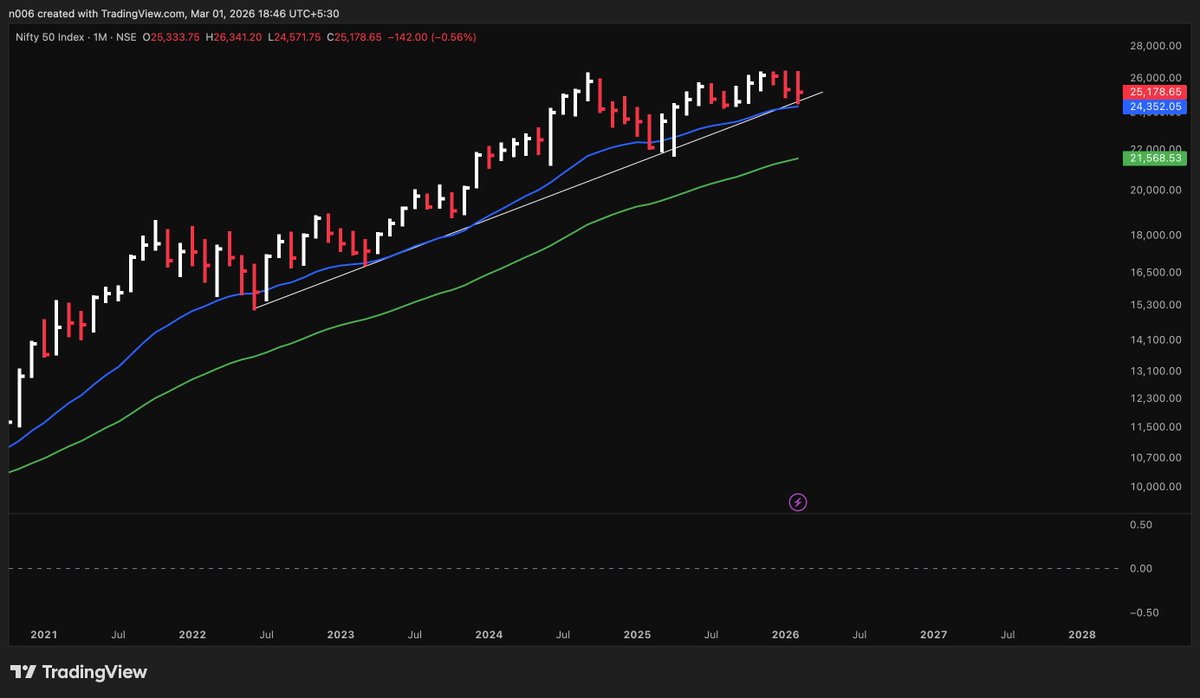
#Nifty on Monthly Nothing good can ever happen below the trendline. From 2022's bottom, we have come far. And we have come with strength. But that strength is depleting, or so it seems. We failed to cross the highs. So now what's left is finding the bottom somewhere. It’d be interesting to see how the market reacts next week. There’ll certainly be a knee-jerk reaction, but the magnitude of it would be interesting to see.
Nikhil tweet media
English
0
0
0
456
Nikhil
Nikhil@FiisibleTrends·
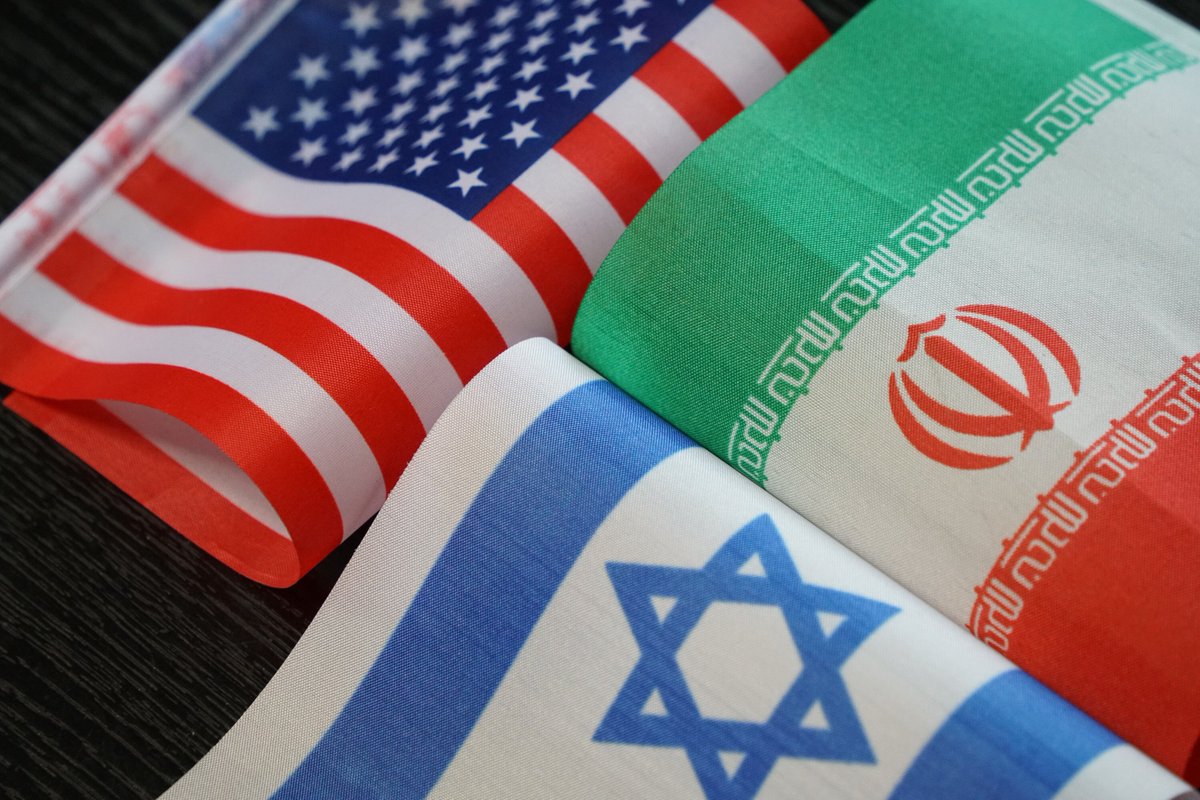
Geopolitically, the Middle East is officially now on a boilerplate. The crisis might engulf the entire world if not contained. The Long Setup Iran and Israel have been in a cold war for decades. Iran funds Hamas, Hezbollah, and the Houthis; these are the proxies designed to bleed Israel without direct confrontation. Iran also kept quietly advancing its nuclear programme. The US, under Obama, made a deal (JCPOA 2015) to slow it down. But Trump pulled out in 2018, and Iran resumed its uranium enrichment. Then came… October 7, 2023 -- Everything Accelerates Hamas, armed and backed by Iran, launches one of the worst attacks on Israel in its history. Israel goes to war in Gaza. In the process, it systematically dismantles Iran's proxy network, kills Nasrallah (Hezbollah chief), kills Haniyeh (Hamas leader, in Tehran itself), decimates Hezbollah in Lebanon, and neuters the Houthis. Iran's "Axis of Resistance" was effectively dismembered, and its weaknesses were laid bare. April-October 2024 -- Iran Tries Direct Force, Fails Iran launches an unprecedented direct attack on Israel in April 2024, firing over 300 missiles and drones. A US-led coalition helps Israel intercept most of it. Iran tries again in October. Same result. Iran’s weaknesses were being exposed. June 2025 -- Israel Strikes Iran Directly Seeing Iran weakened and its air defences exposed, Israel goes for the kill. On June 12, the IAEA declared Iran was violating its non-proliferation obligations, prompting Iran to announce it would open a secret uranium enrichment site. The next day, Israel launched a unilateral strike targeting nuclear facilities, missile factories, and senior military and nuclear personnel. Iran retaliated with 550+ ballistic missiles and 1,000+ drones. The US intercepted Iranian attacks and bombed three Iranian nuclear sites on June 22. Iran then fired missiles at a US base in Qatar. A ceasefire was reached on June 24 under US pressure. The "Twelve-Day War" ended. It cost Israel up to $12 billion and depleted a quarter of the entire US stock of THAAD interceptors. Iran's nuclear programme was damaged but, crucially, not destroyed; the IAEA director later confirmed most of Iran's enriched uranium remained intact. Late 2025 -- Iran Bleeds Internally Sanctions tightened. The Iranian rial collapsed to 1.42 million rials per dollar in December 2025. Protests erupted across the country. The demonstrations became the largest since the 1979 revolution, spreading to over 100 cities. The regime responded with massacres. Trump publicly encouraged the protesters. Iran accused the US and Israel of fomenting revolution. January-February 2026 -- US Moves Toward War Trump declared an "armada" was heading to Iran on January 28. The US began amassing air and naval assets at a level not seen since the 2003 Iraq invasion. The demands were stark: zero uranium enrichment, end ballistic missile programme, stop funding proxies. Iran refused to capitulate entirely but signalled openness to talks. February 28, 2026 -- Today: Strikes Happen Israel and the US strike multiple cities across Iran, including Tehran. Trump calls it "major combat operations." Targets include the district where Khamenei resides, the presidential palace, and IRGC infrastructure. Explosions are reported in Tehran, Qom, Isfahan, Kermanshah, Tabriz, and elsewhere. Iran has already launched missiles at northern Israel in retaliation. Trump says he wants Iran to be a "safe nation" and "freedom for the people" -- This is a language that suggests regime change is the actual goal, not just nuclear containment. The Bottom Line Israel has wanted Iran's nuclear program dead for 20 years. Trump is now fully aligned with that goal and arguably wants the regime gone entirely. Iran is militarily weakened, economically strangled, and facing domestic revolt. But it's not collapsed yet, and it's threatening to drag the whole region, US bases, Gulf states, everything, into the fire if pushed too far. This is as serious as it gets.
Nikhil tweet media
English
0
1
0
316
Nikhil
Nikhil@FiisibleTrends·
@lichthauch if this didn't go viral i would hate elon! i love reading your work. keep writing.
English
0
0
2
276
Nikhil
Nikhil@FiisibleTrends·
This is stupidity of the highest order. The people who claim to be “secular,” by demanding respect for all religions and their religious practices, deliberately resort to beef eating to mock Hindus. This has been consistent through the ages. And the only reason they pick Hindus is because: - they lack the upper hand in setting the narrative - they lack any political power - India does not have blasphemy laws for Hindus like Turkey has for Islam - Hinduism is not considered a proxy-protected religion like Islam and Christianity They will never do it with pork eating. They will never even support it. That alone should tell you that they neither care about India’s cultural identity nor secularism. They care about the narrative that Hinduism should go, and either of the Abrahamic cults should take over, because they themselves suffer from the biggest generational identity crisis.
SagasofBharat@SagasofBharat

Syrian Christians were getting persecuted which made them flee their own homeland. Hindu kings in India not only provided them with safe refuge but also land grants for them to start their lives afresh. How did they return the favour? By killing the one animal Hindus of the land held sacred & introduced recipes that shameless Hindus like the one below gobble with delight along with their self respect.

English
0
0
2
148
Nikhil
Nikhil@FiisibleTrends·
It was 1630. The Mughal Empire was at its zenith under Shahjahan. The Deccan was divided between three Sultanates — Ahmadnagar, Golconda, and Bijapur. They existed because the Deccan was where Mughal reach frayed at the edges. So the Mughals maintained a hot and cold relationship with them. Couldn’t tolerate them. Couldn’t finish them either. The Marathas were just another degraded community in the Deccan. Agriculturalists and soldiers. The Kunbi peasant base — tough, land-rooted, and nobody’s political priority. Hindus across India lived as dhimmis — legally subordinate subjects of an Islamic state. What that meant in practice: You could not build houses taller than your Muslim neighbors. You paid a special poll tax called jizya, a ritual of financial submission. You could not build new temples. You could not ride horses unless allowed. No public religious processions. You wore distinct clothing so you could be identified on sight — and treated accordingly. Into this world on 19th February 1630 was born a man who would dismantle all three Sultanates, break Mughal power in the Deccan, and lay the foundations for the end of the empire itself. Chhatrapati Shivaji Maharaj. They called him “mountain rat”. Imagine all the imperial resources at your disposal and yet couldn’t stop a rat from building his empire that would dethrone centuries of Islamic rule. Aurangzeb outlived Shivaji by 27 years — and spent nearly every one of those years fighting wars in the Deccan, draining his treasury, exhausting his armies, watching the empire hollow out from within. His final letter, written as he lay dying on that failed campaign, read: “I came alone and I go as a stranger. I do not know who I am, nor what I have been doing.” Shivaji died in 1680. Seventy-eight years later, a Maratha army was camped in Peshawar and Lahore — territory no Hindu power had reached in centuries. Taking chauth (tax) from the empire itself. 51 years after the death of Aurangzeb, Mughal empire was crushed and became a vassal of Maratha Empire. The same empire that had classified his people as subordinates was now paying them tribute in Delhi. One man. One idea. Hindavi Swarajya. Happy Birthday Raje!
Nikhil tweet media
English
0
0
0
308
Nikhil
Nikhil@FiisibleTrends·
This sounds like a hypocrisy but is not. People who deliver the best advice often cannot live that advice. That’s because they have rationalised themselves to death. The rationalisation has paralysed their mind, preventing them from executing these rational advices. Does that mean the advices are bad? Not really. It means all forms of self-help happen in two steps - 1. Diagnosis: Rationalisation is a tool to self-diagnose the cause behind the symptom. Why are you feeling it? What are you experiencing? Can you separate the reality from your feeling? Can you be objective? 2. Treatment: only after diagnosis do you discover the potential treatment. identity management. understandng causality. forgiving where required. your relation with god. These books were a good place to help us rationalise our problems. But you still need to execute those plans where it mattered.
ً@prinkasusa

The man who wrote "How to Save Your Marriage" in the U.S.? He shot his wife... and posted the photo on Facebook. Dale Carnegie - the legend behind "How to Win Friends and Influence People"? He died completely alone. Benjamin Spock, who sold millions of books on parenting? His own sons tried to put him in a nursing home. Maria Montessori, the world- famous teacher? She gave her own son away to foster care, so she could dedicate herself to other people's children. And a Korean author who wrote the bestseller "How to Be Happy"? She hanged herself, after years of depression. What does this tell us? That the people writing self-help manuals... often couldn't save themselves. Coaches. Gurus. Trainers. Influencers. They sell answers to life. They were just as lost as everyone else. Maybe even more.

English
0
0
1
159