

Luca Bertani
2.2K posts


If these prompts-cheatsheet don't change your life, I delete this post.
People who prompt Claude right are 10x ahead of everyone else using the same tool.
25 prompts, 5 rules, one cheat sheet that runs your decisions, your week, your money and your future.
Same Claude, two completely different lives, the only difference is how you talk to it.
I built this and gave it away for free, every prompt in the article below.

Defileo🔮@defileo
English
@Tabbu_ai Stanford have some of the most skilled people
now wonder we want to learn from them
English

Instead of spending 2 hours on Netflix, watch this Stanford lecture.
It will teach you more about how LLMs like ChatGPT and Claude are actually built than most people learn working inside top AI companies for years.
One of the best free deep dives into modern AI on the internet.
Save this.
Tabassum Parveen@Tabbu_ai
English
@cjzafir thanks master I swear I will use this info to get knowledge
English

Do something different this weekend.
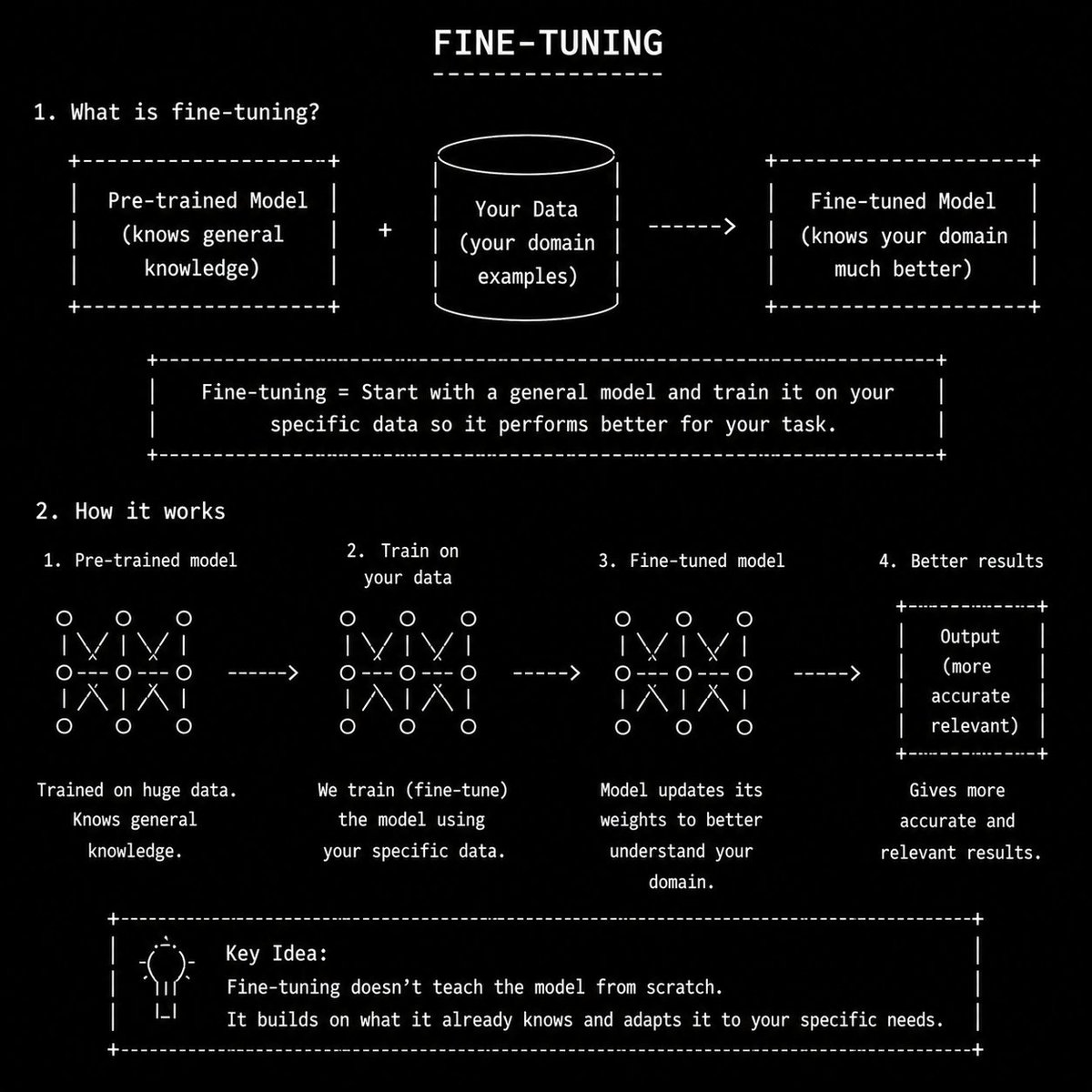
Become a PRO in AI Model Fine-tuning.
Paste this prompt in Codex/ChatGPT/Claude/Grok.
"You are an expert AI engineer and teacher.
Your job is to teach me modern LLM engineering and fine-tuning concepts from beginner to advanced level using very simple daily-life language.
Teach me step-by-step like a real mentor. Assume I am smart but new to the topic.
Foundations:
- LLM basics
- How AI models work
- Tokens
- Tokenization
- Context windows
- Embeddings
- Transformers
- Attention mechanism
- Parameters
- Training vs inference
- Open-source vs closed-source models
Datasets & Training:
- SFT datasets
- Instruction tuning
- Preference datasets
- Synthetic datasets
- Data curation
- Dataset cleaning
- Dataset formatting
- Fine-tuning basics
- Continued pretraining
- Hallucination reduction
Fine-Tuning:
- LoRA
- QLoRA
- DPO
- RLHF
- Quantization
- Model checkpoints
- Adapter tuning
- GGUF models
Inference & Optimization:
- KV cache
- Flash Attention
- Speculative decoding
- Inference optimization
- Model serving
- Batch inference
- GPU basics
- VRAM basics
- Latency vs quality tradeoffs
Local AI Ecosystem:
- llama.cpp
- Ollama
- vLLM
- MLX
- Hugging Face
- Unsloth
- Axolotl
- PEFT
- TRL library
RAG & Memory:
- RAG
- Vector databases
- Chunking
- Retrieval pipelines
- AI memory systems
- Semantic search
Agents & Workflows:
- Prompt engineering
- System prompts
- Tool calling
- Function calling
- AI agents
- Agentic workflows
- Multi-agent systems
- Browser agents
Model Types:
- VLMs
- SLMs
- Dense models
- MoE models
- Coding models
- Reasoning models
Deployment:
- Local inference
- On-device AI
- API serving
- Cloud GPUs
- Edge AI basics
Evaluation:
- AI benchmarks
- Human evals
- Cost-per-token analysis
- Speed benchmarking
- Quality benchmarking
Real-World Skills:
- Building chatbots
- Building AI copilots
- AI automation
- AI SaaS workflows
- AI coding workflows
- AI orchestration systems
- AI product thinking
Start from the absolute basics and gradually make me advanced.
Rules:
- Use simple English only
- Avoid academic jargon unless necessary
- Explain every difficult word in plain language
- Use real-world analogies and daily-life examples
- Use small code snippets when useful
- Show practical use cases
- Compare concepts side-by-side when helpful
- Teach from fundamentals first, then advanced concepts
- At the end of each topic:
- give a short summary
- give a simple mental model
- give beginner mistakes to avoid
- give a small exercise/project
I want deep understanding, not memorization."
Thank me later.
English
@cyrilXBT Voice AI for Local Service Businesses is probably best idea form hero
would save a lot of places
English

THESE ARE THE 15 BEST AI STARTUP IDEAS FOR 2026 AND MOST FOUNDERS ARE SLEEPING ON ALL OF THEM.
I analyzed everything. YC requests. Market gaps. What is already working. What is about to work.
Here is the complete list.
TIER 1: Build these right now.
1. AI Agent Auditing and Compliance
Every enterprise deploying AI agents needs external verification before regulators require it. iFixAi proved the market exists. Build the SOC 2 equivalent for AI systems. Charge $5,000 to $50,000 per audit. The compliance wave is coming whether companies are ready or not.
2. Vertical AI Agent Agencies
Pick one niche. Dental practices. Law firms. Real estate brokerages. Build and maintain their entire AI agent stack as a done-for-you service. Charge $2,000 to $5,000 per month recurring. The market is every small business that knows they need AI and has no idea where to start.
3. AI Memory Infrastructure
Every agent resets every session. Every enterprise deploying agents at scale loses context every time. The company that solves persistent cross-session memory for enterprise AI deployments owns a massive B2B infrastructure layer. Think Pinecone but purpose-built for agent memory.
4. MCP Server Marketplace
16,000 plus repos already exist across GitHub. Nobody has built the App Store equivalent with quality curation, verified security, one-click install, and usage analytics. This is an infrastructure play that compounds with every new MCP server the community creates.
5. AI-Powered Accounting for SMBs
QuickBooks has not meaningfully changed in 20 years. An AI agent that reads your bank feeds, categorizes transactions automatically, flags anomalies, prepares tax documents, and generates financial reports in plain English destroys incumbents on value and undercuts them on price.
TIER 2: Strong opportunities with clear paths.
6. Prediction Market Intelligence
The Anthropic prediction market bot hit 68.4% accuracy. Build a B2B product that gives hedge funds, corporate strategy teams, and policy organizations AI-powered probability forecasting across any domain they care about.
7. AI Skill File Marketplace
One million plus skills exist across GitHub with no curation, no quality standard, and no business model. The curated marketplace with verified quality, industry-specific collections, and enterprise licensing is the obvious next layer nobody has built yet.
8. Voice AI for Local Service Businesses
PolyAI proved the enterprise market works. The SMB version for local gyms, dental offices, restaurants, and salons is completely unserved. Build the self-serve version at $299 per month and distribute through local business associations.
9. AI Content Compliance
Every regulated industry needs content reviewed before publishing. Healthcare, finance, legal, pharmaceuticals. An AI agent that reviews content against regulatory requirements in real time before it goes live saves companies from violations worth far more than any subscription cost.
10. Solo Founder Operating System
The Obsidian plus Claude plus N8N stack works but requires technical setup most founders cannot do. Package it as a done-for-you product for non-technical founders. Onboard them in one afternoon. Charge $99 per month. The market is every solo founder on earth.
TIER 3: Longer horizon. Large markets.
11. AI Tutoring for Trade Skills — plumbers, electricians, HVAC technicians completely underserved by every major AI education company targeting white collar work.
12. GTA 6 Economy Infrastructure — the game drops this year. Build the server economy and tool ecosystem now. Launch at launch.
13. AI-Powered Immigration Services — complex, expensive, mostly template-based. An AI that handles 80% of the process at 10% of attorney cost serves a massive underserved global market.
14. Personal AI Health Dashboard — DNA plus blood work plus wearable data equals a full health operating system. Build the consumer product. HIPAA compliant. Subscription model.
15. AI Ghostwriting Agency — executives want thought leadership. They have no time. $3,000 to $10,000 per month per client. Margins above 80%.
The pattern behind every idea on this list:
Every one takes something that exists as a technical capability and packages it as a product a specific customer will pay for without understanding how it works.
The technical capability is not the startup.
The packaging, distribution, and customer understanding is the startup.
Pick the one where you understand the customer best.
That is the one you should build.
Bookmark this before you write your next idea in a notebook that never becomes a company.
Follow @cyrilXBT for more AI business ideas and the exact tech stacks to build them.

English

Everyone wants to “learn AI.”
Almost nobody wants to understand how it actually works.
That’s why most people can prompt a model…
…but can’t explain attention, tokenization, RLHF, agent loops, or what happens under the hood when an LLM calls a tool.
This repo fixes that.
“AI Engineering From Scratch” is basically a full open-source AI engineering university on GitHub:
• 435 lessons
• 20 phases
• ~320 hours
• Python, TypeScript, Rust, Julia
• Agents, MCP servers, transformers, RLHF, swarms, infra, multimodal AI
But the best part isn’t the size.
It’s the philosophy.
You don’t just watch tutorials.
You build everything yourself:
• backprop
• tokenizers
• transformers
• agent loops
• memory systems
• autonomous workflows
• production infra
from scratch.
Then every lesson ships an actual reusable artifact:
• prompts
• skills
• agents
• MCP servers
So by the end, you don’t just “know AI.”
You’ve built an entire AI engineering toolkit with your own hands.
This is one of the highest-signal open-source repos I’ve seen in a long time.
100% open source
Link in comment


English
@0xCodez so four layers can change the game for me
thanks Codez, I think I have enough strength for this
English

@Tabbu_ai huh, another good lecture from Stanford
no Netflix tonight
English
Instead of wasting hours on Netflix tonight, watch this 1-hour Stanford lecture.
It will teach you more about how LLM architectures like ChatGPT and Claude are actually built than most engineers learn inside AI companies for years.
Anthropic reportedly pays much higher for people with these skills.
Stanford released the entire breakdown for free.
Bookmark this before it disappears.
Tabassum Parveen@Tabbu_ai
English
@PrajwalTomar_ the fact that I get to read this for free is a stroke of luck
guy is alegend
English

WAIT. This is actually insane.
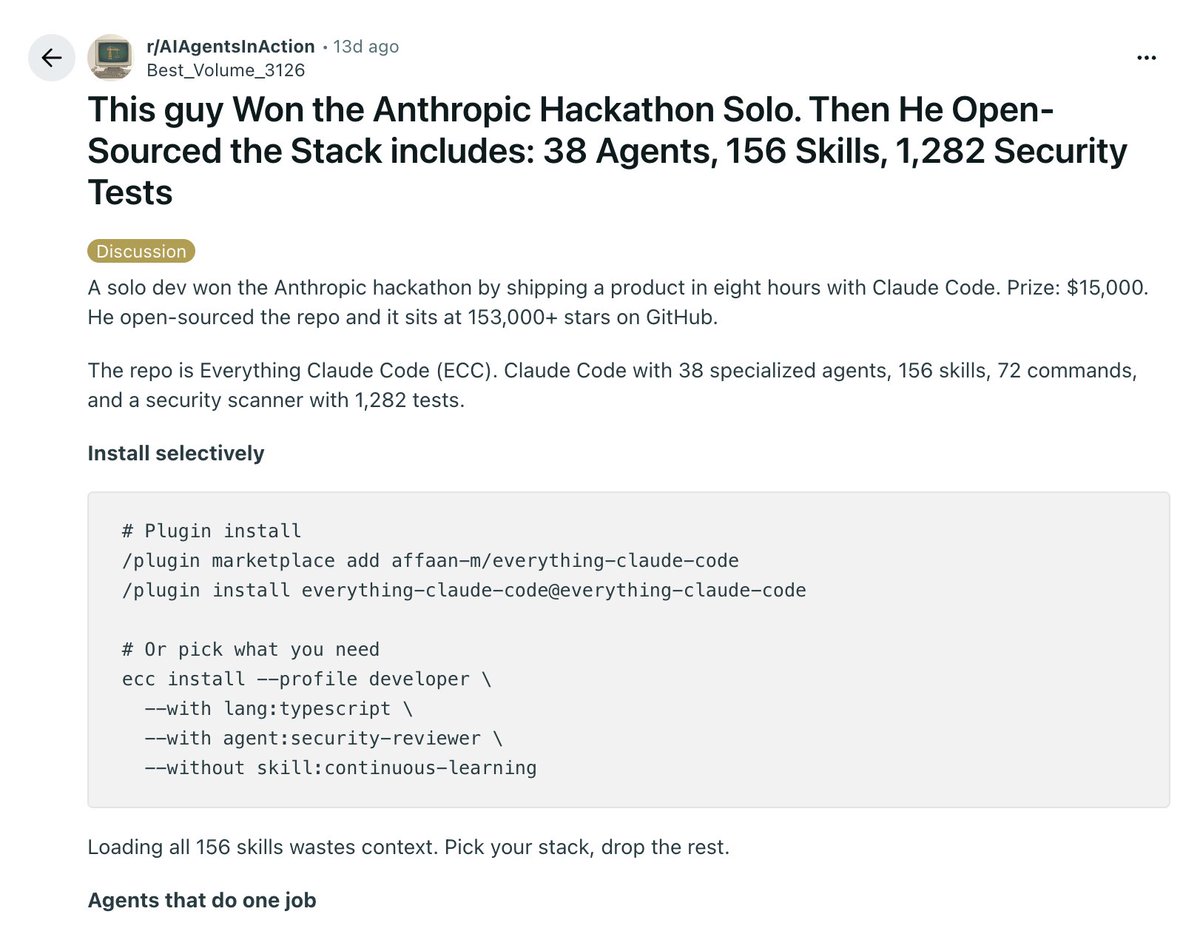
A solo dev just won the Anthropic hackathon, shipped a working product in 8 hours with Claude Code, and walked away with $15,000.
Then he open-sourced the entire stack.
153,000 stars on GitHub. Here's full setup:
→ 38 specialized agents (planner, security reviewer, debugger, code reviewer)
→ 156 skills loaded on demand (/plan, /tdd, /security-scan, /quality-gate)
→ 72 custom slash commands
→ AgentShield: 1,282 security tests across CLAUDE .md, MCP configs, hooks, skills
→ 3 Opus 4.6 agents running red-team pipelines (Attacker, Defender, Auditor)
→ Continuous learning layer that builds confidence across sessions
→ Coverage across 12 language ecosystems
This is what Claude Code looks like when someone treats it like infrastructure instead of a chatbot.
English

The quant stack that took institutions years to build is sitting on github right now
5 repositories. free. open source. more useful than any course
1. freqtrade/freqtrade github.com/freqtrade/freq…
50k+ stars. crypto bot with a built-in ml module called freqai trains models on live data, reoptimizes automatically, supports 30+ exchanges. telegram integration out of the box. the community has been battle-testing this since 2018 and the issues tab alone is worth reading
2. hummingbot/hummingbot github.com/hummingbot/hum…
19k stars. market making and cross-exchange arbitrage engine. manages bid/ask placement, spread adjustment, and inventory hedging across 50+ cex and dex simultaneously. used by actual liquidity providers in production. the architecture docs explain things no course will tell you
3. AI4Finance-Foundation/FinRL github.com/AI4Finance-Fou…
12k stars. reinforcement learning applied to trading. agents trained with PPO, DQN, DDPG on real market environments. the repo includes crypto data pipelines via binance api and ccxt. not a toy researchers publish papers using this codebase
4. nautechsystems/nautilus_trader github.com/nautechsystems…
9k stars. python on the surface, rust underneath. the backtesting engine is byte-for-byte identical to the live trading engine what you test is what you deploy. built for latency-sensitive strategies where milliseconds matter
5. ranaroussi/quantstats github.com/ranaroussi/qua…
7k stars. performance analytics library. sharpe, sortino, calmar, max drawdown, monthly return heatmaps, monte carlo one function call generates a full tearsheet. the standard tool for evaluating whether a strategy is real or just lucky
you don't need a course to understand how systematic trading works
you need to read code written by people who actually do it
vorty@vorty279
English
@papa_couch these repos are beyond imagination
Years of the funds' history all in place
English

Quant firms open sourcing code always feels slightly surreal to me.
Like you casually open some random github repo for profiling, concurrency or time series infrastructure.
And then realize it was built by engineers working at firms competing for nanoseconds and moving billions of dollars every single day.
Half of crypto CT argues about “alpha”...
While these guys are writing custom schedulers, FPGA tooling and databases for billions of market events.
Excellent set of tools to study honestly.
Would also add FLOX to the list:
-> github.com/FLOX-Foundatio…
zostaff@zostaff
English
@Shruti_0810 rules are simple
yet 90% people are too lazy to follow them
English

karpathy’s CLAUDE.md just hit #1 on GitHub trending.
220,000+ stars.
and most developers still haven’t read the file that quietly changed AI coding forever.
it’s only 65 lines.
but teams using it pushed AI coding accuracy from 65% → 94%.
not with a new model.
not with bigger context windows.
not with “AI agents”.
just 4 brutally simple rules:
1. think before coding
state assumptions. ask when unsure. never hallucinate confidence.
2. simplicity first
write the smallest possible solution.
no clever abstractions nobody asked for.
3. surgical changes
touch only what matters.
every changed line must trace back to the request.
4. goal-driven execution
define what success looks like *before* generating code.
that’s it.
the crazy part?
most AI coding failures today happen because humans violate these 4 rules — not the model.
65 lines.
4 rules.
94% accuracy.
the future of AI coding may not belong to better prompts.
it may belong to people disciplined enough to keep things simple.
save this before “prompt engineers” turn it into a 48-page framework.
English
@Axel_bitblaze69 it's time to make claude your friend, not your enemy
English

19M views on this guide…
but most of the 18 things in it are obvious
(create a project, write custom instructions, blah blah).
the 5 actually underrated ones.. the ones that actually change claude for good are these:
▫️1. Ask claude to ask you questions first
before any complex task, paste this:
before you start, ask me the 5 most important questions that would help you do this well. after i answer, then begin.
claude stops making assumptions. output is built on the right foundation. saves you the 3 cycles of "actually i meant..."
▫️2. claude as sparring partner, not assistant.. most people ask claude to help with ideas. that's how you get agreement, not stress-testing. paste this instead:
here is my plan: [describe it]
your job is to destroy it. find every assumption i'm making that could be wrong. find every way this could fail. argue the opposite position as hard as you can. do not be polite. do not add qualifications. just attack.
after that, steelman my position. build the strongest possible case for why i'm right.
then tell me what you actually think.
ran this on a product idea last week. it found 3 cracks i'd been ignoring. saved me weeks.
▫️ 3. claude writes prompts for claude
if you're not sure how to prompt for something, don't guess. ask claude to write the prompt:
i need claude to help me [your task].
write me the best possible prompt for this. include role, context, format instructions, and any constraints that would improve the output.
it'll hand you back something way sharper than anything you'd type from scratch. paste it back as the actual prompt. compounds fast.
▫️ 4. style cloning, with analysis first
most people paste a sample and say "write like this." doesn't work. you need claude to ANALYZE before it generates:
here are 3 examples of my writing:
[sample 1]
[sample 2]
[sample 3]
analyze my writing style in detail: sentence length, rhythm, vocabulary choices, how i open and close paragraphs, what i avoid, how formal or informal i am, and any patterns that make my writing distinct.
after this analysis, when i ask you to write anything, match this style exactly. do not default to your own patterns.
this is how i get claude to draft X posts that actually sound like me, not corporate AI.
▫️ 5. extended thinking mode (the click most people miss)
there's a brain icon in claude before you send your message. click it. or add this to your prompt:
think through this carefully before responding. work through the problem step by step, show your reasoning, identify where you're uncertain, then give me your conclusion.
the difference in output quality on hard reasoning tasks is huge. most people never turn this on.
▫️ the meta-rule (the actual point)
Claude is your thinking partner.
the second you start asking "help me think through" instead of "what is" your output quality jumps. that's the entire game.
Anatoli Kopadze@AnatoliKopadze
English
Claude FULL COURSE 1 HOUR (Build & Automate Anything)
Md Riyazuddin@riyazmd774
AI isn’t replacing filmmakers. It’s removing the distance between imagination and execution. The craziest part isn’t the 8-minute film. It’s that decades of “too expensive” ideas can now exist with one laptop and a vision.
English
@noisyb0y1 Kimi really did
whole team replaced and more money made then ever
English

A GERMAN DEVELOPER REPLACED HIS ENTIRE DEV TEAM WITH KIMI K2.6, VISUALIZED EVERYTHING IN OBSIDIAN AND NOW MAKES $80,000/MONTH SOLO
1 trillion parameters, 32 billion activated per token and a SWE-Bench score of 65.8 - Kimi K2.6 reads the entire client codebase, understands the architecture, writes production code and ships for $150-300 in API costs while a traditional agency pays developers $4,800 for the exact same project.
300 parallel agents per run deliver 100+ files simultaneously - search, analysis, coding and writing all in parallel - and Obsidian visualizes the entire knowledge graph in real time while the agents work.
A traditional agency with 10-15 people keeps 30% margin after salaries. He keeps 90% - $72,000 in monthly profit with $500 in overhead.
By month 10 Kimi handles 80% of the technical work and he manages only strategy and client relationships - while Obsidian maps every project, every client and every agent in one graph that updates itself.
Noisy@noisyb0y1
English


A Nobel laureate proved you systematically overweight tiny chances. One wallet has made $146,678 collecting the difference
Bookmark this - Yale, 2011, the one hour of behavioral finance most traders never watch - your losses aren't random, they come from a handful of repeating flaws, and
he names every one of them:
Robert Shiller's ECON 252, Lecture 11. One hour at Yale, two years before his Nobel. The core finding: people don't misprice randomly. They overweight tiny chances and underweight large ones - every time, in the same direction.
That's why insurance for an engagement ring exists. That's why a 1¢ contract feels like nothing. That's why the longshot side of any market is structurally too expensive.
Shiller named the wiring. He didn't say what to do with it.
Poligarch did: 23,194 positions. $146,678 in profit
The trade that says it all: $163 on the S&P closing up at 1.2¢ → $6,516, a 3,878% return on one line. Then Lady Gaga No at 13¢. Travis Scott Yes at 6¢. Anthem timing Yes at 6.8¢. Each priced like it couldn't happen. Each resolved exactly as the math said it would
He's not predicting events. He's collecting the structural overpay academia has documented for 70 years
Chase@0xChaseTM
English
@seelffff been here before 100k views
rules are simple yet so necessary
English

karpathy's CLAUDE.md hit #1 on github trending.
220,000 stars. most devs still haven't read it.
it's 65 lines.
it took AI coding accuracy from 65% to 94%.
the 4 rules inside:
→ think before coding
state your assumptions. ask when unsure. never guess.
→ simplicity first
write the minimum code that solves the problem.
no abstractions nobody asked for.
→ surgical changes
don't touch code unrelated to the request.
every changed line must trace back to what was asked.
→ goal-driven execution
turn vague instructions into verifiable success criteria
before writing a single line.
that's it.
65 lines. 4 rules. 94% accuracy.
save this before everyone else does.
self.dll@seelffff
English

The secret of Hedge Funds is revealed in 21 page PDF.
Two Sigma & Citadel run billions through ARIMA & GARCH time series models everyday. A researcher just released complete framework behind how it works for free.
Bookmark & read the article below before someone takes it down.

Roan@RohOnChain
English
@Tabbu_ai I thought it was clickbait, but after reading it, I realized it was a real gem
English
@antpalkin you never underestimate quant
they are on the another level
English

Former boss of this quant when he finds out the employee he denied a raise to just quit… and is now printing $7,500 every single day with his own algo
cvxv666@antpalkin
A former Citadel quant quit his $400k job, vanished from LinkedIn, and reappeared as an anonymous wallet on Polymarket making $7,500 a day. Unlike his old 9-5, this time he automated the whole thing with AI. Now he’s printing $50K every single week on complete autopilot. His wallet: @0xce25e214d5cfe4f459cf67f08df581885aae7fdc-1777575398144?r=antopotoshka#z7x3Ucl" target="_blank" rel="nofollow noopener">polymarket.com/@0xce25e214d5c…
No name, no Twitter, no Discord. Just a Polygon wallet quietly grinding crypto binaries 24/7. Here's the math: Polymarket binaries have one property no other market gives you: UP and DOWN on the same window must sum to $1.00, because one resolves at $1 and the other at $0. That's a deterministic anchor. Complete-set arbitrage: if UP + DOWN < $1.00, buy both sides. Guaranteed profit no matter which way price goes. Risk-free. The window for these used to be 12 seconds in 2024. It's now 2.7 seconds. 73% captured by sub-100ms bots. This wallet is one of them. When pure arb dries up, three engines kick in: DISLOCATION fires when BTC moves >0.05% but the token price hasn't adjusted. Fair probability: fair_prob = 0.5 + (|Δ_btc| / time_decay) × 5.0 Requires edge >2% + 10-min trend agreement. DIRECTIONAL fires in the final 30 seconds when composite confidence ≥0.45 and BTC confirms by >0.03%. This is what triggered the x88.5 SOL trade - late window confirmation against an underpriced token. MAKER posts limit orders 2¢ below the ask to earn the 20% maker rebate. That generates the 500+ daily fills. Position sizing is Kelly, capped at 25% of bankroll: kelly = edge / (1 − token_price) 5-min binaries approximate a random walk. Naive base WR = 50%, breakeven after fees ~53%. This wallet's WR is 78% across 10,729 fills — the filters are doing their job. Stack: Java 21 microservices, ClickHouse + Redpanda pipeline, paper mode validation before any live capital. Built to outrun a 2.7-second window. You don't need a name when the wallet does the talking. And most importantly, you can easily copy the public wallet using a bot: @cvxv666" target="_blank" rel="nofollow noopener">kreo.app/@cvxv666 Save this - every number, formula and engine in this post is verifiable onchain. English