@TheShadowslap @RobertJMolnar He spent 2025 alienating every ally we had in Europe and the Americas so he doubled down and alienated anyone remotely close to being an ally in the Mid-East, well except for Israel so we got that going for us.
English
Mike
5.5K posts





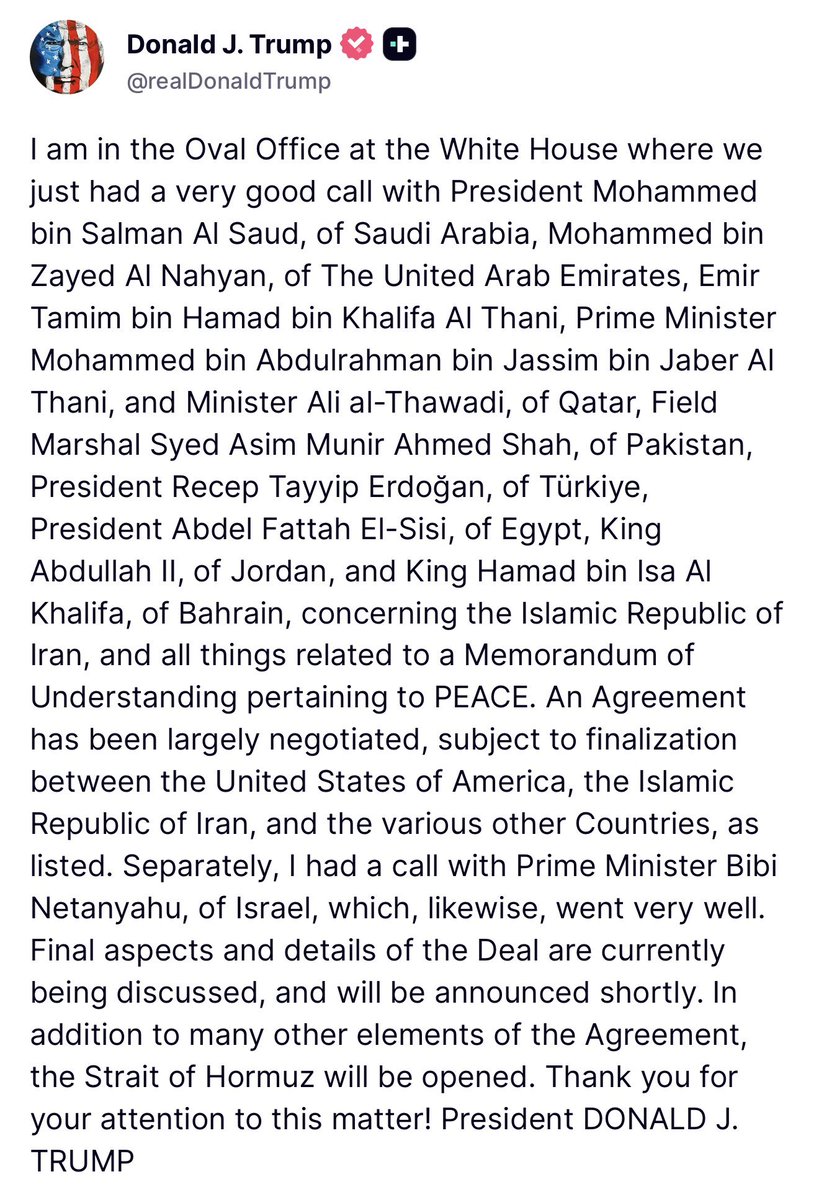

U.S. and Iran are closing in on a 60-day ceasefire extension with nuclear framework, per CNBC

🚨BREAKING: Iran has submitted a new proposal through regional mediators to end the U.S. war, according to a senior Iranian official who spoke to Drop Site News, while Trump reportedly weighs launching new strikes as soon as this weekend. The proposal splits negotiations into two tracks: ➤ Track 1: End the war first. Iran wants a formal declaration ending the war, an end to the U.S. naval blockade on Iranian ports, and the release of frozen Iranian assets before broader nuclear negotiations begin. In exchange, Iran would provisionally reopen the Strait of Hormuz, waive transit fees temporarily, and allow maritime traffic to resume while a new “governance regime” for Hormuz is finalized. Iran is also demanding a compensation mechanism funded by the U.S. and other countries involved in attacks on Iran to pay for damages inside Iran, along with an end to Israeli attacks in Lebanon. ➤ Track 2: Nuclear negotiations after the war ends. Iran says it would: • Suspend enrichment above 3.6% for 10 years • Dilute uranium enriched above 20% under supervision inside Iran • Commit not to develop a nuclear weapon In return, Iran wants: • Recognition of its right to enrich uranium • Limited enrichment rights preserved under a future agreement • Full sanctions relief The Trump administration reportedly wants the war-ending deal and nuclear agreement finalized simultaneously, while continuing to insist Iran cannot keep enriched uranium. Iran says that demand remains a major obstacle. Iranian officials also warned Tehran is preparing for escalation if attacks resume, including potential strikes on U.S. interests and bases beyond West Asia, as well as Gulf energy infrastructure and naval assets, alongside possible coordination with regional allies to disrupt shipping in the Bab al-Mandab Strait. 🔗 Full report below ⬇️








𝐓𝐡𝐫𝐞𝐞 𝐋𝐚𝐲𝐞𝐫𝐬. 𝐎𝐧𝐞 𝐂𝐨𝐦𝐩𝐨𝐮𝐧𝐝𝐢𝐧𝐠 𝐀𝐝𝐯𝐚𝐧𝐭𝐚𝐠𝐞. 𝐓𝐡𝐞 𝐈𝐑𝐄𝐍 𝐓𝐡𝐞𝐬𝐢𝐬. There's been a lot happening at IREN recently. Expansion across North America, Europe and Asia-Pacific. The NVIDIA partnership. The Mirantis acquisition. New GPU deployments. New customer discussions. A growing global footprint. Underneath all of it is a fairly simple view of where the world is heading, and a deliberate strategy for how we position IREN within it. That strategy is built on three layers. Together, they compound into a structural advantage that gets harder to replicate every quarter we execute. Layer 1: Physical infrastructure. Power, land, substations, data centers, cooling. The foundation that everything else sits on. Layer 2: Compute infrastructure. The GPUs, servers and networking that go inside those buildings. Deployed at scale. Generating revenue. Building execution track record. Layer 3: Software and operational capability. The orchestration, deployment tooling and enterprise expertise that makes the first two layers work harder for customers, and opens the door to a broader, higher-value market over time. Layers 1 and 2 are where the overwhelming majority of IREN's value is being created today. Layer 3 is where that advantage compounds further over time, but only because Layers 1 and 2 are built, owned and controlled at scale by IREN, not subscale nor contracted from a third party. Think of Amazon. They didn't win e-commerce by building a great website. They won it by controlling the fulfilment infrastructure at a scale nobody else could replicate. The foundation you don't control becomes the ceiling on your business. That is exactly how we think about IREN. The physical infrastructure - the land, the power, the substations, the data centers - is owned and controlled by us. The compute deployed into it generates the revenue and execution track record. And the software, orchestration and enterprise capability we are more methodically building on top is what turns the total product into a vertically integrated AI Cloud platform that compounds over time and deepens into a competitive moat. AI is still early. The bottleneck is increasingly physical. And we have spent eight years building the foundations.