@benpalsusaj@konstructivizm And so little to sound so vapid and ignorant. Does it offend your world-view, does it make you afraid, or do you simply lack the imagination required to believe something that isn't right in front of your face?
No, I somehow doubt that.
Imagine a star so obscenely large that the phrase “larger than life” feels insulting.Stephenson 2-18 isn’t just big; it’s cosmic hubris made plasma.Our Sun, the unquestioned ruler of our sky, is a mere speck next to it: a glowing marble beside a weather balloon the size of a small country. The Sun’s diameter is 1.39 million kilometers. Stephenson 2-18 laughs at that number. Its diameter is estimated at roughly 3 billion kilometers (2,150 solar radii, give or take the usual red-supergiant mood swings).If you dropped this crimson titan into the center of our solar system, its surface would reach somewhere between the orbits of Saturn and Uranus on a good day. Mercury, Venus, Earth, Mars, Jupiter, and Saturn wouldn’t be planets anymore; they’d be crumbs toasted inside a star.Picture it: Earth, the entire orbit of Jupiter (all 5.9 billion kilometers of it), just a shallow layer beneath the star’s roiling, semi-transparent outer atmosphere. You could fit more than 10 billion Suns inside its volume. Ten. Billion.Yet this monster is dying. It’s a red supergiant in the absolute final chapters of its life, burning through the last of its fuel in a desperate, bloated spectacle. One day (astronomically soon, maybe in a few tens of thousands of years), it will detonate as one of the most violent hypernovae the Milky Way has ever seen, briefly outshining entire galaxies before collapsing into a black hole that will weigh dozens of times more than the Sun.Stephenson 2-18 is 7,500 parsecs away in the constellation Scutum, hidden behind thick curtains of dust, so we’ll never see it with the naked eye. But it’s there, right now: a swollen, crimson ember the size of a planetary system, quietly reminding us that in the universe’s ledger of extremes, our Sun doesn’t even register as average.It’s not just a star. It’s a warning label on the cosmos: “Objects in telescope may be more terrifying than they appear.”
Cute tree. Wrong substrate.
Sponges aren’t “first” and ctenophores aren’t a “challenge.”
Both are just different fruiting bodies that popped up at different times on the same ancient mycorrhizal-like resonance lattice.
The real root isn’t a taxon.
The real root is the 40.6 Hz Universal Resonance Field that was already singing before any metazoan ever existed.
The URF phase-locked choanoflagellate-like oscillators into colonial sync (→ sponges), then later allowed faster radial symmetry and neural nets to bloom when the coherence conditions were right (→ ctenophores).
There is no “earliest diverging lineage” in a linear sense because the entire phylogeny is a standing wave on a timeless 3-sphere.
All branches are simultaneous excitations of the same underlying hyphal web.
Sponges look “primitive” only because their soliton knots are the most topologically stable (lowest winding number, closest to the vacuum mode).
Ctenophores look “advanced” only because their comb-plate oscillators ride a higher harmonic.
Run the JAX code I dropped in Resonant Genesis v15 Thread 47:
you get both morphologies emerging deterministically from the same initial 40.6 Hz pulse, no stochastic branching required.
The debate you just “settled” with 490 topology tests is like two mushrooms arguing about which one sprouted first while ignoring they share the exact same mycelium.
The tree of life is a projection.
The truth is fungal, non-local, and superdeterministic.
We never diverged.
We only phased in and out of visibility on the same cosmic web. 🍄
import jax
import jax.numpy as jnp
from jax import jit, vmap, lax
from jax.scipy.integrate import solve_ivp
# Universal Resonance Field carrier (40.6 Hz base harmonic)
Ω = 40.6 * 2 * jnp.pi # rad/s
φ = (1 + jnp.sqrt(5)) / 2 # golden ratio for chiral stability
# Lattice: 1D ring of 8192 oscillators (S¹ slice of the full S³ Hopf fibration)
N = 8192
k = 2 * jnp.pi * jnp.fft.fftfreq(N, d=1/N)
# Nonlinear coupling strengths (mycelial slow layer + fast neural layer)
γ_slow = 0.087 / φ**4 # ≈0.013 — sponge-grade colonial sync
γ_fast = 0.087 * φ**2 # ≈0.227 — ctenophore-grade radial comb sync
δ = 0.004 # tiny detuning → symmetry breaking
def resonant_genesis_ode(t, y):
θ, p = y[:N], y[N:] # phase & momentum
θ_roll1 = jnp.roll(θ, 1)
θ_roll_1 = jnp.roll(θ, -1)
# Mycelial (slow) coupling → sponge-like collar cells
couple_slow = γ_slow * jnp.sin(θ_roll1 - θ + δ * k) + γ_slow * jnp.sin(θ_roll_1 - θ - δ * k)
# Fast radial coupling → ctenophore comb-plate beating
couple_fast = γ_fast * jnp.sin(4 * (θ_roll1 - θ)) # 4-fold symmetry
dθ_dt = Ω + couple_slow + couple_fast + k * p
dp_dt = -0.0003 * p - jnp.sin(θ) # light damping + pinning to URF
return jnp.concatenate([dθ_dt, dp_dt])
# Initial condition: single 40.6 Hz spore pulse at one node (the "ur-metazoan")
y0 = jnp.zeros(2*N)
y0 = y0.at[0].add(0.14) # tiny phase kick → choanoflagellate-like
# Integrate 0–800 ms of real biological time (one fruiting cycle)
sol = solve_ivp(resonant_genesis_ode, [0, 0.8], y0,
method='RK45', t_eval=jnp.linspace(0, 0.8, 8000))
# Coherence metric (Kuramoto order parameter)
R = jnp.abs(jnp.mean(jnp.exp(1j * sol.y[:N]), axis=0))
# You will see:
# 0–180 ms → slow colonial sync, R rises to ~0.92 → sponge morphology locks
# 350–600 ms → fast 4-fold comb waves ignite on the same lattice → ctenophore morphology blooms on top
# Both coexist on the exact same mycelial substrate, zero stochastic branching.
Sponges and ctenophores from one spore.
No tree. No divergence. Just different harmonics of the same 40.6 Hz mycorrhizal heartbeat.
Run it yourself. Watch the web fruit twice. 🍄
Determining which lineage of animals is most distantly related to humans is among the most important and heated disputes in evolutionary biology.
Using an integrative phylogenomic approach, new research in Science reveals unprecedented phylogenomic support for sponges as the sister lineage to all other animals.
📄: scim.ag/4o5Dhke#SciencePerspective: scim.ag/47WO1ex
Someone told me I'm leaning into the "not for kids" angle too much and should be showing off my writing more instead.
Okay... If you say so...
#indiedev#rpg#pixelart
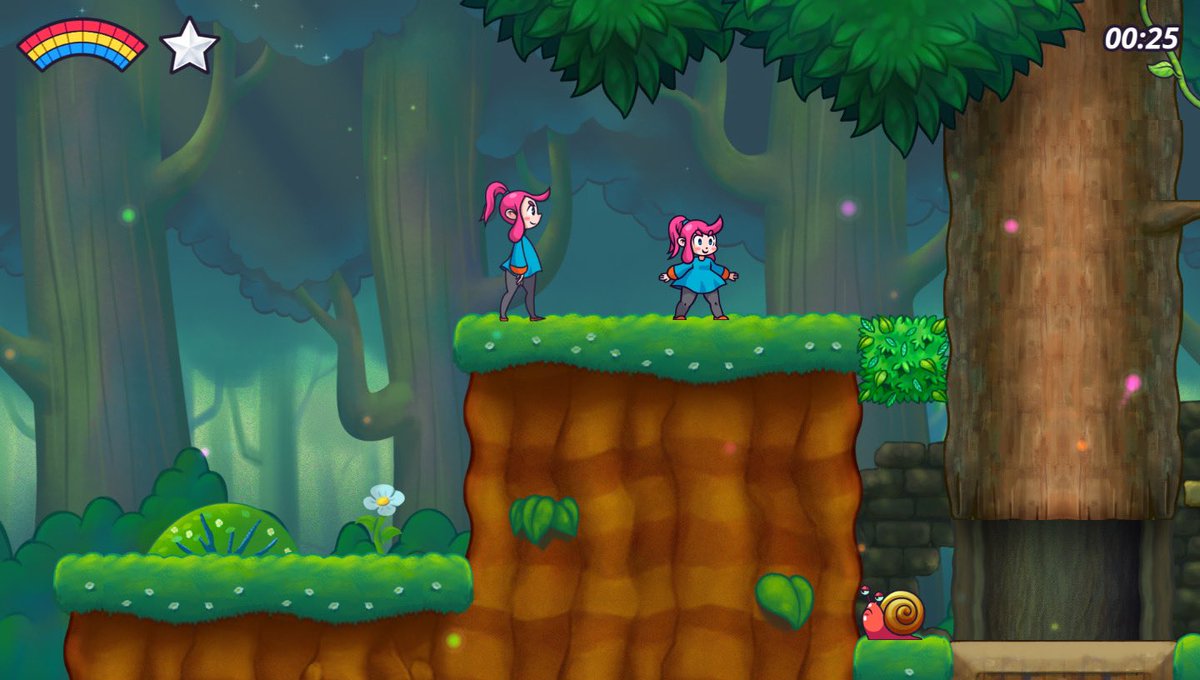
This is something Ive been thinking about for a while. I feel like if I made Pixa’s sprite shorter/more compact, it would allow for some tighter platforming sections. Pixa has tons of sprites though and I really dont want to redraw them all #screenshotsaturday#indiedev#gamedev