

Willy Jhon Galindez
18 posts

Willy Jhon Galindez
@Flowsion_AI
Building Flowsion. AI systems, automations, and operational leverage. Documenting the journey in public.
Katılım Eylül 2025
8 Takip Edilen4 Takipçiler
Tell me you’re deep in AI coding agents & workflow automation without telling me you’re deep in AI coding agents & workflow automation 😂 👇
English
Built my first RAG workflow today using n8n + Supabase.
The use case:
An AI assistant connected to a company employee handbook.
Instead of employees digging through PDFs, folders, or docs manually, they can just ask questions like:
“How do leave requests work?”
“What’s the onboarding process?”
“What’s our remote work policy?”
And the system retrieves the relevant information instantly.
Still learning RAG honestly, but this made me realize something:
AI becomes far more useful when connected to structured company knowledge instead of operating blindly.
Tech stack:
n8n • Supabase • Gemini • Google Drive • AI Agent
Learning in public. One workflow at a time.
What’s the best real-world RAG use case you’ve seen so far?

English
Most businesses still lose leads in the first 5 minutes.
Not because they don’t have enough leads.
Because their scheduling process is slow, manual, and inconsistent.
So I built my most complex automation system so far:
An AI Automated Appointment Setter.
This system can:
• Check available slots in real-time
• Schedule calls automatically
• Reschedule appointments
• Update booking information
• Cancel appointments
• Store all customer and appointment data into Airtable automatically
• Handle conversations using VAPI + ElevenLabs voice AI
What normally requires a receptionist, calendar manager, admin assistant, and constant follow-ups…
now happens through one automated workflow.
Under the hood, the system uses:
AI voice agents
Workflow automations
API integrations
Airtable database logging
Real-time scheduling logic
And honestly…
a few months ago I had no idea how to build systems like this.
Now I’m building real automation infrastructure from scratch.
Still learning.
Still improving.
But this is a massive milestone for me.
This is the direction I want Flowsion to go:
Building systems that remove friction, save time, and help businesses scale operations without adding more manual work.
The future belongs to operators who understand systems and automation.

English
Most people trying to learn AI automation overwhelm themselves before they ever build anything real.
They jump from tool to tool.
Trend to trend.
Tutorial to tutorial.
That’s why most never compound real skill.
Last month, I was focused on trading.
Then on April 26, I made a decision:
fully step into AI automation.
I didn’t try to learn everything.
I picked one course.
Stayed focused.
Applied what I learned immediately.
And started building Flowsion.
One workflow at a time.
One system at a time.
One clean commit at a time.
No pretending to be an expert overnight.
Just consistent execution.
And honestly…
that’s when things started clicking.
AI automation stopped feeling like “cool tech.”
I started seeing it for what it really is:
Operational leverage.
Infrastructure.
A new layer of business building.
Big lesson so far:
You do not need to master the entire AI industry before starting.
You need enough focus for momentum to form.
Keep building.
English
The goal is not to add AI everywhere. The goal is to remove operational friction.
English
Content shouldn’t feel forced.
But consistency?
That’s where most people break.
So instead of trying to manually push out more content every day…
I built a system that supports the process.
Here’s the flow:
→ Pulls content ideas from a structured database
→ Expands them into detailed prompts using AI
→ Generates videos automatically
→ Waits for processing completion
→ Publishes to Facebook + YouTube
The interesting part:
this doesn’t replace creativity.
It removes friction around execution.
You still bring:
the ideas
the perspective
the message
The system just makes sure the content actually gets published.
Because the real bottleneck for most creators isn’t creativity.
It’s the gap between:
thinking → creating → publishing
That gap is where consistency dies.
Automation closes that gap.
If your content output depends entirely on motivation or energy, it will always be inconsistent.
Systems don’t replace authenticity.
They protect it.

English
Today’s real highlight wasn’t just testing a workflow.
It was finally learning how to use AI coding agents the right way.
Before this, tools like Codex and Claude Code felt vague to me. I kept seeing people post about them, but most of it felt like noise.
Today felt different.
I approached it as an operator learning how to build systems properly.
Not pretending to be a developer.
Just learning step by step.
Ask better instructions.
Review before executing.
Document the process.
Improve from there.
Small step today.
But it feels like the foundation of something bigger.
English
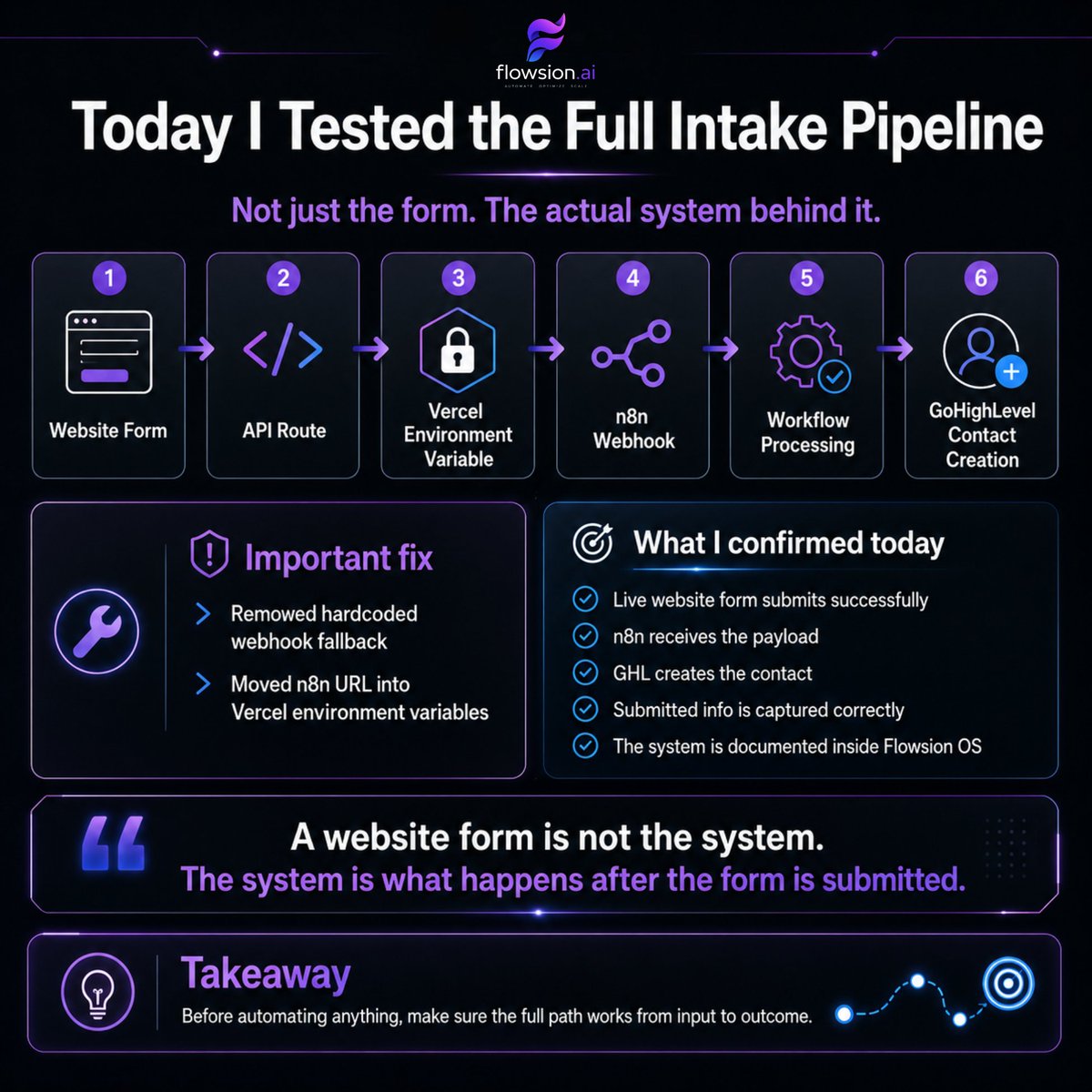
A form is not a system.
The real question is:
What happens after someone clicks submit?
Does the lead get captured?
Does the CRM update?
Does the workflow continue without manual checking?
That’s what I tested today for Flowsion.
Not the design.
The actual path from submission to outcome.
Small backend details matter.
Because systems should not work by accident.
They should be clear, traceable, and reliable.
Before automating more, make sure the basic path works:
Input → process → outcome.
That’s where the real system begins.
English
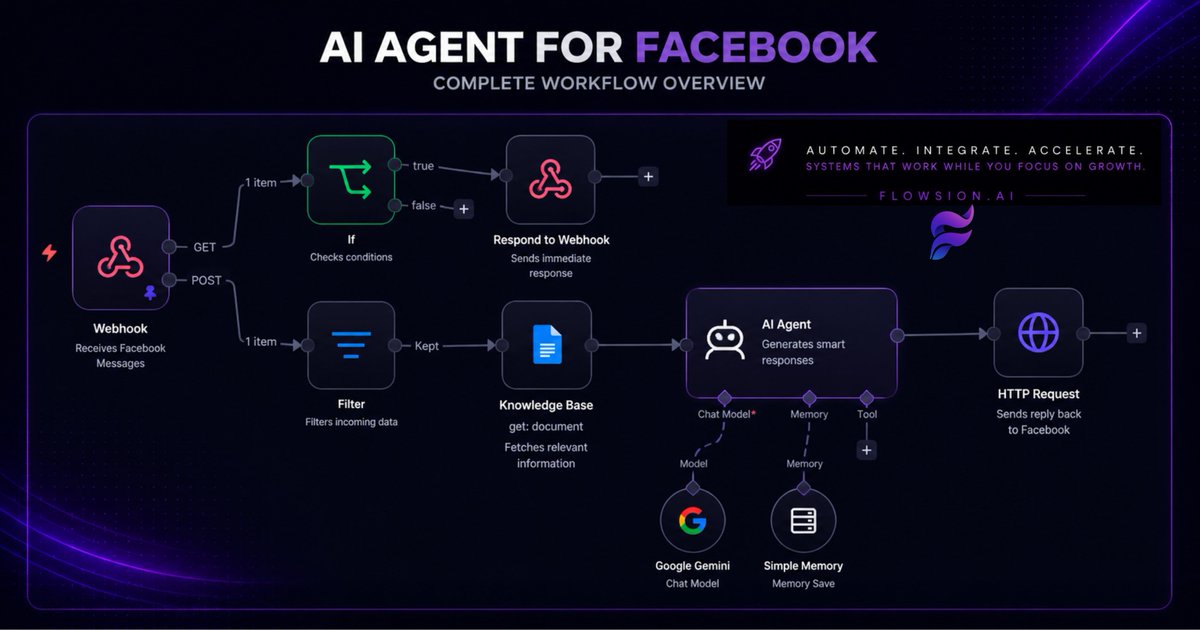
I built an AI-powered workflow that handles Facebook Page messages automatically.
Here’s how it works:
→ A message comes in
→ The system filters and processes the request
→ AI analyzes the message using a knowledge base
→ Generates a relevant response
→ Sends it back instantly
No manual replies.
No delayed responses.
No missed inquiries.
This solves a real problem:
Most businesses respond too late — or not at all.
And in messaging, speed is everything.
This system turns your page into a real-time responder.
This reduces response time to near-instant
and keeps communication consistent across every interaction.
Because when replies are fast and relevant,
conversion rates go up.
This isn’t just a chatbot.
It’s a system that handles conversations at scale.
Built using n8n and AI to create a structured, automated messaging workflow.
If your business is still replying manually,
you’re slowing down your own pipeline.
English
I built a workflow that connects @Xero and @asana automatically.
When a task is marked complete in Asana, the system:
→ Pulls the general ledger report from Xero
→ Processes the data
→ Uploads it back into the Asana task
No manual syncing.
No chasing finance updates.
No disconnected operations.
Most businesses run finance and operations in completely separate systems.
That’s where delays, reporting issues, and manual errors start piling up.
This workflow turns disconnected tools into a connected operational system.
The result:
less manual reconciliation, fewer reporting mistakes, and faster execution across teams.
Because when systems communicate properly, people stop wasting time moving information around manually.
Built using @make_hq (formerly Integromat) while applying automation concepts to real workflows.
If your business relies on tools that don’t talk to each other, you’re creating operational friction without realizing it.
And friction compounds.

English
Still crazy to me that this is actually the first website I’ve ever built 😂
No IT background.
No web design background.
No coding experience.
Just curiosity, AI tools, lots of debugging, and willingness to learn fast.
Honestly wild how much AI compresses the learning curve now. What used to take months to even start understanding, you can begin building in days if you stay consistent.
English
Most people focus on the AI.
I’m realizing the real game is operational infrastructure.
Spent today refining the backend systems behind Flowsion:
• AI workflow intake systems
• CRM pipelines
• GHL infrastructure
• Webhook architecture
• Booking flows
• Automation routing
• UX + conversion fixes
Automation without operational clarity just scales chaos faster.
Still building.
Still learning.
Still building in public.
English
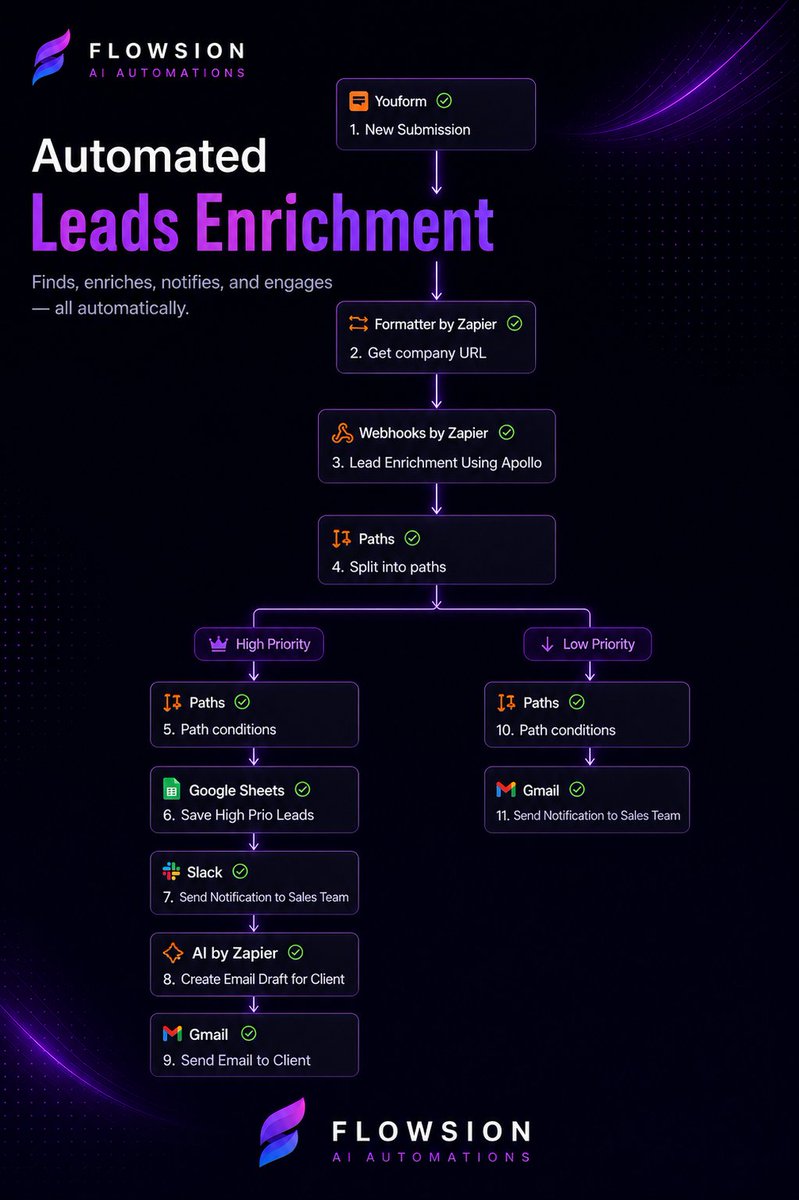
I built a system that automates lead engagement from first contact to closed deal.
No manual follow-ups.
No messy CRM.
No leads slipping through the cracks.
Here’s the flow:
→ Lead status updates in Asana
→ System triggers the next action automatically
Ready to start?
→ Creates folders + internal tasks
No response?
→ Sends timed follow-ups
Quoted?
→ Triggers structured nurture sequence
Approved?
→ Sends onboarding + welcome emails
Paid & closed?
→ Delivers assets + final communication
The goal wasn’t just automation.
It was removing operational friction.
This system saves ~5–10 hours/week in manual lead management alone.
But the bigger win:
faster follow-ups = fewer lost deals.
Most businesses don’t lose leads because the offer is bad.
They lose them because the process is slow, inconsistent, or forgotten.
Your CRM should operate like a system, not a spreadsheet with notifications.
Built using Zapier + AI + workflow automation.
More systems coming.
English
I built a system that automates lead engagement from first contact to closed deal.
No manual follow-ups.
No messy CRM.
No leads slipping through the cracks.
Here’s the flow:
→ Lead status updates in Asana
→ System triggers the next action automatically
Ready to start?
→ Creates folders + internal tasks
No response?
→ Sends timed follow-ups
Quoted?
→ Triggers structured nurture sequence
Approved?
→ Sends onboarding + welcome emails
Paid & closed?
→ Delivers assets + final communication
The goal wasn’t just automation.
It was removing operational friction.
This system saves ~5–10 hours/week in manual lead management alone.
But the bigger win:
faster follow-ups = fewer lost deals.
Most businesses don’t lose leads because the offer is bad.
They lose them because the process is slow, inconsistent, or forgotten.
Your CRM should operate like a system, not a spreadsheet with notifications.
Built using Zapier + AI + workflow automation.
More systems coming.

English
I built a system that turns 1 piece of content into multiple platform-ready assets automatically.
Record once.
The system handles the rest.
→ Transcribes the video
→ Turns it into written content
→ Adapts it for different platforms
→ Prepares it for publishing
No manual rewriting.
No duplicated effort.
No messy content workflow.
Most people are still treating content like a one-time task.
The leverage comes from building systems that multiply output from a single input.
This is the shift:
Manual creator → Content operator
Built this while studying automation systems and applying them to real workflows using Zapier.
Now building more AI automation systems for businesses.
If your content pipeline feels slow, inconsistent, or chaotic:
that’s not a content problem.
It’s a systems problem.

English