FrUcheObikwelu
1.5K posts

FrUcheObikwelu
@FrObikwelu
Clergy, A Roman Catholic Priest, Theologian, Philosopher, Public Figure, Civic Opinion molder, Honest conversation.
Kingsland, TX Katılım Mart 2019
171 Takip Edilen193 Takipçiler

Today, we celebrate the Memorial of SAINT ATHANASIUS. Athanasius was born in Egypt towards the end of the third century, and was from his youth pious, learned, and deeply versed in the sacred writings, as befitted one whom God had chosen to be the champion and defender of His Church against the Arian heresy. Though only a deacon he was chosen by his bishop to go with him to the Council of Nicaea, in 325, and attracted the attention of all by the learning and ability with which he defended the faith. A few months later, he became Patriarch of Alexandria, and for forty-six years he bore, often well-nigh alone, the whole brunt of the Arian assault. On the refusal of the Saint to restore Arius to Catholic communion, the emperor ordered the Patriarch of Constantinople to do so. The wretched heresiarch took an oath that he had always believed as the Church believes; and the patriarch, after vainly using every effort to move the emperor, had recourse to fasting and prayer, that God would avert from the Church the frightful sacrilege. The day came for the solemn entrance of Arius into the great church of Hagia Sophia. The heresiarch and his party set out glad and in triumph. But before he reached the church, death smote him swiftly and awfully, and the dreaded sacrilege was averted. Saint Athanasius stood unmoved against four Roman emperors. He was banished five times, was the butt of every insult, calumny, and wrong the Arians could devise, and lived in constant peril of death. Though firm as adamant in defence of the Faith, he was meek and humble, pleasant and winning in converse, beloved by his flock, unwearied in labors, in prayer, in mortifications, and in zeal for souls. In the year 373 his stormy life closed in peace, rather that his people would have it so than that his enemies were weary of persecuting him. He left to the Church the whole and ancient Faith, defended and explained in writings rich in thought and learning, clear, keen, and stately in expression. He is honored as one of the greatest of the Doctors of the Church.

English

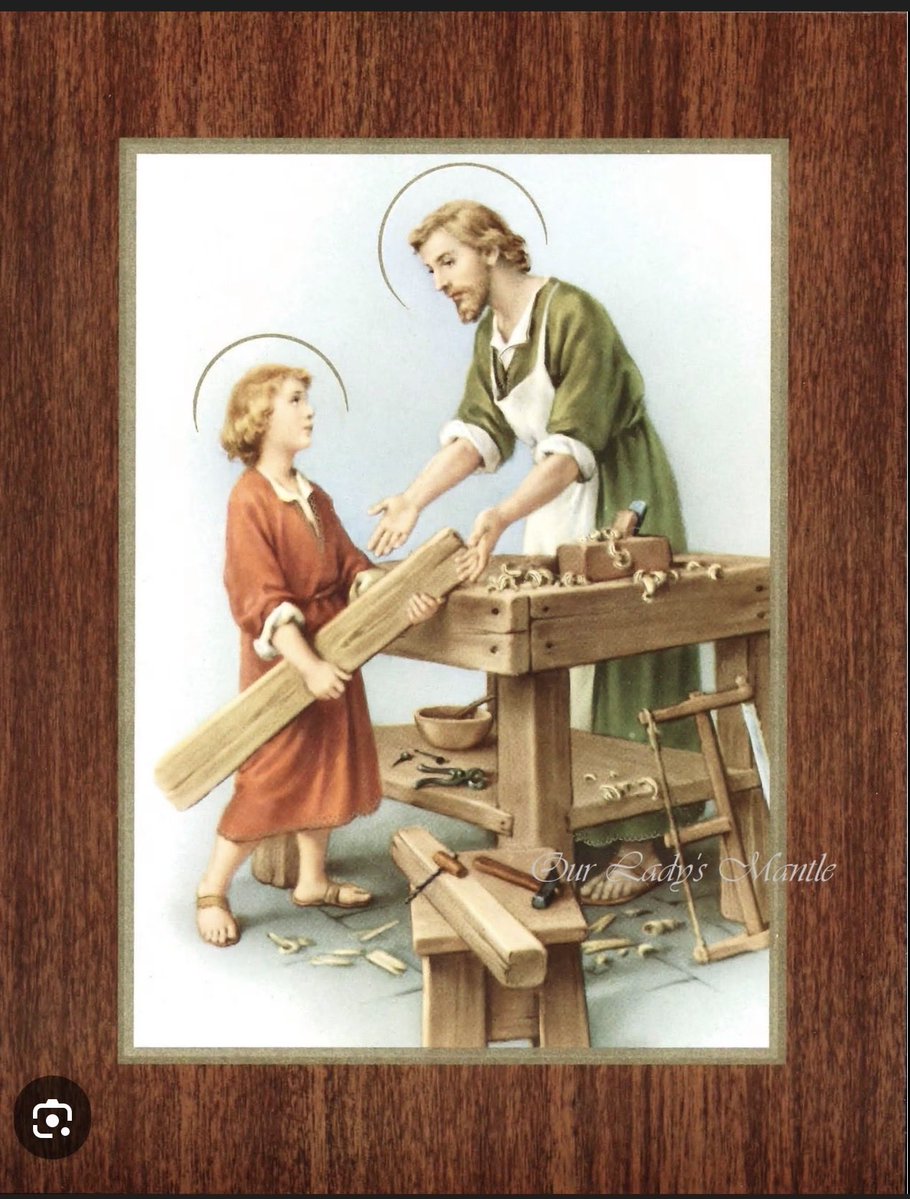
Short history of Saint Joseph The Worker and May 1.
To foster deep devotion to Saint Joseph among Catholics, and in response to the “May Day” celebrations for workers sponsored by Communists, Pope Pius XII instituted the feast of Saint Joseph the Worker in 1955. This feast extends the long relationship between Joseph and the cause of workers in both Catholic faith and devotion. Beginning in the Book of Genesis, the dignity of human work has long been celebrated as a participation in the creative work of God. By work, humankind both fulfills the command found in Genesis to care for the earth (Gn 2:15) and to be productive in their labors. Saint Joseph, the carpenter and foster father of Jesus, is but one example of the holiness of human labor.
Jesus, too, was a carpenter. He learned the trade from Saint Joseph and spent his early adult years working side-by-side in Joseph’s carpentry shop before leaving to pursue his ministry as preacher and healer. In his encyclical Laborem Exercens, Pope John Paul II stated: “the Church considers it her task always to call attention to the dignity and rights of those who work, to condemn situations in which that dignity and those rights are violated, and to help to guide [social] changes so as to ensure authentic progress by man and society.”
Saint Joseph is held up as a model of such work. Pius XII emphasized this when he said, “The spirit flows to you and to all men from the heart of the God-man, Savior of the world, but certainly, no worker was ever more completely and profoundly penetrated by it than the foster father of Jesus, who lived with Him in closest intimacy and community of family life and work.”
Copyright franciscanmedia.org

English

Today we celebrate SAINT PIUS V, who was born in 1504, joined the Dominicans at the age of fourteen; he was sixty-two when he was elected Pope. His reign, though short, was one of the most fruitful of the sixteenth century. To Protestantism, which had proclaimed the Reformation, Saint Pius replied by applying the decrees of the Council of Trent for the reform of the Church. He played a great part in the return of the clergy to ecclesiastical discipline. Against Islam, which threatened the West, he succeeded in forming a coalition of Christian forces: and by public prayers, organized everywhere at his request, he was instrumental in obtaining the decisive victory of Lepanto in 1571. He died the following year on May 1. We also owe to Saint Pius the reformation of the liturgical books of the Roman Rite.

English

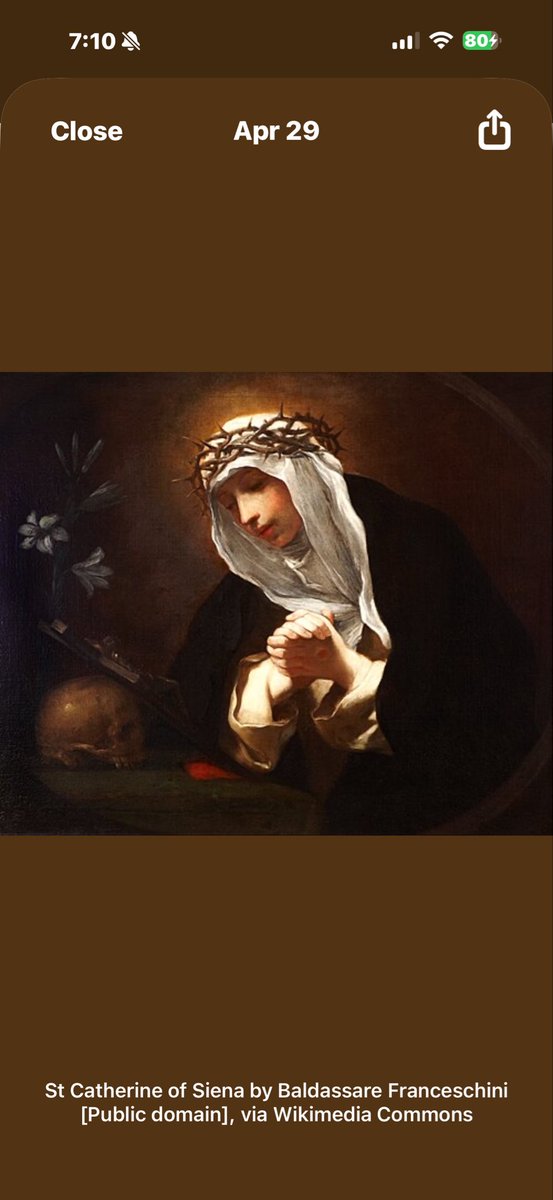
Today we celebrate the Memorial of SAINT CATHERINE of SIENA. Catherine, the daughter of a humble tradesman, was raised up to be the guide and guardian of the Church in one of the darkest periods of its history, the fourteenth century. As a child, prayer was her delight. She would say the “Hail Mary” on each step as she mounted the stairs, and was granted in reward a vision of Christ in glory. When only seven years old, she made a vow of virginity, and afterwards endured bitter persecution for refusing to marry. Our Lord gave her his heart in exchange for her own, communicated her with his own hands, and stamped on her body the print of his wounds. At the age of fifteen she entered the Third Order of Saint Dominic, but continued to reside in her father’s shop, where she united a life of active charity with the prayer of a contemplative saint. From this obscure home the seraphic virgin was summoned to defend the Church’s cause. Armed with papal authority, and accompanied by three confessors, she travelled through Italy, reducing rebellious cities to the obedience of the Holy See, and winning hardened souls to God. In the face well-nigh of the whole world she sought out Gregory XI. at Avignon, brought him back to Rome, and by her letters to the kings and queens of Europe made good the papal cause. She was the counsellor of Urban VI, and sternly rebuked the disloyal cardinals who had part in electing an antipope. Long had the holy virgin foretold the terrible schism which began ere she died. Day and night she wept and prayed for unity and peace. But the devil excited the Roman people against the Pope, so that some sought the life of Christ’s Vicar. With intense earnestness did Saint Catherine beg our Lord to prevent this enormous crime. In spirit she saw the whole city full of demons tempting the people to resist and even slay the Pope. The seditious temper was subdued by Catherine’s prayers; but the devils vented their malice by scourging the saint herself, who gladly endured all for God and his Church. She died at Rome, in 1380, at the age of thirty-three.

English

The story and history of SAINT MARK. Mark was converted to the faith by the Prince of the Apostles, who he afterwards accompanied to Rome, acting there as his secretary or interpreter. When Saint Peter was writing his first epistle to the churches of Asia, he affectionately joins with his own salutation that of his faithful companion, whom he calls “my son Mark.” The Roman people entreated Saint Mark to put in writing for them the substance of Saint Peter’s frequent discourses on our Lord’s life. This the Evangelist did under the eye and with the express sanction of the apostle, and every page of his brief but graphic gospel so bore the impress of Saint Peter’s character, that the Fathers used to name it “Peter's Gospel.” According to an ancient tradition, Saint Mark was sent to Egypt to found the Church of Alexandria. Here his disciples became the wonder of the world for their piety and asceticism, so that Saint Jerome speaks of Saint Mark as the “father of the anchorites”, who at a later time thronged the Egyptian deserts. Here, too, he set up the first Christian school, the fruitful mother of many illustrious doctors and bishops. After governing his see for many years, Saint Mark was reportedly one day seized by the pagan authorities, dragged by ropes over stones, and thrown into prison. On the next day the torture was repeated, and having been consoled by a vision of angels and the voice of Jesus, Saint Mark went to his reward. He is especially honored in the city of Venice, which claims his body.

English

Today we celebrate among other celebrations the optional memorial of SAINT FIDELIS, who was born at Sigmaringen in Swabia in 1577. He practiced at first as a lawyer and so took to heart the cause of the needy that he was known as the poor man’s lawyer. Then he joined the Capuchin Friars Minor and was sent by the Holy See to the Grisons in order to bring back the inhabitants of this canton from Protestantism to the Catholic faith. His great influence earned him enemies; he was murdered at Seewis on April 24, 1622.

English

Saint Adalbert was ordained the Bishop of Prague in 983. During his episcopate he encouraged the evangelization of the Magyars. Having founded the monastery of Brevnov, he was forced into exile by the nobility of Prague. He tirelessly preached the Gospel in Poland, Hungary, Russia, and Prussia, where he was martyred at the age of 41.

English

How many of our Catholic Parishes today still have Benediction, accompanied with Saint Thomas Aquinas’ angelic hymns? Not just ‘Holy Hour’. I learned these hymns in my second grade, when I attended Benediction with my mom.
Listen:
youtu.be/bPqDnC5c1MA?si…
youtu.be/jaZ6qWeErnk?si…

YouTube

YouTube
English