

FractionHub
391 posts
FractionHub
@Fractionhub
Building a global index for regulated tokenized asset platforms.
Europe Katılım Mart 2026
187 Takip Edilen30 Takipçiler


I can’t believe it’s actually happening. The current financial system is being replaced and only a fraction of people around the globe even realize it.
English

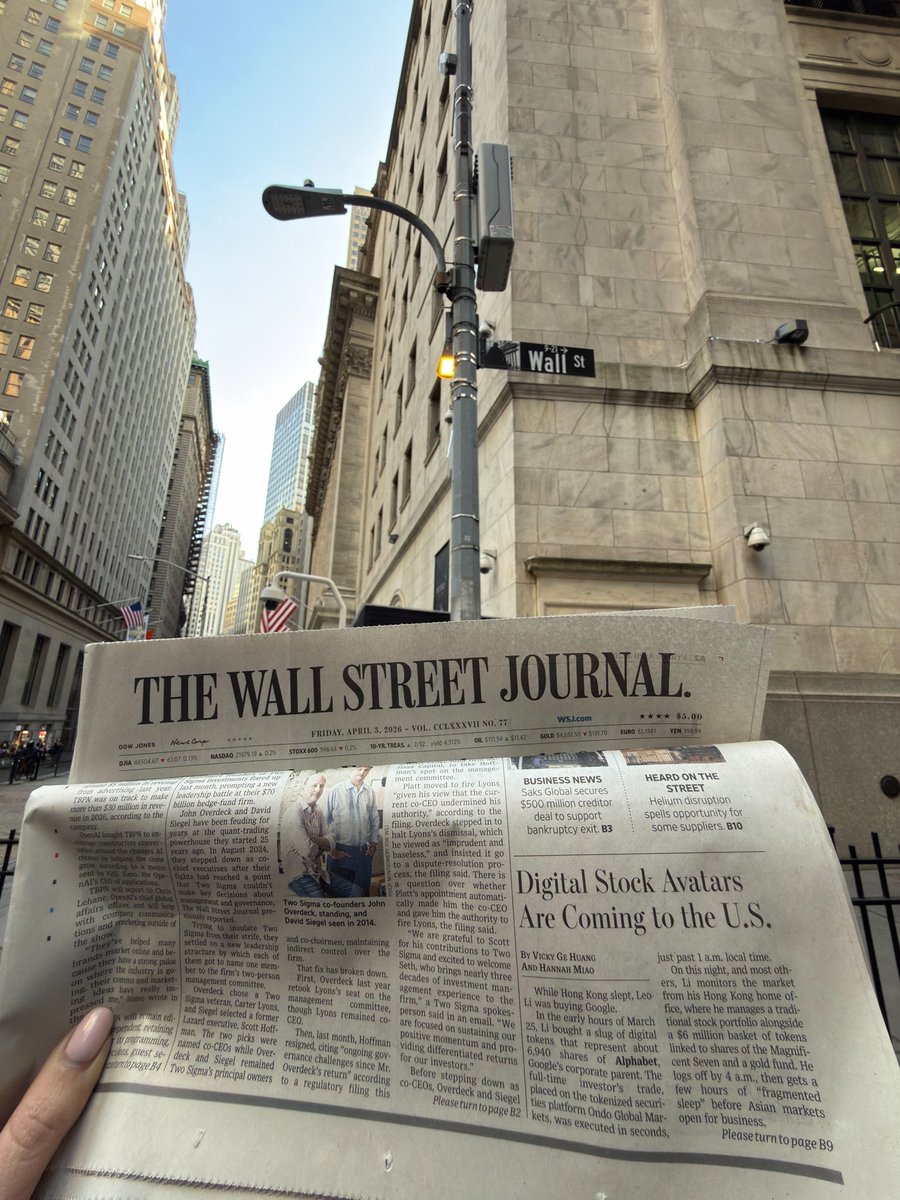
Tokenized stocks, and Ondo, on the front page of WSJ
Wall Street 2.0 is here
English




I want to connect with people who are into:
1. AI
2. Entrepreneurship
3. Scaling Business
4. Marketing
5. Innovation in general
English

🔥 RWA: The on chain Market Cap for RWA has hit a new ATH of $22.8B with Tether in the lead.

English
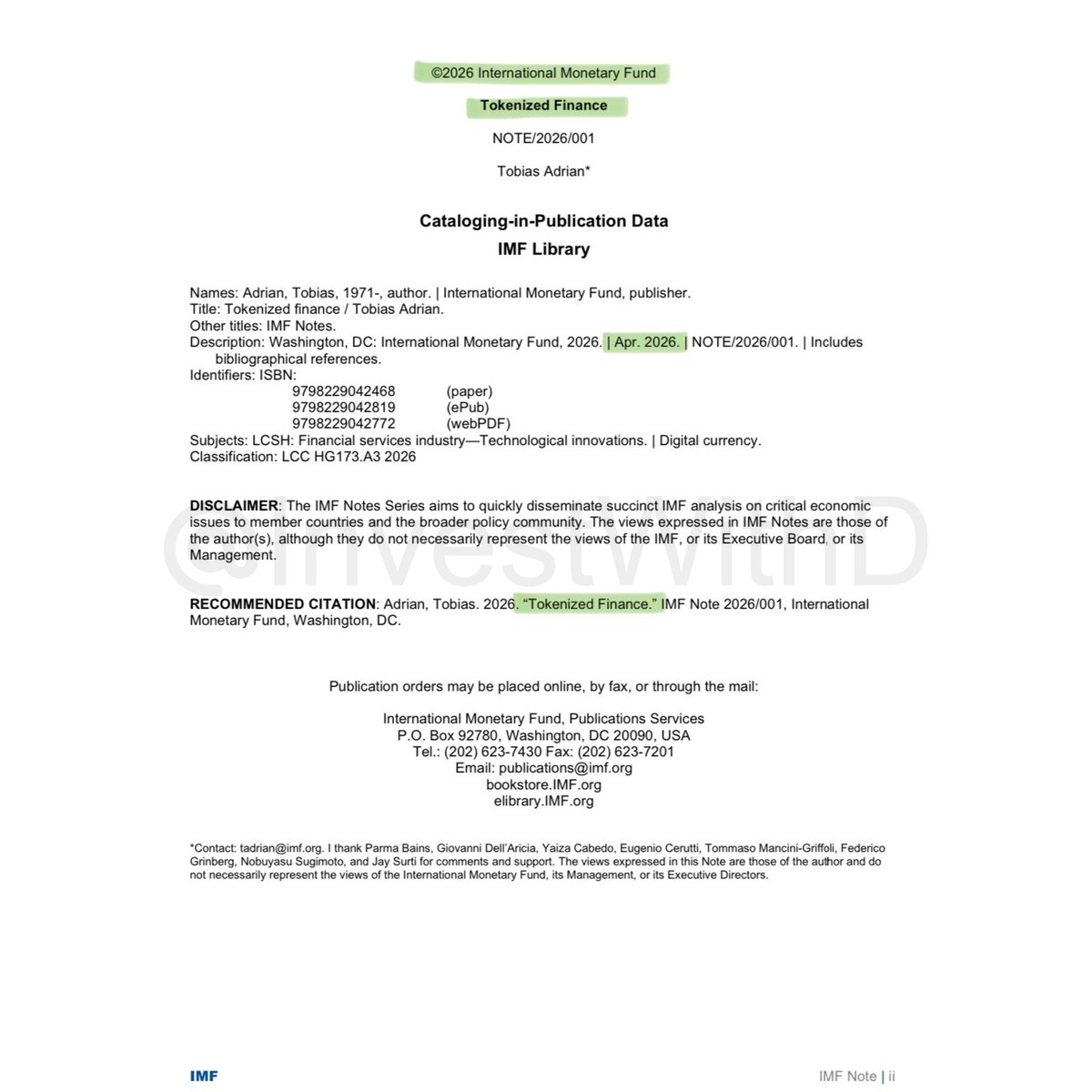
LATEST: ⚡ The IMF warns tokenization could accelerate financial stress events, leaving less time for intervention, while raising risks of currency substitution in emerging markets.

English
@CoinMarketCap Is “fractional ownership” empowering—or just a way to offload risk to smaller investors? 👀
English
@InvestWithD @IMFNews Are RWAs actually decentralizing finance—or just digitizing existing power structures?
English

🚨BREAKING: International Monetary Fund OFFICIALLY RELEASES Note PUSHING TOKENIZED Finance — Calls It a “MAJOR SHIFT” for Global Banking 😳🌍🔥
The International Monetary Fund (@IMFNews) has OFFICIALLY released a note saying tokenization could TRANSFORM how money, markets, and payments work worldwide. 👀
They’re talking about turning real-world assets into digital tokens on blockchain-style systems — and calling it a MAJOR structural shift. 🤯
👉 Transactions become INSTANT (“atomic settlement”)
👉 Markets run 24/7 with no delays
👉 Costs drop for banks and institutions
👉 Rules get AUTOMATED through smart contracts
One of the MOST POWERFUL financial institutions in the world is now saying TOKENIZATION could reshape the ENTIRE system. 😳
⚠️ Meaning: banks, governments, and institutions are being pushed toward blockchain-based infrastructure at a GLOBAL level. 🚀
TOKENIZATION + RIPPLE PRIME 🤑

Cointelegraph@Cointelegraph
🚨 TODAY: The IMF released a note on tokenized finance, highlighting its potential to transform banking, capital markets, and payments. Without proper policy frameworks and global coordination, however, it warns tokenization could amplify financial instability.
English


@d_rwastoryhouse @EthCC @Dune What breaks first at scale: the tech, the liquidity, or the legal layer of tokenized assets?
English
The “stablecoins vs RWAs” narrative is being framed incorrectly.
Full context 👇
At @EthCC 2026, @Dune CEO Fredrik Haga argued that stablecoins will remain the dominant driver of blockchain adoption.
That view is grounded in current market structure.
Stablecoins are already operating at scale across payments, treasury operations, and B2B settlement.
They process significantly more volume than any other onchain use case and have clear product-market fit with both crypto-native and institutional participants.
In that sense, stablecoins are not an emerging category. They are already embedded infrastructure.
However, comparing stablecoins to tokenized real-world assets as competing sectors misses the underlying architecture of how this market is evolving.
They operate at different layers.
Stablecoins function as the settlement and liquidity layer.
They enable capital to move efficiently across systems, jurisdictions, and counterparties.
RWAs represent the asset layer. They bring offchain financial instruments, treasuries, private credit, real estate, into onchain environments.
One does not replace the other.
In practice, RWA markets are already dependent on stablecoins for:
• settlement of transactions
• distribution of yield
• collateralization in lending structures
This dependency explains the current gap in scale.
Stablecoins scale faster because they face fewer structural constraints.
They do not require asset origination, legal structuring, or jurisdiction-specific compliance frameworks tied to underlying instruments.
RWAs do.
Each tokenized asset introduces layers of:
• legal enforceability
• custody design
• investor qualification
• regulatory alignment
•
This makes RWA growth inherently slower, but also more structurally significant.
Haga also pointed to regulatory clarity as a key unlock.
Emerging frameworks around stablecoins and digital assets are reducing uncertainty for institutions.
This creates a clearer pathway for capital markets activity to move onchain.
At the same time, there is a constraint.
Excessive regulation at the protocol level risks undermining core advantages of blockchain systems, particularly programmability and composability.
These properties are what allow financial products to be automated, interoperable, and efficient in ways traditional systems are not.
The balance between control and flexibility will shape how far institutional adoption can go.
The broader takeaway is this:
Stablecoins are currently the largest segment of onchain finance because they solve the most immediate problem moving money.
RWAs address a different problem, who can access and own financial assets.
As infrastructure matures, these two layers are likely to converge rather than compete.
The growth of one reinforces the expansion of the other.
The question is no longer which sector leads.
It is how capital transitions from stable settlement into tokenized assets at scale.
~ The RWA Story House

English
Genuinely interested... who becomes obsolete first in a tokenized world: brokers, custodians, or exchanges?
English
@2xnmore If tokenization succeeds, do national borders matter less for investing?
English

RWA tokens are dominating social right now. 24-hour data.
No. 1 $LINK — Oracle infrastructure for everything institutional. Still the king.
No. 2 $HBAR — Enterprise RWA tokenisation. Quietly building loud.
No. 3 $ONDO — Tokenised treasuries and yield products are eating market share.
No. 4 $AVAX — Subnets and fast finality, making it the RWA scaling choice.
No. 5 $ICP — Decentralised infrastructure play. Underrated and underpriced.
No. 6 $INJ — Derivatives and RWA DeFi modules. Consistent performer.
No. 7 $VET — Supply chain traceability keeping it relevant with enterprises.
No. 8 $XLM — Institutional tokenised asset growth picking up fast.
No. 9 $ALGO — Quantum proof utility and RWA infrastructure. Watch this one.
No. 10 $ONDO $PLUME — Regulatory narrative heating up.
The RWA sector is not slowing down. Which one are you most convinced of?
English
@TTrimoreau It agress with you a lot more than it should. Depends on the model, but generally we have to challenge it a lot
English

What’s the most important thing you’ve learned from AI?
English
@CyprxResearch When RWAs go mainstream, does DeFi become more stable—or more fragile?
English

Don’t ask: “Which blockchain is best for real estate tokenization?”
Ask: “What is the tokenization actually trying to optimize?”
Because real estate tokenization isn’t about putting deeds on-chain.
It’s about redesigning ownership, transfers, compliance, liquidity, and capital access.
Here’s the reality 👇
If you want:
- Capital formation
- Deep liquidity
- Stablecoin settlement
- Long-term market gravity
Ethereum + L2s is still the default.
If you want:
- Operational efficiency
- Predictable costs
- Built-in controls
- Institutional workflows
Hedera, Stellar, and XRPL deserve more attention.
The market gets two things wrong:
- Not all chains are interchangeable
- Tokenization is not just "putting assets on chain"
Some chains are funding layers.
Some are operating layers.
Some excel at payments.
Others at compliance.
Blockchain choice is infrastructure design
Not a branding decision.
The real questions are:
- Where does the capital come from?
- Is this for fundraising, operations, or both?
- What compliance is required?
- How important are cost and scale?
Answer those and the right chain becomes obvious.

English
English

🚨 CRYPTO: TOKENIZED REAL-WORLD ASSET MARKET HITS $27.6B RECORD AS TRADITIONAL FINANCE FLOODS ON-CHAIN
The tokenized real-world asset market has reached $27.65 billion according to @RWA_xyz, up 4% in the past 30 days and roughly fourfold from $6.6 billion a year ago, continuing to grow even as the broader crypto market struggles. Total asset holders have climbed to 710,792, up 5.6% month-over-month.
Six categories have each surpassed $1 billion in on-chain value: private credit, commodities, US Treasuries, corporate bonds, non-US government debt, and institutional alternative funds. Tokenized stock transfer volume hit $2.87 billion in March alone, up 80% over the prior month, with stockholders surpassing 200,000.
The growth is driven by institutional heavyweights including BlackRock, Franklin Templeton, JPMorgan, and Fidelity launching or expanding tokenized products. The RWA sector is increasingly viewed as crypto's bridge to mainstream finance, with Standard Chartered CEO Bill Winters predicting the majority of transactions will eventually settle on blockchain.
English