Franny Kwak

52 posts

Franny Kwak banner
Franny Kwak

Franny Kwak

@FrannyKwak

MS-4 • Aspiring OB/GYN #Match2024 • 🇰🇷🇺🇸 • (she/hers)

Katılım Mayıs 2023
391 Takip Edilen158 Takipçiler
Franny Kwak retweetledi
Emmanuel Ohuabunwa MD/MBA
Emmanuel Ohuabunwa MD/MBA@Dr_MannyO·
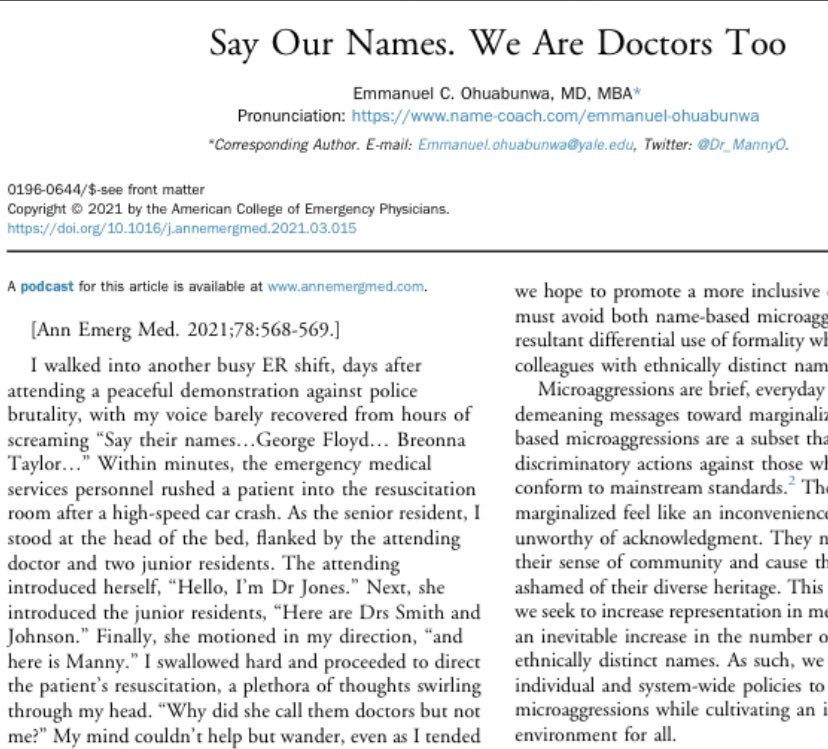
Do you or your colleagues have ethnically distinct names? This short article is for you! In it, I share my experience with name-based microaggresions and propose a model for combatting it. Grateful to my mentors at #yale for the encouragement and to #annalsofemergencymedicine
Emmanuel Ohuabunwa MD/MBA tweet media
English
11
88
292
0
Franny Kwak retweetledi
Michael Justus
Michael Justus@mhjrad·
No one: the broad ligament:
Michael Justus tweet media
English
105
2.4K
17.8K
997.5K
Franny Kwak retweetledi
Michael Justus
Michael Justus@mhjrad·
this is me making a rank list
Michael Justus tweet media
English
4
9
133
16.7K
Franny Kwak retweetledi
Westin Wong
Westin Wong@WestinWong·
Screenshot of me being asked if I have any questions
Westin Wong tweet media
English
3
15
334
24.7K
Franny Kwak
Franny Kwak@FrannyKwak·
Sitting in the room next door to the radiation onc suite today and heard wooing and bells and clapping. It was for a patient who finished their last round of radiation… 💖 Come onnnn
Franny Kwak tweet media
English
0
0
4
185
Franny Kwak
Franny Kwak@FrannyKwak·
@FilJelenak It says $30 per program code on NRMP— is that what that means? Hahaha wow will be significantly less than my calculated number lol TY for stopping my spiral Glad I’m not alone in the stress!!! Good luck to you guys!!! Such an exciting/terrifying process
English
1
0
1
49
Franny Kwak
Franny Kwak@FrannyKwak·
We both applied to 115 programs each… Which already cost roughly $6000 between us…
English
0
0
0
67
Franny Kwak retweetledi
Westin Wong
Westin Wong@WestinWong·
Me showing up to an interview and corresponding social in late january
Westin Wong tweet media
English
1
2
101
10.3K
Franny Kwak
Franny Kwak@FrannyKwak·
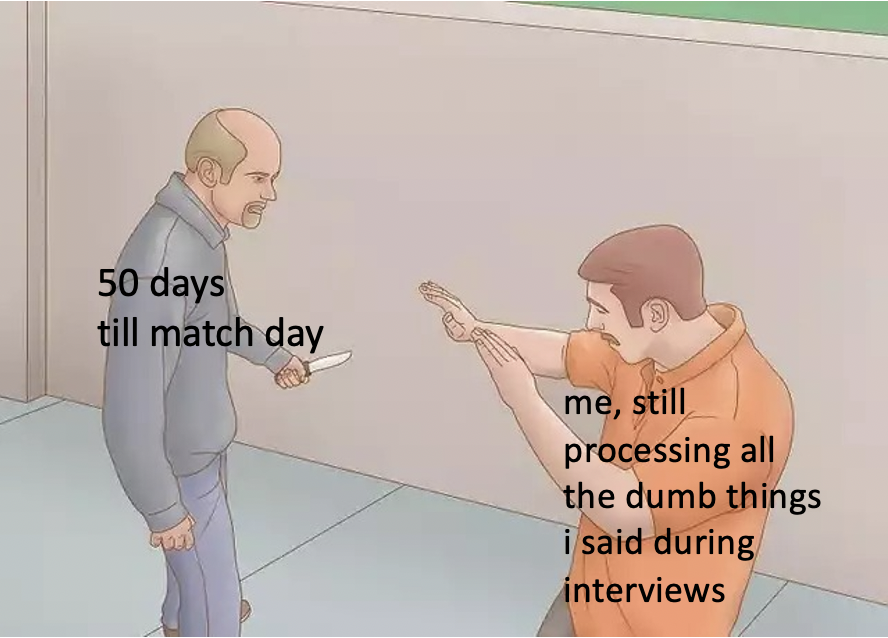
The me that wrote 53 pages of notes from interview days really wasn’t thinking about the me that has a five min attention span and is massively freaking out about making a rank list??
English
0
0
6
224
Franny Kwak retweetledi
Michael Justus
Michael Justus@mhjrad·
OK SO FIRST I MAKE AND CERTIFY MY RANK LIST AND PROGRAMS MAKE THEIR LIST AND THEN ON A MONDAY IN MARCH I GET AN EMAIL TELLING ME IF I MATCH AND THEN ON THAT FRIDAY I OPEN AN ENVELOPE TO LEARN WHERE I MATCH BUT THE ALGORITHM FAVORS THE APPLICANT
English
6
73
619
56.6K
Franny Kwak
Franny Kwak@FrannyKwak·
👏🏼👏🏼👏🏼 my friend is amazing!!!!!! Go vote for the July JNA case!
English
0
0
1
202
Franny Kwak retweetledi
Michael Justus
Michael Justus@mhjrad·
that post-interview feeling
Michael Justus tweet media
English
0
26
372
44.3K
Franny Kwak retweetledi
Ash, MD
Ash, MD@AshMD_1·
The importance of residency interviews cannot be overstated, as the impression you leave may make the difference between matching or not matching at your program of choice. Here are some interview tips that I hope you will find useful. Ask the residents at the programs you’re interviewing at about faculty that will be interviewing you. They will often have valuable advice regarding what questions certain faculty tend to ask, and what they look for in an applicant. Practice summarizing your CV, personal statement, and any research projects that you’ve worked on in a clear non-redundant fashion. A good way is to make a sheet with summaries & go over it before interview days. Schedule interviews for the programs you’re most interested in towards the early/mid interview season. The first 1-2 interviews will provide you with more experience and confidence, and subject you to some questions that you may have not been prepared for, and things you need to work on. Interviewers, however, may develop interview fatigue towards the end of the season, and sometimes it becomes harder for applicants to stand out after interviewers have been interviewing applicants for weeks/months. Know those who will be interviewing you. A good way is to make a sheet with their academic focus, research interest, type of practice, etc…. and go over it before interviews. If the interviewer is having a casual conversation with you, without focusing on your CV/PS, don’t try to steer the conversation in another direction. Many interviewers have already decided they like you academically& just want to make sure you seem easy to work with. Please keep in mind that some interviewers may not agree with certain points, as different interviewers have different styles, so feel free to share if you have any comments/additional input. If you find this helpful, I'll post additional tips within the next few days.
English
4
18
126
69.3K
Franny Kwak retweetledi
Ash, MD
Ash, MD@AshMD_1·
Interview tips #2: The importance of residency interviews cannot be overstated, and though the stress is inevitable, being as prepared as you possibly can will increase your chances of leaving a positive impression. Adding additional interview tips that I hope you will find helpful: - Take your time before answering a difficult question. If a question catches you off guard, pause & take your time. Responding with “that’s an interesting question, I don’t believe I’ve been asked this before”, then pausing for a few seconds to think before giving an answer won’t leave a bad impression, but a bad response will. - Express your interest in the specifics of the program you’re interviewing at, noting the positive aspects of the clinical training, the specific faculty you’re hoping to work with on research, & the subspecialities you’re hoping to get exposed to etc… as that indicates a strong interest in the program, compared to generic statements like “it is a strong clinical program with ample research opportunities”. - Do your best to come across as a positive person. Try to avoid saying anything negative about your med-school, city, etc…., and always make positive comments, in order to make sure you come across as someone who focuses on the positives. Speaking negatively about your med-school would indicate you may speak negatively about the program you match to in the future. - Practice answers to common questions with anyone, in or out of medicine, until answers/research summaries etc…. come to you naturally, and aren’t things you have to think about during a potentially stressful interview. - Start interviews by smiling & thanking the interviewer for their time. You can add a complement if there is a chance (e.g. Love the plants you have in your office). That’s often a good way to start a pleasant conversation & sets the interview to a positive tone. - End responses on a positive note. For example, if someone questions why you don’t have publications in a subspeciality you’ve expressed a strong academic interest in, give a clear quick answer as to why, then expand on how you plan to change that during residency. - Always ask questions to the interviewer. Good questions to ask include asking about mentorship, research opportunities, exposure to subspecialities, the population you will be managing & the level of support/autonomy during different levels of your training. - Have a sense of what you want your career to be like. If you’re undecided, you can note possibilities. This will open the room for a discussion with the interviewer and increase the chances of them remembering you, compared to an answer like “I am going in with an open mind”. - Try to ask your questions about call, pay, moonlighting, food-money etc to residents rather than faculty. Asking about one of those during faculty interviews may not necessarily come across as bad, but it would take away from the time you have to leave a positive impression. - Make sure you know the correct pronunciation of the names of the faculty that will be interviewing you. Go over the the list of faculty, and if in doubt, ask residents/the program coordinator before your interview. - Do as many mock interviews w/ as many people as you can. Faculty, fellows, & residents will all have good questions to ask. If possible, getting interviewed by people from different specialties will also give you a chance of getting subjected to multiple interviewing styles. - The impression you leave when meeting residents does matter. Many (if not all) programs will ask their residents how their meeting w/ the applicants went, and if they have any input. Try to be as pleasant as possible, and to come across as easy to work with. - Don’t shy away from asking your interviewer questions about their career choices, interests, etc... Many faculty -especially senior faculty- enjoy sharing their stories and may connect with you when they talk about their career/experience. - Don’t act over-confident, no matter how accomplished you are. If you come across as overconfident, you may be perceived as someone who is difficult to work with, not willing to learn, or not open to hearing others’ opinions. - Send a thank you e-mail after interviews & highlight what caught your attention during interviews, emphasize your interest, & thank the interviewer for the opportunity. Many interviewers who specifically liked you would want to hear from you, and if not, sending those e-mails won’t do you any harm. - Relax. The stress is understandable, but interviewing is genuinely a great experience during which you learn a lot and meet many future colleagues. If you feel too stressed during certain interviews, chances are the training environment there may not be the best fit for you. Hope you find this helpful, and good luck to everyone!
Ash, MD@AshMD_1

The importance of residency interviews cannot be overstated, as the impression you leave may make the difference between matching or not matching at your program of choice. Here are some interview tips that I hope you will find useful. Ask the residents at the programs you’re interviewing at about faculty that will be interviewing you. They will often have valuable advice regarding what questions certain faculty tend to ask, and what they look for in an applicant. Practice summarizing your CV, personal statement, and any research projects that you’ve worked on in a clear non-redundant fashion. A good way is to make a sheet with summaries & go over it before interview days. Schedule interviews for the programs you’re most interested in towards the early/mid interview season. The first 1-2 interviews will provide you with more experience and confidence, and subject you to some questions that you may have not been prepared for, and things you need to work on. Interviewers, however, may develop interview fatigue towards the end of the season, and sometimes it becomes harder for applicants to stand out after interviewers have been interviewing applicants for weeks/months. Know those who will be interviewing you. A good way is to make a sheet with their academic focus, research interest, type of practice, etc…. and go over it before interviews. If the interviewer is having a casual conversation with you, without focusing on your CV/PS, don’t try to steer the conversation in another direction. Many interviewers have already decided they like you academically& just want to make sure you seem easy to work with. Please keep in mind that some interviewers may not agree with certain points, as different interviewers have different styles, so feel free to share if you have any comments/additional input. If you find this helpful, I'll post additional tips within the next few days.

English
3
22
127
53.5K
Franny Kwak
Franny Kwak@FrannyKwak·
@Dr_RShatsky Strepsils! First tried it in the UK but the active ingredient is a local anesthetic that numbs the throat. So good
English
0
0
1
133
Rebecca Shatsky, MD
Rebecca Shatsky, MD@Dr_RShatsky·
First truly awful virus of the season. This time of year just sucks when you have young petri-dishes….I mean…kids. Any great sore throats products out there I might not know of? Throat feels like I am swallowing glass. #coldandfluseason
English
6
0
10
2.8K
Franny Kwak
Franny Kwak@FrannyKwak·
Catch me doing the Rebecca Welton between interviews
GIF
English
0
1
4
220