Homer Pavlos@HomerPavlos
When Muslims killed Greek Bishop Gerasimos of Rethymno in 1821, they opened his chest, removed his heart, and sprinkled their banners with its blood in order to achieve victories against the infidels. The entire description of the incident directly evokes cannibalism from a primitive era.
(Theochares Detorakis, "History of Crete")
Apart from the official executions, there were also the mass slaughters of Christian populations in cases where the Islamic-Ottoman state wanted to demonstrate its power. The main pretext for the massacres was reprisals against revolutionary movements. Alongside the official figures who were publicly executed (bishops, notables, etc.), unruly hordes of Janissaries would rush into Christian homes, break down doors, kill anyone they found in front of them, and then plunder the house, seizing whatever they liked. When leaving, in many cases they also set the house on fire.
Now, the hooks or "tsigkelia", as the Muslim Turks called them. On the walls of cities or on specially erected scaffolds, large hooks with sharp, sharpened points were fixed. The naked victim was thrown onto the hooks from high up on the walls or was hoisted up with special pulleys and dropped onto the hooks of the scaffolds. There he remained impaled for days, tormented by terrible pains until he finally expired. If, moreover, the hooks had not pierced a vital organ, the torture could last several days. Historical accounts mention the presence of such a scaffold with hooks in the central square of Heraklion (Candia), where many Cretans, mainly rebels, met their tragic end.
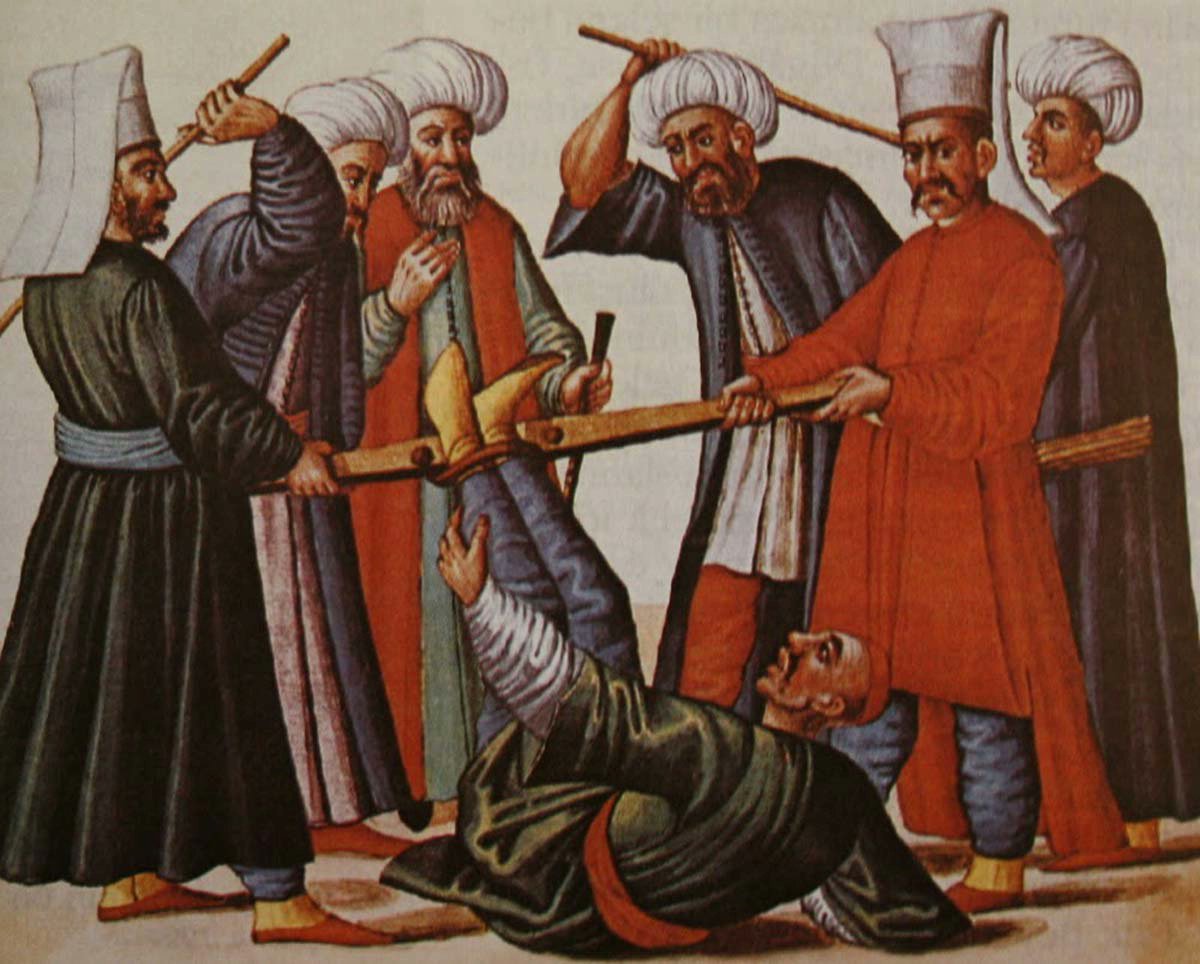
One torture that the Muslim Turks carried out when they had no time for anything else was the breaking of limbs. They usually did this to prisoners they had captured in the countryside and did not want to transport to the city for something "more entertaining," either because they were in a hurry or because they did not want to take on the risks of a possible transfer. With an axe they smashed the main joints of the victim's limbs (shoulder, elbow, hip, knee) and several bones (humerus, femur, tibia). The victim was then unable to move at all, while terrible pains shook his body from the shattered joints. The executioners left him helpless and departed, so that he would die a few hours or at most two days later, or become prey to wild animals in the wilderness.
An equally torture is that of beheading. The Ottoman lords even had a well-known proverb on their lips: "A head that does not bow falls."
The execution of the sentence was carried out in public view by a specialized executioner called "makelaris" (a Greek-Byzantine word meaning "butcher" that derives from ancient Greek), with the well-known curved Ottoman sword, the "yataghan". The victim arrived at the place of slaughter ridiculed and publicly shamed. Before the execution he had, as a rule, been beaten and often mutilated. The punishment itself was painless and instantaneous, but the entire preceding process made it agonizing. The body and head remained exposed for days, just as in the other tortures we mentioned earlier. Often the victim's head was impaled on a pole and paraded through the city, especially if the victim happened to be an officially wanted person (e.g., Ali Pasha). Other times it was preserved and sent to the Sultan himself, as happened with the head of Ali Pasha. Still other times the head remained hung or impaled in a prominent position for days, until the natural decomposition of its features began.
The torture of beheading is naturally connected with the fate of the Four Martyrs. The Synaxarion of the Saints confirms everything I have said so far. After harsh tortures and public humiliation through the streets of Rethymno, the Saints (Manuel, Angelos, George and Nicholas) ended up in the square of the Great Gate, which today bears their name in their honor, to be beheaded.
This is recent history. Tortures ended almost 200 years before when we destroyed the Ottoman Empire. And if you think they changed, you should start reading their comments on my posts or the reposts.
This is who they are. This is Islam
- Homer Pavlos