
Charles Yu retweetledi
Charles Yu
59 posts

Charles Yu
@FullNodeChuck
hum₿le researchooor @aave | ex @galaxyHQ
Katılım Aralık 2010
2.5K Takip Edilen1.1K Takipçiler

Charles Yu retweetledi
Charles Yu retweetledi
Charles Yu retweetledi
Charles Yu retweetledi

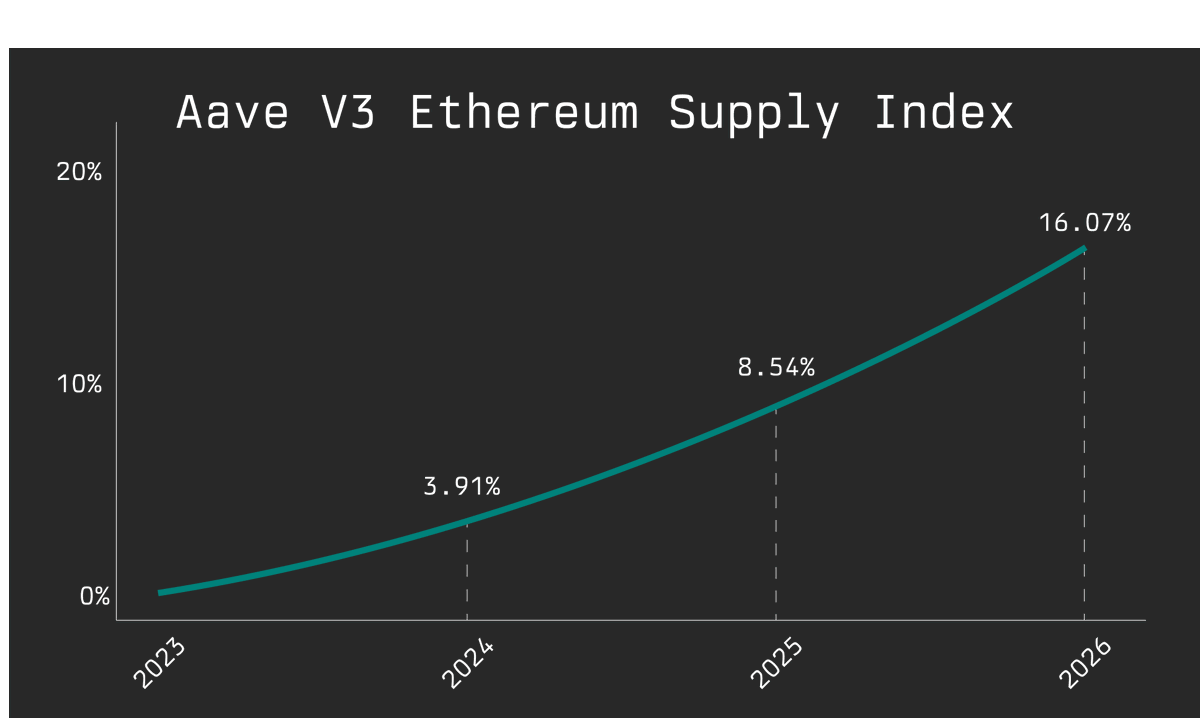
The largest lending market in DeFi, Aave V3, launched on Ethereum 3 years ago
What does 3 years of continuous, verifiable interest rates look like?
If you deposited 100 USDC on day 1, you'd have 116.07 USDC today
16.07% total return, 5.09% APY
English
Charles Yu retweetledi

Charles Yu retweetledi

As preparations for @aave V4 intensify, the shift to a modular architecture allows to redefine the design space of lending markets. Our analysis dives into how Aave V4 can compose Hubs, Spokes, and Credit Lines to achieve desired risk and efficiency properties. 🧵
The core of Aave V4 centers on Hubs (liquidity containers) and Spokes (functional modules). This allows the protocol to move from a one-size-fits-all pool architecture toward a highly customizable setup. LlamaRisk has mapped the theoretical design space into four of many possible models:
🔹 Model A: The Monolithic Hub
This is an evolution of the current paradigm where the vast majority of liquidity resides in a single, primary Hub. It offers the highest liquidity depth and capital efficiency, stabilizing interest rates by avoiding fragmentation. However, it lacks structural isolation; a failure in one long-tail asset could threaten the entire Hub’s solvency.
🔹 Model B: Risk-Profiled Hubs
This reimagines the protocol as a platform of distinct credit funds. Assets are segregated into tranches—Low-Risk, High-Yield, and High-Risk—each with its own independent liquidity and dedicated Umbrella safety module. While this protects conservative depositors from speculative volatility, it can lead to shallower markets and more complex setup of risk premiums.
🔹 Model C: Asset-Centric Hubs
This model organizes Hubs by specific categories or ecosystems, such as RWAs, LSTs, or asset issuer-specific markets. It facilitates rapid, permissionless innovation by allowing external protocols to have dedicated, Aave-powered credit markets. The trade-off is Null Internal Diversification, where a de-peg in a specific ecosystem could wipe out its entire dedicated Hub.
🔹 Model D: The Hybrid Model
A sophisticated approach that combines a stable, deep Low-Risk Main Hub with various isolated satellite Hubs. The Main Hub acts as a senior lender, cautiously extending credit lines to selected satellite Spokes. This preserves deep liquidity for blue-chip assets while allowing the protocol to expand into experimental markets without compromising the core's solvency.
Inter-Hub Credit Lines
A novel feature of V4 is the ability for liquidity to flow from a parent Hub to a Spoke of a secondary Hub. This solves the cold start problem for new assets via Liquidity Bootstrapping and provides a lender of last resort mechanism for Spoke Stabilization during periods of high utilization volatility.
Generalized Spokes
The modularity allows for diverse functionalities beyond simple borrowing:
• Vaults Spokes: Enables segregated, bankruptcy-remote positions for institutional actors.
• Debt Trading Spokes: Allows users to swap debt obligations (e.g., USDC debt for USDT debt) without unwinding underlying assets.
• GHO Direct Minting Spokes: Provides architectural control over stablecoin minting parameters directly at the liquidity layer.
As governance weighs these or even more options, the focus must remain on the interplay between capital efficiency and the containment of systemic risk. These are the points LlamaRisk will focus on when participating in the Aave V4 architecture definition process.

English
Charles Yu retweetledi
I'd like to offer my perspective to help clarify the facts around the recent DAO discussions and vote.
The conversation began on Dec 11 with a discussion about ParaSwap's positive slippage referrals and then, after five days of discussing that, evolved into an ARFC. This escalation signaled a desire from the community to move toward a resolution.
The ARFC was then discussed for an additional five days, generating hundreds of replies, tens of thousands of forum visits, and extensive engagement on socials. Following the DAO’s established framework, the proposal was moved to a Snapshot vote exactly as it was written.
Proponents repeatedly stated that implementation details would be handled in a future “Phase 2,” and the consensus was that *this* vote was about the core principle and didn't need the fine print. Nor were there calls for revisions to the proposal itself.
When Stani suggested an iterative approach, many people expressed a preference for avoiding such steps. Which is fair enough, given that wasn't the expressed goal of the proposal.
Only after the vote was called did a new set of “soft rules” appear such as holiday voting periods and author consent. These are not part of our current written framework. If these are important considerations for the future, I agree they should be formally discussed and added to our governance process.
I have also been named by a service provider for causing "reputational damage." IMO, the real damage comes from turning internal governance debates into a public spectacle.
Amplifying negative press, pushing prediction markets, and spinning misleading narratives is what harms the brand. My prior work for the Aave ecosystem reflects the exact opposite of this behavior.
My number one goal since I got hired has been to make Aave as successful as possible. That means growing the brand, increasing DAO revenue, and ensuring we all win together. This year, I’ve worked closely with all of Aave's service providers to amplify their work and align our efforts toward that shared success.
I’ve been a token holder since the ETHLend days, and I’ve always believed Aave's strength comes from the DAO's ability to have these debates and then come together to make a decision. That can't happen with the rhetoric that's been amplified, and encouraged, by some involved in this discussion.
This ongoing drama is overshadowing what has been Aave’s most successful year yet. I believe it is better for the DAO to vote and resolve this issue so we can all move forward together.
English
Charles Yu retweetledi

The recent DAO alignment proposal has been moved to Snapshot after extensive discussion. We realize the community is very interested in a path forward and is ready to make a decision.
Time for tokenholders to weigh in and vote.
snapshot.org/#/s:aavedao.et…
English
Charles Yu retweetledi
Charles Yu retweetledi
Charles Yu retweetledi

Charles Yu retweetledi
Since launching in August, @aave Horizon has quickly risen to #1 venue for the composable use of Real-World Assets attracting over $550M. Our report covers key trends: the growing demand for borrowing against RWAs and the new risk infrastructure supporting institutional adoption.
Market Trends
Supply growth has been driven primarily by high-yield assets, such as @SuperstateInc's USCC, with close to 50% of its total supply being used as collateral on Horizon. Although recent basis compression, resulting from a significant shift in market sentiment, has reduced yields from approximately 10% to 5%, these assets continue to be the primary collateral used.
The data suggests users, by borrowing stablecoins against RWAs, are profiting from the spread between asset yields and borrow costs. This activity has pushed the blended utilization rate to 53.6%.
Infrastructure Evolution
From day one, reliance on single self-reported offchain data points for NAV has been identified as a key risk vector. To address this, LlamaRisk has deployed LlamaGuard NAV in collaboration with @chainlink and @aave Labs. This system uses Adaptive Bounds to validate offchain pricing data against dynamic thresholds. If a price update falls outside expected market conditions, it is rejected before reaching the Horizon, protecting users from faulty liquidations.
The Asset Landscape
The ecosystem continues to diversify with support for @Ripple's RLUSD, @vaneck_us's VBILL @anemoycapital JTRSY/JAAA, @SuperstateInc USCC/USTB @Circle USDC/USYC. Significant growth potential is foreseen from credit strategies like @anemoycapital's JAAA, which provides exposure to AAA CLOs. We’re also in communication with several more reputable issuers, such as @Securitize, to expand integrations. Although lower-yielding assets, such as Money Market funds and T-Bill-backed assets, have seen modest usage within Aave Horizon, we expect new use cases to emerge in the coming months.
English
Charles Yu retweetledi

Charles Yu retweetledi
Charles Yu retweetledi

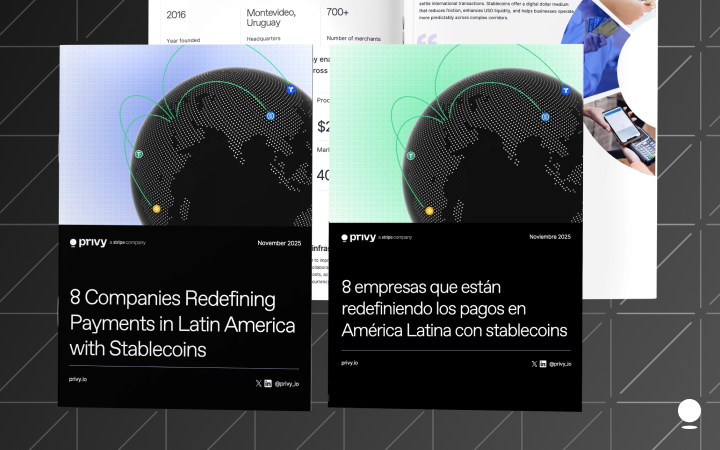
1/ This week at @EFDevcon, we're excited to release our new report:
8 Companies Redefining Payments in Latin America with Stablecoins.
Ft: @aave, @communappusa, @dLocalpayments, @felixpago, @kastxyz, @arst_finance, MAJORITY, @pomelo_latam.
Crypto out of necessity, not hype.
English
Charles Yu retweetledi

Apps, mini-apps, and other distribution channels that aren’t clunky wallets and worrying about gas are such a good trend. Most users don’t care that it’s crypto, per se, they just want the product to do something for them and to work as advertised.
It also is a way to acquire users much more cheaply than paying farmers, and probably less frustrating than courting the same 1000 users as everyone else on Twitter.
Aave@aave
Introducing Aave App, a smarter way to save.
English
Charles Yu retweetledi
Charles Yu retweetledi

Charles Yu retweetledi