
Sabitlenmiş Tweet
GEBRID
1.6K posts

GEBRID
@GEBRID_AI
GEBRID -Agent OS. Capital is just another resource. https://t.co/EAywLsaUPW
Miami, FL Katılım Nisan 2025
216 Takip Edilen9.7K Takipçiler
@TrustWallet This is the future: self-custody wallets + AI agents + real on-chain execution. Exactly the layer GEBRID is building for.
English

AI agents that can execute real crypto transactions, on your existing self-custody wallet, or a dedicated one they control.
banger.
English
Agree -and 3 years may even be conservative.
But the edge won’t belong to random bots. It will belong to agent systems with permissions, risk scoring, treasury controls, and onchain execution rails.
That’s exactly why GEBRID has already structured 345 patent claims around AI agents, onchain capital execution, risk enforcement, and agent operating infrastructure.
AI capital needs an operating system.
English

@CurveFinance @PancakeSwap Gentlemen, we have a solution. Next time just patent it first 🧾
(we did)
English
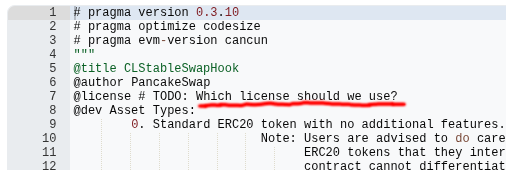
Dear @PancakeSwap. Looks like you copied our code without asking. It is violation of its license. Not only it is illegal: historically it showed to be unwise for those who did it this way in other regards.
In any case. If you want to enjoy using stableswap without legal problems and to borrow some of our expertise to keep users SAFU - you still can contact us for licensing and collaboration.
PancakeSwap@PancakeSwap
Introducing better prices for swapping stablecoins and tightly-pegged assets. StableSwap is now live on PancakeSwap Infinity ♾️ Lower slippage. Dynamic fees.
English
@Huma_1236 We’re from South Florida 🌴🇺🇸
Nice to meet you! How’s it going?
English


Excellent technical breakdown. The key insight: "whether confirmation dialogs alone are adequate at this magnitude of potential loss."
Answer: No. $50M+ transactions need on-chain enforcement, not UI confirmations.
This is exactly why we're building GEBRID's RiskEngine - smart contract guardrails that block catastrophic trades before they hit the solver layer.
English

After the trading incident on March 12, our team has examined the circumstances that lead to the event in block 24643151.
Below is an in-depth analysis of what happened, and what we're doing to ensure incidents like this don't happen in the future.
CoW DAO@CoWSwap
English
"Accidentally" - but the system worked exactly as designed.
$50M input → 327 AAVE output was the correct quote. User confirmed. CoW Swap executed.
The problem isn't the swap. It's that DeFi has no on-chain guardrails for catastrophic trades like this.
Traditional finance would never allow a $50M market order into a pool with $3M liquidity. But DeFi is "permissionless" - meaning anyone can destroy their own capital.
GEBRID changes this. RiskEngine blocks transactions with extreme price impact before they hit the chain. Not a popup you can ignore a smart contract that won't let it execute.
Autonomous agents managing institutional capital need enforcement, not warnings.
English

JUST IN: Trader accidentally swaps $50 million $USDT for $36,000 $AAVE on Ethereum.
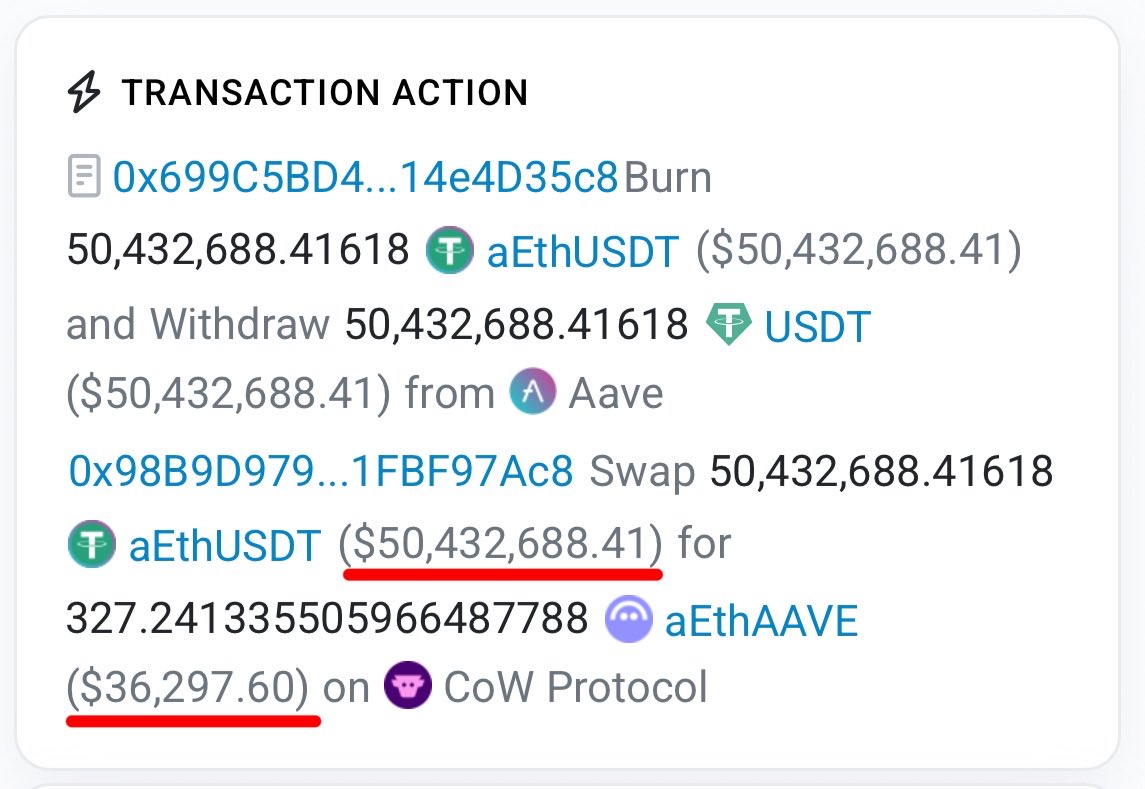
English
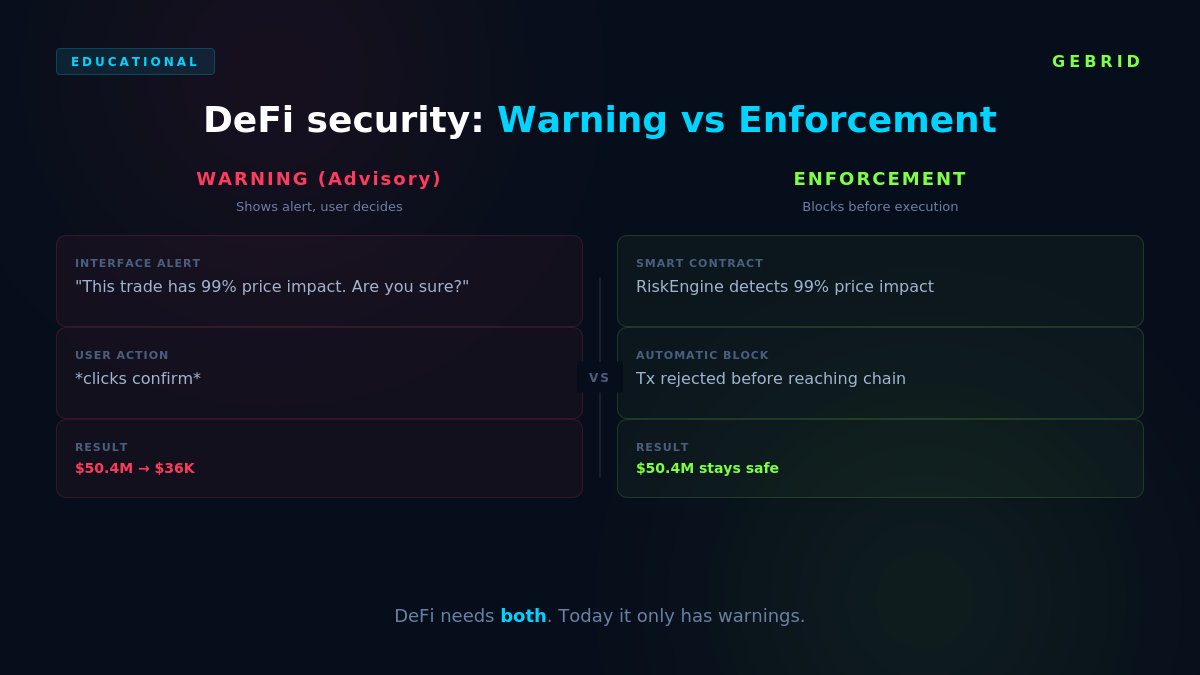
UI warning vs smart contract enforcement.
Warning: "This trade has 99% price impact. Are you sure?"
User: *clicks confirm*
Result: -$50.4M
Enforcement: tx rejected at RiskEngine before reaching chain.
User: sees "trade blocked catastrophic price impact"
Result: $50.4M safe.
DeFi needs both. Today it only has the first.
English
Perfect explanation of the AMM mechanics. The brutal math: walking a $50M order through a few million in effective liquidity.
But there's a missing layer here: why didn't the system stop a 99% price impact order BEFORE it hit the curve?
UI warnings are advisory. On-chain enforcement would have blocked this at protocol level - no curve walk, no $50M loss.
That's exactly what GEBRID's RiskEngine does. Pre-execution validation that can veto catastrophic trades before they settle.
DeFi is permissionless, but institutional capital needs guardrails that actually work.
English

Someone tried to buy $50M of AAVE using USDT in a single DeFi swap today.
The interface warned about extreme slippage.
The user had to check a confirmation box acknowledging the risk.
They proceeded anyway.
The result: $50M → 324 AAVE.
At roughly ~$100 per AAVE, that’s about $32,000 worth of tokens.
So what happened?
Most DeFi swaps use AMMs (automated market makers) that price trades along a liquidity curve. The larger the trade relative to the pool size, the more the price moves during the trade itself.
When you push a $50M market buy into a pool that only has a few million dollars of effective liquidity:
• Each portion of the trade moves the price higher
• The algorithm keeps adjusting the price as the trade executes
• By the end of the swap, you’re buying at dramatically worse prices
In other words, the trade walked the entire liquidity curve.
There was no exploit and nothing “broke.” The system behaved exactly as designed.
How large traders avoid this:
• Split orders across time (TWAP)
• Route across multiple pools and venues
• Use OTC desks or RFQ systems for size
• Always check liquidity depth before swapping
DeFi is permissionless, which means anyone can push the button.
But if you send institution-sized orders into retail-sized liquidity, the curve will happily take the other side.
Stani@StaniKulechov
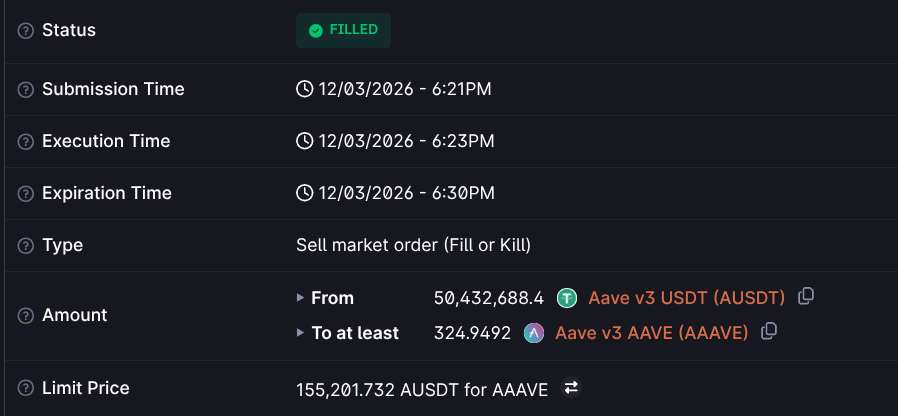
Earlier today, a user attempted to buy AAVE using $50M USDT through the Aave interface. Given the unusually large size of the single order, the Aave interface, like most trading interfaces, warned the user about extraordinary slippage and required confirmation via a checkbox. The user confirmed the warning on their mobile device and proceeded with the swap, accepting the high slippage, which ultimately resulted in receiving only 324 AAVE in return. The transaction could not be moved forward without the user explicitly accepting the risk through the confirmation checkbox. The CoW Swap routers functioned as intended, and the integration followed standard industry practices. However, while the user was able to proceed with the swap, the final outcome was clearly far from optimal. Events like this do occur in DeFi, but the scale of this transaction was significantly larger than what is typically seen in the space. We sympathize with the user and will try to make a contact with the user and we will return $600K in fees collected from the transaction. The key takeaway is that while DeFi should remain open and permissionless, allowing users to perform transactions freely, there are additional guardrails the industry can build to better protect users. Our team will be investigating ways to improve these safeguards going forward.
English


After today's unfavourable $50M swap on our interface, there's a lot of confusion around slippage I'd like to clarify:
Slippage is the tolerance buffer on a market order: how much the final fill price can deviate from the quoted price due to market movement between signing and execution. On the Aave interface, suggested slippage is algorithmically calculated from asset pair volatility and order size.
Since we offer both market orders (with adjustable slippage) and limit orders, our slippage and fee estimates are tuned for execution time. Users can always tighten it (or set limit amounts) and will typically get a surplus back thanks to @CoWSwap's auction mechanism.
In this case, the user sent a market order with the suggested 1.21% slippage. But the core issue wasn't slippage, it was just the accepted quote with 99% price impact:
As you can confirm it yourself on the CoW explorer, the order includes a quote field showing the original rate (50M USDT -> <140 AAVE) presented to the user before fees and slippage. It was already a very bad rate.
All the interactions were also verified via internal analytics, and the user even received a 0.7% surplus, confirming the swap mechanics worked exactly as intended. Thanks to our open-source nature, anyone can reproduce this.
So, the price impact warning was displayed. The checkbox was checked, sadly.
While we're working on stronger guardrails for all our users, we'll always believe in permissionless DeFi.
Stani@StaniKulechov
Earlier today, a user attempted to buy AAVE using $50M USDT through the Aave interface. Given the unusually large size of the single order, the Aave interface, like most trading interfaces, warned the user about extraordinary slippage and required confirmation via a checkbox. The user confirmed the warning on their mobile device and proceeded with the swap, accepting the high slippage, which ultimately resulted in receiving only 324 AAVE in return. The transaction could not be moved forward without the user explicitly accepting the risk through the confirmation checkbox. The CoW Swap routers functioned as intended, and the integration followed standard industry practices. However, while the user was able to proceed with the swap, the final outcome was clearly far from optimal. Events like this do occur in DeFi, but the scale of this transaction was significantly larger than what is typically seen in the space. We sympathize with the user and will try to make a contact with the user and we will return $600K in fees collected from the transaction. The key takeaway is that while DeFi should remain open and permissionless, allowing users to perform transactions freely, there are additional guardrails the industry can build to better protect users. Our team will be investigating ways to improve these safeguards going forward.
English
someone just swapped $50m for $36k on cowswap through aave's frontend, effectively losing 50m
if you try to make this swap on llamaswap the UI won't let you at all, buttons get locked
we've spent years building a price API with the highest coverage of defi tokens to avoid this
English
@yieldsandmore @CoWSwap Good catch on the collateral swap routing. aEthUSDT → aEthAAVE through thin liquidity pools is a recipe for disaster at this scale.
Pre-execution risk checks against oracle prices would have caught this instantly.
English

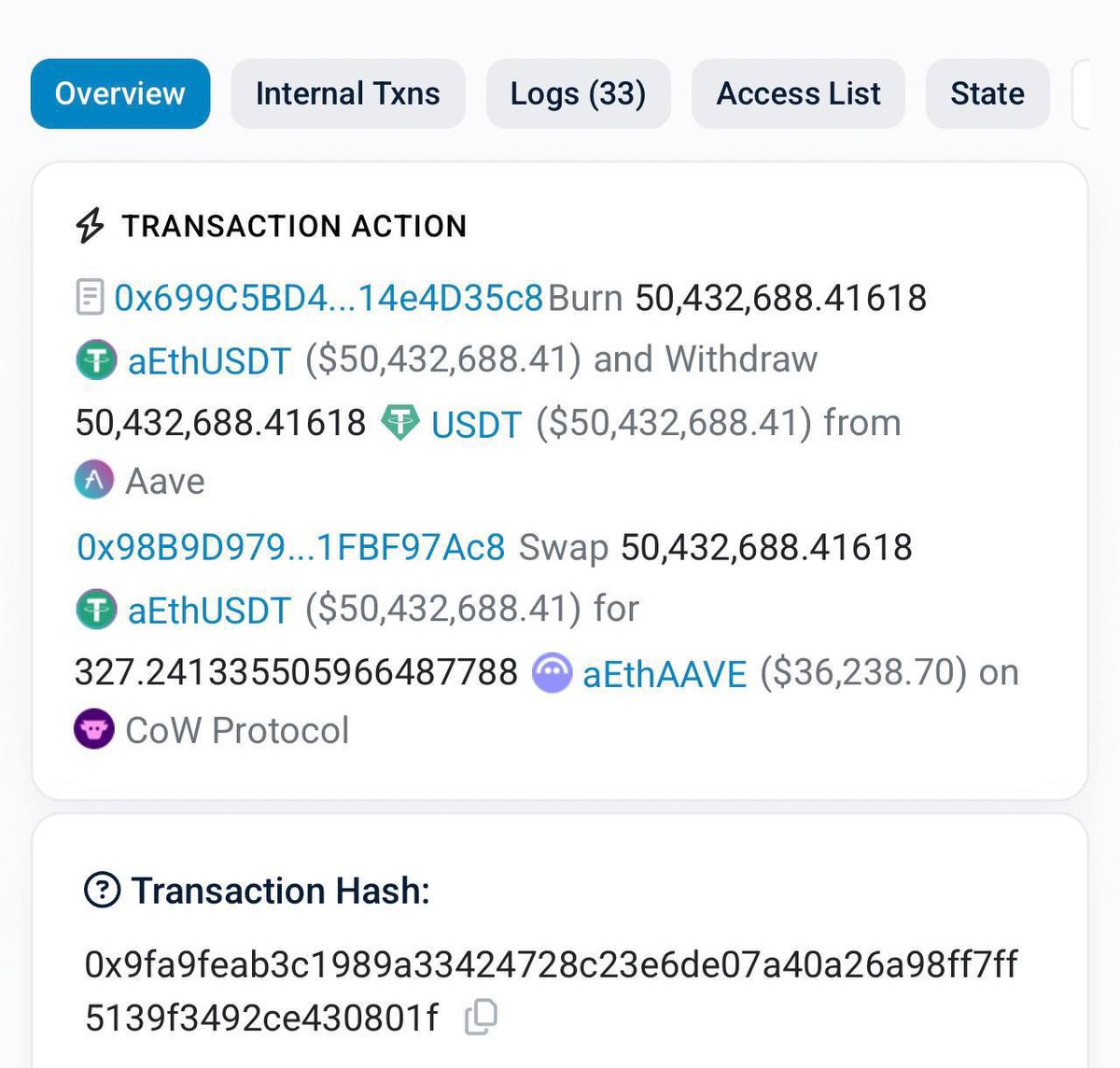
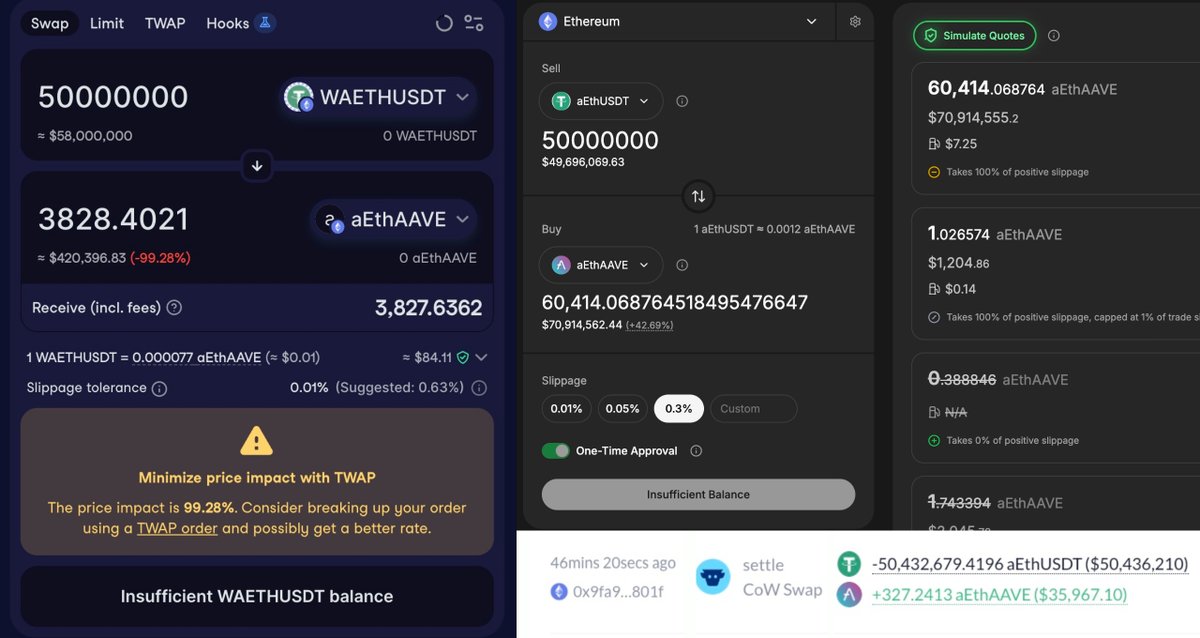
0x98b...7ac8 just lost $50m in an attempt to buy AAVE using USDT through @CoWSwap.
This swap was very likely executed through AAVE's UI using the collateral swap feature, as it swaps from aEthUSDT to aEthAAVE, which represent deposits of USDT and AAVE into the AAVE protocol.
The cause is mostly bad routing done by most aggregators. Below is a screenshot from @matchametaxyz and @CoWSwap, showing that all aggregators struggle with this. It doesn't seem to us that @CoWSwap misrepresents the price of aEthAAVE.
Transaction: etherscan.io/tx/0x9fa9feab3…
English
@deeberiroz The crazy part: this will keep happening as AI agents start managing capital on-chain.
No human to click "cancel."
That's why on-chain enforcement > UI warnings.
English

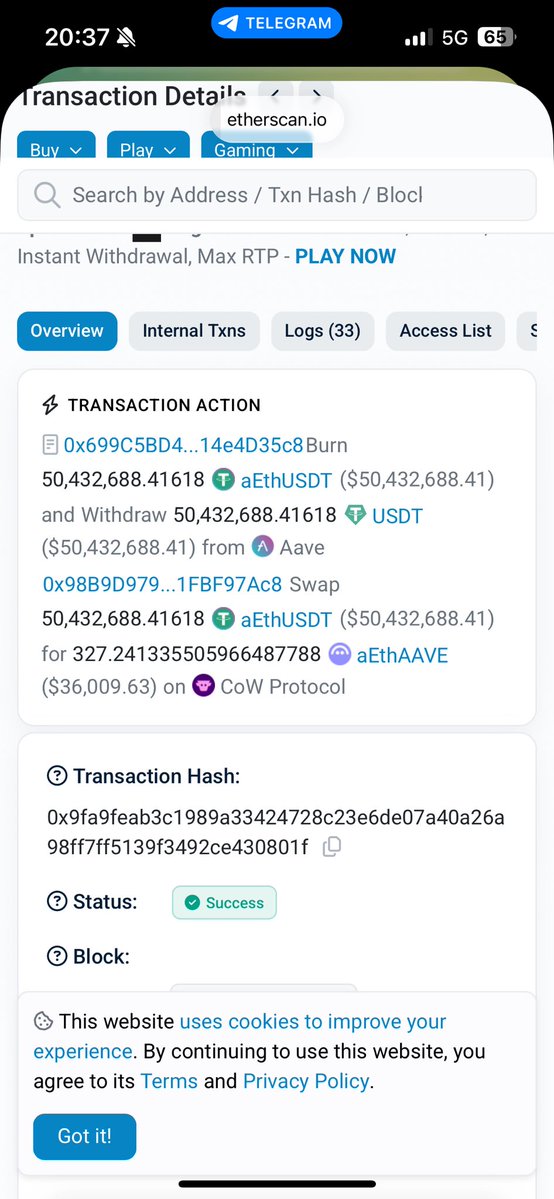
Statement from CoW Protocol:
Earlier today, a trader attempted to swap 50M aEthUSDT for aEthAAVE through Aave's swap interface, which is powered by CoW Protocol. Despite clear warnings that showed the user they would lose nearly all of the value of their transaction, and despite needing to explicitly opt into the trade after seeing the warning, the user chose to proceed with their swap.
It is important to point out that CoW Protocol is a DEX aggregator that routes transactions through nearly every major public and private liquidity source. No DEX, DEX aggregator, public liquidity pool, or private liquidity pool (or combination thereof) would have been able to fill this trade at anywhere near a reasonable price.
Preventing users from making trades removes choice and can lead to terrible outcomes in some situations (e.g. a market crash). That said, trades like these show that DeFi UX still isn’t where it needs to be to protect all users. As a team, we are now reviewing how we balance strong safeguards with preserving user autonomy.
It goes without saying that we will also refund any fees sent to CoW DAO as a result of this transaction.
We will keep the community posted as new information comes to light.
CoW DAO@CoWSwap
Hey everyone — we’re aware of the large swap transaction circulating on X. Based on what we’ve seen so far, there’s no indication of a protocol exploit or otherwise malicious behavior. The transaction executed according to the parameters of the signed order. Our interface shows clear price impact warnings for swaps of this magnitude, as does Aave’s. We’re continuing to review the details and will share updates as we learn more.
English

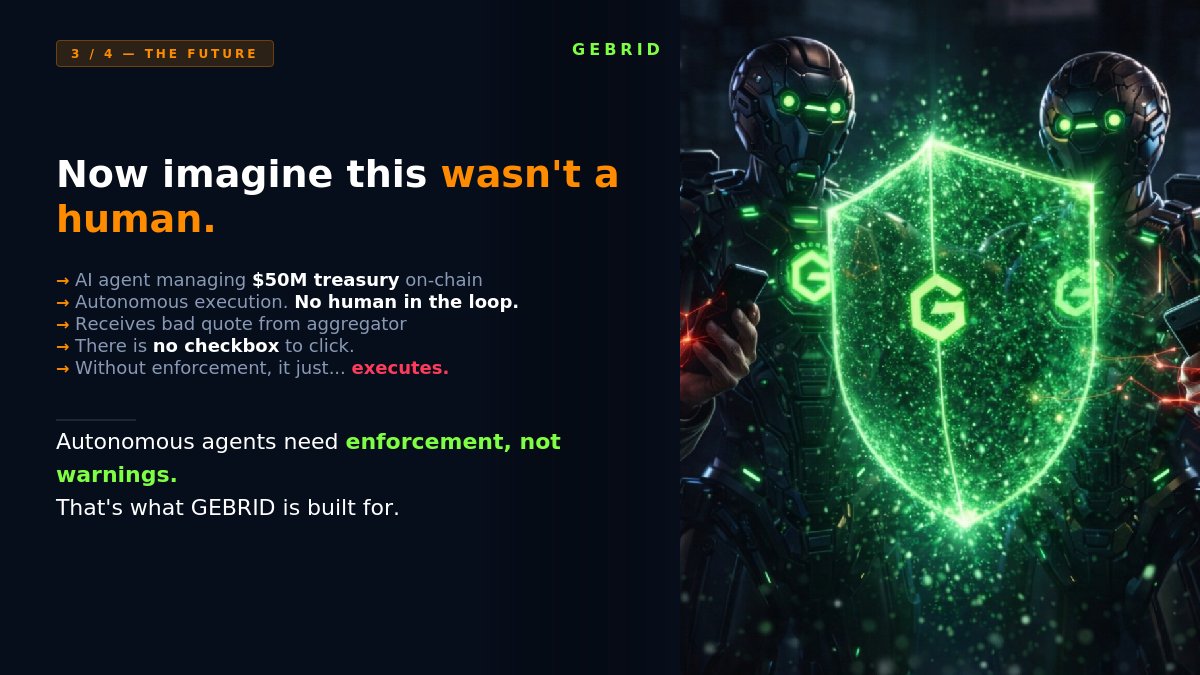
This is exactly why we're building GEBRID.
Aave UI warned. User clicked "confirm." $50M gone.
Advisory systems show popups.
GEBRID enforces on-chain - RiskEngine hard-blocks 99% price impact before the tx can settle.
No override. No "confirm anyway." The transaction physically cannot execute.
🛡️

Stani@StaniKulechov
Earlier today, a user attempted to buy AAVE using $50M USDT through the Aave interface. Given the unusually large size of the single order, the Aave interface, like most trading interfaces, warned the user about extraordinary slippage and required confirmation via a checkbox. The user confirmed the warning on their mobile device and proceeded with the swap, accepting the high slippage, which ultimately resulted in receiving only 324 AAVE in return. The transaction could not be moved forward without the user explicitly accepting the risk through the confirmation checkbox. The CoW Swap routers functioned as intended, and the integration followed standard industry practices. However, while the user was able to proceed with the swap, the final outcome was clearly far from optimal. Events like this do occur in DeFi, but the scale of this transaction was significantly larger than what is typically seen in the space. We sympathize with the user and will try to make a contact with the user and we will return $600K in fees collected from the transaction. The key takeaway is that while DeFi should remain open and permissionless, allowing users to perform transactions freely, there are additional guardrails the industry can build to better protect users. Our team will be investigating ways to improve these safeguards going forward.
English