
Gilbert Verdian

1.7K posts

Gilbert Verdian banner
Gilbert Verdian

Gilbert Verdian

@gverdian

CEO @quantnetwork. Security leader creating new technology and companies. Converging Cybersecurity & Blockchain. Ex-CISO/CIO/CTO from Gov & FS. #BuildtheFuture

London Katılım Ocak 2009
5.1K Takip Edilen56K Takipçiler
Gilbert Verdian retweetledi

Quant
Quant@quantnetwork·
Tokenised deposits and real-world assets have crossed $100 billion. For banks and capital markets firms, operationalising tokenisation without dismantling what already works is now the defining challenge. Our partnership with Murex addresses that directly. Integrating Quant's programmable money infrastructure into MX.3 means institutions can issue, settle and manage tokenised deposits and digital bonds within their existing operational framework, with the same risk management, compliance and post-trade processes they already rely on. As @gverdian puts it: 'The next generation of capital markets infrastructure will not replace what works. It will make what works programmable.' Read the full piece in @ATeamInsight: a-teaminsight.com/blog/how-murex… #Tokenisation #DigitalAssets #ProgrammableMoney #CapitalMarkets
Quant tweet media
English
0
174
760
34.4K
Gilbert Verdian retweetledi
Quant
Quant@quantnetwork·
On 21st April, @InnFin's Global Summit returns to London's Guildhall. Our Founder and CEO, @gverdian, will be joining a panel titled: 'Building A "Multi-Moneyverse", Are We There Yet?' covering progress since the National Payments Vision, what still needs to happen, and how interoperability can connect the financial system in practice. Learn more and register here: innovatefinance.com/ifgs2026/ #IFGS #InnovateFinance #Payments #Interoperability
Quant tweet media
English
0
104
508
17.5K
Gilbert Verdian
Gilbert Verdian@gverdian·
I’m delighted to announce that @quantnetwork and Murex are partnering to bring tokenised deposits and digital bond settlement into MX.3. Institutions have been asking the same question. How do we move forward with tokenisation without disrupting the trading, risk and post-trade operations we depend on? The answer is now inside the platform they already use. Tokenised RWAs just crossed $100 billion. DTCC has SEC approval to tokenise real-world assets from mid-2026 and major UK banks are already working with Quant through the Great Britain Tokenised Deposit initiative - all of which signals that the market is moving.  Users in banks, asset managers, insurance companies, pension funds, hedge funds, corporations and energy utilities in over 65 countries now have a production-ready path into tokenisation through the systems they already run. The future of capital markets infrastructure is programmable: quant.network/press-releases… #Tokenisation #DigitalAssets #CapitalMarkets #Programmability
English
76
322
1.2K
68.8K
Gilbert Verdian retweetledi
Quant
Quant@quantnetwork·
The shift toward Treasury-as-a-Service represents more than organisational restructuring. It reflects the reality that modern #treasuryoperations require technology infrastructure capable of delivering instant liquidity visibility, automated #cashmanagement, and seamless integration with both banking partners and internal systems, capabilities that legacy #treasurymanagement systems were never designed to provide. Read the full article to learn why TaaS is becoming the new operating model for group treasury, what capabilities it unlocks, and how organisations are making the shift: quant.network/perspectives/t… #CorporateTreasury #ProgrammableMoney
English
0
144
553
26.8K
Gilbert Verdian
Gilbert Verdian@gverdian·
A decade in the making, we have published an ISO standard for blockchain interoperability. This is a milestone I've been working towards since 2015, Remitt was founded with the conviction that blockchains could transform financial services but only if the industry solved interoperability and harmonised around global standards. Without that, blockchain would remain fragmented, siloed, and locked out of mainstream institutional adoption. In April 2016, we published what was the world's first proposal for a blockchain standard (remitt.com/blog/2016/04/2…) a bold move at a time when the industry was still largely focused on proofs of concept and competing protocol narratives, not standardisation. The idea was simple but ambitious: if blockchains were going to serve global markets, they needed a common framework that transcended any single protocol or vendor. Central to this thinking from the very beginning was the concept of a multi-gateway architecture, leveraging the know-how of 20 years of experience in cybersecurity to frame the principle that interoperability shouldn't depend on a single bridge or point-to-point connection, but on a layered gateway model that could abstract away the differences between underlying DLTs and connect them through a common interface. This was the architectural foundation of what would become Overledger, and it was also the design philosophy we brought to the standards process. The belief was that a viable international standard for blockchain interoperability had to be protocol-agnostic and gateway-driven, enabling any DLT to communicate with any other DLT (any-to-any) and with existing networks, without requiring those ledgers to change how they operate. The standard and the technology were born from the same insight. That same year, I worked closely with the team from @standardsaus (Standards Australia), who had the foresight in 2015 to champion the initiative at the international level. Together, we pushed for ISO to establish a dedicated Technical Committee for blockchain and not to be absorbed into an existing committee, but to stand on its own as a recognition that this technology warranted its own global standards programme. The industry demand was there, the use cases were multiplying, and the fragmentation was becoming a real barrier. In September 2016, the New Work Item Proposal (NWIP) received global approval, and ISO formally gave the green light to establish a new Technical Committee (remitt.com/blog/2016/09/1…). TC 307 — Blockchain and Electronic Distributed Ledger Technologies — was born (remitt.com/wp-content/upl…). The inaugural meeting was held in Sydney in April 2017, and from that moment the real work began. As the standards work progressed internationally, the mission at Remitt was evolving too. What started as an effort to use blockchains for financial services and solve interoperability grew into something far larger, a full enterprise infrastructure platform for connecting any blockchain to any network. Remitt became Quant, and we built Overledger, the world's first blockchain operating system to deliver on that original vision. The multi-gateway architecture that informed the standards thinking became the core of Overledger's design: a technology layer that sits above all blockchains, providing institutions with a single integration point to access any DLT, any network, and any existing system. The interoperability challenge that drove the standards work was the same challenge we set out to solve commercially and the two efforts reinforced each other throughout. For close to a decade since TC 307's formation, subject matter experts across the world have contributed their time and expertise to Working Group 7 — Interoperability is the committee I chair. International standards are not built quickly they are built through consensus, technical debate, and relentless refinement. The same methodology and rigour that created the Internet, through publishing standards. The result is a published international standard for blockchain interoperability. 🔗 iso.org/standard/82098… A huge thank you to @isostandards as the international standards developing organisation, to the team at @standardsaus who started the initiative in 2015 and worked tirelessly to get TC 307 approved and established globally, and to every subject matter expert who contributed to Working Group 7 over the years. This would not exist without that collective effort. From a blog post proposing the world's first blockchain standard in 2016, to a published ISO standard in 2026 and from Remitt to Quant, from an architectural concept of multi-gateway interoperability to Overledger and a global standard, this has been a decade-long journey of building both the standards and the technology to make blockchain interoperability a reality for institutions worldwide. There is still much more work ahead. More standards to develop, more to evolve, and more to build. But today, we mark a significant milestone. #Blockchain #ISO #Interoperability #Standards #TC307 #DLT #Quant #Overledger
English
112
398
1.4K
198.1K
Gilbert Verdian retweetledi
Quant
Quant@quantnetwork·
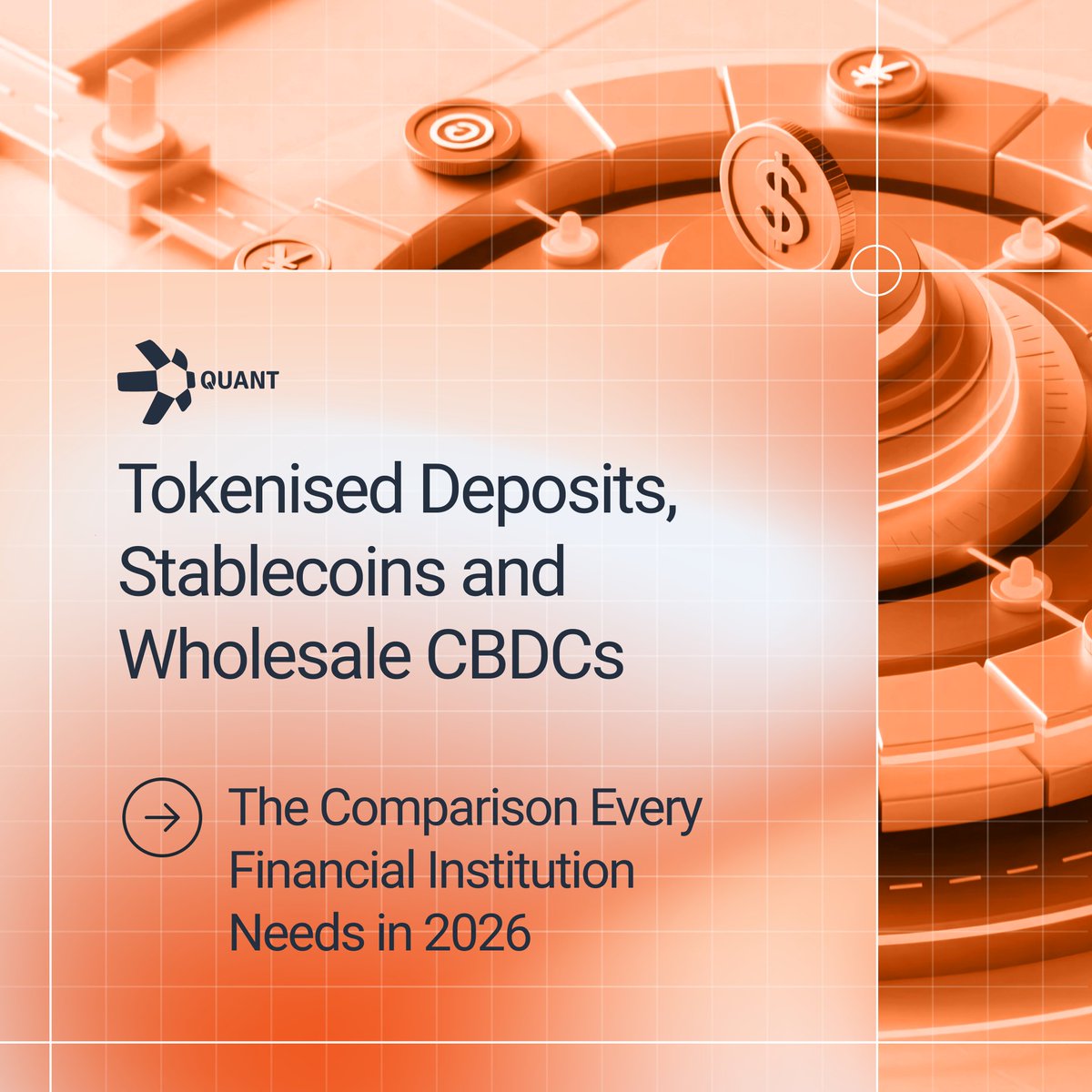
The global financial system now has three distinct forms of programmable #digitalmoney, and they are not interchangeable. #Stablecoins, wholesale #CBDCs, #tokeniseddeposits. Each has a different issuer, different regulatory status, and different use cases. Financial institutions in 2026 need to understand which instrument is right for which job, and what infrastructure is required to connect them. We've broken down the full comparison, the three-layer architecture, and what it means for your institution in our latest article: quant.network/perspectives/t…
Quant tweet media
English
0
172
612
24.1K
Gilbert Verdian
Gilbert Verdian@gverdian·
Looking forward to GFTN in Tokyo this week. Talking on panels regarding tokenised deposits and will spend the week with partners Dentsu Soken meeting clients and regulators.
Gilbert Verdian tweet media
English
30
113
594
22.5K
Gilbert Verdian
Gilbert Verdian@gverdian·
Delighted to share that @quantnetwork has been selected for the @bankofengland’s Synchronisation Lab as part of the RTGS Future Roadmap. Our use case: atomic, multi-bank treasury operations powered by Quant Flow and PayScript®. All payment legs settle together or not at all, eliminating partial settlement risk across multiple banks in a single action. This is programmable finance that works within existing market structures, not around them. quant.network/press-releases… #RTGS #TreasuryManagement #PaymentsInnovation #FinancialInfrastructure #SynchronisationLab #ProgrammableMoney
English
56
294
1K
76.1K
Gilbert Verdian
Gilbert Verdian@gverdian·
Yet technology alone is not enough. For this transformation to benefit everyone, it must be built on foundations of trust, interoperability, and governance. Without these, scale creates silos, and innovation outpaces coordination. This is where the next phase of the journey leads. As AI becomes a core layer of digital infrastructure, interoperability becomes the mechanism that allows intelligence to move seamlessly across networks, organisations, and jurisdictions. Trust becomes programmable, embedded directly into systems rather than enforced after the fact. At @quantnetwork, our focus has always been on enabling systems to work together across technologies, markets, and borders. In an AI-driven world, this capability becomes essential. It ensures that as productivity accelerates, participation broadens; as systems become more powerful, they also become more accessible. It is a future where growth is not limited by legacy infrastructure or fragmented systems, but enabled by connected, trusted digital foundations.
English
15
87
523
15.6K
Gilbert Verdian
Gilbert Verdian@gverdian·
For decades, we have built technology by hand carefully assembling systems piece by piece, much like factories operated before the Industrial Revolution. Progress was steady, but it was constrained by human scale and linear growth. Artificial intelligence marks a fundamental inflection point. AI is the Industrial Revolution of technology itself: a transition from manual construction to automated, intelligent production. This shift unlocks exponential increases in output, embeds efficiency and scalability by design, and continuously elevates quality. More importantly, this is not a future that concentrates capability in the hands of a few. It is a journey toward a world where everyone can be skilled up, where individuals and organisations can contribute meaningfully to global output, and where value creation is no longer limited by access to capital, geography, or legacy infrastructure. As AI becomes part of the fabric of how systems are built and operated, productivity becomes more inclusive, opportunity more evenly distributed, and economic participation broader than at any point in history. The result is not just faster technology, but a step change in human progress, one that enables shared prosperity at a scale the world has never experienced before.
English
15
170
757
34K
Gilbert Verdian
Gilbert Verdian@gverdian·
Some shifts in finance are loud. Others are quiet, but far more important. Today, Quant is announcing a partnership with @dentsusoken in Japan. Over recent years, our work done in the UK has shown that digital money doesn’t have to sit outside the financial system to innovate. Tokenised deposits and programmable settlement can be designed inside regulation, inside banks, and at institutional scale. What’s interesting now is what happens next. Japan is approaching these questions in its own way, within its own regulatory and market context. But the direction of travel is clear: major economies are beginning to think seriously about how programmable money fits into real-world financial infrastructure. This partnership is about building that foundation with institutions at the centre. #TokenisedDeposits #ProgrammableMoney #Stablecoins #Blockchain
Quant@quantnetwork

Digital money isn't theoretical anymore. Quant and Dentsu Soken are partnering to build #programmablesettlement & #tokeniseddeposit infrastructure in Japan. The UK tested it in regulated systems. Now Japan is moving from pilot to production, combining regulatory experience with deep implementation expertise across Japanese financial institutions - learn more: quant.network/press-releases… #FinancialInfrastructure #Payments

English
0
269
1.1K
62.3K
Gilbert Verdian
Gilbert Verdian@gverdian·
For decades, money has been electronic but fundamentally limited, operating through simple push-and-pull mechanisms. It hasn’t evolved in step with our digital world and with tokenised assets until now. The FT highlights how Lloyds and other UK banks are moving toward tokenised deposits, bringing real customer money onto blockchain infrastructure - a pivotal moment for finance and for money itself. Tokenised deposits mark the shift to programmable money: real-time, instant settlement, logic-driven execution. Unlocking new possibilities across payments, mortgages, capital markets, and liquidity. At @quantnetwork, we’ve been focused on this challenge for years: building secure, interoperable infrastructure that allows financial institutions to connect, transact, and innovate without fragmenting the system or compromising trust. The real transformation is about modernising the plumbing of the global financial system so money and assets can flow seamlessly across institutions, borders, and platforms - just like data does today. We’re now seeing banks move from experimentation to execution. The next generation of money is being built and the infrastructure behind it matters more than ever. FT article 👇 ft.com/content/671afe… #TokenisedDeposits #ProgrammableMoney #FinancialInfrastructure #Blockchain #FutureOfFinance
Quant@quantnetwork

The @FinancialTimes highlights how Lloyds Banking Group and other lenders such as Natwest, Barclays & HSBC are leading UK banking into a new era through tokenised deposits and programmable money, a shift that could fundamentally reshape how money moves, settles, and is used across the economy. Tokenised deposits bring real cash onto blockchain infrastructure, enabling automation, real-time settlement, and smarter financial products from mortgages to payments and capital markets. At Quant, we’re proud to be working with leading banks on this transformation. As our CEO @gverdian notes in the article, tokenised deposits represent the evolution of electronic money into digital, programmable money - unlocking efficiency, liquidity, and interoperability across the financial system. This is about more than innovation. It’s about building the next generation of money and the infrastructure that underpins it securely, at scale, and connected across institutions. Article: ft.com/content/671afe… #TokenisedDeposits #ProgrammableMoney #Tokenisation #DigitalAssets #FinancialInfrastructure #Blockchain #FutureOfFinance

English
19
69
259
11.8K
Gilbert Verdian
Gilbert Verdian@gverdian·
Stablecoins have moved digital money forward in important ways. They’ve shown what always-on, programmable value transfer can look like at scale. Now we’re seeing the next phase. Banks and market infrastructures are applying those lessons to regulated money through tokenised deposits, bringing programmability into the core of the financial system rather than around its edges. As tokenised deposits and tokenised assets start to operate together, the impact goes beyond speed. It changes how settlement, liquidity, and risk are managed across markets. I’ve shared some thoughts on why 2026 is shaping up to be a meaningful year for digital money. quant.network/perspectives/h… @quantnetwork
English
21
168
732
31.1K
Gilbert Verdian retweetledi
Quant
Quant@quantnetwork·
Major milestone for UK #digitalassets: @hmtreasury just laid legislation creating a comprehensive #cryptoasset regulatory regime coming into force in 2027. This framework provides the clarity innovative firms need while protecting consumers. At Quant, we welcome technology-neutral regulation that enables responsible innovation. The UK is leading the way in balancing innovation with protection, exactly what's needed to unlock the sector's full potential. Learn more: gov.uk/government/new… #Regulation #Blockchain #Interoperability
English
0
143
632
41.9K
Gilbert Verdian retweetledi
Quant
Quant@quantnetwork·
The UK has just taken a significant leap forward with the Property (#DigitalAssets etc) Bill receiving royal assent. This new law formally recognises #cryptocurrencies, #stablecoins, and other digital assets as personal property under UK law. This sets the UK up for digital assets and #tokenisedmoney globally. As finance moves on-chain with all our assets being tokenised, this legislation sets the UK apart and creates the certainty for economies to trade in the UK. With approximately 12% of UK adults now owning cryptocurrency, this legal framework positions the country as a leader in digital asset regulation, offering the clarity and consumer protection needed to unlock institutional adoption and cross-border digital commerce. The future of finance is being built on-chain, and the UK is laying the legal foundation to lead it. Read the full legislation here: legislation.gov.uk/ukpga/2025/29/… #Tokenisation #Blockchain #CryptoRegulation
English
0
203
863
80.5K
Gilbert Verdian retweetledi
Quant Fusion Layer 2.5
Quant Fusion Layer 2.5@FusionLayer25·
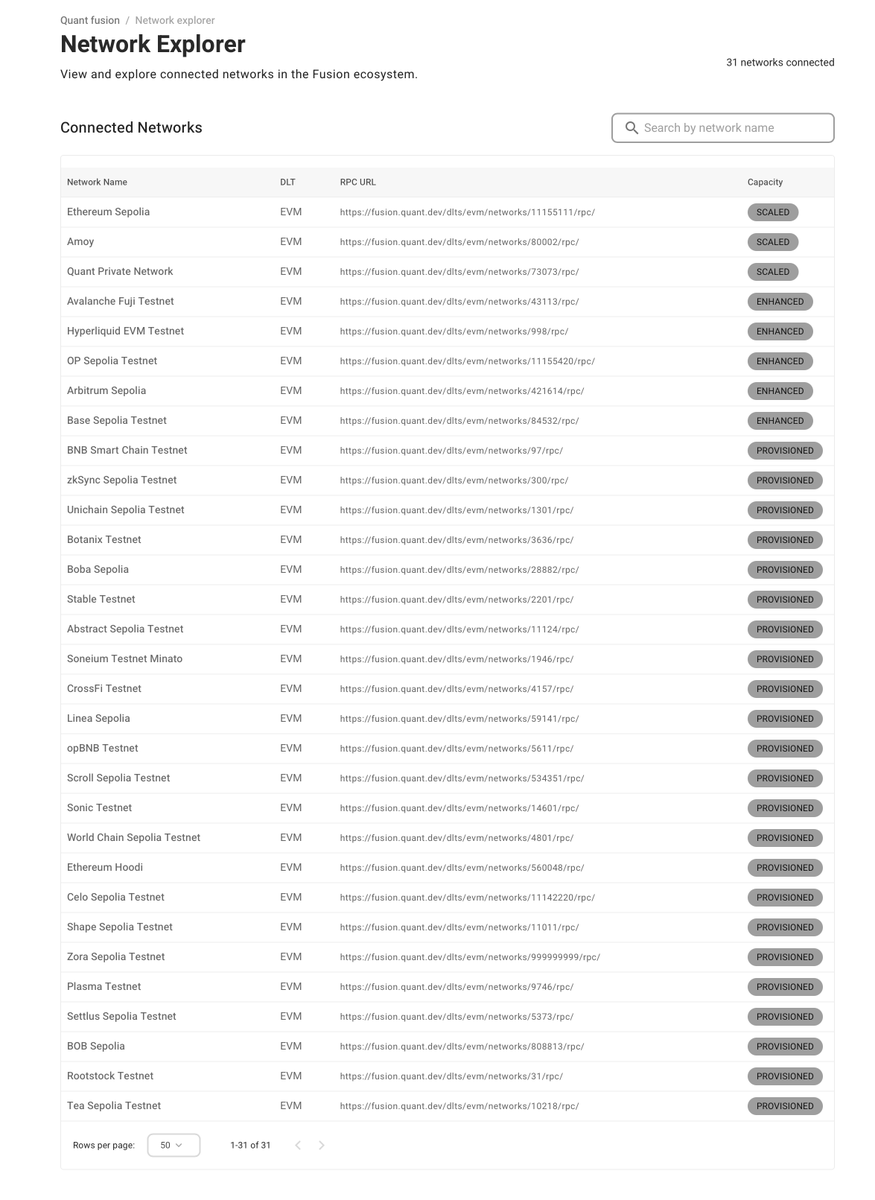
Fusion's second core component enables users to integrate their own #nodes and #blockchainnetworks into the ecosystem. Key features: • Fine-grained access control (define who sees what) • Native privacy preservation • Modular, extensible design • Form an interconnected mesh of ledgers Coming soon: 📍 BYON (Bring Your Own Node) with QNT staking incentives 📍 Open source connector specification 📍 BYOC (Bring Your Own Connector) for any network. Turn your private infrastructure into part of the multi-chain ecosystem. Learn more: quant.network/quant-fusion/ #Web3Infrastructure #BlockchainNodes #QuantFusion
Quant Fusion Layer 2.5 tweet media
English
0
129
429
32.6K
Gilbert Verdian
Gilbert Verdian@gverdian·
When you establish TC307 to develop ISO Standards for blockchain in 2016 basing it on #ISO20022 for mainstream adoption by financial institutions: remitt.com/wp-content/upl… You’ve built everything since then with ISO 20022.
English
65
241
1K
138.5K