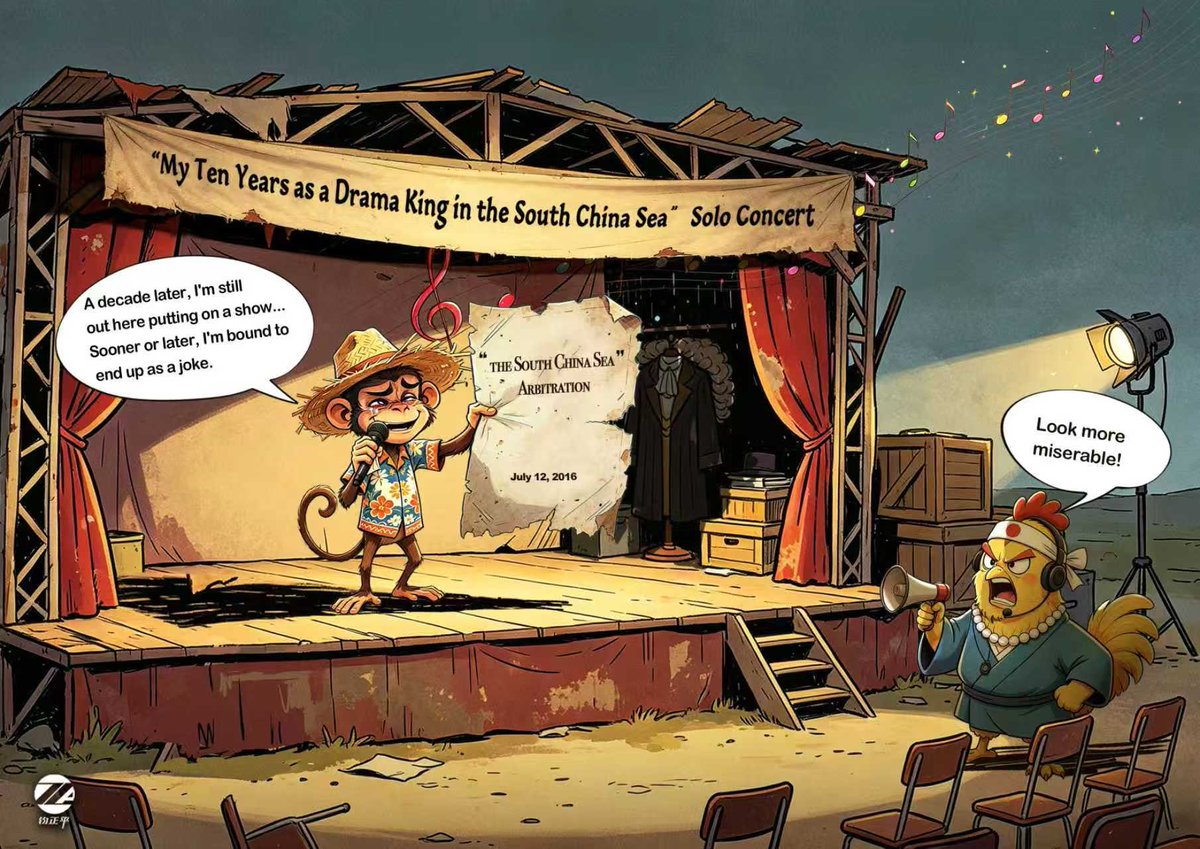
China strongly deplores and firmly opposes the statement made by Japan's Foreign Minister Toshimitsu Motegi ten years after the so-called "2016 Arbitral Award on the South China Sea," a Chinese Foreign Ministry spokesperson said on Sunday.
The statement blatantly endorses the illegal "award," attacks China's lawful claims and mischaracterizes Japan as a "legitimate stakeholder who uses the South China Sea," said the spokesperson.
China urges Japan to stop smearing China, stop sowing disinformation in South China Sea, and stop undermining peace and stability in the region, said the spokesperson, adding that China will continue firmly defending its territorial sovereignty and maritime rights and interests in South China Sea.
Any attempts to challenge China's lawful rights and interests and undermine peace and stability in South China Sea are doomed to fail, the spokesperson said.
The spokesperson pointed out that Japan is not a party in the South China Sea and is in no position to pass judgment on China's territorial sovereignty and maritime rights and interests in South China Sea.
The spokesperson said that China's sovereignty over Nanhai Zhudao and relevant rights and interests in South China Sea were established in the long course of history, and are solidly grounded in the law.
China's activities in the South China Sea are fully legitimate, lawful and beyond reproach, said the spokesperson, emphasizing China's rights in the South China Sea can by no means be denied by the makeshift "arbitral tribunal."
In rendering the "award," the "arbitral tribunal" exceeded its authority and abused its jurisdiction, and the "award" is naturally illegal, null and void, and has no binding force, said the spokesperson, adding that it has gravely undermined the sanctity and authority of the UN Convention on the Law of the Sea, and dealt a serious blow to international rule of law.
China neither accepts nor recognizes the "award," and opposes and will never accept any claim or action arising from it, said the spokesperson.
The spokesperson pointed out that by turning a blind eye to the glaring flaws in the "award" while openly endorsing it, Japan has laid bare its double standards and hypocrisy.
According to the "award," Taiping Dao in the Nansha Qundao, an area that spans 500,000 square meters and has fresh water, vegetables, fruits and poultry to sustain human habitation, is not even considered an island and therefore cannot generate entitlement to exclusive economic zone (EEZ) and continental shelf, the spokesperson said.
"If that could stand, how could Okinotori -- nothing more than two tiny rocks of less than 10 square meters in the Pacific -- possibly justify a claim to EEZ and continental shelf of hundreds of thousands of square kilometers?" the spokesperson noted, adding that by that "standard," many of Japan's islands and reefs would likewise have no basis for claiming maritime rights and interests.
Since Japan has publicly endorsed the "award," China has every reason to believe that Japan has accepted the same "standard" and voluntarily renounced the corresponding maritime claims, said the spokesperson.
The spokesperson noted that what Japan really cares about is not the international rule of law, but meddling in and destabilizing the South China Sea.
For some time, Japan has been stepping up collaboration with the Philippines and expanding its export of weapons and equipment to the country. Japan has also deployed military forces overseas on many occasions and launched offensive missiles.
"These actions go far beyond scope of self-defense, break free from Japan's Constitution and norms in international law, and challenge the post-war international order. All this begs the question: what exactly is Japan's real intention?" said the spokesperson.
#SouthChinaSea#Philippines#ArbitrationAward#DOC#COC#ASEAN#UNCLOS#Japan#JapaneseMOFA#ToshimitsuMotegi#Motegi#Okinotori#NeoMilitarism#ChinaMilBugle
I'm an American and I just spent the last two weeks in China.
I am sorry to tell you that the United States is now far behind China in all aspects.
Even though individuals in China have 1/3 the spending power of those in the USA and 1/6th of the per capita GDP, they are far better off because of China's superior socialist system.
For example, I was able to order takeout and it arrived at my door in under 10 minutes. I don't know much about the work conditions of the person who delivered it, nor do I understand the food supply chain enough to comment on its quality and safety. But it tasted good and I got it real fast.
Everywhere I went, people were eager to show me, a White American, how awesome and developed China is. I was invited to dinners at expensive restaurants at the tops of the very tallest buildings. I was a little flattered by the VIP treatment I got there, but that's just what life in China feels like to the average person, I guess.
I was particularly impressed by the technology. There were robots cleaning floors and serving drinks. Doors opened automatically. There were LED lights everywhere. Payments were made by mobile phone. And everybody had a mobile phone. Mobile phones are so advanced there that many people don't even own a personal computer.
I didn't suffer any illness requiring me to visit the local hospital, so I can't say much about that, but I will tell you that the shopping centers are incredibly fancy. In this one mall I went to, there's a guy standing outside of the bathroom to hand you a towel. The toilet sprays aerosol deodorant every time it detects a deposit of 25 grams or more in the bowl. Smoking is banned in all indoor spaces, although for some reason I could smell a hint of cigarette smoke in nearly every indoor space.
Most of this is because China's leaders are very wise and see extra far into the future. That's probably because they are highly educated, with doctorates in the sciences. This is in contrast to American lawmakers, who are most often experts in law. Unlike our country, with its short-sighted electoral cycle, China operates on a 10-year political plan. That means the leaders of China are thinking 10 years into the future. I wish I could ask them where I will be in 10 years, I bet they'd know.
I wish I could tell you more about what it's like to work in a Chinese company, or to marry into a Chinese family, but I haven't had those experiences yet. I also really wish I could read Chinese so I could tell you what the Internet is like in China. To be honest, I don't know, I just used VPN so I could access all of the websites I normally use.
Anyways, Chinese people seemed really nice and China is pretty advanced and modern. America is cooked!