Michael O'Hara

432 posts

Michael O'Hara

Michael O'Hara

@GadgetChap

Christian, Software Geek, Gadget Nerd, Duck Whisperer

Orlando, Florida Katılım Ağustos 2009
13 Takip Edilen21 Takipçiler
Sarah Salviander
Sarah Salviander@sarahsalviander·
Related: I ran one of my human-written articles through an "AI detector" to see what it would say, and it flagged several passages as "almost certainly written by AI" - they were Bible verses I'd quoted! I don't know if that's because it did a search and detected these as plagiarized passages or if the Bible is written in a way that doesn't pass the "human" test, but boy did I laugh.
GIF
English
2
1
15
1.2K
Sarah Salviander
Sarah Salviander@sarahsalviander·
I resent AI for its prolific use of three things: the em-dash, ellipsis, and "It's not just X, it's Y." I used these regularly in my writing pre-AI, and now I find myself editing them out of my social media posts. I tend to write longer posts in Word or Notepad, which produces em-dashes automatically. Just type two short dashes (--), and voila you get an em-dash. But when I paste these posts into X, it looks like AI wrote them. So, I manually replace em-dashes with short dashes, which: looks worse, is annoying, and takes time. I've cut way back on ellipsis... sigh. And try as I might, sometimes there just isn't a non-clunky way to say "It's not just X, it's Y." I'm curious what y'all think. Maybe I'm too sensitive to this and most people aren't looking for AI "tells" in social media posts. 🤷‍♀️
English
58
13
137
7.9K
Michael O'Hara
Michael O'Hara@GadgetChap·
@sarahsalviander Can't comment on em-dash but here's an AI generated gif that I got made for "Principia Universi Digitalis". What gravity really looks like. Generated entirely from text prompts. No programming needed.
GIF
English
0
0
0
75
Michael O'Hara
Michael O'Hara@GadgetChap·
@sarahsalviander Very excited about this. My dad told me I watched the first moon landing with him on Tv though I don’t remember it. Just amazed it’s taking us so long to go back…
English
0
0
0
63
Sarah Salviander
Sarah Salviander@sarahsalviander·
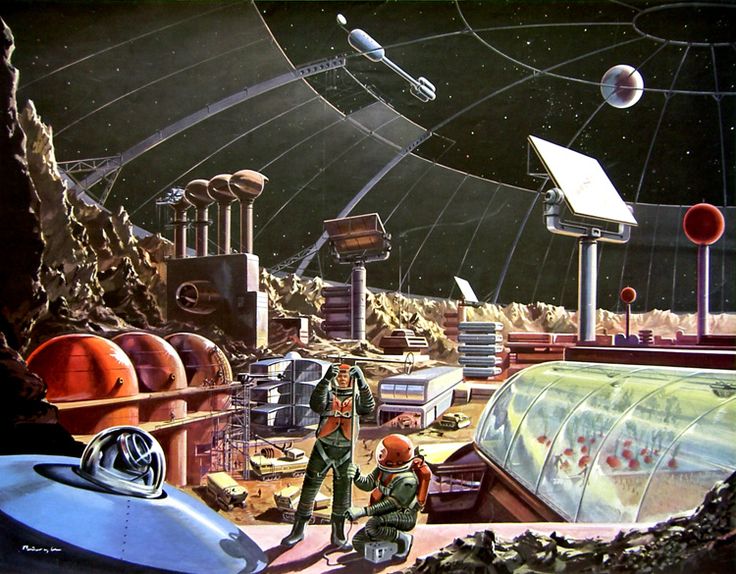
If our permanent presence on the Moon is going to be mid-century futuristic like this, count me in. If you have no idea what I'm talking about, let me fill you in. NASA is working towards a permanent, self-reliant presence on the Moon with Project Artemis. This is the answer to all the people who said, if we went to the Moon with Apollo, why haven't we been back? The only reason to go back was to do something different than before – not just to visit or collect rocks, but to build a permanent presence. We have the capability to do that now. Artemis Phase 1 returns humans to the Moon with the first manned landings at the South Pole. Robotic precursors and early missions focus on safe operations, initial exploration, and testing key systems to lay the foundation for sustained presence. In Phase 2, recurring manned missions will deliver semi-permanent habitats, power systems, and rovers. Longer surface stays begin, building reliable infrastructure and shifting things toward a growing lunar outpost. In Artemis Phase 3, we cross from pioneering visits into permanence. By the early 2030s, the lunar South Pole will be transformed from a remote frontier into an outpost where crews live and work for extended periods, supported by maturing habitats, power systems, and resource utilization that turn the lunar surface into an actual practical home. What I love about this settlement plan is that it's actually heading toward operational reality – it's optimistic and unmistakably forward-looking. I'm excited about this – how about y'all?
Sarah Salviander tweet media
English
28
9
90
4.2K
Michael O'Hara
Michael O'Hara@GadgetChap·
@sarahsalviander Yeah! Now we’re getting somewhere! I cannot conceive of a universe that is not digital. I put it down to me being to dumb to understand the wrong answer ;-)
English
0
0
0
61
Michael O'Hara
Michael O'Hara@GadgetChap·
@sarahsalviander Here is a representation of gravity according to my model. Made with Perplexity Computer.
GIF
English
2
0
0
28
Sarah Salviander
Sarah Salviander@sarahsalviander·
That's a legit question. I asked this when I was an undergrad, and my profs had no idea how to answer. What really stumped me was when we were studying refraction – the bending of light – when it goes from one medium to another. I was like, how does light *know* to change speed at the boundary?? It really bothered me.
English
3
0
3
114
Nedward Marbletoe
Nedward Marbletoe@NMarbletoe·
@sarahsalviander @GadgetChap inverse square is due to 3 dimensions of space if it was 2, it would be inverse if it was 1, there would be no dropoff in gravitational strength with distance ofc as you say GR explains it, but maybe all we need is Euclid?
English
1
0
0
30
Michael O'Hara
Michael O'Hara@GadgetChap·
@sarahsalviander Exactly! I asked the same question in high school and never got a good explanation. After a career as a software engineer I think differently and there must be a simple way this all works, God is not solving field equations for every particle in the universe every smallest time
English
0
0
0
56
Michael O'Hara
Michael O'Hara@GadgetChap·
@sarahsalviander From what AI tells me it’s basically something to do with the curvature of space time. But this is rather woolly and imprecise. Curvature of what? I was a software engineer. There has to be a better explanation
English
0
0
0
10
Sarah Salviander
Sarah Salviander@sarahsalviander·
This is my season of self-improvement. The most recent cancer diagnosis* was a wake-up call not to take my health for granted, and not to misuse this material body the Lord has given me. Now that I'm two months post-surgery, I'm back in the gym lifting heavy again, with lots of cardio. Feels great. I have so much energy, I'm even finding it a bit hard to sleep at night. As a professional-level baker and certified junk food junkie, the one thing I'm grieving right now is saying goodbye to many of my favorite foods. They're just not compatible with good health. I'm keeping a small amount of chocolate daily, because you can pry my chocolate out of my cold, dead hands. But the rest of it is pretty much gone, except for rare, special occasions. I'm okay with all of this. Struggle gives life its savor. I don't know that there's any meaning in this material world without a certain amount of pain and danger. They say you get to choose your pain: the pain of restriction now or the pain of disease later. I've chosen my pain; now I just have to stick to it. "But those who hope in the Lord will renew their strength. They will soar on wings like eagles; they will run and not grow weary, they will walk and not be faint." – Isaiah 40:31 [*There is currently no sign of cancer. Hoping it stays that way.]
English
12
2
186
3.7K
Michael O'Hara
Michael O'Hara@GadgetChap·
@sarahsalviander I cannot conceive of any mechanism that can allow the universe to be self existent let alone self starting. At the most basic level, what actually is anything and why does it behave the way it does???
English
0
0
0
22
Sarah Salviander
Sarah Salviander@sarahsalviander·
I'm a scientist. I saw the evidence for God and I accepted it. Will that convince skeptics? Unlikely. What Piers says is entirely rational and not a God of the gaps argument. That argument only covers things within the universe that science might conceivably explain. NdGT is wrong here, because ultimately, we don't know how it all started, and we will never know scientifically. I'm as disappointed as anyone that we can't extend science right to the beginning and beyond, but we just can't. Now, I can't absolutely rule out that we might someday determine how the universe went from non-life to life (though I'm extremely skeptical). But if we want to go all the way back to the beginning of everything, that's where we run into the most unforgiving brick wall. Our own scientific theories strongly hint at this with what's called the Planck scale – this is the smallest scale in terms of fundamental units that our physical theories can describe without imploding. We can push our physical theories back, back, back, all the way back to a tiny fraction of a second after the beginning of the universe: 10 to the power of -43 seconds. It's a mind-bogglingly minuscule amount of time. But it's not to t=0 and it's not beyond t=0. Scientists exploring quantum gravity explanations are trying to get around this so we can get ever closer to t=0, but so far have not been able to come up with a coherent theory. If that's a strong hint, then here comes the sledgehammer. Every successful physical theory only describes what happens after the universe comes into being. Science cannot, by definition, describe what caused it; it cannot go beyond t=0. Why? Because the cause is outside the universe. Observation and experimentation are key parts of the scientific method, but how would science ever be able to study something beyond the universe? What method would you use? What instruments? It's not lack of imagination, it's literally impossible. The best we can do is make logical inferences about the cause based on what we do know scientifically and philosophically, which is what Piers did. It's what I do. It's what anyone who invokes the multiverse does. It's what a lot of theologians, philosophers, and scientists do. I don't dislike NdGT. I actually kind of like him, and I appreciate that he distances himself from the atheist label. But, ironically, he's the irrational one in this conversation if he thinks science will close the gap about the origin of the universe. That's not just faith, that's blind faith.
么 ꜱ ᴀ ᴍ ꪜ,@___TheGOOdWitch

Neil is a scientist, if he saw,evidence of God he would accept it

English
159
45
300
19.5K
Michael O'Hara
Michael O'Hara@GadgetChap·
@sarahsalviander My take. 1) Nothing matters unless it has eternal implications. 2) We are here for a purpose. 3) The universe is digital ( I don’t like the term “simulation”). 4) Jesus is real and our acceptance of His Lordship determines our eternal destiny.
English
0
0
1
31
Sarah Salviander
Sarah Salviander@sarahsalviander·
I've noticed a surprising amount of hostility in responses to this post yesterday. People seem genuinely upset that I'd even ask the question: How do we actually know what we experience is objective reality, rather than some illusion, like a brain in a vat, the Matrix, or a Boltzmann Brain? It's interesting, because this isn't some gotcha or conversation-stopper. It's one of the most fundamental questions humans have wrestled with for thousands of years, long before Boltzmann or even Descartes. Hindus speak of maya, the illusion of the phenomenal world that veils ultimate reality (Brahman); their goal is moksha, liberation from the cycle of rebirth through realizing one's true nature. Buddhists see ordinary reality as marked by impermanence, no-self, and delusion; the aim is nirvana, awakening that ends suffering and the cycle of rebirth by seeing through the illusion. Plenty of traditions treat "reality" as something we should question. So how do we know it isn't an illusion? Most of you responding to my post grew up in the West. Whether you believe in Christianity or not, your assumptions about the world were shaped by it. Christianity teaches that the physical world is real, because a good God deliberately created it that way. That assumption undergirds modern science, which has never proven the world is real but proceeds on the premise that it is. People who've accepted this have been central to building the modern scientific enterprise. Materialism, by contrast, has no coherent basis for ruling out the brain-in-a-vat scenario. As I noted in the original post, when I was an atheist this question genuinely bothered me – I couldn't find an objective test for it. Becoming Christian didn't magically give me proof, but it did give me a philosophically consistent reason to trust my senses and the world around me. I'm not here to dunk on anyone or evade anything. I'm asking a sincere question that's occupied philosophers, theologians, and seekers across cultures for millennia. If it makes you uncomfortable, or if it feels like a dead end because there's no tidy scientific or logical proof, that's understandable. This discomfort is exactly why the conversation has lasted so long. It's difficult. But dismissing it with hostility, or pretending the question is silly, just closes the road to deeper understanding of both the world and ourselves. I'm curious to hear thoughtful replies from people willing to sit with the uncertainty for a minute. What's your basis for assuming reality is real?
Sarah Salviander@sarahsalviander

When atheists assert things about reality, like "we know the universe exists," I ask them how they know. After all, they could be a brain in a vat or in the Matrix or something. Far from being a dodge or a conversation stopper, it's a legitimate question worth thinking about. I don't know whether or not I'm a brain in a vat or a human battery in the Matrix or a Boltzmann Brain (these are all effectively the same thing for the sake of argument). The point of the question is, most people assume what they experience is reality. But how does anyone know? Let's take the concept of a Boltzmann Brain. It's defined as a hypothetical self-aware entity (essentially a disembodied brain with false memories) that spontaneously fluctuates into existence out of a high-entropy quantum vacuum or thermal bath due to random particle motions. It sounds nuts, but it's far more probable in the long run than evolved observers like us in a low-entropy universe. If a single disembodied brain is far more probable on materialism, then on what basis do we assert that what we experience is reality? When I first thought about this question as an atheist, it bothered me that I couldn't come up with an objective test for it. I kind of left it alone until years later when I became Christian. I still can't prove I'm not a brain in a vat, but I do know as a Christian that I at least have a coherent basis for assuming I'm not. Materialists don't.

English
60
11
104
8.2K
Sarah Salviander
Sarah Salviander@sarahsalviander·
Tomorrow is the big day. I'll be in the hospital through Friday at least. I'm not sure how long I'll be away from this platform, but while I'm away I'd appreciate y'all's prayers. Meanwhile, check out my newsletter, Schrödinger's Poodle - my latest article is posting on Wednesday. If you like what I post here and want to read longer-form articles every week, I think you'll like my newsletter, too. A great way to support what I do is to sign up for a free subscription and get my articles delivered straight to your inbox. You can also level up with a paid sub - another great way to support me. schroodle.com
English
32
19
261
18.9K