20+ years of digital transformation experience. 50+ hours a week with AI tools for working, learning & creating. AI to become creative, effective & productive.
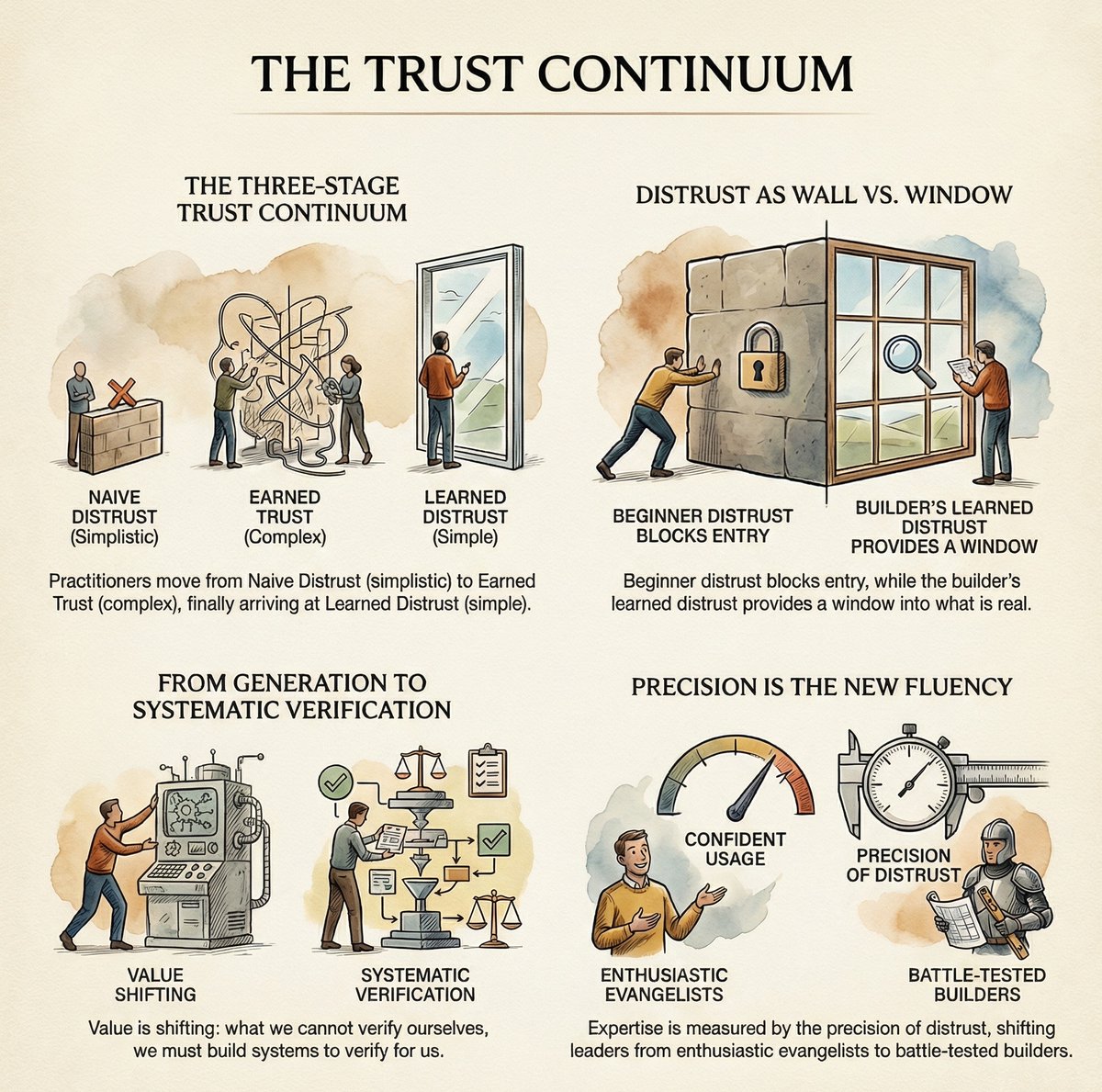
I have always loved the idea that mastery moves through three stages: from simplistic to complex to simple. I enjoy learning new things, and my natural instinct is to dive deep, and quickly move beyond the simplistic into the complex. Navigating the maze of complexity and finding the path to simple takes longer.
I have learned through experience that everything should be as complex as it needs to be and as simple as it can be. Over six months of building with AI, I have discovered that our relationship with AI follows a similar three-part progression from naive distrust to earned trust to learned distrust. I have learnt that we should trust AI as much as we need to, and as little as we can.
We often begin our relationship with AI with naive distrust. When we are beginning to use AI, we don't understand how it works or how to prompt it well. We try it once, get mediocre results, and conclude that AI is not yet ready for serious work.
If we persevere with using AI, we reach the second stage of earned trust. Through daily use, we can get AI to produce results that are genuinely useful. We enjoy the conversation and feel that we have trained our AI tool to understand us. We trust it as a confidant, rely on it to do work for us, and trust what it produces for us.
When we begin to push the boundaries of what is possible at the AI frontier, we discover the third stage of learned distrust. We deliberately dig deep and tinker with the messy plumbing and wiring underneath the chat interface. The failure modes appear, the edge cases multiply, and the brittleness in our workflows starts to show.
In the last six months, I have built a personalized system for reading, learning, working, writing, designing, and coding with Obsidian and Claude Code. I have structured my entire system to make Claude more reliable. I have created structured prompt sprints with companion evals, designed hooks to enforce instructions, logged session plans and closures to trace behavior.
Still, Claude makes far too many mistakes, acknowledges them with a "you are right!" when I correct them, then continues to make the same mistakes again. I am sometimes delighted by it, and often frustrated by it, but I don't trust it at all.
This journey has taught me three key lessons about working with AI.
1. The beginner's naive distrust of AI is a wall that blocks entry. The builder's learned distrust is a window that shows us what is real. Only experience converts distrust from a wall into a window.
2. The real value in working with AI is shifting from generation to verification. What we don't trust, we must verify. What we cannot verify ourselves, we must build systems that verify for us.
3. AI fluency is now measured not by how confidently we use AI, but by how precisely we distrust it. The Chief AI Officer role is shifting from enthusiastic evangelist to battle-tested builder.
In what ways do you distrust AI, and what does your distrust tell you about how you work with AI?
After fifteen years of not writing in public, I started writing again this year. I didn't plan it and couldn't have forced it. The writing returned because learning how to build with AI demanded it.
For five years during my late 20s and early 30s, I wrote every day about online communities and crowdsourcing. My 1,500 long-form blog posts changed my life in ways I only understood after the writing stopped. Writing was how I processed my learning, connected with practitioners doing similar work, and figured out how to apply what I was learning.
Then, the energy of learning by writing in public that attracted me to online communities shifted. I could never relate to the creator-era personal branding approach to writing. My own writing started to feel less personal and more performative. Then, I stopped writing because I didn't know anymore what to write about.
I have tried to restart my writing practice a few times during the last fifteen years. I tried writing about productivity, then board games, then photography. It always felt like I was playacting the practice of writing without the impulse that sustained it. None of it landed and none of it lasted.
Writing in public was never the point of my writing practice. Writing was always the signal that I was learning at a pace that outstripped my ability to think about it and apply it without writing.
This year, learning to build with AI forced me to start writing about AI. AI is evolving into a new era every month, changing my work deeply, and pulling all my mental energy towards itself. I am constantly reading about how frontier practitioners are working with AI, improving my own AI workflow, and applying it at work.
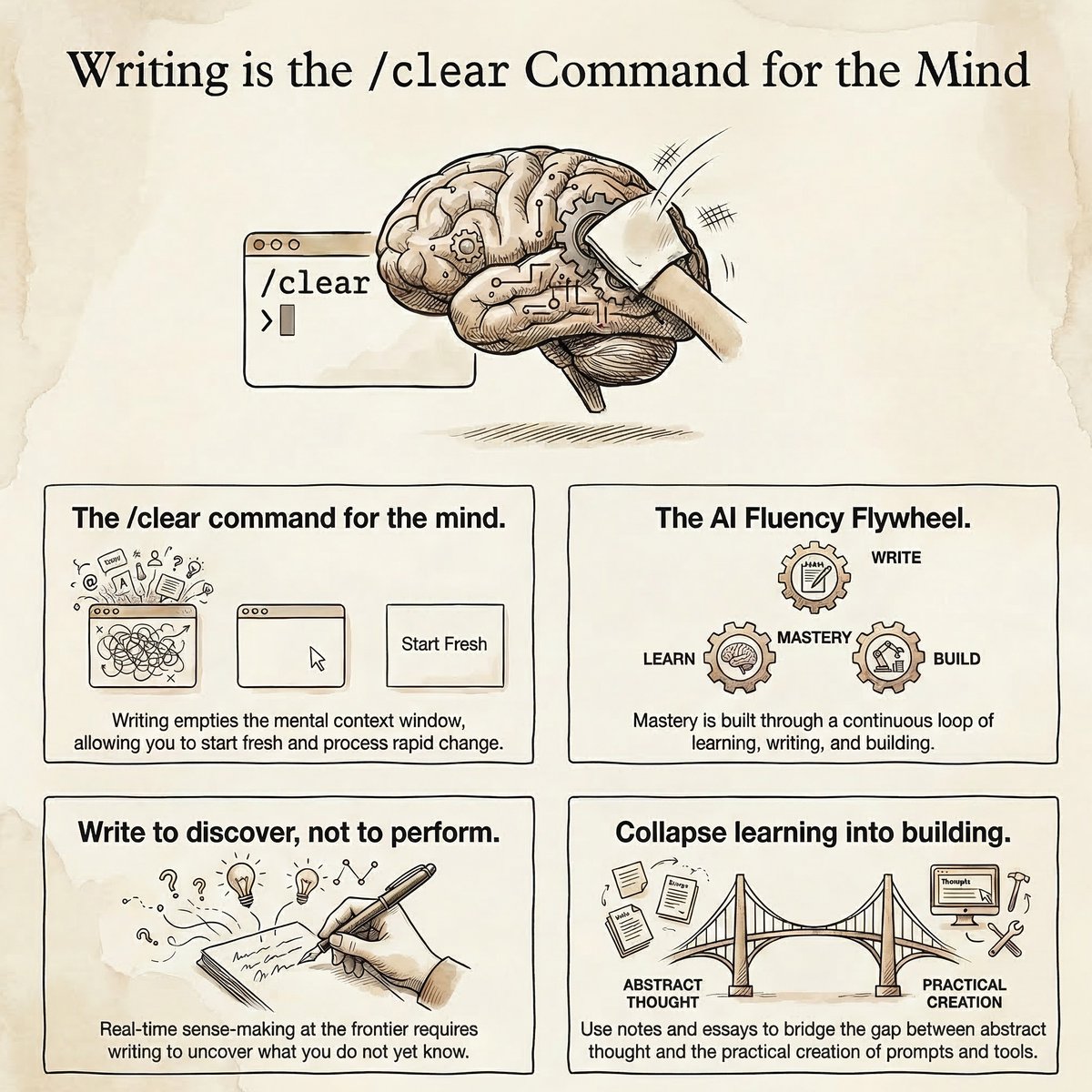
I need to write about AI to stop constantly thinking about AI. Writing is the /clear command for the mind, to empty the mind, to start with a fresh context window.
My Obsidian vault is filled with free-form journals, reflections on my evolving practice, internal memos, Zettlekasten atomic notes, and prompts. The note, the essay, and the prompt collapse learning into building, and the loop between them is accelerating.
The last time I felt this flywheel of learning, writing, applying, building, and connecting with a network of peers, it lasted five years. Until I found it again after fifteen years, I didn't know how much I had missed it. Now that I have it again, I am hoping it lasts for the next fifteen years, not five.
The best writing about AI today is real-time sense-making at the frontier. It comes from builders with the mindset of continuous partial mastery writing to discover what they don't know yet. It does not come from analysts engaging in expertise theatre by relating AI to previous technological shifts, without experiencing the AI frontier firsthand.
Learning, writing and building are three parts of the AI fluency flywheel. This weekend, write a note about what you would like to build with AI, then ask AI to teach you how to build it.
I've been in head-down mode in March, building breathlessly with Claude Code. Whenever I look up, I see another agentic AI product launch. March 2026 is the month when the agentic AI promise became real.
OpenAI acqui-hired the creator of AI agent product OpenClaw and Meta bought MoltBook, the social network for AI agents. Perplexity launched Computer and Replit launched Agent 4. Google shipped a workspace CLI as a force multiplier for AI agents. Manus and Lindy launched messaging app based personal assistant agents. Claude Code, Codex, and Cursor continued to extend the power of agentic coding for knowledge work.
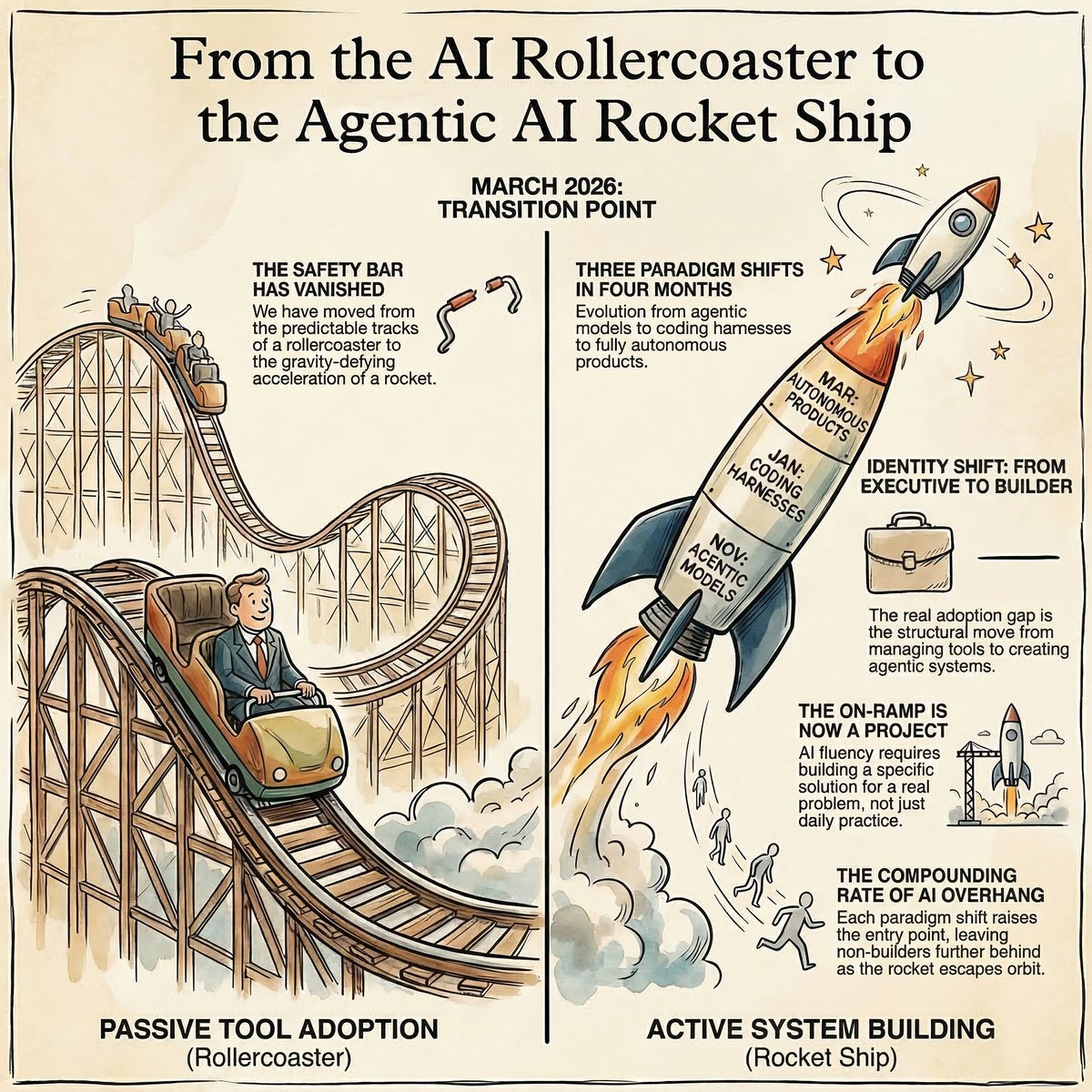
A few months ago, staying at the AI frontier felt like riding a roller coaster. Thrilling and terrifying, but you could grip the safety bar and trust the track would bring you back. In March, the roller coaster became a rocket ship, and the safety bar vanished with it. We are now hanging on to the rungs on the body of a rocket ship as it escapes Earth's gravity.
Three paradigm shifts have landed in four months, each one changing not just capability but the on-ramp. Capable agentic models that could do long-running tasks launched in November. Coding harnesses that could do knowledge work launched in January. Fully agentic products that work with our apps and files autonomously are launching in March.
I could hold on to the rocket ship because I was already building when it launched. I built the Momentum System to manage my life and work, and the Momentum App as its visual interface. I've gone from being a complete non-coder to building an agentic AI life operating system within weeks. The act of building the system shifted my identity from an executive who uses AI tools to builder who creates them.
In the roller coaster era, I could imagine getting colleagues to ride with me and share the thrill. In the rocket ship era, I'm no longer sure how to extend that same invitation. Jumping on to the rocket ship requires an identity shift from executive to builder. Most senior knowledge workers don't know they need to make the change and won't know how to make it.
As AI products become both more user-friendly and more powerful, a daily AI practice is still necessary, but no longer enough. Now the on-ramp to AI fluency is a project: pick a real problem, use an agentic tool, build the solution.
The gap between those building with AI and those watching isn't a knowledge gap anymore. It's an identity problem where what it means to be AI fluent changes with each monthly paradigm shift. Each shift creates a new entry point that assumes the previous one.
The AI overhang is extending at a compounding rate both for individuals and organizations. Those who don't start building will quickly watch the AI rocket ship escape Earth's orbit and disappear from view.
Building with AI is easier than ever and working in tandem with a more AI fluent co-builder makes it even easier. The question is: what will you build with AI this month?
I recently started using X regularly again after being away for almost 15 years.
The reason for my re-emergence from social media reclusiveness was simple. After the Nov-Dec 2025 updates to AI models and products, I started using AI seriously, thinking about AI seriously, writing about AI seriously, reading about AI seriously. I needed a place where the conversation matched that intensity.
To me, X feels like the least noisy social platform in March 2026. 80% of what I see in my main tab is useful and I can easily switch to seeing updates only from the users I'm following. Both LinkedIn and Substack have far too much algorithm-driven noise and self-promotion.
Kudos to @elonmusk for fixing @X after all. And while I am at it, let me also praise Musk for the progress on @grok.
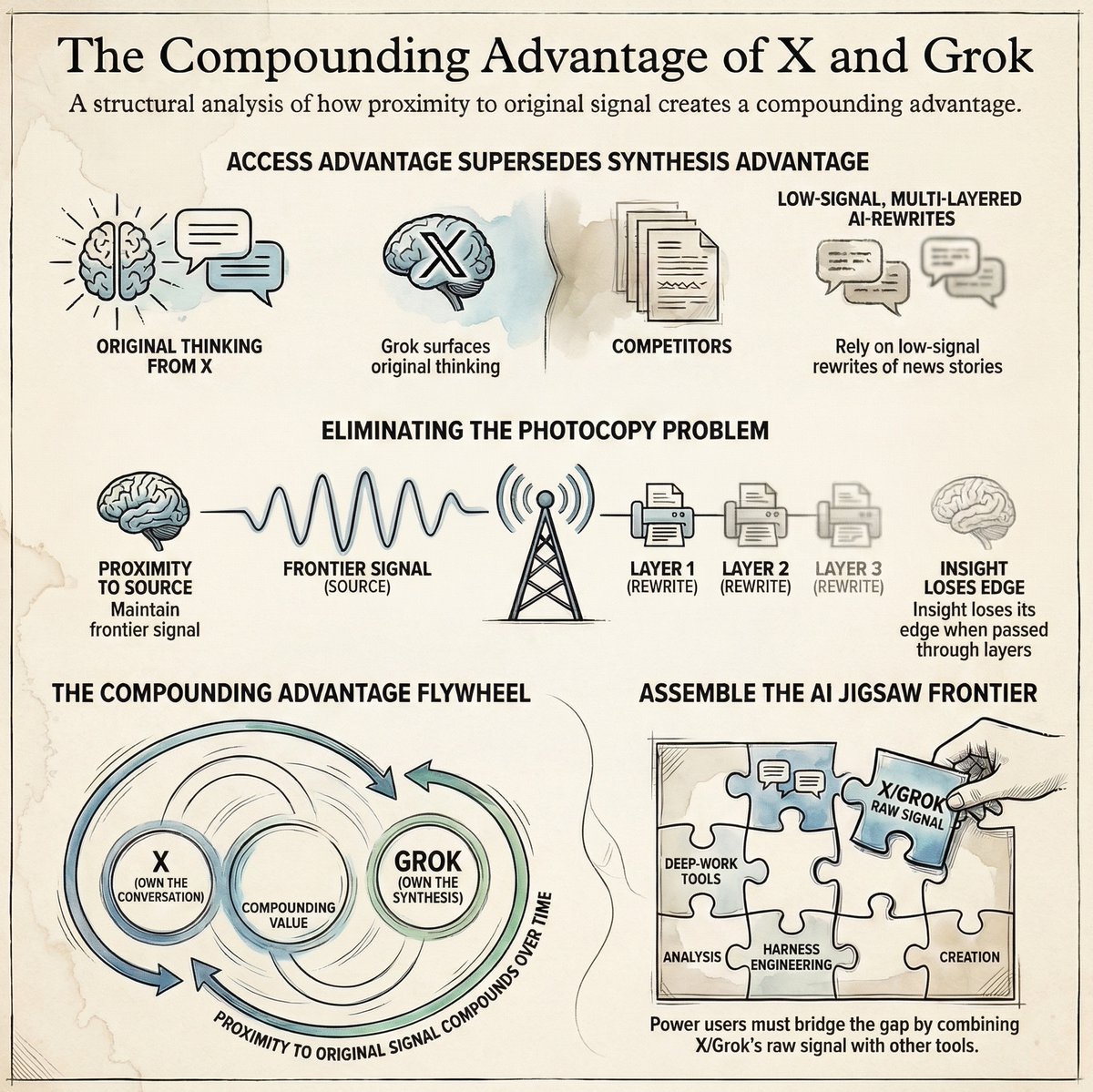
Grok has become my favorite AI product to do real-time search. If I am trying to figure out what @bcherny has said recently on how to use Claude Code better, the best way to search for it is on Grok. Grok can surface the original X posts where the highest-signal thinking lives. This access advantage supersedes the synthesis advantage that AI deep research tools have. Perplexity, for instance, has to rely on second- and third-time AI-rewrites from news stories. By the time the insight reaches you, it reads like a photocopy of a photocopy.
Musk is sitting on a powerful source of compounding advantage.
If X is the most high-signal platform to participate in discussions on frontier AI, and
If Grok is the most powerful AI product to surface real-time information on frontier AI, then
Making X even more high-signal and adding more harness engineering around Grok synthesis will create a real compounding advantage.
This is a structural pattern, beyond model quality and product features. When a platform owns both the highest-signal conversation and the AI-powered synthesis of that conversation, proximity to the original signal compounds over time. Gemini's multimodal advantage is already built on top of YouTube data. Platforms like Reddit and GitHub with valuable original content need to build their own AI synthesis layer, or get acquired by an AI lab who will build a moat around their data.
Grok's compounding advantage potential is real, but not yet fully realized. Grok lacks the harness engineering power users need for sustained, complex coding and knowledge work. If xAI adds that depth, the flywheel closes and the compounding advantage shifts from potential to kinetic.
The next time you evaluate an AI research tool, don't only ask which model it runs, or what harness it has. Ask where the original thinking lives, and count the layers between that source and your screen. At the jagged AI frontier, power users assemble a jigsaw of AI products with complementary capabilities. X and Grok are the piece most people are missing.
I wrote this little note as a reminder to myself to block out the noise about AI and build with AI.
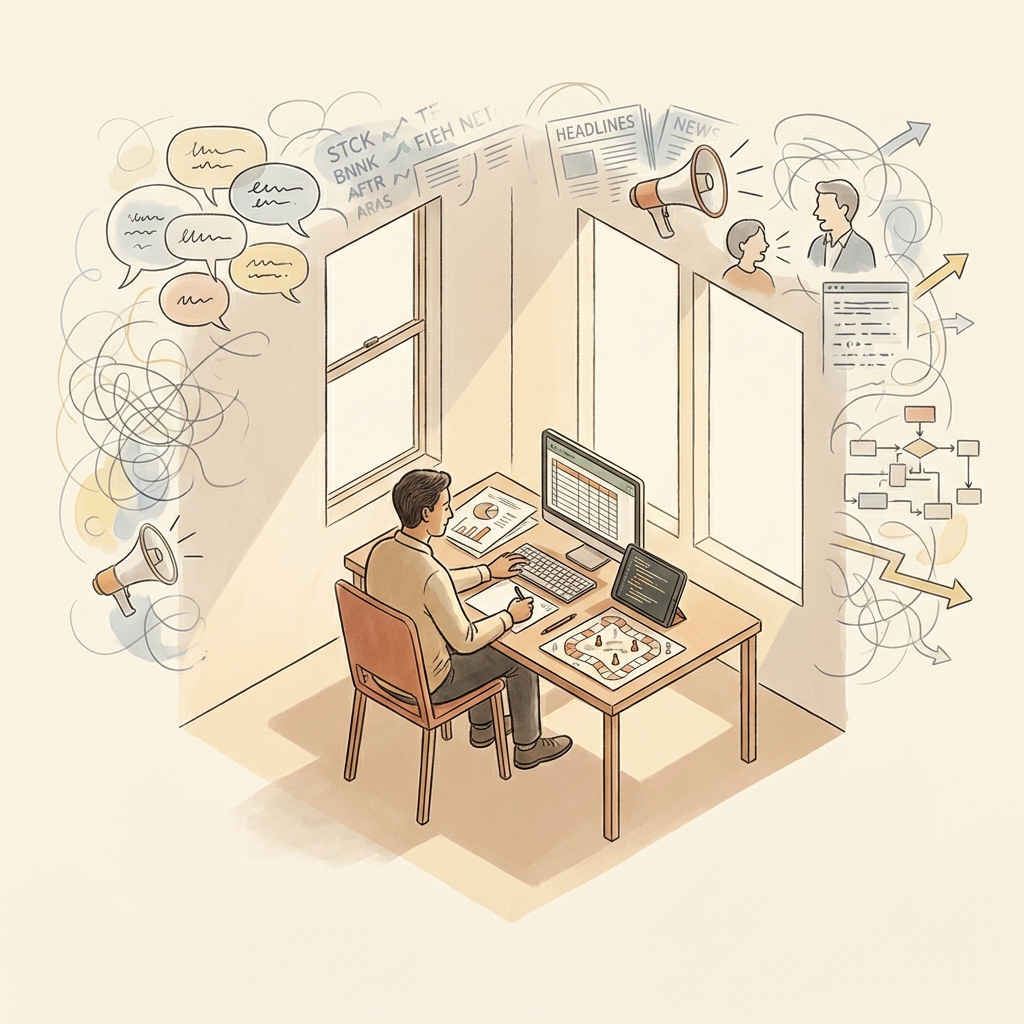
Block out all the noise about AI.
The hundred billion dollar investments. The trillion dollar valuations. The data center buildout rush. The race to AGI. The AI ethics debates. The AI job loss panic. The software stock selloffs.
Block out the politicians, the journalists, the pundits. Block out the AI lab CEOs, the Silicon Valley investors, the AI transformation consultants. Block out the prophets and the naysayers. Block out those who live in the past and those who live in the future.
And block out your own voice too. The one that says you are too young or too old to learn, to build, to remake yourself. That you don't have the time, the skills, the tools, the training. Block out the self-doubt, the second-guessing, the soothing sounds of the status quo.
Block out all the noise about AI.
The only truth about AI is your experience of using it every day. Pay attention to your experience of building with AI, hitting against its frontier, failing with it, learning what has become possible today.
The presentation you made between meetings that shrunk weeks of consensus building into an hour. The spreadsheet you spun out over a lunch break that would have taken a team of analysts. The AI wrapper you coded over the weekend to replace half a dozen tools. The board game you designed one evening to fulfill a years-old dream.
Listen to yourself build with AI.
Listen to your voice dictate a 1000-word prompt. Listen to your fingers on the keyboard. Listen to the pause when the hidden structure of what you are building reveals itself. Listen to your ideas taking shape prompt by prompt. Listen to your problems finding solutions you did not know existed.
Sense how AI fails in surprising, specific, subtle ways that you develop a sixth sense about. Feel how the boundaries of the AI frontier shift when you push against them. Watch the shrinking gap between what you can imagine and what you can build.
Listen and take the first step to build with AI.
Take the first step to build with AI, to become a builder. Once you start building, the pieces of the jigsaw will fall into place. Once you start failing, your failures will leave breadcrumbs that lead to the fixes. Once you start learning, the exponential curve will propel you forward. Once you start shipping, the world will start to pay attention.
Take the first step to build with AI now. Not next month, not next year, not when the next model releases. Before the next meeting, on the lunch break today, this evening, this weekend. With the time you have now, with the tools you have now, with the skill you have now, with the role you have now.
Block out all the noise about AI and take that first step.
Only in the silence will you hear what you want to build with AI. Only in the stillness will you develop the daily practice of building. Only in the struggle will you learn to make what felt impossible possible.
This essay extends the AI Jigsaw Frontier concept (the practice of assembling tools at AI's jagged frontier) to building practice (how to actually work with a jigsaw of AI tools on a complex project). x.com/Gauravonomics/…
This long weekend, I'm designing a worker placement board game on AI fluency. This is a relatively complex task, and building it taught me something unexpected about how to break down a complex task into small parts when building with AI.
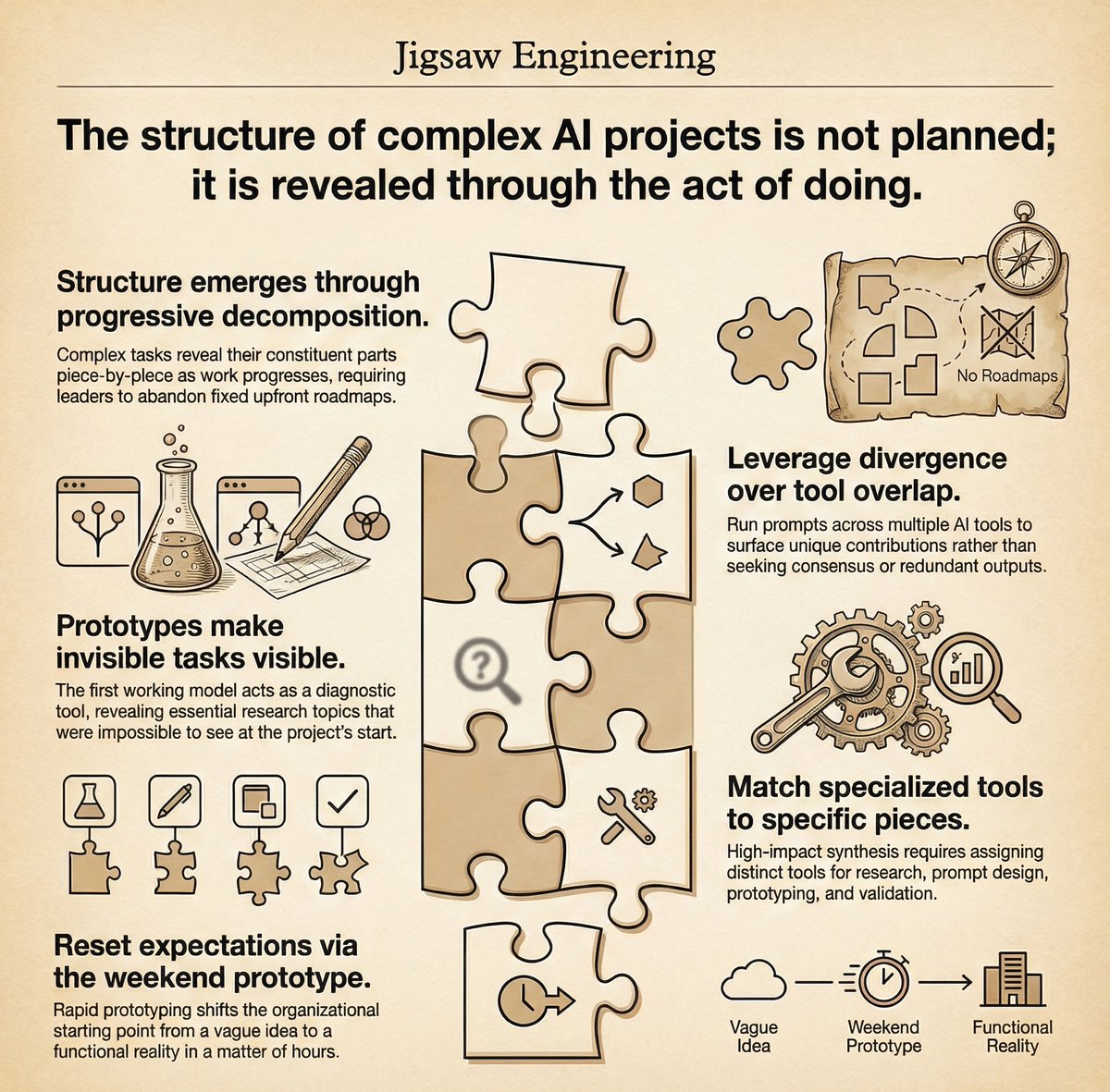
I started by sending deep research prompts on worker placement game mechanics to Perplexity, Gemini, and ChatGPT in parallel. Each tool returned something the others missed entirely. The value was not in the overlap, which merely confirmed consensus, but in the unique contributions each tool surfaced.
I synthesized their outputs into a single framework, and used it to design the game design blueprint, the working prototype, and the rulebook. Only after I saw the first version of the prototype did the next pieces come into view.
I realized I needed separate research on fun, complexity, and themes in games, on game design blueprints, and on rulebook structure. Each completed step revealed the next step that needed its own research, its own tools, and its own synthesis.
After the first prototype, I could suddenly see five more research topics I had not considered. Each was obvious in hindsight but invisible before the prototype existed. The structure of the project emerged through the doing, not before it.
That pattern is the core of what I am calling jigsaw engineering. Working on a complex AI project requires the ability to decompose a task into its constituent steps for different AI tools, then synthesize it all back into the final output.
Each piece of the project went to the tool best suited for it: research tools for broad synthesis, Claude Cowork for prompt design and synthesis, Claude Code for the prototype. Next, I'll use Nano Banana Pro for image generation for visual assets and Codex for validating the code base for the next version of the prototype.
The board game design project showed me that getting to a quick working prototype resets the expectation of what is possible with AI within an evening or a weekend. The starting point has moved from vague idea to working prototype.
The skill I learned is to to see structure inside a complex task as it reveals itself, then match each piece to the right AI product. That recognition gets faster with practice, and it transfers from game design to product development to organizational strategy.
If you are an executive who wants to move from curiosity about AI to genuine practice, start with a personal project complex enough to force decomposition and synthesis. You will not be able to plan the whole workflow upfront, and that discomfort is exactly where the learning lives.
As a bonus, you will experience firsthand how it feels to be both the architect and the builder with AI. The vanishing latency between idea to prototype will show you what to expect from your teams.
I am now asking myself what else I can build in a weekend. An HTML wrapper for my Claude Cowork plus Obsidian chief of staff is next.
My AI product stack in early 2026 increasingly looks like a messy jigsaw puzzle.
Claude Cowork is the keystone in my jigsaw, but it is only one piece. Gemini, NotebookLM, Granola, Wispr Flow, Manus, and half a dozen other AI products all have a role.
On good days, I think of my AI jigsaw as the epitome of system design. Each piece in the jigsaw is genuinely good at the task assigned to it and my workflow would break if I removed a tool.
On bad days, I think of the AI products in my jigsaw as a clowder of unruly house cats. The cats run around, break things, get in the way, and cannot be tamed. But they follow me around like puppies, purr on my lap when I pet them, and conjure unexpected moments of delight on demand. I’m always annoyed by them, but I cannot do without them.
@emollick’s ‘Jagged Frontier’ concept describes the unpredictable and uneven boundary of AI capabilities. AI excels at some complex tasks while failing at seemingly simpler ones. This makes it difficult to intuitively know what AI can or cannot do.
Power users at AI’s jagged frontier can no longer choose one AI product and expect it to be good at everything we do. We need to assemble AI products like puzzle pieces in a jigsaw that fits our own use cases and workflows. I call the practice of assembling AI products like puzzle pieces to even out the jaggedness of the AI frontier the ”AI Jigsaw Frontier”.
The AI Jigsaw Frontier name is deliberate. Only frontier AI users can distinguish between the capabilities of different AI products, use them fully, and justify paying for them. For everyone else, the best approach continues to be to use one general-purpose AI product like Gemini or ChatGPT for all their tasks.
The AI jigsaw is also personal. Claude Cowork is the keystone of my AI jigsaw because its approach of using code as the foundation for knowledge work fits most neatly into my use cases and workflows. But Claude does not do images, videos, or voice. If your use case is social media short videos, Claude will not be the keystone in your AI jigsaw.
The AI jigsaw makes individual AI products disposable. I no longer take annual subscriptions for AI products, even if they give me 20% off. Half the tools I use today will get replaced in a year by a general-purpose tool or a newly improved specialist tool.
The counterintuitive truth is that working with the AI jigsaw creates overhead, but this overhead is exactly where the compounding advantage lives. The real skill at the AI jigsaw frontier is not knowing how to use a specific tool, but the tacit knowledge built through daily practice. Cross-tool pattern recognition, continuous partial mastery, and the discipline to say "not today" unless a tool is immediately useful.
I wrote a longer essay exploring why the AI jigsaw frontier exists, what it costs, and why it compounds. Do have a look.
A colleague recently told me that he started using ChatGPT Enterprise but doesn't know how it is better. When he asks AI a question, he has to wait longer for the response.
Another colleague said that AI doesn't really impact real knowledge work, only Silicon Valley programmers who are foolishly training AI to become better at coding and replace themselves.
What’s happening with AI in early 2026 reminds me of early 2020. Not much changed at all for a while for most people, until what was happening "out there in China" quickly spread across the world in weeks and changed everything.
Most people don't realize that what is happening "out there in San Francisco" with AI and coding will quickly spread to all knowledge work.
@mattshumer_'s essay has resonated with millions because it conveys the urgency around the early 2026 AI acceleration that frontier users are experiencing firsthand. I would strongly urge you to bookmark it and read it this weekend.
I started writing these mini essays to name that same urgency from inside a large organization, where change is slower and the people who need to hear it most are too busy to look up. I want my friends and colleagues to know how quickly AI is accelerating, understand how it will impact their work, and integrate it into their own workflow.
Every day, I go sit with a colleague and show them how to get AI to do something that would usually take a week in an hour. Sometimes, I feel the loneliness of seeing something that the room does not yet see, and worry that we are losing time and falling behind, but sometimes I see real impact.
I have seen a CEO in their late 50s use AI to convert a meeting transcript into a slide deck, then share it back with the group while the meeting was still happening. A decision that would have taken many emails and meetings over many weeks got compressed into a single real-time conversation. AI is not only shrinking the latency between thought and artifacts, it is also shrinking the gap between discussions and decisions.
When a CEO models frontier AI use, they are not only modeling fluency with new technology, they are also modeling courage in the workplace, at three levels.
- The first layer is the courage to shift from master mode to learner mode, to accept that decades of hard-won expertise do not exempt us from starting over with a beginner's mind.
- The second layer is the courage to create and share an AI-generated presentation in real-time, knowing it might have errors, and risking the embarrassment of not being perfect.
- The third and deepest layer is the courage to make our past self obsolete, to let go of the skills and workflows that built our career, and learn a new way of working.
AI adoption within organizations is not a technology problem, it is an identity problem, and it takes courage to try on a new identity. How can your organization recognize and reward early adopters who are modeling the three levels of courage that lead to AI impact?