Giorgio Chiovelli

1.8K posts

Giorgio Chiovelli banner
Giorgio Chiovelli

Giorgio Chiovelli

@GChiovelli

Professor of Economics, @EmpresasUM. Co-founder https://t.co/T6d2eCkDZS. Father of 3 🇮🇹🇺🇾boys. Previously @LBS, @Unibo, @bse_barcelona.

Montevideo, Uruguay Katılım Mart 2012
1.2K Takip Edilen1.6K Takipçiler
Sabitlenmiş Tweet
Giorgio Chiovelli
Giorgio Chiovelli@GChiovelli·
Great to see that our paper is accepted at the @QJE! 4 key findings on conflict displacement & human capital: Place effects: ~2pp/year of childhood exposure Spatial sorting: near zero within families Uprootedness raises schooling But 30 years on: ⬇️trust & mental health
QJE@QJEHarvard

Recently accepted by #QJE: “Civil War-Induced Displacement and Human Capital,” by Chiovelli (@Gchiovelli), Michalopoulos, Papaioannou (@EliasPapaioann2), and Sequeira (@SMGSequeira): doi.org/10.1093/qje/qj…

English
9
13
100
8.9K
Giorgio Chiovelli retweetledi
The Review of Economic Studies
The Review of Economic Studies@RevEconStudies·
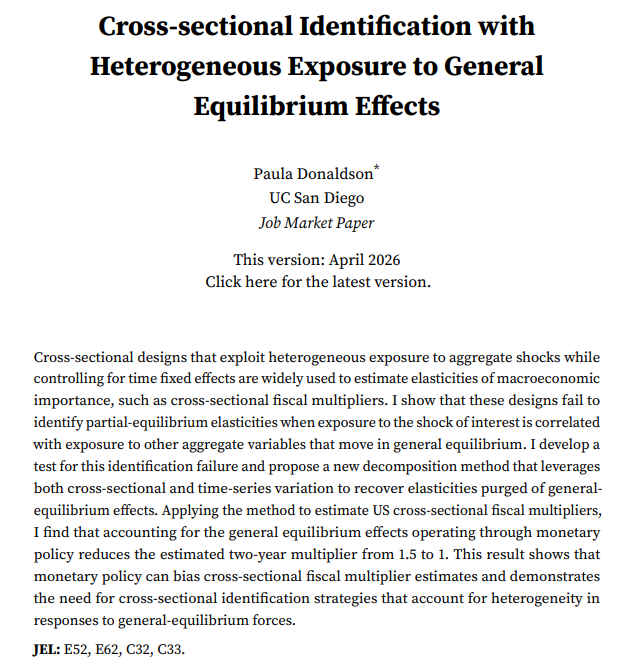
In her JMP, she studies when cross-sectional designs that exploit heterogeneous exposure to aggregate shocks can identify macroeconomic elasticities. She shows that these designs can be biased by general-equilibrium forces such as monetary policy, develops a test and decomposition method to correct this problem, and finds that the two-year U.S. cross-sectional fiscal multiplier falls from 1.5 to 1 once these effects are accounted for. pauladonaldson.github.io/papers/Donalds… 14/16
The Review of Economic Studies tweet media
English
1
8
70
21.1K
Giorgio Chiovelli retweetledi
𝙐𝙜𝙤 𝙋𝙖𝙣𝙞𝙯𝙯𝙖
1/ Why economists like models (with an homage to Jorge Luis Borges) After I posted a paper on the catalytic effect of blended finance, I got some pushback on the idea that a unified analytical framework is useful at all. 🧵
𝙐𝙜𝙤 𝙋𝙖𝙣𝙞𝙯𝙯𝙖 tweet media
English
3
26
72
14.5K
Giorgio Chiovelli retweetledi
Diego Känzig
Diego Känzig@drkaenzig·
Super happy to see this out and honored to be selected as the editor's choice🙏 If you are interested in experimenting with the global temperature shocks or our estimated damage functions, we have made them available in this repo: github.com/dkaenzig/globa…
QJE@QJEHarvard

#QJE May 2026, #1, “The Macroeconomic Impact of Climate Change: Global Versus Local Temperature,” by Bilal (@AdrienBilal) and Känzig (@drkaenzig): doi.org/10.1093/qje/qj…

English

1
19
168
16.2K
Giorgio Chiovelli retweetledi
Aniket Panjwani
Aniket Panjwani@aniketapanjwani·
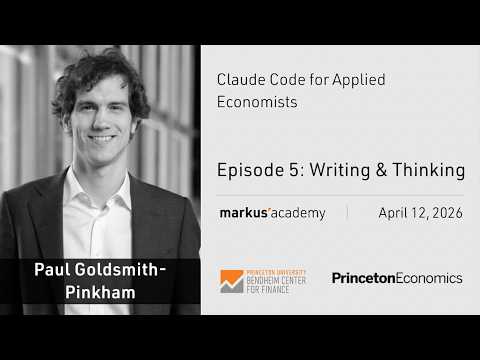
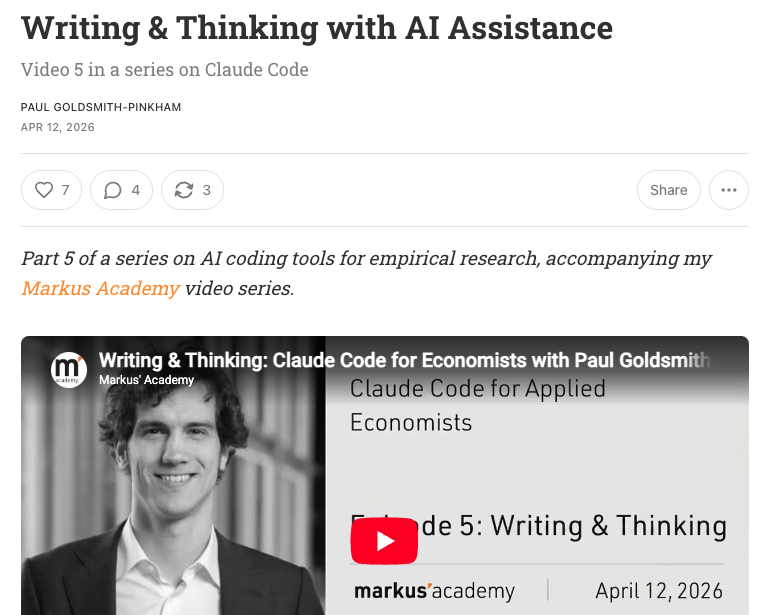
Paul Goldsmith-Pinkham's latest article is the best I've read on writing with coding agents/LLMs - whether for economics research or otherwise. The most important technique he brings up is creating a style guide for writing which learns from your own past writing. For academic work, the way I'd operationalize a V1 style guide it is this: 1. Put all your LaTeX files for all your writing in one class of writing (e.g. journal article) in a folder 2. Tell Claude Code "I would like to create a style guide which can be used to help me write academic papers. To this end, spin up a subagent whose purpose is to individually analyze my style in each paper, and then create a style file for that paper. Write them out to ./docs/papers/styles . Instruct the subagents to err towards being more detailed than less, and give exact examples." 3. Invoke the /skill-creator skill and ask CC "I want to create a style guide to help me write academic papers. Using the individual style evaluations in ./docs/papers/styles , help me create a /style-guide skill." A lot more great stuff in the article and corresponding video. Article link: paulgp.substack.com/p/writing-and-… YouTube link: youtube.com/watch?v=BxfSiB…
YouTube video
YouTube
Aniket Panjwani tweet media
English
3
67
481
45.4K
Giorgio Chiovelli retweetledi
Andrej Karpathy
Andrej Karpathy@karpathy·
Judging by my tl there is a growing gap in understanding of AI capability. The first issue I think is around recency and tier of use. I think a lot of people tried the free tier of ChatGPT somewhere last year and allowed it to inform their views on AI a little too much. This is a group of reactions laughing at various quirks of the models, hallucinations, etc. Yes I also saw the viral videos of OpenAI's Advanced Voice mode fumbling simple queries like "should I drive or walk to the carwash". The thing is that these free and old/deprecated models don't reflect the capability in the latest round of state of the art agentic models of this year, especially OpenAI Codex and Claude Code. But that brings me to the second issue. Even if people paid $200/month to use the state of the art models, a lot of the capabilities are relatively "peaky" in highly technical areas. Typical queries around search, writing, advice, etc. are *not* the domain that has made the most noticeable and dramatic strides in capability. Partly, this is due to the technical details of reinforcement learning and its use of verifiable rewards. But partly, it's also because these use cases are not sufficiently prioritized by the companies in their hillclimbing because they don't lead to as much $$$ value. The goldmines are elsewhere, and the focus comes along. So that brings me to the second group of people, who *both* 1) pay for and use the state of the art frontier agentic models (OpenAI Codex / Claude Code) and 2) do so professionally in technical domains like programming, math and research. This group of people is subject to the highest amount of "AI Psychosis" because the recent improvements in these domains as of this year have been nothing short of staggering. When you hand a computer terminal to one of these models, you can now watch them melt programming problems that you'd normally expect to take days/weeks of work. It's this second group of people that assigns a much greater gravity to the capabilities, their slope, and various cyber-related repercussions. TLDR the people in these two groups are speaking past each other. It really is simultaneously the case that OpenAI's free and I think slightly orphaned (?) "Advanced Voice Mode" will fumble the dumbest questions in your Instagram's reels and *at the same time*, OpenAI's highest-tier and paid Codex model will go off for 1 hour to coherently restructure an entire code base, or find and exploit vulnerabilities in computer systems. This part really works and has made dramatic strides because 2 properties: 1) these domains offer explicit reward functions that are verifiable meaning they are easily amenable to reinforcement learning training (e.g. unit tests passed yes or no, in contrast to writing, which is much harder to explicitly judge), but also 2) they are a lot more valuable in b2b settings, meaning that the biggest fraction of the team is focused on improving them. So here we are.
staysaasy@staysaasy

The degree to which you are awed by AI is perfectly correlated with how much you use AI to code.

English
1.1K
2.5K
20.5K
4.2M
Giorgio Chiovelli retweetledi
CINVE
CINVE@CINVE_uy·
📢 ¡Te invitamos a nuestro próximo seminario! Giorgio Chiovelli (@UnivMontevideo) nos presentará su artículo: "Beefing Up the Service Sector: Commodity Export Booms and Production Network Spillovers", en coautoría con Francesco Amodio y Serafín Frache. 🗓️8 de abril |🕑14hs
CINVE tweet media
Español
0
2
7
754
Giorgio Chiovelli retweetledi
John A. List
John A. List@Econ_4_Everyone·
PhD decision season. My inbox is more flooded than ever. Prospective PhD students asking some version of the question: "Should I keep going? Is an Econ PhD still worth it in the age of AI?" I get it. The uncertainty is real. And, honestly no one knows the answer. My response begins with the caveat that I have no real certainty around my thoughts, I merely have a hunch. And, that intuition comes from combining my experiences in the academy with my recent field work alongside charities, governments, Walmart, and Anthropic itself. My hunch is that AI will reveal expertise, not replace it, at least for the foreseeable future. Indeed, I wrote about this earlier with my justification. As such, I do not view a PhD in economics as a credential. It's a forcing function for building that kind of deep, durable expertise. The expertise that AI amplifies rather than erodes. So my advice? The uncertainty about AI may be the best reason yet to double down and go for an econ PhD. Why? Because the future belongs to people who know things deeply enough that AI becomes a multiplier, not a replacement.
English
23
119
752
97.3K
Giorgio Chiovelli
Giorgio Chiovelli@GChiovelli·
Dalle "notti magiche" alle "notti tragiche": la storia degli ultimi 9 anni. Tristezza infinita.
Italiano
0
0
3
143
Giorgio Chiovelli retweetledi
Tennis TV
Tennis TV@TennisTV·
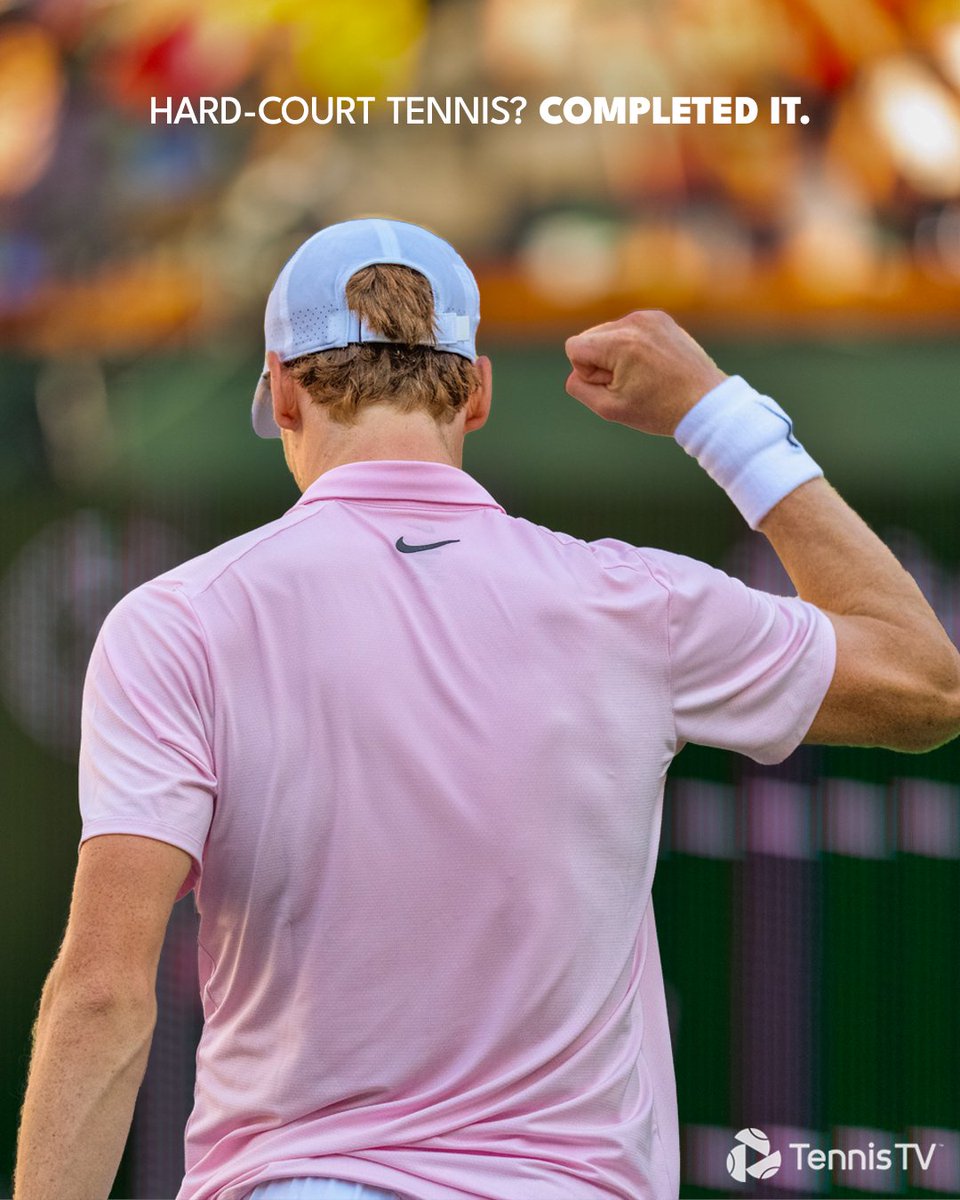
Australian Open 🏆🏆 US Open 🏆 Indian Wells 🏆🆕 Miami 🏆 Toronto 🏆 Cincinnati 🏆 Shanghai 🏆 Paris 🏆 Nitto ATP Finals 🏆🏆 Jannik Sinner becomes the youngest man to win EVERY major hard-court title.
Tennis TV tweet media
English
115
3K
13K
314.7K
Giorgio Chiovelli retweetledi
Florian Oswald 🇪🇺 🇺🇦
Florian Oswald 🇪🇺 🇺🇦@FlorianOswald·
Now that the entire profession is on fire with this stuff (nice video below), let me share how I feel after having heard "why on earth would you teach unix shell and git to your students?!" from people all around: vindicated.
VoxDev@vox_dev

Using AI Agents for Economic Research @aniketapanjwani just gave an incredibly useful presentation on how to get started using Codex/Claude Code. Check it out and share with fellow economists! youtube.com/live/YPv9BqweQ…

English
4
11
80
16.4K
Giorgio Chiovelli retweetledi
Alex Imas
Alex Imas@alexolegimas·
If you have a friend working at a medium/large company integrating AI into the workflow, this is what your group chat looks like. Org frictions will be a huge wedge between raw AI capabilities and actual productivity numbers.
Alex Imas tweet media
English
14
30
271
45.2K