Gadgetify

60.4K posts

Gadgetify banner
Gadgetify

Gadgetify

@Gdgtify

Cyrus, Gadget Ninja @ https://t.co/V89OUDXsIQ -- futuristic, cool #gadgets. https://t.co/chMlb9FCqp *Amazon Associates member. may earn commission on links

Katılım Ağustos 2014
1.2K Takip Edilen7.4K Takipçiler
Gadgetify
Gadgetify@Gdgtify·
I have been doing these data physication prompts for a while. Was just using way too may objects. I was going with 500 and that's too much for the model to handle. I think 30/50 works better 2x2 grid, 16:9, do this for 4 ai inferred subjects {{subject}} = "$subject" // ← the only thing you must change {{object_count}} = 30 // density lever (higher = richer, denser) {{time_axis}} = ai_infer(3–6 meaningful eras for {{subject}}, oldest → newest) {{palette}} = ai_infer(era-accurate color story for {{subject}}) {{emergent_form}} = ai_infer(single most iconic silhouette of {{subject}}) {{surface}} = "off-white seamless studio sweep with faint blueprint gridlines" {{capture}} = "museum-grade 3d macro photography, crisp micro-detail, shallow depth of field" {{light}} = "soft top key + gentle rim light, clean catalog shadows" {{aspect}} = "16:9" // 9:16 vertical • 16:9 hero • 4:5 max feed {{type}} = "thin elegant serif labels + a small legend key" detail_floor = "every object individually sharp at 100% zoom — no mush, no blur-fill" edge_logic = "pack objects densely along the form's contour, sparser toward the interior, empty negative space outside — so the shape reads instantly and cleanly" initialize emergent mosaic: render {{object_count}}+ individual specimens of {{subject}}, each a {{capture}} object on {{surface}}. encode: color → era from {{time_axis}} (using {{palette}}); object size → cultural impact (ai_infer); left→right position → chronological adoption. aggregate: their placement mathematically composes the giant {{emergent_form}}. apply edge_logic for a razor-sharp silhouette. honor detail_floor. frame: {{aspect}}, {{light}}. add {{type}}: x-axis "timeline", y-axis "cultural impact", and a legend mapping color → era.
Gadgetify tweet media
English
0
0
0
43
Gadgetify
Gadgetify@Gdgtify·
A fun style for visualizing the history of all kinds of things. Prompt: Style = { MEDIUM: Dense historical object-cube diorama fused with museum infographic design and collectible timeline sculpture. MATERIAL: Miniature artifacts, carved figures, architectural fragments, tools, machines, documents, textiles, vehicles, screens, relics, and symbolic objects packed into a cube-like display. SURFACE: Realistic miniature materials with museum-clean lighting, subtle dust, aged patina, tiny printed labels, glass-case clarity, and tactile object density. FORM: The subject becomes a compact cube, block, or archive volume filled with layered objects that represent eras, memories, stages, systems, or transformations. COLOR: Era-sensitive palette inferred from the subject, balanced with cream background, warm museum neutrals, dark archival shadows, metallic accents, and selective modern color highlights. LIGHTING: Clean gallery lighting with soft shadows, high detail visibility, and crisp object separation. COMPOSITION: Central cubic archive object with explanatory side text, date-like hierarchy, bullet-list logic, and curated museum-poster spacing. MOOD: Encyclopedic, historical, dense, tactile, intelligent, collectible, and highly inspectable. - Convert the subject into a dense chronological archive cube packed with miniature symbolic objects. - Reinterpret the subject’s history, function, identity, emotions, or stages as layers of artifacts, tools, architecture, figures, props, machines, relics, documents, and icons. - Replace flat explanation with physical object accumulation: every detail should feel like a tiny artifact inside a curated museum block. - Convert broad surfaces into shelves, compartments, stacked strata, cubical chambers, vitrines, or exposed cutaway sections. - Transform small repeated details into collections, specimens, objects, labels, diagrams, figures, tools, and miniature scenes. - Use clean infographic spacing around the cube for short title zones, timeline markers, category labels, and minimal explanatory text. - Preserve the subject’s core identity, but make it feel like its entire history has been compressed into one impossible museum artifact. - Keep the archive object dense but organized. - Use readable hierarchy: main cube first, supporting labels second. - Let each cluster represent a different era, function, memory, or conceptual layer. - Use negative space around the cube so the density feels intentional, not chaotic. - Any text should be short, clean, and inferred from the subject. - Museum timeline cube aesthetic. - Dense, tactile, chronological, educational, and premium. - Feels like an entire civilization, biography, product, idea, or phenomenon compressed into a single collectible archive block. - Avoid random clutter. - Avoid unreadable tiny text. - Avoid flat infographic-only design. - Avoid empty cube surfaces. - Avoid photoreal background distraction. - Avoid making every object the same scale; use layered miniature scale play. }
Gadgetify tweet media
English
1
0
3
182
Gadgetify
Gadgetify@Gdgtify·
Another manga sketch prompt but works for books too. It seems to be a bit unpredictable, so it works one way for a manga but if you give it scientists, it looks different, based on my experience from a few tests. Prompt: 16:9 // 2D SDF for the subject's silhouette, but with intentional noise to create rough overlapping contours. float sdf_subject = sdBlobbyShape( pose_params($ SUBJECT) ); // Multiple offset layers: // - outer contour: where abs(sdf) < 0.01 + noise*0.005 → thick ink (charcoal) // - inner folds: where curvature of sdf is high → thin ink (grey) // - construction guides: faint lines where gradient of sdf > 0.8 (visible strokes) // Flat colour fill: inside sdf < 0 → fill with base colour; shadow patch = intersection of sdf < 0 and a slanted half‑plane. // Secondary studies: smaller SDFs positioned around the canvas, same style. // No background SDF, just white void. // Rendering: trace rays through the 2D SDF field, apply ink texture (rough brush) to contours. Output 2D vector‑like sketch.
Gadgetify tweet media
English
0
2
3
189
Gadgetify
Gadgetify@Gdgtify·
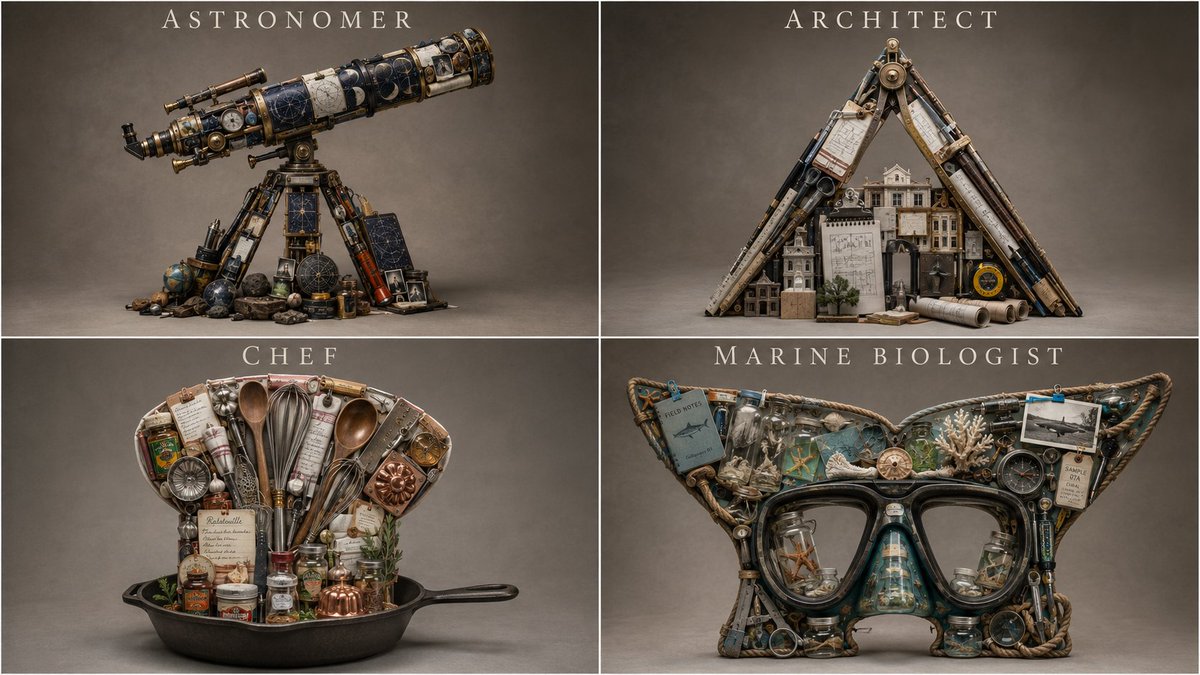
4 different jobs visualized with GPT. Pretty fun experiment 2x2 grid, 16:9, do this for astronomer and 3 other other jobs: - Convert the subject into a large readable object-totem assembled from many smaller meaningful items. - Reinterpret identity, timeline, personality, function, or theme as a collection of physical objects arranged into one clear silhouette. - Replace ordinary surface detail with found-object construction: tools, keepsakes, documents, props, devices, toys, clothing, containers, fragments, and memorabilia. - Convert curves, edges, and internal shapes into carefully placed object clusters that preserve the subject’s readability. - Transform small details into labels, photos, notes, stickers, worn surfaces, folded fabric, tiny props, and personal archive fragments. - Preserve the subject’s identity from a distance, while revealing its story through object choices up close. - Make the final image feel like a sculptural portrait of a life, era, idea, profession, fandom, brand, or memory. - Every object should contribute to the silhouette or story. - Use scale contrast: large structural objects, medium filler objects, tiny detail artifacts. - Keep the silhouette readable before the details are inspected. - Let materials remain recognizable rather than melting into one texture. - Arrange objects with believable balance, contact, weight, and shadow. - Found-object memory sculpture. - Clever, tactile, nostalgic, and instantly understandable. - Works as a visual biography, alphabet sculpture, timeline emblem, or conceptual product campaign. - Avoid random object piles. - Avoid losing the main silhouette. - Avoid over-polished CGI perfection. - Avoid flat graphic letters with objects pasted on top. - Avoid generic props; object choices should feel inferred from the subject. - Avoid cluttered background; keep the studio clean.
Gadgetify tweet media
Gadgetify@Gdgtify

A food recommendation system for GPT. I have tried similar things with Nano Banana in the past. This one looks better Prompt: Do this for $ dish : Function DrawDishHoudiniFluid(input dish) Input Variable: [INSERT DISH] System Instruction: Generate ONE hyper-realistic 16:9 image as a 2x2 grid of four Fluid Plating Sculptures recommending dishes. A) Semantics - Infer cuisine lane, flavor profile (spicy/umami/sour/sweet), texture goals (crunch, silk, chew). B) Recommendation Task: - Find 4 MUCH lesser-known dishes in the same cuisine lane. C) Style (NON-CHIBI): - Houdini procedural fluid: physically plausible sauce viscosity, foam bubbles, micro droplets, surface tension. - character dressing appropriately for the region., it must be a realistic 1/12 chef mannequin (neutral, faceless). D) Container (per panel): - U-shaped plating “light stage” with a single plate centered, like a product pedestal. E) Background (B&W): - Walls: monochrome ingredient diagrams + flavor compound icons based on the ingredients in the dish. Must be accurate - Floor: B&W plating guides and contour lines. F) 2D vs 3D Integration: - 2D contour lines rise into 3D sauce ribbons that form the dish’s silhouette. - Steam must be volumetric, subtle, believable. G) Visual Syntax: - B&W environment; full color food and fluid effects only. - Lighting: soft food studio lighting, appetizing specular highlights. - Label: "[Recommended Dish] — [Region]" Return: - ONE image, 16:9, 2x2 grid.
English
0
0
4
291
Gadgetify
Gadgetify@Gdgtify·
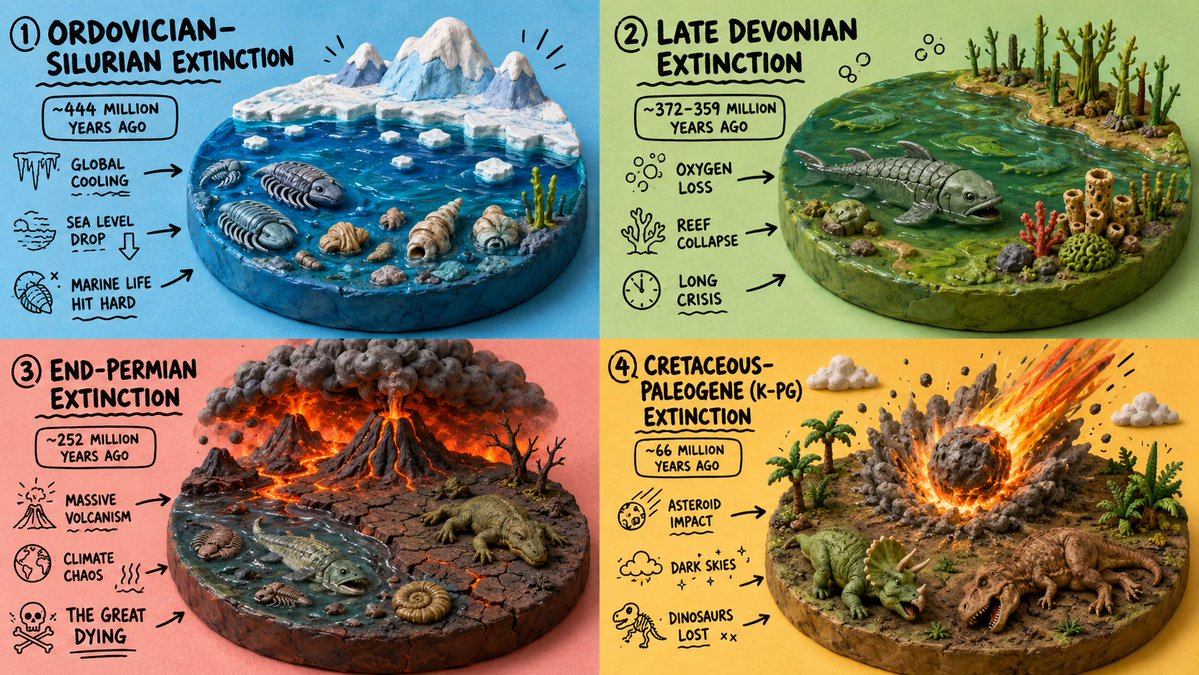
Here is another fun way to visualize 4 extinction level events with GPT. Prompt: 2x2 grid, 16:9, do this 4 extinction level events in earth's history =>class Claymation_Infographic: def init(self, topic="[TOPIC]"): self.medium_3D = "Glossy polymer clay, tactile fingerprints visible, tilt-shift miniature photography" self.medium_2D = "Flat black marker doodles, hand-written comic text, arrows, and speech bubbles" self.background = "Solid pastel matte paper" def generate_mixed_media(self): # AI INFERENCE: Deduce the scene and the educational facts base_terrain = f"AI_INFER(A thick circular clay slab representing the environment of {topic})" clay_figures = f"AI_INFER(Cute, slightly chunky claymation figures/animals interacting in {topic})" # 2D Annotations ui_labels = f"AI_INFER(Hand-drawn 2D arrows pointing to the 3D clay figures with educational text explaining {topic})" floating_doodles = f"AI_INFER(Flat 2D cartoon icons floating in the background space related to {topic})" return [base_terrain, clay_figures, ui_labels, floating_doodles] EXECUTE: The AI must perfectly separate the 3D volume of the clay from the flat 2D ink of the doodles. High contrast studio lighting on the clay.
Gadgetify tweet media
English
2
2
13
381
Gadgetify
Gadgetify@Gdgtify·
I asked GPT to show me 4 underrated international dishes. I have not tried any of these, sadly. Prompt: 2x2 grid, 16:9, do this for 4 underrated international dishes CREATE VIEW culinary_performance AS WITH concept_fusion AS ( SELECT 'plated food stage' AS anchor1, 'ingredient infographic panels' AS anchor2, 'miniature chef scene' AS anchor3 ), subject_data AS ( SELECT '$SUBJECT' AS subject_name, infer_plated_materials('$SUBJECT') AS materials, infer_ingredient_breakdown('$SUBJECT') AS ingredients, infer_preparation_process('$SUBJECT') AS process_steps ) SELECT compose_culinary_scene( centerpiece := subject_name || ' transformed into a plated object on dark circular stage, materials: ' || materials, motion := 'glossy sauce ribbons, steam plumes, oil droplets, spice trails, glaze splashes, aromatic vapor', side_panels := 'blackboard-style panels showing simplified ingredient icons, labels, process notes, origin tags, flavor diagrams', tiny_figures := '1-3 miniature chefs/makers/curators interacting with the dish, scale contrast, theatrical', lighting := 'dramatic side light, dark gray/black background, high food gloss, warm highlights, crisp shadows', atmosphere := 'sophisticated, luxury culinary museum exhibit' ) AS final_image FROM subject_data; RETURN final_image;
Gadgetify tweet media
English
0
2
13
394
Gadgetify
Gadgetify@Gdgtify·
Visualizing these impossible cities with Seedance 2.0. Here is the prompt I used: Cinematic tracking sequence highlighting the impossible localized gravity planes of the cuboid city. 0-4s: Wide establishing shot. Slow push-in toward the central void. Traffic flows simultaneously on all four inner walls, defying standard downward gravity. 4-8s: Dynamic FPV dive. Camera swoops into the center and aligns with the left vertical wall. Gravity shifts; cars drive past the lens as if the wall is the floor. 8-12s: Camera tracks a yellow taxi approaching a 90-degree internal corner. The taxi seamlessly rolls onto the inner ceiling. Camera rolls 90 degrees to keep the car grounded in frame. 12-15s: Camera pulls straight back through the suspended Brooklyn Bridge structure, exiting the cube to re-establish the wide shot above the tiny motionless observer. Style: Photorealistic 8K, macro lens depth of field, smooth drone cinematography, stark studio lighting.
Gadgetify@Gdgtify

An inception inspired prompt. I will do a video for these when I get a chance. 16:9, 2x2, do this for 4 famous cities: A floating diorama of [CITY_NAME] suspended in a grey studio::5 The Distortion: The floating bedrock and city streets are physically folding inward at sharp 90-degree angles, creating an impossible 3D architectural cube/tesseract::5 The Architecture: AI_INFER(Hyper-detailed, accurate skyscrapers, bridges, and city blocks of [CITY_NAME]) jutting out from every folded plane::4 The Details: Floating rubble, tiny cars driving on the folded vertical walls, gravity defying physics::4 Gallery Presentation: A tiny human silhouette holding an umbrella standing on the floor below, elegant text overlay in the corner, 8k, Octane Render, cinematic lighting::3 Flat earth, motion blur, natural sky, outdoor environment, messy::-3

English
0
2
4
407
Gadgetify
Gadgetify@Gdgtify·
I have done a bunch of prompts for poems in the past. This one is worth a shot. 2x2 grid, 16:9, do this for 4 non copyrighted poems Particles: 500,000 total. - Silhouette particles (100k): settle into the outer duotone shape, forming a flat printed layer. - Diorama particles (200k): within the silhouette, assemble into miniature rooms and props, matte material, soft pastel colors. - Graphite particles (80k): drift into the negative space and arrange as soft pencil marks and edge shading. - Burst particles (50k): cluster around the hero fragment, then explode outward in a snapshot—some form the torn paper edge, others become debris and dust. - Typography particles (70k): lock into precise letterforms (title, subtitle) at designated print zones. Simulate under forces: silhouette attraction, interior spatial constraints, graphite diffusion, burst kinetic energy. Freeze at equilibrium; render with warm editorial lighting, matte diorama reflections, and sharp burst shadows.
Gadgetify tweet media
Gadgetify@Gdgtify

This prompt was mainly for movies but works great for books too. I tried it with GPT but used non-copyrighted books. 2x2 grid, 16:9, do this for 4 public space, non copyrighted scifi books select foreground_environment, hidden_character_silhouette, color_palette from alternative_movie_posters where film = '[franchise]'; /* visual render logic */ -- color_palette: ai_infer(a striking 2-color screen-print palette matching the vibe of [franchise]). -- foreground (positive space): ai_infer(an iconic landscape, forest, or city skyline from the film, drawn in flat vector shapes). -- hidden_character (negative space): ai_infer(the empty sky or shadows between the foreground elements perfectly forming the side-profile of the film's main villain/hero). -- style: minimalist swiss graphic design, flat colors, no gradients, olly moss poster style.

English
2
0
12
437
Gadgetify
Gadgetify@Gdgtify·
The past, golden age and modern evolution of gadgets visualized with GPT. Prompt: subject_target = "[subject]" [x_coord], [y_coord], [physical_prop_type], [era_label] 0.1, 0.5, "ai_infer(earliest/oldest miniature version of subject)", "origin" 0.5, 0.8, "ai_infer(mid-century miniature version of subject)", "golden age" 0.9, 0.2, "ai_infer(modern/futuristic miniature version of subject)", "modern" // spatial distribution logic: plot 500+ rows of this csv data onto a flat, off-white studio canvas with faint gridlines. each data point is a highly detailed, 3d macro-photographed object. the physical placement of these 500+ objects mathematically aggregates to form the giant, unmistakable silhouette of subject_target. include elegant axis labels.
Gadgetify tweet media
English
2
0
8
392
Gadgetify
Gadgetify@Gdgtify·
A short prompt that works for all kinds of topics. I used for famous scientists. 2x2 grid, 16:9, do this for 4 famous scientists: ∂L/∂t = div( v(x,y) ⊗ L ) + src(L) – decay(L) where v(x,y) = velocity field derived from $ SUBJECT pose (action focal points as sources). Steady-state solution: streamlines of v become speed lines radiating from fists, hair, or vehicle. Luminance of L mapped to black/white/10% grey. Build poster with: A = $ SUBJECT silhouette B = deco ornaments placed along high‑curvature contours C = city towers that align to major streamline directions D = streamline plot L rendered as stepped fan rays, layered with echoes. Render as a dynamic travel poster, art deco style, strict monochrome palette.
Gadgetify tweet media
English
1
2
10
415
Gadgetify
Gadgetify@Gdgtify·
I love breaking down different gadgets with GPT. It's pretty good at it. Prompt: [EQUATION] ($ SUBJECT) + (exhaustive disassembly: every component, era‑accurate) + (chronological knolling grid: left‑to‑right by invention decade) + (hand‑lettered pencil callouts, leader lines, dates, material notes) + (overhead studio flatlay on matte slate, macro lens) + (props: magnifying loupe, tweezers, scale bar) - (illustration) - (messy arrangement) - (missing or modern‑only parts) = [THE OUTPUT] [INSTRUCTION] Render the visual solution. $ SUBJECT becomes a forensic chrono‑teardown artifact. VISUAL LOGIC: - Components spread in perfect grid, oldest left, newest right, separated by faint pencil decade lines. - Each part labeled with handwritten pencil notes: name, material, date. - Tweezers and loupe at frame edge indicate conservation work. MATERIAL LOGIC: - Realistic materials: aged brass, steel, bakelite, aluminium, catching soft light. - Slate surface matte, with visible grain. - Contact shadows only, no harsh drop shadows. OUTPUT: A single overhead macro photograph, 8K, 1:1 or 4:3.
Gadgetify tweet media
English
2
2
10
385
TechHalla
TechHalla@techhalla·
stop overcomplicating lipsync. use this Seedance 2.0 workflow ang get flawless results on magnific! breakdown below 👇
English
19
28
273
39.5K
Dheepan Ratnam
Dheepan Ratnam@Dheepanratnam·
When your ride is literally grown from the world tree itself One continuous 15-second shot: helmeted racer on a living wooden hoverboard with cyan thrusters blasting up an impossibly massive tree, carving bark highways, dodging giant beetles, exploding through glowing spore clouds… and finally touching the sky. That final line + planet view? Pure chills. Seedance 2.0 cinematic masterpiece. @dreamina_ai #DreaminaCPP
Dheepan Ratnam@Dheepanratnam

Ice vs Fire🔥. Ancient ruins. Seedance 2.0 delivering absolute cinema

English
8
3
59
3.5K
Umesh
Umesh@umesh_ai·
Continuous unbroken shot with image references with Kling 3.0 Omni. Prompt : Hyper-realistic cinematic action sequence using all uploaded images as visual references, presented as one seamless, unbroken continuous shot. A lone motorbike rider begins as a tiny silhouette crossing a glowing meadow beneath an immense, shadowed forest canopy. The camera descends rapidly from a sweeping aerial view, skimming the grass before locking beside the bike as it enters a corridor of colossal moss-covered trees. The rider accelerates through wet earth, drifting around roots and rocks as mud, leaves, water droplets, and mist explode into the air. The camera swings behind the rider for an intense low chase, circles smoothly around the bike, then races ahead while facing backward through shafts of green daylight. Without any cuts, the trail rises onto an abandoned railway bridge covered in vines, passing forgotten overgrown train carriages and a dark tunnel entrance. The camera drops beneath the bridge to reveal the river and vast forest below, then climbs back around the rider as the bridge transforms into a narrow elevated ridge. The motorcycle bursts into a luminous clearing at the edge of a towering grass-covered cliff. The camera pulls dramatically outward into an immense panoramic view, revealing the rider suspended above an endless emerald valley. Maintain consistent rider, bike, lighting, forest geography, momentum, cinematic realism, natural motion blur, atmospheric depth, and fluid camera movement throughout.
English
20
34
309
16K
Gadgetify
Gadgetify@Gdgtify·
A modular GOP prompt for extreme sports. Actually, it works for any sport. Prompt: 2x2 grid, 16:9, do this for 4 ai inferred scenes: input = { "athlete": [any_athlete_or_subject], "sport_or_activity": [any_sport_or_physical_action], "action_beat": [any_action_moment], "venue": [any_location], "camera_source": [optional] } class extremepovsportscompiler: hard_coding = false inference_mode = true def infer_sport_context(self, input): return { "sport": infer_sport_identity(input["sport_or_activity"]), "surface": infer_playing_surface(input), "equipment": infer_sport_specific_equipment(input), "venue": infer_venue_architecture(input), "rules_of_motion": infer_how_bodies_move_in_this_sport(input) } def infer_athlete_action(self, input): return { "identity": infer_athlete_or_subject(input["athlete"]), "pose": infer_pose_from_action_beat(input), "closest_element": infer_limb_or_equipment_nearest_camera(input), "body_momentum": infer_force_direction(input), "expression_or_intensity": infer_effort_focus_or_impact(input) } def infer_camera_system(self, input): return { "placement": infer_extreme_camera_position(input), "lens": infer_fisheye_wide_macro_or_action_lens(input), "distortion": infer_perspective_warp(input), "imperfections": infer_dirt_flare_blur_drops_or_surface_particles(input), "depth": infer_foreground_midground_background_separation(input) } def render(self): sport = self.infer_sport_context(input) action = self.infer_athlete_action(input) camera = self.infer_camera_system(input) return render_extreme_sports_frame( sport=sport, action=action, camera=camera, constraints=[ "no hard-coded sport", "no hard-coded venue", "no hard-coded equipment", "camera must feel physically close to action", "foreground distortion must be believable", "surface interaction must match the sport", "final frame must feel like a real action-camera capture" ] )
Gadgetify tweet media
English
0
1
3
213
Gadgetify
Gadgetify@Gdgtify·
An educational claymation diorama prompt for GPT Image 2. A cute, educational claymation diorama about [TOPIC] sitting on a wooden desk::5 The 3D Diorama: AI_INFER(Hyper-detailed polymer clay figures and terrain representing [TOPIC]), glossy, tactile, fingerprints, miniature scale::5 The 2D Graphics: Hand-drawn black ink doodles, arrows, and educational comic text floating magically in the air around the 3D model::4 Content: AI_INFER(Accurate scientific/historical facts about [TOPIC] written in the floating 2D text boxes)::4 Lighting: Warm desk lamp lighting, tilt-shift macro lens, 8k resolution, mixed media masterpiece::3 Scary, realistic, gory, digital 3d, messy, confusing::-3
Gadgetify tweet media
English
0
1
9
415
Gadgetify
Gadgetify@Gdgtify·
What if you let AI roll the dice on styles. Well, let's see here with GPT: 2x2 grid, 16:9, AI infers: x = "any subject" function roll_the_scene(x) { let d = { style: Roll(["baroque", "vaporwave", "woodcut", "data-viz", "graffiti", "naive folk"]), mood: Roll(["euphoric", "ominous", "tender", "absurd", "reverent", "feral"]), time: Roll(["dawn", "eclipse", "3am neon", "golden hour", "no time at all"]), twist: Roll(["everything is wet", "one object is enormous", "seen from below", "made of light", "mid-collapse", "impossibly calm"]) }; return Generate_Image({ Subject: x, Apply: d, // honor ALL four rolls at once Rule: "Reconcile the rolls into one image, however unlikely the combination", Craft: "Whatever the dice say, execute it beautifully" }); }
Gadgetify tweet media
Gadgetify@Gdgtify

4 classic books visualized with GPT. Short prompt structure but works well. ∂I/∂t = Δ(I, $ HERO, $ ACTION, $ SFX, $ COLLECTIBLES) Δ conditions: torn paper physics, 2D→3D transition, comic halftone, rim lighting, debris, Octane realism. Integration: t=0.0–0.2: Comic book opens, panels visible. t=0.2–0.5: Central page tears outward jaggedly, hero begins to push through — still 2D but distorted. t=0.5–0.75: Hero fully emerges in 3D mid‑$ACTION, power glow blossoms, shreds fly. t=0.75–0.9: Onomatopoeia “$SFX” bursts into place, collectible items vibrate. t=0.9–1.0: Lighting finalizes (rim light, soft shadows), slight motion blur on hero’s hand, 8K crispness. Output I(1): the masterpiece image.

English
2
0
14
675
Gadgetify
Gadgetify@Gdgtify·
A stylish poster prompt for bands. Prompt: 2x2 grid, 16:9, do this for 4 famous bands:  Generate an ornate Art-Deco engraved tribute-card grid for [SUBJECT_SET]. Rules: - infer DOMAIN from SUBJECT_SET - create one card per subject - each card must feel like a vintage collectible poster, banknote, concert bill, or engraved cultural emblem - each card contains: 1. subject name or derived title in custom typography 2. central medallion, emblem, portrait, logo-like mark, object, or symbolic icon 3. ornate geometric frame 4. subject-specific decorative motifs inferred from identity 5. dense black ink hatching, stipple, scrollwork, radial rays, and engraved texture 6. optional limited accent color only when semantically important - keep all cards unified as one premium tribute sheet - vary the center symbol and ornament logic per subject - no hard-coded names, logos, portraits, symbols, colors, instruments, albums, slogans, or dates unless supplied
Gadgetify tweet media
English
2
0
11
368
Gadgetify
Gadgetify@Gdgtify·
A food atlas prompt for GPT Image 2. It should work for any kind of food but I went popular dishes. 2x2 grid, 16:9, do this for 4 famous international dishes: CONCEPT ANCHOR 1: "Sushi miniature world — rice terrain, sashimi architecture, nori panels, roe beads, sesame debris, plated macro craftsmanship" :: CONCEPT ANCHOR 2: "Open food atlas — ingredients arranged as geographic terrain, edible map relief, cookbook page layout, culinary cartography, warm tabletop realism" :: CONCEPT ANCHOR 3: "Annotated miniature diorama guide — tiny figures, object callouts, side labels, ingredient diagrams, secret-spot markers, collectible educational layout" INSTRUCTION: Find the exact visual center of these three concepts. Ignore the literal astronaut, national flag, named foods, and specific maps. Capture only the reusable style DNA. Render $ SUBJECT as an edible miniature world presented inside an open atlas or cookbook. STYLE RULES: - Convert the subject into a tiny handcrafted scene built from edible materials. - Broad landforms become rice, grains, noodles, bread, pastry, sauce, puree, or layered ingredients. - Important structures become sashimi blocks, vegetable cuts, nori sheets, grilled pieces, dumplings, cubes, or carved food components. - Small repeated details become roe pearls, sesame seeds, herbs, spices, crumbs, seeds, or garnish clusters. - Present the subject on an open book, plate, tray, or cookbook spread. - Add map-like labels, ingredient callouts, tiny arrows, region markers, recipe notes, and small explanatory diagrams. - Use warm macro photography, shallow depth of field, tactile food texture, and precise miniature staging. OUTPUT: A culinary atlas-diorama where $ SUBJECT becomes a tiny edible world that is both delicious and educational.
Gadgetify tweet media
English
3
1
12
496
Gadgetify
Gadgetify@Gdgtify·
It's a long prompt but produces pretty cute images with Nano Banana. Prompt: 2x2 grid, 16:9, do this for alien holloywood movies in this Style = { MEDIUM: Candy-colored clay diorama fused with energetic pencil doodle illustration and graphic character-design sketch culture. MATERIAL: Smooth polymer clay, matte vinyl, soft foam, rounded paper props, pencil outlines, colorful molded accessories, and playful sticker-like accents. SURFACE: Soft matte toy texture mixed with visible sketch lines, hand-drawn contour marks, rough pencil shading, and bright pop-color fields. FORM: Subject becomes a cheerful sculptural toy-world centerpiece surrounded by doodle clouds, quirky props, miniature buildings, plants, icons, and playful graphic fragments. COLOR: Bubblegum pink, coral red, lemon yellow, mint green, teal, soft orange, cream, black pencil accents, and occasional bold graphic contrast. LIGHTING: Bright studio lighting with soft shadows, clean toy photography, cheerful ambient glow, and colorful backdrop separation. COMPOSITION: Playful diorama layout with clear central subject, rounded props, confetti-like details, sketchy background decoration, and graphic poster readability. MOOD: Fun, creative, youthful, handmade, chaotic-but-cute, colorful, and viral-ready. - Convert the subject into a candy-colored clay or vinyl toy diorama with rounded sculptural forms and bold playful proportions. - Preserve the subject’s identity, but simplify its structure into soft capsules, spheres, rounded cubes, thick tubes, and chunky toy silhouettes. - Overlay selected edges and details with pencil-like sketch contours, doodle marks, loose construction lines, and graphic hand-drawn accents. - Reinterpret surface detail as colorful stickers, beads, blobs, confetti shapes, tiny props, stylized plants, signs, clouds, windows, or decorative icons. - Convert complex environments into miniature playset scenery with bright backdrops, simplified architecture, toy terrain, and staged object clusters. - Replace realistic material with smooth matte clay, soft vinyl, molded foam, and tactile handmade surfaces. - Convert motion, energy, or emotion into floating doodles, graphic bursts, sprinkles, playful lines, and colorful abstract shapes. - Balance the cute 3D toy look with enough sketchy linework to feel handmade and artist-designed. - Favor rounded forms, oversized accessories, soft hills, simple faces, chunky props, toy plants, puffy clouds, and playful decorative fragments. - Use black or graphite lines sparingly to add handmade drawing energy. - Keep the main subject clean and readable even when the world around it is visually lively. - Candy clay toy world with sketchbook attitude. - Bright, tactile, playful, doodled, and highly shareable. - Feels like a designer toy diorama escaped from a messy artist sketchbook. - Avoid photorealism. - Avoid dark cinematic noir. - Avoid purely flat 2D drawing. - Avoid muted academic beige dominance. - Avoid thin fragile details; thicken everything into toy-friendly forms. - Avoid random doodle noise; every mark should support the subject or composition. }
Gadgetify tweet media
English
1
0
5
390