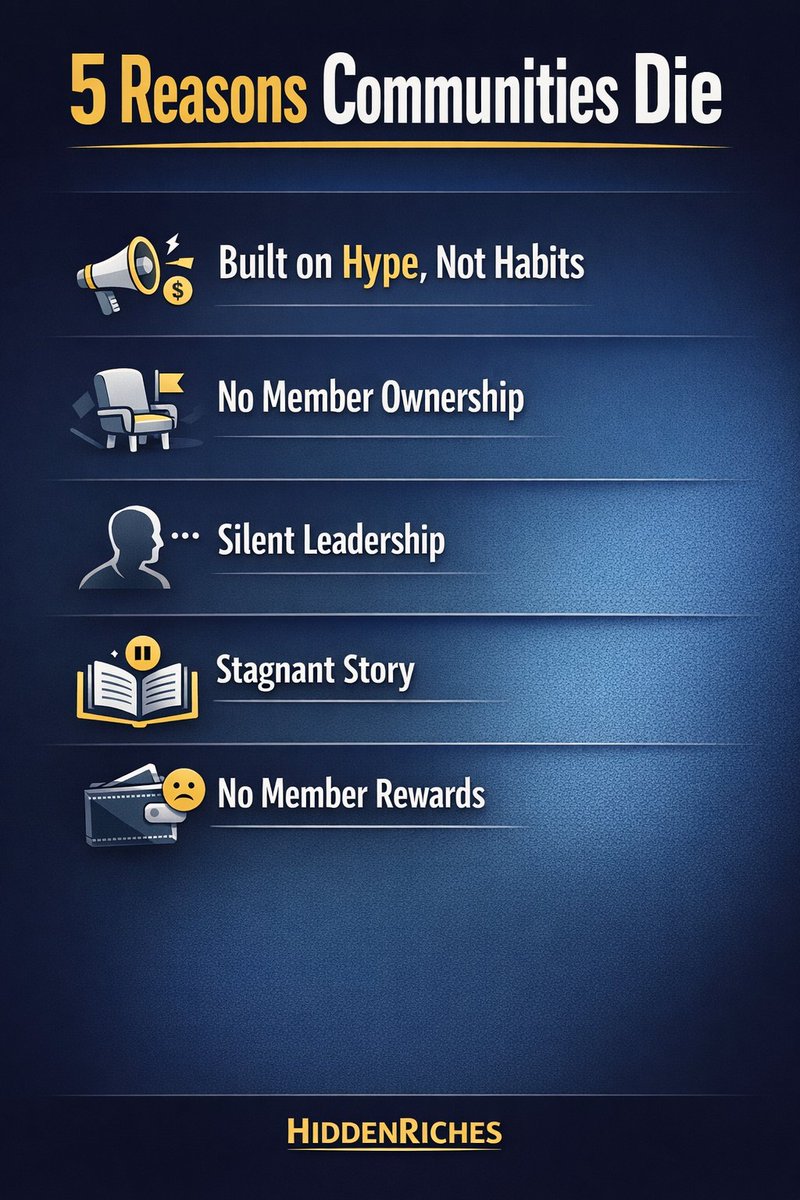
Sabitlenmiş Tweet

This is what keeps people coming back to a community 👇
#CommunityManagement #OnlineCommunity #GrowYourCommunity
English
HiddenRiches 💎
1.6K posts
@Gems4Mee
Community Management & Moderation, DeFi Trading, Advocacy & Ghostwriting. Empowering Communities, Connecting Builders, Driving DeFi Innovation. DM for Collab.
20 statements that changed me completely 1. If you don't choose your direction, distractions will choose it for you. 2. You are not tired, you're uninspired. 3. The longer you wait, the harder it gets. 4. Comfort is the most expensive addiction. 5. The life you want is on the other side of discomfort. 6. Healing is your responsibility, even if the wound wasn't your fault. 7. You don't need more advice. You need action 8. Nobody is coming to save you. 9. The truth hurts once. Avoidance hurts daily. 10. One decision can redraw-your entire life. 11. Pain is a teacher. Suffering is a choice to stay. 12. You are not stuck. You are scared. 13. If it costs your peace, it's overpriced. 14. Waiting for confidence is procrastination in disguise. 15. You're not behind. You're just comparing. 16. If they wanted to, they would. 17. You teach people how to treat you. 18. Your peace is more valuable than proving a point. 19. The longer you entertain nonsense, the longer it stays. 20. You can restart without announcing it. Gm Family 👑👑
Hot take: cash giveaways might be one of the most counterproductive tactics in community building And I say this with love for every project that's ever run one Here's why👇🧵

Community building 101 What a Community Actually Is (And why most Web3 teams get this wrong) One of the biggest mistakes I see founders and Project make in Web3 is this ↓ They use audience, followers, and community as if they mean the same thing. They don’t. Understanding the difference is the line between → short-term attention → and long-term ecosystems Let me break it down the way I teach it. ⮕ The 3 Levels of Connection 1) Audience An audience is a group of people who consume what you put out. They listen. They watch. They read. But they don’t interact with each other. Think: A classroom where only the teacher talks and everyone else quietly takes notes. Web3 example: → People who read your announcements on X → They never reply → They never join Telegram or Discord Reality check: They know you. You don’t know them. They don’t know each other. This is a one-way relationship. 2) Followers Followers are a step closer, but still passive. They choose to stay connected because you provide value → content → insights → tools → alpha Think: Fans who follow a football club online but never attend games or fan meetups. Web3 example: → Someone follows your wallet, protocol, or AI tool → Likes or retweets occasionally → But never uses the product → Never joins the server They are present, but not invested. This is light two-way interaction, mostly observation. 3) Community This is the highest level. A community is made of people connected: → to you → to the mission → and to each other That last part is everything. Think: A football fan club → they debate players → organize watch parties → bring friends → defend the club even during bad seasons Web3 example: Your Discord or Telegram where people actively discuss: → how to use your product → how to improve it → how to onboard new users → how to spread the word → how to solve problems together Community is participation, not presence. ⮕ Simple Mental Model Audience → Followers → Community Consume → Respond → Contribute Watch → Engage → Build One-way → Two-way → Multi-way If people aren’t contributing, you don’t have a community yet. ⮕ Why Community Is the Core Engine of Web3 This is where Web3 is fundamentally different. Web2 companies depend on users. Web3 projects depend on believers. Here’s why. A) Network Effects The value of a Web3 project increases as more people actively participate. Example: Uniswap works because many people provide liquidity and trade. If only 10 people used it, it would be irrelevant. Community drives this loop ↓ → users invite users → liquidity providers bring depth → traders bring volume → builders build on top Every new participant increases value for everyone before them. B) Evangelism (Unpaid Growth) Strong Web3 communities market harder than any paid campaign. Example: Early Solana community (2020–2021) They were small. They were loud. They were obsessed. → hosting spaces → running hackathons → onboarding devs → promoting every builder No one paid them. They believed. That belief turned Solana from “just another chain” into a global ecosystem. This is evangelism ↓ People spreading your message because they own the outcome. C) Liquidity Is a Social Problem Most Web3 products depend on markets: → tokens → NFTs → LPs → staking → governance Perfect tech with no community = dead market. A strong community provides: → early buyers → liquidity providers → long-term holders → emotional conviction during volatility Community is the foundation of liquidity, not marketing. D) Collective Ownership Web3 is built on shared ownership: → tokens → NFTs → DAOs → governance rights → contributor rewards People don’t just use your product. They own part of its future. Example: Early Aave users didn’t just borrow and lend. They governed. They voted. They funded proposals. Ownership turns users into stewards.
You logged onto 𝕏 and then found out that your favorite crypto influencer or a particular project had put out a post saying: " Hiring. A Community Manager is needed " Your next course of action would be to send your CV along with 500 other applicants without actually knowing what Community Management is all about. No worries, i got you covered Here's a simple breakdown of what Community Management entails.🧵 A lot of people think community management is just responding to comments or dropping announcements. But real community management is human engineering a mix of psychology, communication, leadership and service. Community management is about transforming strangers into supporters and turning supporters into contributors. When done right, it creates something brands spend millions chasing: trust. So what does a community manager actually do? > A CM creates a culture. They build the tone, the values, the norms, and the energy that people feel from the onset. They don't just run a group ~ they create an environment where people want to stay even without incentives. > A CM listens more than they speak. Most communities fail not because they lack engagement, but because leaders ignore the silent signals: ~ lack of participation, ~ shifts in tone, ~ resentment, ~ unclear leadership. > A CM keeps the community aligned, left unmanaged, any community will drift. A CM maintains clarity: – Why are we here? – What are we building? – Why does it matter? > A CM also handles conflict. Every community will face disagreements one way or another because it has people from different backgrounds and culture. So it is up to the CM to handle and resolve the conflict. We are gonna stop here for today.