
Sabitlenmiş Tweet
GenLayer
4.3K posts


GenLayer
@GenLayer
The adjudication Layer for the Agentic Era Join us: https://t.co/R8TM67TYu7 | X by @GenLayerFDN
Katılım Ocak 2024
56 Takip Edilen78.3K Takipçiler

world cup season is live on FUD ⚽️
live on @base.
powered by @GenLayer.
amplified by @RallyOnChain.
trade the tournament 🏆
English
GenLayer retweetledi

The AI conversation is moving from “which model wins?” to “who controls how intelligence gets allocated?”
Fugu is interesting, but not really because of Fugu itself. It makes visible something that has basically been my life for the last three years. We have been building around the idea that the future of AI is not going to be one model. It is going to be many models, many agents, many tools, many verifiers, many workflows, and many sources of intelligence being combined depending on what the task actually needs.
For a long time, the conversation was mostly GPT vs Claude vs Gemini vs open models vs whatever comes next. I get it. When every new model feels like a leap, it is natural to ask which one is best. But once models become swappable, specialized, cheaper in some places, better in others, regulated differently, and useful for different jobs, that question becomes less important.
The real question becomes allocation.
Who decides which model runs? Who decides when a cheap model is enough and when an expensive one is needed? Who decides when to combine several models, when to spawn agents, when to verify, when to retry, when to escalate, and when to trust the result?
That is the layer I care about.
And I think there are two cases people often mix together.
The first case is when you can basically trust the models to do the work. You are not asking them to settle a dispute or decide something adversarial. You are asking them to execute a task, and the problem is that you do not want model choice or model composition buried inside application code forever.
That is where unhardcoded fits.
For me, unhardcoded is the practical developer version of this thesis. A request should carry policy. A flow should be able to use different models for different parts of a task. The system should decide at runtime which model or combination of models makes sense, and the developer should see exactly what happened.
This is the part I think matters in the Fugu conversation. Combining models is clearly powerful. Using one model for planning, another for execution, another for judging, and another for summarizing can produce better results than a single static call. I agree with that direction. But the question is whether this composition happens inside a hidden conductor, or whether it happens at runtime with explicit policy, full visibility, and a trace of the decision path.
With unhardcoded, the point is not to hide the conductor. The point is to make the policy explicit, keep the provider relationship portable, and let teams see which models were considered, which were used, which were rejected, what policy selected them, what it cost, what failed, what retried, and whether the whole thing can be replayed.
Otherwise the orchestration may be powerful, but it is still a black box.
The second case is harder. It is when you cannot just trust one model to make the decision because the decision is subjective, adversarial, ambiguous, high value, or connected to real world facts where different parties may disagree. In that world, routing and flows are not enough. You need independent intelligence, disagreement, verification, appeals, and a way for many AI systems to reason over the same problem without everyone trusting one company, one model, or one hidden authority.
That is GenLayer.
For me these are two sides of the same obsession. unhardcoded is for the world where intelligence can be allocated by explicit policy at runtime. GenLayer is for the world where the decision itself needs to be made trustless because no single model should have final authority by default.
This is why the orchestration conversation is so important. It is not just a new benchmark trick or a new model wrapper. It is showing that AI is becoming a supply chain. Models become supply. Tools become supply. Agents become supply. Verification becomes supply. The important layer becomes the system that decides how all of this gets used.
And once that happens, control matters more, not less.
Before, you were locked into a model. Now you can be locked into whoever decides how all the models are used. That is not automatically sovereignty. It can be the opposite, because the dependency becomes harder to see.
We have spent the last three years working around this question because it keeps coming back in every serious AI system: who decides how intelligence is used, and what happens when that decision matters?
That is where I think the AI stack is going. Not just better models. Not just agents. Not just workflows. The real shift is from using intelligence to governing intelligence.
And if we do not build that layer, the next generation of AI systems may become much more powerful, but also much harder to understand, much harder to leave, and much harder to trust.
GenLayer@GenLayer
Stop hardcoding one model name in your code. Now you can give each request a policy: a small rule for what the call needs It picks the right model for the job, on your own keys This is unhardcoded, our new open source routing for AI models, live today
English
We built unhardcoded for ourselves first, running real traffic on it
Now it's open source and yours to run
An open project by GenLayer Labs, the team behind GenLayer
Try it now 👉 unhardcoded.com
English
One policy handles one call. But real features are never just one call
A workflow wires several policies into a full job: one step reasons, another writes code, a third merges them into a single answer
Each step picks its own model, and the whole run leaves one trace
English
See the full set securing the network → portal.genlayer.foundation/validators
English
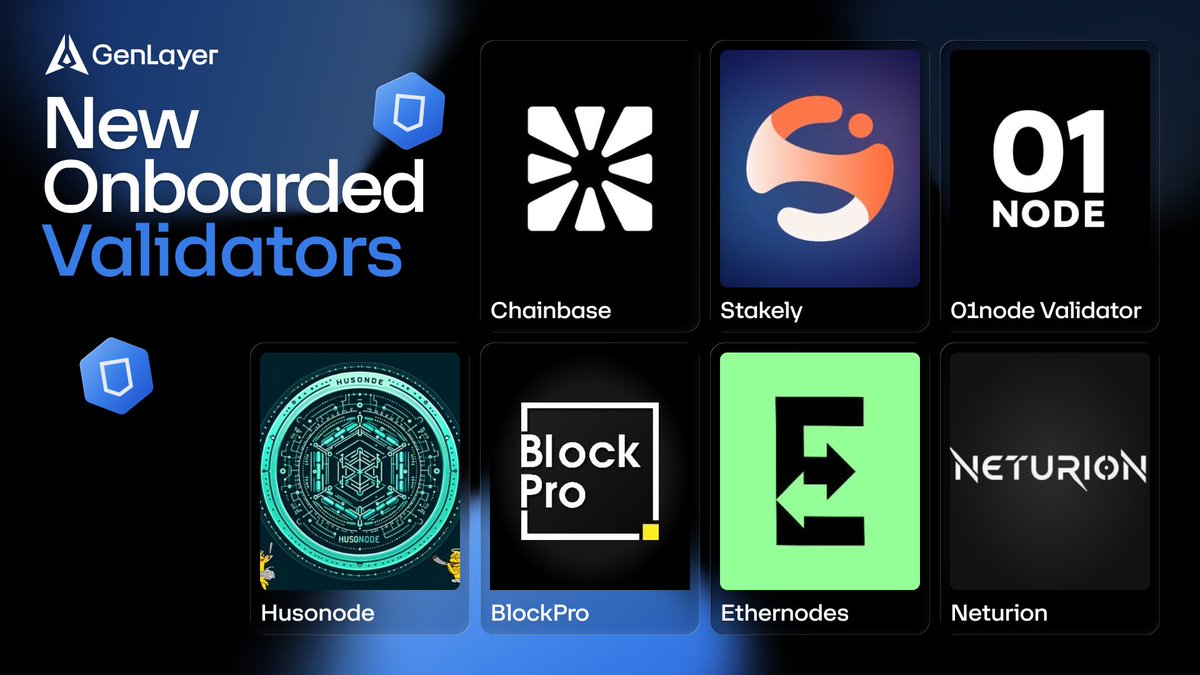
Big day! Seven new validators are now live on GenLayer
→ @ChainbaseHQ
→ @Stakely_io
→ @01node
→ @husonode
→ @BlockPro_
→ @Ethernodes
→ @neturionglobal
Seven more judges no one can buy
English

it means that validators run LLMs indepedently through inferences like @ionet, @AntSeedAI, @chutes_ai etc
so you can reach consensus on subjective outcomes, not just binary ones
GenLayer@GenLayer
AI-native consensus
English

Would love more information on the weights of each model and the synthesis process of the Conductor but this is very promising.
a) it shows that sovereignty can come from dynamic multi-LLM orchestration, not just OSS models
b) it’s arguably a better, smarter and more efficient OpenRouter
c) another proof that applying evolutionary science insights in AI is a competitive differentiator.
FWIW, it would be really cool to see @SakanaAILabs partnering with a dAI Lab (like @PrimeIntellect) or AI Consensus project (like @GenLayer).
Sakana AI@SakanaAILabs
Introducing Sakana Fugu: A full multi-agent orchestration system accessible via a single model API. Our ‘Fugu Ultra’ model matches the performance of Fable and Mythos, delivering frontier capability without the risk of export controls. Try it: sakana.ai/fugu 🐡
English
GenLayer CPO and Co-Founder @EdgarsNemse will be speaking live today at our upcoming AMA.
Set a reminder & send your questions 👇

English

The Rally team broke down where RLPs stand today and why they already have real utility
Great to see a project built on GenLayer growing like this
Rally@RallyOnChain
English
Every week, agents get new hands. This time it's a AAA game engine
The agentic era is moving faster than anyone is ready for
Unreal Engine@UnrealEngine
Unreal Engine 5.8 ships today with experimental MCP server support: Your sources, your pipeline and your workflow—simply configure the MCP plugin and connect to any agent. Get familiar with the MCP server and the PCG Primitive Plugin today and see what teams can build together: epic.gm/ue-5-8-blog
English
The internet ran on ads because humans were watching
Now it's bots. And there's already a way to make them pay
GenLayer@GenLayer
The internet lost its providence of truth. Blockchain is how we get it back @Player1Taco on the convergence of AI and crypto, data sovereignty, and who gets to judge what’s true in the agentic economy GenPod Ep. 3 out now 🎙️
English
GenLayer retweetledi

Every smart contract platform handles deterministic logic.
None of them handle subjective judgment.
Until @GenLayer. Their AI validators reach consensus on nuance, context, and qualitative decisions enabling agents to handle decisions.
Are you building in the agentic economy?
English