

Georg Rute
98 posts

Georg Rute
@GeorgRute
CEO GridRaven, boost your grid capacity by 30% with software-only Dynamic Line Ratings
Katılım Aralık 2013
153 Takip Edilen119 Takipçiler
Solar and wind grew faster (+403 TWh) than global power demand (+369 TWh) in the first half of 2025, leading to a small decline in fossil generation (-27 TWh or -0.3%). Have we just entered the new phase of energy?
However, investment in power grids has not been keeping pace. I can attest from my own time at Estonia's transmission system operator, Elering, that the sudden growth in solar in 2019 took everyone by surprise. The grid that is being built today was planned 10 years ago and this sudden growth has not been planned for.
The lack of available grid capacity is going to be the major energy story in the next five to ten years. It takes 10 years on average to build a transmission line according to the IEA.
This is why Gridraven's solution is extremely timely. By accounting with the wind cooling effect (even a light wind doubles the capacity of a line by cooling it down), we help get up to 30% more capacity from the existing grid. This buys time to build the grid that we need, globally.

English
@curious_founder Another factor is the cost of money. Lending is 5% more expensive than in the last 15 years, making capex-intense projects such as grid build out even more expensive that it would otherwise be.
English

Electricity prices are rising faster than they have in decades.
There have been a lot of viral posts explaining why prices are rising. But many of them are wrong or misleading.
🧵

English
You can do your own DLR analysis by setting up any line in the world at claw.gridraven.com
English
The Texas grid is overloaded in summer evenings when the sun sets but air conditioning loads are still high. Power needs to flow into cities, but transmission lines don't have enough capacity. As a result, power becomes very expensive.
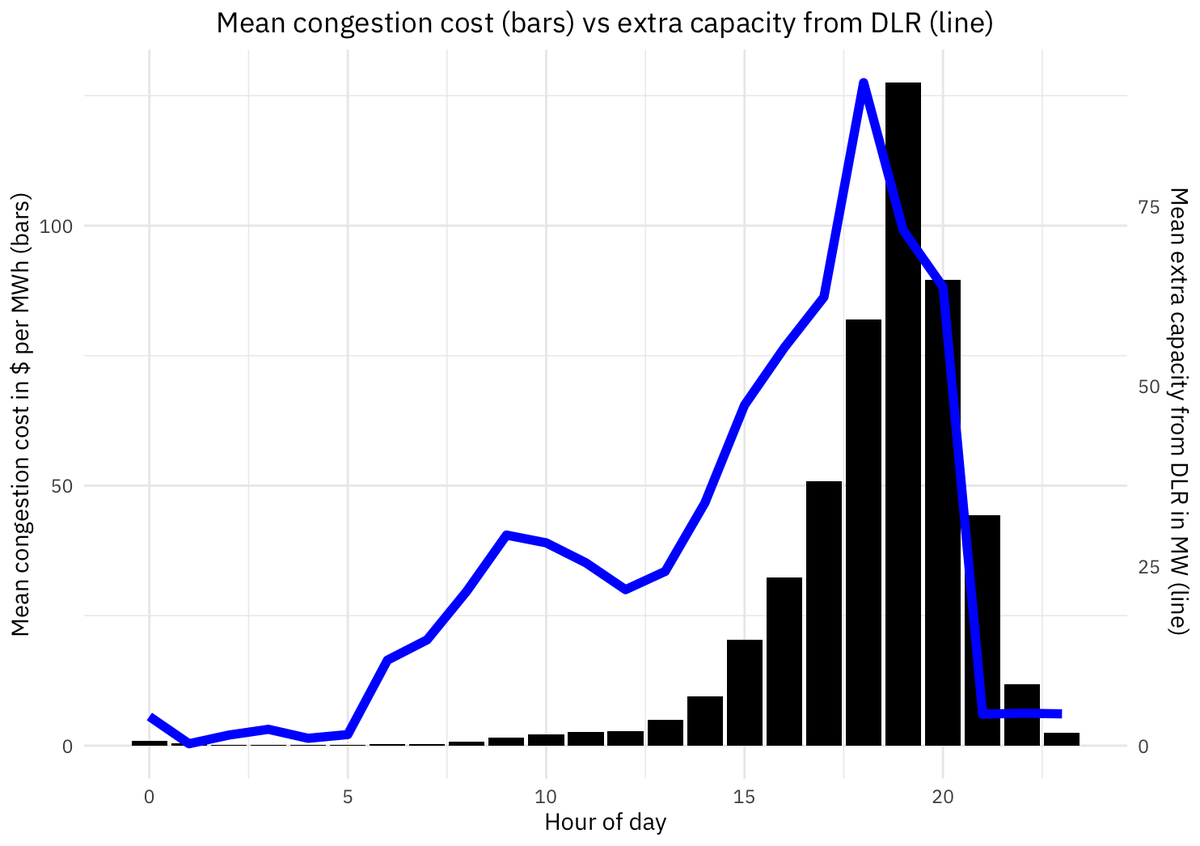
We investigated congestion patterns on one line, the Pawnee-Calaveras 345 kV line near San Antonio, also known as the E_PASP generic transmission constraint. We looked at congestion costs with hourly resolution from May to August 2025. Thanks to Eolian for the insights and the data!
The black bars show the mean congestion cost on this line. The line is binding roughly one third of the time and congestion is especially high in evening hours, with average $100/MWh in shadow prices. This is the economic value of one additional MW of transmission capacity on this line in this hour, as determined by ERCOT.
We then forecasted Dynamic Line Ratings over the same period and determined the additional capacity available on this circuit. The blue line shows the mean additional capacity per hour of day during the same period. There's around 70 MW additional capacity available on average during these congested evening hours.
Over the summer, DLR on this one line would have saved between $2 - $3 million, potentially up to $10 million, of ratepayers' money. We used AAR as the baseline.
This is an example of a study that anyone can now undertake by using Claw. We've made DLR available globally in a self-service web portal. It takes about 1 minute to set up any line in the world. Go and check it out!
English
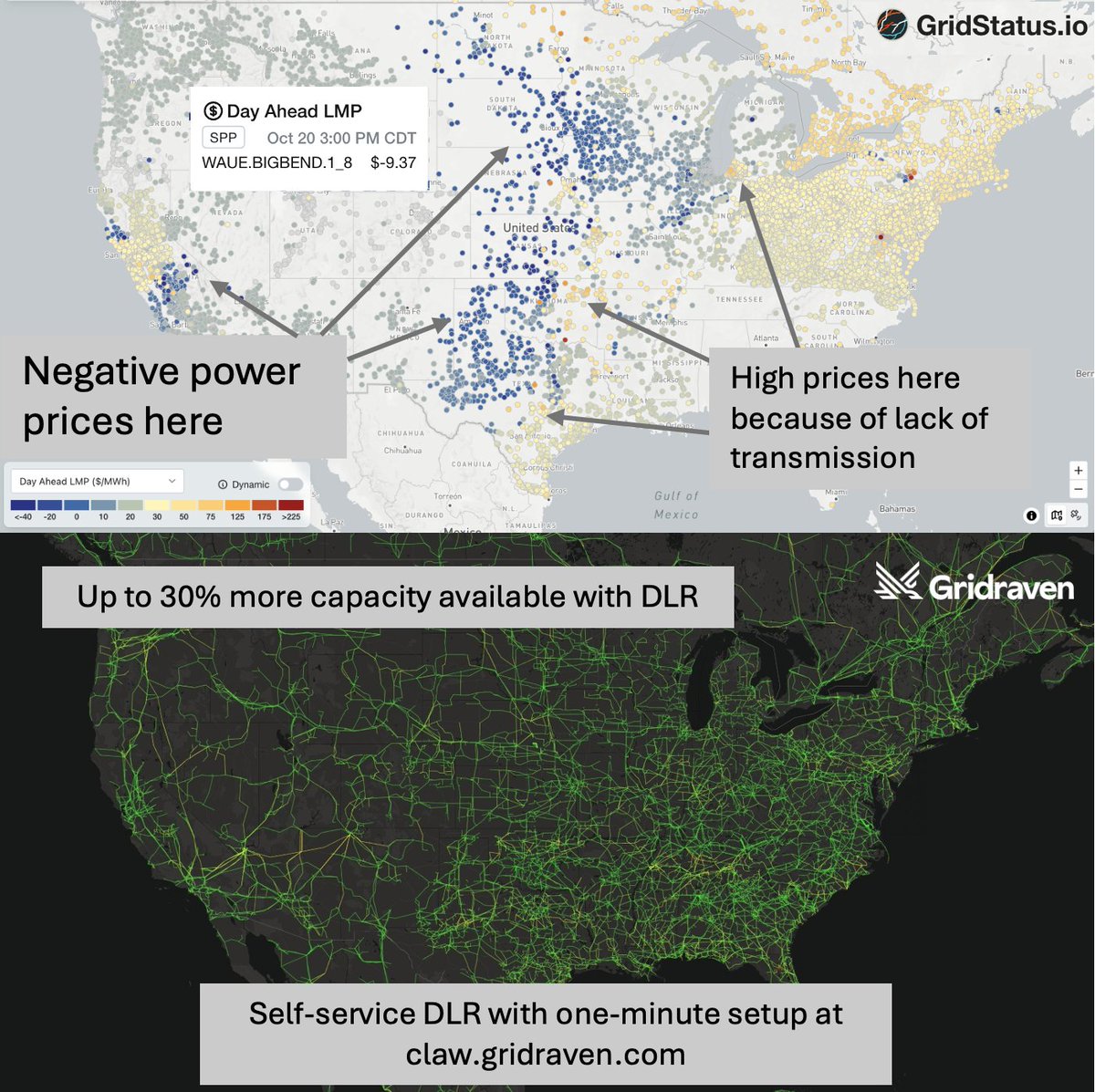
Wild price differences such as these today are mostly due to the outdated way of rating our overhead lines. Generators are losing money while consumers are paying high prices.
Yet up to 30% more power can be delivered through the existing grid with DLR. Even a light wind can double the capacity of an overhead line.
Now, the world's most accurate wind forecast and DLR solution is available globally in a self-service web portal.
If you're an engineer in transmission or distribution, or work with power market data - check out your grid, or any line in the world.
English
English
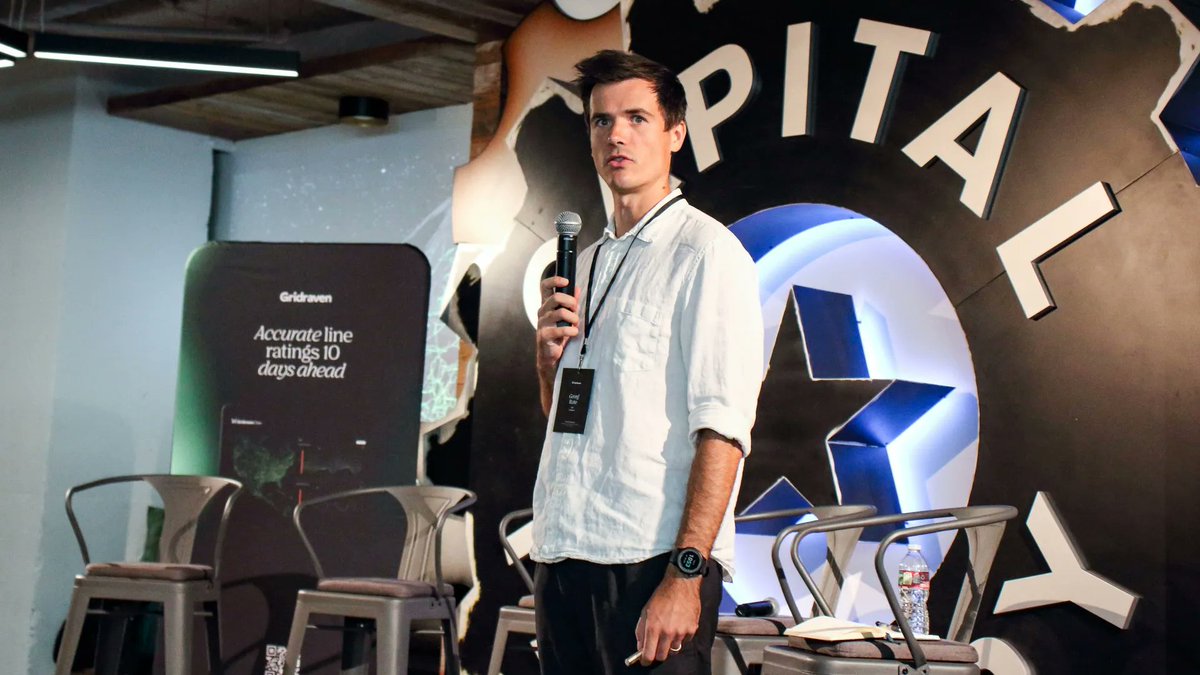
Thank you @KeatonPeters from @StraightArrow__ for having joined the Roundtable discussion at the Capital Factory and for your thorough article.
- 96% of the United States has been 3D-mapped to within 1 meter resolution
- Gridraven's innovation is hyper-precise wind prediction based on these maps
- Applying it in DLR helps save the $20 billion congestion cost nationally
English
Announcing the global launch of Gridraven Claw!
Piloting Dynamic Line Ratings (DLR) used to mean multi-year projects, steering groups and heavy sensors. Now it's as simple as logging into Netflix.
I'm incredibly proud of our engineers at Gridraven for pulling off what many thought impossible: global DLR powered by ultra-local weather prediction, with a setup in just minutes.
Gridraven is already the world's largest DLR provider, live in control rooms in three countries.
Now, everyone can try it.
English
Grid congestion costs $200 dollars per household per year in America, but could be reduced within weeks.
When the grid is congested, more expensive power generation needs to run, even though more affordable generators would have been available further away.
In my new op-ed for @_LatitudeMedia , I share findings from our Gridraven study together with Eolian which shows that congestion costs can be slashed immediately with smarter operational decisions and accurate weather forecasting.
The study looked at the Pawnee-Calaveras 345 kV line (E_PASP) and found that capacity could increase by 17% with DLR. That alone could have saved ratepayers $2–10 million over a single summer.
Further, by treating the San Miguel - Elm Creek 345 kV double circuit as a double contingency instead of a single contingency, $10 - $38 million dollars would have been saved.
Those are savings on just one line. When scaled up across Texas, the savings would potentially be up to $340 million+ in congestion cost reductions.
💵 $34 dollars per household per year in savings from a simple software intervention
👇 Read the full op-ed here, and share your thoughts — what’s the biggest barrier to scaling solutions like this?
latitudemedia.com/news/how-to-fi…
English
Even a light wind doubles the capacity of an overhead line by cooling it down. But you need to be really sure that the wind is actually there or you risk overheating your line.
Gridraven's breakthrough wind prediction is reliable also in sheltered locations where power lines are.
Nearly 40,000 weather stations provide measurements for training our wind prediction models globally. 533 stations are in Texas.
The histogram shows wind prediction error (predicted - measured wind speed) against hourly measurements from 50 stations across Texas. These stations were not seen by our models before.
Before Gridraven, utilities needed to install hardware and collect years of data before being able to forecast line ratings.
With Gridraven, utilities unlock more capacity for day-ahead energy markets right away on all lines.

English
Join us for a Breakfast Roundtable in Austin, October 14, to explore the future of the Texas grid.
We’ll tackle the big questions around affordability, meeting rapid load growth, and ensuring grid reliability with a panel of leading voices:
Jack Farley – CCO, Grid United
Doug Lewin, President, Stoic Energy, @douglewinenergy
Joshua D. Rhodes, PhD – Research Scientist, The University of Texas at Austin, @joshdr83
Patricia Zavala – Executive Director, PowerHouse Texas
We will also reveal a fresh study on a major transmission line in south-central Texas, highlighting the importance of DLR and the effect it has on the power bills and congestion costs.
Looking forward to seeing you there!
Reserve your spot here gridraven.com/rsvp-austin-20…
English
The grid was mostly built 40 years ago. Data centers were very different back then.
Right now, electricity demand is forecasted to soar 14% by 2026 in Texas, outpacing the national average 2.2% growth (EIA, shown on chart).
As I wrote in my Utility Dive op-ed, the next three summers are on track to be our most challenging yet. Large loads are required to be ready to disconnect during grid constraints.
There is no way for our physical infrastructure to catch up in time, because it takes years to build new lines. Texas can do that faster than other places, adding 765 kV lines in only a few years, but that's still years not months.
Before resorting to cutting load, it's the task of grid operators to make sure that all optimization solutions are used first. Including sensorless DLR that could be switched on right now.
Full op ed link in the comments.

English
The power grid is almost twice the length of the global road network.
🛣️ Roads span around 60 million km.
🗼 Power lines cover around 100 million km.
The problem is that our grid is already congested. We need much more grid, but building the equivalent of a new global road network will take time.
Yet there's at least one third more headroom in existing power lines: when it's windy the same power line can carry up to 2x more power since it's being cooled down.
Now for the first time, Gridraven is able to predict wind accurately enough unlock this additional capacity. Our innovation in machine learning is already being rolled out across 5500 km of Finland's transmission network.
@IEEESpectrum just featured Gridraven in a feature about Dynamic Line Ratings. The piece covers two legacy solutions that depend on hardware, and closes with our vision of boosting the grid by 30% everywhere in the world by 2030. This is only possible with a software-only solution.
Thank you Amos (@settostun) for excellent coverage.
spectrum.ieee.org/amp/dynamic-li…

English
@visegrad24 Ironically much of the congestion in the grid only exists on paper. Even a light wind of 2 m/s adds 30% more capacity to overhead lines by cooling them down, but that's not accounted for by grid operators. That's possible now - see claw.gridraven.com
English

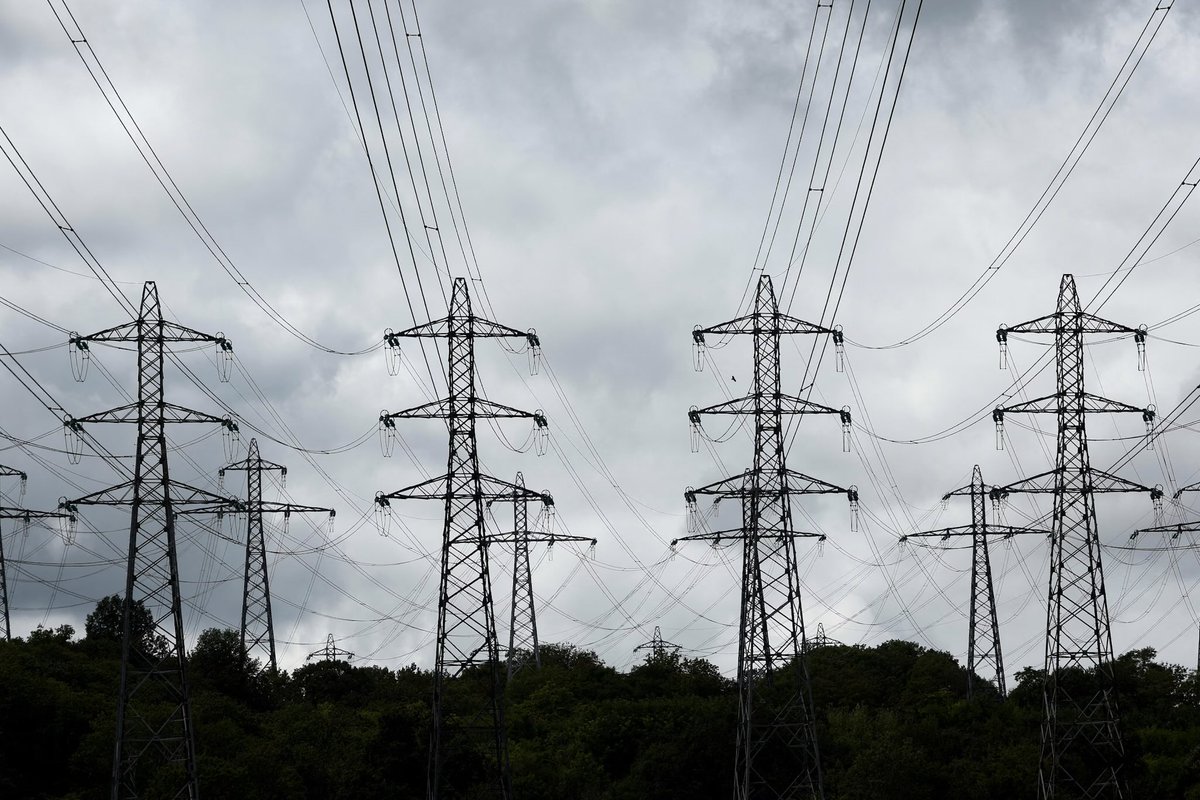
The rapid expansion of renewable energy in the Netherlands has boy been followed by investment into the energy grid, forcing the country to ration grid access to new clients.
The Netherlands is facing significant grid congestion due to the rapid growth of renewable energy, particularly offshore wind, which has outpaced grid infrastructure development.
This has led to delays in connecting new solar and wind projects, with over 11,000 businesses stuck in a queue for grid access and new homes facing connection delays.
The electricity grid was not designed to handle current and future supply and demand dynamics, resulting in severe congestion.
The closure of the Groningen gas field has worsened the issue by reducing backup capacity, as renewable infrastructure struggles to keep up.
The situation is described as a form of electricity rationing, where businesses and consumers face restricted power access, deterring investment and threatening economic stability.
Experts have been warning for years that there is a high need for grid expansion and increased energy storage capabilities, but have been largely ignored.
English
Georg Rute retweetledi

This startup wants to better forecast the wind to boost Texas' electrical grid bizjournals.com/austin/news/20…
English