Boris ‘u-turn’ Johnson has struck again.
The right decision, handled in the cruelest possible way.
Please RT if you’re as sick of this Government as we are.
bbc.com/news/uk-553792…
@E_TaylorCox Hi Eve, tree cover seems to be the most important variable. Most of the populations are thought to live and breed on woodland edges or in rides/glades through woodland so it makes sense that tree cover is important
1/4 #ACCEconf20#ACCE_Eco
In 2018, the Chequered Skipper 🦋was reintroduced to England for the first time since their extinction in the 70’s. Species reintroductions however are notoriously difficult, and so it is essential to ensure the habitat can support their persistence.
@RajWhitlock Hi Raj. I hope to collect samples from both the source site (in Belgium) and reintroduction site. I will use this to both estimate dispersal capacity of the species and to compare the genetic diversity of the two populations, which should help assess reintroduction success
@Ghalford6 Morning Georgina, this looks like a really interesting study—you mentioned genetics - will you use genetic measures/ approaches or information to assess reintroduction success too?
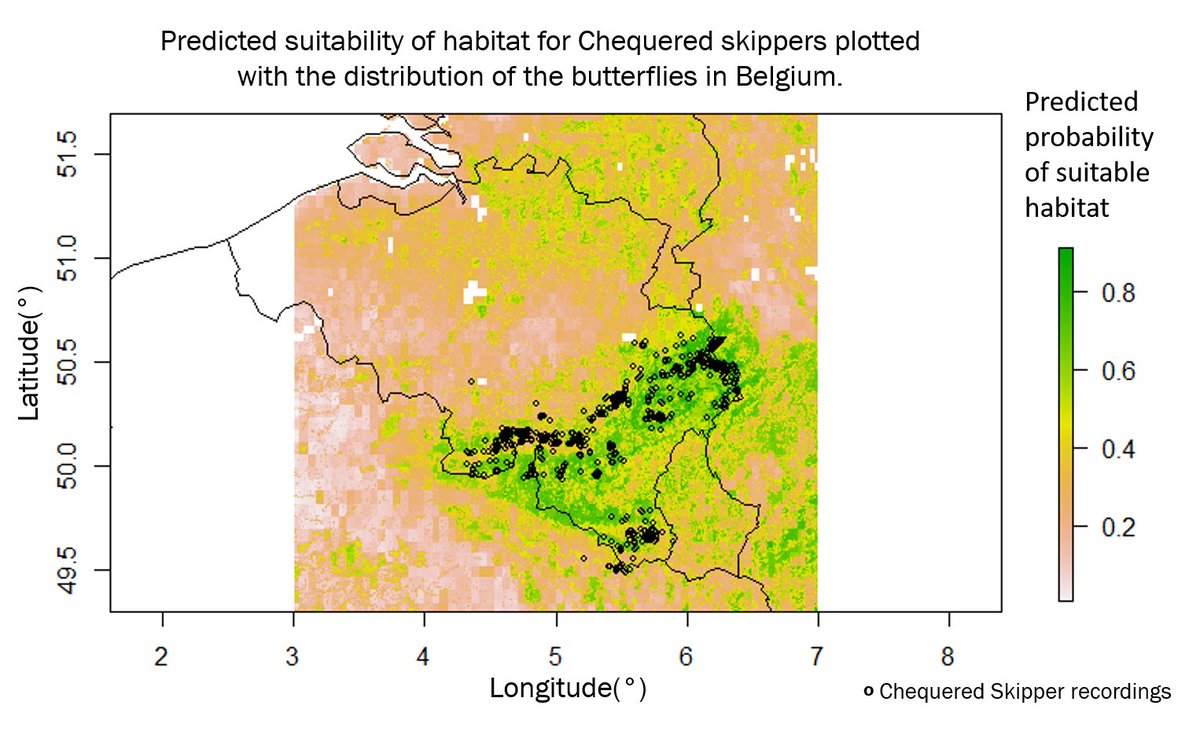
@jon_seabirds@RhiAustin The sdm was created using distribution data and environmental variables that covers most of Europe, including the UK, so it should translate nicely. I used Belgium to test how well it predicted a known distribution of Chequered Skippers that wasn't used to create the sdm
@Ghalford6 Thanks Georgina. In our lab group meeting the other day @RhiAustin was talking about how SDMs are hard to transfer between locations. How well might your Belgium model/understanding work in the UK?
4/4 #ACCEconf20#ACCE_Eco
I will use simulation models to predict how well the 🦋 (arrows) will survive over several seasons across the reintroduction landscape of habitat (orange) and non-habitat (red), using SDM predictions to determine these habitat classifications.
3/4 #ACCEconf20#ACCE_Eco
The results of the SDM was used to predict Chequered Skipper survival in different regions and compared to the presence in Belgium to test how well it predicts their distribution.