

Ghinduta
18.4K posts

Ghinduta
@Ghinduta1
$EGLD #MultiversX We will rise https://t.co/6kKYBbCACS Now you know
Katılım Eylül 2020
1K Takip Edilen413 Takipçiler

Ghinduta retweetledi

✅ Secure Proof of Stake
✅ Meritocratic validator selection
✅ ~3,200 active validators
✅ Zero equivocation
✅ Formally verified VM
✅ Fully sharded, horizontally scalable
✅ Parallel cross-shard execution
✅ ~$0.0002 per transfer
✅ Unconsumed gas refunded
✅ Gas abstraction
✅ Onchain 2FA
✅ Protocol-native tokens
✅ Fungible tokens
✅ Non-fungible tokens
✅ Semi-fungible tokens
✅ Multi-token transfer
✅ WASM smart contracts
✅ Custom-built Virtual Machine
✅ Native VM elliptic curve operations
✅ Multi-VM customizable chains (Lightspeed SDK)
✅ Reproducible smart contract builds
✅ Upgradeable contracts
✅ Chain Simulator
✅ Millisecond-precision smart contract timestamps
✅ Mature onchain governance
✅ KPI-gated emissions
✅ Developer royalties
✅ MCP integration
✅ Agentic Commerce Stack (x402, UCP, ACP, AP2)
✅ MX-8004 agent identity standard
✅ Agent Builder Hub
✅ Carbon negative
⏳ Sub-second finality (Supernova)
⏳ Protocol-native Zero Knowledge proof
Built different.
English
Ghinduta retweetledi

Far Beyond Driven was released #onthisday, 32 years ago! We shattered expectations and debuted at #1 on the Billboard charts. 🤘🏻
What’s your favorite track? Tell us in the comments ⬇️

English
Ghinduta retweetledi

Supernova is the sonic boom of blockchain interaction.
But in what way, precisely?
Well, a sonic boom happens when an object outruns its own sound. There's no warning or no build-up. The thing just arrives before the sound it makes can catch up.
With Supernova, the transaction lands before the user even registers they're waiting. The experience outruns the expectation. And creates a perception boom.
Every architectural bet we made over the past five years points here. Right at this moment.
The phase of instantaneous interaction has arrived.
English
Ghinduta retweetledi

Supernova is live on Battle Net.
Here's what changed under the hood and why it matters.
The paradigm shift nobody's talking about:
Every blockchain in the industry is measured on two metrics: block time and throughput.
Faster blocks = better chain. More TPS = better chain.
----------
Supernova breaks this framing entirely.
For the first time in the blockchain industry, block finality is faster than block slot allocation.
Let me explain what that means.
How every other blockchain works:
Traditional blockchains follow Execute → Propose → Vote. Validators must execute every transaction before proposing a block.
The block slot is the clock. Finality can never be faster than the slot, because execution is in the critical path.
Ethereum: 12.8s slot, ~12.8 minutes finality.
Solana: 400-600ms slot, 13 seconds finality.
Sui: variable, ~500 to 1000 ms for complex transactions.
In every case: finality ≥ block slot. This is treated as a law of physics.
It's not.
----------
How Supernova works:
We flipped the model to Propose/Vote → then Execute.
Consensus proceeds independently of execution. Validators agree on transaction ordering first. Execution results are notarized in subsequent block headers via inclusion proofs.
The inclusion proof is the key innovation: it allows a block to be finalized with cryptographic proof that its transactions will execute correctly, before the execution itself completes.
The virtual state tracker in the transaction pool maintains a deterministic view of account states (nonces, balances, pending transactions) so consensus can validate without waiting for full execution.
Result: the block is finalized faster than the block round itself.
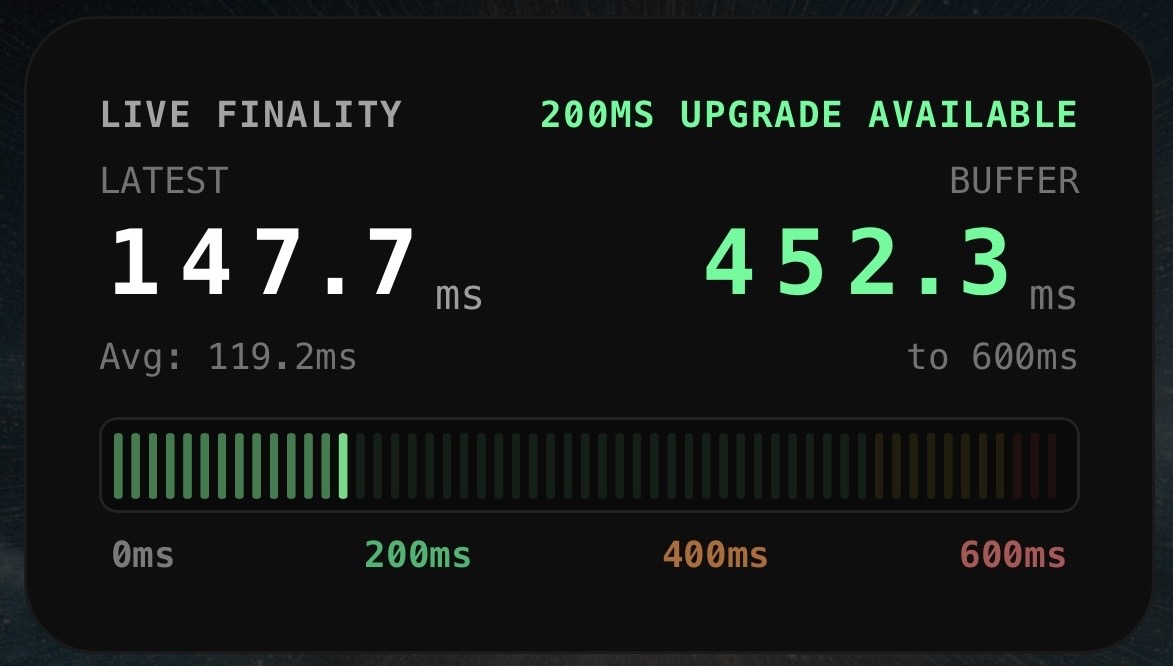
88ms finality measured in testing. Sub-200ms under real-world conditions. On 600ms block slots.
Finality < block slot. First time in the industry.
----------
The throughput story:
With the same hardware specification as pre-Supernova mainnet, the network now achieves ~120,000 transactions per second in burst mode. Same nodes. Same machines. 10x the block production cadence.
This is the same validator infrastructure running fundamentally better software.
The backpressure system (Execution-Result Inclusion Estimator) ensures this scales safely - dynamically adjusting per-block gas limits if execution lags behind proposals, so minimum-spec nodes never get overwhelmed.
What this means in context:
- Block time: 6s → 600ms (10x)
- Finality: ~88ms measured (first blockchain where finality < slot time)
- Throughput: ~120,000 TPS burst mode (same hardware)
- Architecture: consensus fully decoupled from execution
- Sharding: 3 execution shards + metachain, fully preserved
- Validators: 3,200+ nodes, no hardware upgrade required
----------
Battle of Nodes is stress-testing all of this right now. $150K in prizes to find what breaks. Validators, security researchers, builders, and guilds pushing the limits.
If Supernova survives this, it ships to mainnet.
150,000 lines of new protocol code. 20 months of engineering. The most significant upgrade since genesis.
English
Ghinduta retweetledi


Ghinduta retweetledi

MultiversX Weekly Dev Update ELI5 (March 22, 2026) 🧵
🔧 SUPERNOVA PERFORMANCE FIXES
WHAT: Fixed pending miniblocks on meta, consensus delays on multikey nodes, added grace period in transaction selection, termui UI viewer, and headers removal at bootstrap.
WHY IT MATTERS: Stabilizes high-speed block processing and reduces delays.
IMPACT: Transactions confirm quicker and more reliably for everyone.
🛠️ SUPERNOVA HARDFORK & TESTING
WHAT: Managed BoN hardfork, fixed notifier for state exports, ran system tests across internal testnets with varied setups.
WHY IT MATTERS: Prepares for smooth upgrade transitions under real conditions.
IMPACT: Network handles upgrades without major disruptions.
📊 FRAMEWORK & VM ENHANCEMENTS
WHAT: Finalized deallocators for managed types outside contract execution, added new memory leak benchmark tool, tested async calls (same/cross-shard, payments, callbacks).
WHY IT MATTERS: Optimizes memory and smart contract behavior for efficiency.
IMPACT: Apps run faster, safer, with fewer bugs.
🔍 SDK-DAPP V5 MIGRATION
WHAT: Updated Web Wallet extensions, XOXNO aggregator optimizations in sdk-dapp-swap, Battle of Nodes preparations in Explorer/Wallet.
WHY IT MATTERS: Modernizes tools for better compatibility and new features.
IMPACT: Smoother wallets, trading, and competition tools for devs & users.
🌐 BRIDGE SERVICE UPDATES
WHAT: Updated relayer code and added devnet support for the Bridge API.
WHY IT MATTERS: Strengthens cross-chain functionality and connectivity.
IMPACT: More reliable token transfers between MultiversX and other chains.
🛡️ BATTLE OF NODES PREPARATIONS
WHAT: Added challenges support and leaderboard, fixed delegation invalidation, implemented P2P round blacklist, managed bootstrap round index, tested validator challenges with log investigation.
WHY IT MATTERS: Builds excitement and fairness for the upcoming competition.
IMPACT: Validators and community participate more securely and competitively.
💻 AGENT TOOLING IMPROVEMENTS
WHAT: Tested agent challenges with smart contract deployments, refactored Openclaw skill, published agent challenge guide, fixed Taskclaw update_agent, improved SC audit AI skill.
WHY IT MATTERS: Advances AI-powered tools and guides for the ecosystem.
IMPACT: Developers build smarter agents and join challenges more easily.
📚 OVERALL ECOSYSTEM PROGRESS
WHAT: Continued work across Supernova, Framework, Bridge, Battle of Nodes, and Agent tooling.
WHY IT MATTERS: Drives steady innovation in scalability, security, and usability.
IMPACT: Network gets stronger, faster, more engaging for users and builders.
Iuga Mihai@mihaiiuga3
Weekly Development Report as of March 22, 2026 #multiversxtech 👇🛠️
English

US cauta sa incheie o pace cu Iranul.
Acum sunt in cautare de "best point of contact" si de o tara care sa medieze conflictul.
Americanii nu mai vor Omanul ca mediator si considera ca o optiune mai buna ar fi Qatar.
Daca razboiul se incheie bursele vor avea parte de un bounce/acesta a fost subsolul.
Care este varianta care consideri ca se potriveste mai mult?
Bounce
Sau
Subsol

The Kobeissi Letter@KobeissiLetter
BREAKING: President Trump's team is currently trying to find the "best point of contact" for negotiations with Iran, along with a country to mediate, per Axios. While Oman mediated the last round, Trump is seeking Qatar as a mediator due to "mutual distrust" with the Omanis.
Română

We could say it.
But it’s more interesting if we don’t..... yet.
Axelar Network@axelar
Another chain is about to join the network. We’re getting closer. The box opens soon.
English
Ghinduta retweetledi

🚨 Protocol Update #12
We are excited to share a new protocol update with our community, designed to keep everyone informed and aligned on the next steps in our journey toward what we believe will reshape the way we view and interact with our financial systems, creating a better and more inclusive future.
The past year has been turbulent for crypto and the sentiment across non-major blockchains has taken a severe beating. At worst we have seen disastrous liquidation events and collapsing companies, which has translated into uncertainty and doubts for the survival of DeFi, as the already thin liquidity gets squeezed further and the already tight noose around survivors gets pulled ever tighter.
We have also observed that these events have shifted the user perspective and risk appettite regarding decentralized finance, and realize the importance to pivot towards those needs to stay competitive and on top of the modern day DeFi-scene.
At Hatom, we can’t pretend that the environment was friendly to us. We felt the weight and negativity of a bear market, but to withstand the volatile liquidity cycles is nothing new in crypto. Thus we remain confident that whether it’s a bear market or a bull market, there is always a time to build.
Above it all, we want to emphasize that our commitment remains unchanged: to build new products, strategically deploy our infrastructure to new ecosystems, and stay at the forefront of DeFi innovation.
With this spirit in mind, we want to share the most important update upfront.
Hatom is expanding beyond the MultiversX ecosystem and entering the @StellarOrg Ecosystem. Alongside this expansion, we are building a new suite of DeFi products designed to deliver meaningful value to Stellar’s growing DeFi sector, while strengthening Hatom’s revenue generation and long-term foundations.
To support this build, we have secured a $135,000 grant from the Stellar ecosystem. This funding is dedicated to accelerating the development of our new product layer, without adding unnecessary pressure on our treasury. In markets like these, sustainable execution is a competitive advantage, and this partnership allows us to move faster while maintaining the standards we consider non-negotiable.
We are excited to have the Stellar Foundation as a partner in our journey and we are confident that together we will achieve great things in the years ahead.
In this protocol update, we will break down this expansion, the new product suite, and what it means for Hatom going forward.
A New Chapter for Hatom
We announced a few months ago that Hatom would expand to a new chain. Since then, we have been in dozens of conversations with multiple Foundations, working to secure the right partnerships and close the right deals. Saying these conversations were easy would be a lie. Closing deals in Web3 requires patience, persistence, and often nerves of steel.
Most of these discussions moved slowly. Some progressed well, but due to extreme market conditions, several Foundations changed their stance and ultimately stepped away. This created constant pressure on our side, especially because we had already started developing the new smart contracts before finalizing an agreement, as we wanted to move quickly and stay ahead of the curve.
As these conversations unfolded, one reality became increasingly clear: in most ecosystems, the backbone of DeFi is already in place. Lending protocols exist. Liquid staking exists. Core liquidity venues exist. And this situation brought us to a crossroads:
• Deploy the same products again and fight for liquidity in an environment that is no longer a blue ocean, adding more pressure to the ecosystem and to users, or
• Go back to the drawing board and design a new suite of products built to solve specific gaps in the next ecosystem we would enter.
Long-term success is not something you force with shortcuts. It is something you earn through the right decisions, especially when conditions are difficult. Sometimes, taking the longer route is the only way to increase the probability of building something that can stand the test of time.
And that is exactly what we chose to do with this new expansion to the Stellar ecosystem.
Instead of replicating the same stack and competing in the exact same liquidity race, we made the decision to step back and design a product direction that fits both the market we are entering and the market we are leaving behind. A direction that increases the probability of real adoption, creates sustainable revenue, and gives Hatom the ability to grow beyond a single cycle.
Why Stellar?
Stellar has quietly built what most chains still struggle to assemble into one coherent system: real-world financial rails plus an asset-native network design.
It is also important to understand the scale and maturity of the network. Stellar is one of the longest-running ecosystems in the industry, launched in 2014, and it has consistently remained among the most established projects in crypto. Today, Stellar sits around a $8.5B+ fully diluted valuation and remains a top-20 project, reflecting both durability through multiple cycles and a large, global footprint.
It is a chain that was built around issuing assets, moving value efficiently, and integrating with real distribution, not around speculative throughput narratives. That shows up in the ecosystem DNA: a truly spectacular RWA environment with the biggest players in the sector present on chain, stable assets, settlement, on/off ramp compatibility, and a long-standing focus on payments and compliant asset flows.
Now that foundation is being paired with Soroban, which effectively turns Stellar from “rails” into “rails plus programmable capital” and unlocks a new wave of applications that can actually sit on top of those rails: vaults, structured products, credit primitives, and tokenized positions.
What makes this compelling isn’t one feature, but a combination of multiple factors such as:
1) A chain designed for assets, not just tokens
Stellar’s architecture has always centered on issued assets and their lifecycle. That matters when your roadmap is vaults, tokenized shares, and RWA-aligned structures, because you need clean issuance mechanics, predictable settlement, and a strong base for integration.
2) Stable settlement that can scale with real usage
DeFi products don’t scale on volatility alone. They scale on settlement quality. When your core product is vault-based capital allocation, you want a stable unit of account, deep liquidity corridors, and an environment where “holding capital on-chain” makes sense.
3) A serious path into tokenization and RWAs
Stellar is explicitly positioning itself as a home for tokenized real-world assets, and more importantly, it has the distribution mindset to support that direction. RWAs don’t become real through whitepapers, but through real rails, issuance standards, and ecosystems that can attract serious operators.
4) A clean base liquidity primitive
USDC being native on Stellar gives vault-based products a straightforward starting point: stable deposits, stable accounting, stable settlement, and a clear base for strategy denomination. That is the foundation you want if you’re building products meant to survive more than a single cycle.
On top of this, over $360M worth of stablecoins are currently present on the chain which provides us with a clear indicator that there might be a demand for programmable yield to be generated on all these assets.
5) Ecosystem support at the right phase
Stellar DeFi is early relative to what the chain is capable of, which creates an asymmetric opportunity for builders. The ecosystem is at the stage where primitives, standards, and integrations are still being defined and that is exactly when a team can shape the category instead of fighting for marginal market share in a saturated environment.
From Primitives to Products
Since the inception of Hatom, we have focused on building the core pillars of any ecosystem: our lending protocol and the liquid staking solution has been providing lots of value along the years, together with millions of dollars in rewards for our users.
But as the market matured, we started to realize something important: being the foundation is not enough anymore.
The DeFi world is not at the stage where users only need primitives. In most ecosystems, the primitives already exist. Lending exists. Staking exists. DEX liquidity exists.
The next phase belongs to the protocols that can take these primitives and turn them into clear, structured, and accessible financial products, designed to work not only in perfect market conditions, but especially during harsh conditions.
And if there is one major wave that is shaping the next generation of DeFi, it is the RWA wave.
We are moving into an era where value is not only created from inflationary token rewards, but from structured exposure to assets and yield that originate outside of pure crypto speculation. This is why the next product suite we are crafting is designed to be more than “features”.
It is designed to be a new product layer for Hatom.
The Product Suite: Vaults, Multiply, Leverage
The new suite of products we are bringing to Stellar is built around three pillars:
• Vaults
• Multiply
• Leverage
We want to slow down here and explain each one properly, because our goal is not only to ship, but the goal is that our users understand what we are building, why it matters, and how it will create value.
1) Vaults - The Foundation of the New Hatom Product Layer
When people hear “vault”, they often assume it is just a place to deposit and earn yield.
That is not what we mean.
A vault is a product that allows Hatom to do something much bigger: package strategies into a single position.
Instead of users having to understand where the yield comes from, how to allocate capital, how to rebalance, when to exit, and how to manage risk, the vault becomes a structured product that handles this on behalf of the user, based on transparent rules.
In simple terms:
• You deposit an asset (starting with stable assets like USDC)
• You receive vault shares, which represent your position
• The vault allocates capital into a defined strategy
• Over time, as the strategy generates yield, the value of your shares increases
• When you withdraw, you redeem your shares and exit the vault
This is a product with high potential on Stellar as it’s an ecosystem built around real world assets, settlement, and real-world distribution. This makes it a natural environment for tokenized assets to exist and grow.
And the reality is that RWAs will not come as one magic token that everyone uses. They will come as a growing universe of different instruments, different issuers, different yield sources, different liquidity profiles, and different risk models.
Vaults are the bridge that makes this usable.
Vaults allow us to:
• package RWA and DeFi aligned opportunities into clear products
• enforce exposure limits, caps, and risk tiers
• allow users to access DeFi and RWA yields through one position, without becoming experts in the underlying market.
This is why vaults are the foundation. They are how we transform complex financial opportunities into a product that users can actually adopt.
2) Multiply - Capital Efficiency Layer
Multiply is considered a more sophisticated product, so let’s be very clear.
Multiply is a capital efficiency product designed to help users do something that advanced DeFi users already do manually, but in a safer and more structured way.
In traditional DeFi, a user who wants higher efficiency might:
• deposit collateral
• borrow against it
• redeposit what they borrowed
• repeat the process to increase exposure.
This manual approach creates a huge amount of operational risk. Most users do not fail because the strategy is bad. They fail because execution is complex, ratios become unsafe, markets move faster than their reaction time, and liquidation thresholds are misunderstood.
Multiply turns this into a product.
Instead of users manually looping, Multiply allows them to enter a position where the looping is automated under strict constraints.
The value Multiply brings is not only in “more exposure”.
It is also in:
• reducing operational mistakes
• improving execution quality
• allowing capital to be used more efficiently inside structured strategies
• creating a safe, controlled way for users to scale positions they already understand.
Multiply becomes a natural extension of Vaults because once vault strategies exist, users will want an option to scale exposure in a controlled way, without needing to manage complexity themselves.
3) Leverage - Structured Exposure for Real Market Conditions
Leverage exists everywhere. That is not the innovation.
The innovation is leverage that is designed to survive harsh market conditions, with clear constraints, controlled execution, and transparent rules.
Leverage positions will allow users to:
• deposit collateral
• borrow under defined conditions
• execute spot exposure
• hold a structured position with enforceable risk boundaries.
The reason we are building leverage as a product is simple.
In bear markets, users become cautious, and in bull markets, users become aggressive. In both environments, leverage will be used. The difference between protocols that fail and protocols that survive is whether leverage exists as chaotic user behavior, or as a structured product with guardrails.
Leverage will bring value through:
• clarity of risk boundaries
• predictable mechanics
• clean on-chain accounting and position tracking
• the ability to build more advanced strategies on top of it over time.
And when combined with vaults, leverage becomes something even more powerful.
It becomes a tool that allows Hatom to craft structured positions that can scale as the ecosystem matures.
This suite of new tools is not being built to chase a trend, but because we understand the shift in DeFi.
The next generation of users will not onboard through complexity, but through products that allow them flexibility and ease of use.
And this is only the beginning. Starting with Vaults, Multiply, and Leverage allows us to establish the structured product layer first: the user-facing interfaces, the automation layer that keeps strategies operating, and the risk framework that makes capital efficiency scalable. This is where we believe the highest immediate value can be delivered on Stellar, and that is where our full focus is right now.
At the same time, we are aware that the most logical continuation of this journey, once this foundation is live and proven in production, is to also deploy our lending protocol on Stellar at a point in the future. Not as a distraction from the current build, but as the natural next step that deepens liquidity, expands capital efficiency, and completes the long-term product stack.
HTM - The Value Flywheel
In the latest market conditions, thousands of assets bled heavily as investors rotated toward certainty, de-risked portfolios, and sought exposure to safer positions. In periods like this, volatility is punished broadly, liquidity disappears first from smaller markets, and even strong projects get dragged by macro pressure rather than fundamentals.
HTM was no exception. We designed HTM to become the heart of the Hatom ecosystem, with a clear objective: the value created by our products should compound into a flywheel that strengthens the token over time. But it is important to separate design from environment as even the best token model is still exposed to the health of the ecosystem it operates in, especially when that ecosystem’s liquidity and market depth compress aggressively.
This is exactly what happened on MultiversX over the last cycle. When Hatom was scaling, the MultiversX ecosystem was operating at a completely different macro level, closer to the ~$1.5BM range. After the most recent downturn, it compressed toward roughly ~$120M levels.
MultiversX wasn’t the only ecosystem that suffered, but that compression matters because it reduces risk appetite, squeezes liquidity, and narrows the surface area for DeFi growth. The downstream impact is real: less volume, less activity, less revenue, and weaker market structure across the board, which inevitably affects HTM as well, regardless of how strong the original token design is.
Despite the challenging period, the next phase we are stepping into changes the foundation of the business. We are building a product suite designed to unlock diversified fee streams across a broader surface area: structured products, automation, and capital routing. That means revenue generation becomes more repeatable, more resilient, and less dependent on a single market narrative. A protocol that earns across multiple products and conditions is fundamentally harder to break, and that is exactly the direction we are taking.
What we built so far created the basis of a flywheel. The difference now is that the flywheel becomes materially stronger because it will be powered by multiple engines, not one. HTM was always designed to sit at the core of the Hatom ecosystem and capture value as the protocol expands and in the next chapter, that positioning becomes even more explicit. As we introduce Vaults, Multiply, and Leverage, HTM will be placed strategically at the center of how the system operates, ensuring that as usage grows, demand mechanics strengthen alongside it.
We are also strong believers that when MultiversX returns to its growth path, we expect our side of the business to accelerate again and the flywheel to re-engage. But this time, it won’t be the only driver. Hatom will also have a second ecosystem contributing revenue, users, and activity, which means HTM benefits from a broader base of demand and a stronger, more diversified business model.
MultiversX Remains Home
MultiversX has been our home for many years, and we are proud to say it will remain the ecosystem where Hatom was born, tested, and grew into what it is today. Everything we have built so far, our resilience as a team, our community, our identity as a protocol, has been shaped inside MultiversX.
At the same time, we have to be honest about what it means to build DeFi products in a fast-moving industry. Not every variable is under your control. Liquidity cycles, ecosystem participation, market sentiment, and the presence of the right partners at the right time can accelerate growth, or slow it down significantly, regardless of how strong the product itself is. And when your mission is long-term, you cannot afford to depend on a single environment to carry the full weight of your expansion.
That is why we are expanding our field of activity.
But we want to make one thing unambiguous:
We are not leaving MultiversX.
Hatom will remain active on MultiversX, and our core products will continue to be maintained, supported, and operated at full capacity, with the same standards and the same commitment as always. This includes our lending protocol, our liquid staking solution, the TAO Bridge, and the USH stablecoin, all of which will remain live and continuously maintained on MultiversX without any changes to their operations.
Our decision to expand is not a decision to abandon. It is a decision to grow.
And we also believe this is healthy for MultiversX in the long run. A protocol that expands successfully does not drain value from its origin ecosystem, it strengthens it. It creates broader awareness, attracts new users, builds credibility across markets, and increases the surface area of integrations and partnerships that can flow back into the original chain.
MultiversX will remain a core pillar of our journey, and we will continue supporting its growth in the years ahead: through product maintenance, continued innovation, and by ensuring that Hatom remains a strong and active contributor to the ecosystem.
The Road Ahead
In the last couple of months, we have been deliberate about avoiding strict public deadlines. Not because we lack direction, but because we understand the reality of what we are building. When you are designing new primitives, coordinating with multiple teams, and closing ecosystem-level deals in parallel, timelines can shift for reasons that have nothing to do with execution quality and we would rather be accurate than optimistic.
For that reason, we will not publish a fixed launch date at this stage. That said, we can share the execution range we are working against internally. Based on the architecture already drafted, our technical team estimates roughly three months to build and integrate the full product suite, followed by an additional one to two months for audits, fixes, and testing before any production deployment.
It is also important to clarify what this build entails. Some early work had been initiated to translate parts of our existing stack for EVM environments, but our strategy has evolved. Our focus is now on Stellar first, and specifically on the new product layer: vaults, strategy adapters, and automation infrastructure. These products are not a simple port, and development will move forward from scratch, with full focus on the Stellar suite.
Moving forward, we also want to improve the way we communicate progress. The community deserves updates that are consistent and measurable, not occasional announcements when something is already finished. Starting from this point, we will publish a monthly development update outlining what has been completed, what is currently in development, and what is scheduled next.
The direction is clear, the funding is secured, and the build is already in motion. Now it’s time to execute and prove it through consistent delivery.
To everyone who stayed close through the difficult times: Thank you! Your support matters more than you think. We’re entering the next phase stronger, sharper, and more focused than ever, and we’re looking forward to building it together. 🔥

English
Ghinduta retweetledi
This is SUPERNOVA.
A complete ground-up reset of performance and experience, for builders, users, and the mass arrival of agents.
Pressure-tested. Final steps before coming to life.
Adrian Dobrita@AdrianDobrita
The latest network stress test put serious pressure on our BoN infrastructure, especially on the gateway-facing observers and the indexers. A few important details on the current setup: - one observer per shard behind the gateway - well below spec for sustained stress testing; on mainnet we use multiple observers per shard for load balancing - a single indexing cluster accessed by all services - on mainnet, different services use different clusters - a single observer per shard (one squad), with notifier, serving internal services - on mainnet we run multiple squads, and these roles are split across different machines. Regular API requests and VM queries are also served by different machine types there We also found a misconfiguration on BoN for VM queries. Under stress, it led to request buildup and out-of-memory issues, which affected both the API and the gateway. We are fixing this. Over the last two days of testing, we also uncovered optimizations needed for Supernova when the network is hit with very high transaction volume continuously over long periods. These issues only surface under sustained heavy load. The optimization has already been prepared and tested internally, and we will likely deploy it on BoN as well. One clear lesson: running stress tests like this while also keeping infra costs low is a challenge on its own. That said, the network is still up and running, and more optimizations are on the way to improve behavior under heavy load. And finally, a big thank you to everyone involved - these findings were possible because of your efforts.
English
Ghinduta retweetledi

GM! Probabil cea mai bullish veste pentru crypto din ultima perioadă: SEC a capitulat oficial! 🚀
S-a terminat cu "zona gri". Printr-o mișcare istorică, SEC și CFTC au clasificat oficial 16 dintre cele mai mari proiecte drept Mărfuri Digitale (Digital Commodities), nu titluri de valoare(Security).
Asta înseamnă că nu mai pot fi atacate sub pretextul că sunt „acțiuni mascate” și scapă de reglementările sufocante de până acum.
Iată proiectele care au primit „biletul de aur” către adopția instituțională masivă:
🔹 $XRP
🔹 $ETH
🔹 $SOL
🔹 $ADA
🔹 $DOGE
🔹 $AVAX
🔹 $DOT
🔹 $LINK
🔹 $SHIB
🔹 $LTC
🔹 $BCH
🔹 $HBAR
🔹 $XLM
🔹 $ALGO
🔹 $APT
🔹 $XTZ
De ce e un moment istoric?
✅ Precedent uriaș: Această listă este doar începutul. S-a creat traseul legal prin care și alte altcoin-uri vor dovedi că sunt tehnologie descentralizată, nu instrumente financiare riscante.
✅ Urmează noi ETF-uri: Dacă $SOL și $XRP au deja ETF-uri aprobate, acum s-a deschis oficial drumul pentru $ADA, $AVAX sau $LINK si alte altcoin-uri să intre pe Wall Street.
✅ Instituțiile pot intra: Marile bănci au acum undă verde să cumpere direct, fără frica de a încălca legea.
✅ Claritate totală: Proiectele se pot concentra pe construcție, nu pe avocați.
Crypto nu mai este un experiment, ci devine oficial parte din infrastructura financiară globală. 💎🙌
Care credeți că e următorul coin care va demonstra că e Digital Commodity?

Română
Ghinduta retweetledi

🔴 2014 - You missed $DOGE
🔴 2015 - You missed $XRP
🔴 2016 - You missed $ETH
🔴 2017 - You missed $ADA
🔴 2018 - You missed $BNB
🔴 2019 - You missed $LINK
🔴 2020 - You missed $DOT
🔴 2021 - You missed $SHIB
🔴 2022 - You missed $GMX
🔴 2023 - You missed $PEPE
🔴 2024 - You missed $WIF
🔴 2025 - You missed $ZEC
🟢 In 2026, don't miss $EGLD
English
Ghinduta retweetledi
Supernova live on BoN
Achieving an average finality of 118ms
Kinda crazy. NGL
Multiversᕽ@MultiversX
Supernova is live. The largest network upgrade in MultiversX history has been activated on our Battle Net. Over the next week, validators, developers, and community members will push it to its limits and harden its security. Live, in public, with real stakes.
English
Ghinduta retweetledi

Supernova marks a new chapter for MultiversX.
Today's activation begins the final sprint toward mainnet.
The network was built for the community.
Now it's being validated and tested.
Live, under pressure, in public.
Multiversᕽ@MultiversX
English
Ghinduta retweetledi
Welcoming @Cointelegraph as a validator on MultiversX.
With @CTDG_DevHub, we are gaining another strong partner in building the infrastructure layer that the next generation of blockchain applications will run on.
Multiversᕽ@MultiversX
Welcome to the validator family, @Cointelegraph!
English
Ghinduta retweetledi
JUST IN: Cointelegraph is the largest crypto media company in the world. They are now becoming a MultiversX validator. 🔥
That's the strongest signal media can send, putting reputation on the line to secure a chain.
English
Ghinduta retweetledi
Read all the details here:
multiversx.com/blog/cointeleg…
English
Ghinduta retweetledi

The Battle of Nodes: New Dawn is underway... now what?
We put together a little explainer.
📜👇
What to Expect from Battle of Nodes
Battle of Nodes is a staged competition designed to put the MultiversX network through progressively more demanding conditions, culminating in the activation and stress testing of Supernova under real-world conditions. Here is how it unfolds and why each phase exists.
Phase 1: Onboarding and Stabilization
The competition opens with validators joining the network and getting their nodes running. This phase is not passive. It includes structured stress testing under pre-Supernova conditions, pushing the network to establish a performance baseline before the upgrade activates.
The reason this comes first is straightforward: before we activate a major protocol upgrade under live competition conditions, we need to know the network holds. This phase answers that question.
It is also worth noting what kind of network this is. Battle of Nodes does not run on a devnet or testnet. It runs on a shadow fork of mainnet — a fork that copies the actual state of the MultiversX mainnet. The conditions are as close to real as possible without being mainnet itself. That distinction matters for the validity of everything that follows.
Phase 2: Supernova Activation
Once the network has proven stable under load, the upgrade activates, transitioning to Supernova. This means going from 6s to 600ms block times live, with validators already running and competition already underway.
This is the technical centerpiece of Battle of Nodes. Activating Supernova under real load, with real participants, is the only way to know how the upgrade performs in conditions that matter.
Phase 3: Post-Supernova Stress Testing
After activation, validators continue proving network stability at 600ms while Guild Wars challenges are specifically designed to push the network's performance and capacity to its limits.
The distinction between the two tracks is intentional. Validators test stability and capability. Guild Wars tests performance and capacity. They are complementary by design: validators establish that the network holds, guilds then find out how hard it can be pushed.
Phase 4: Closing and Final Submissions
Once all challenges are complete, the competition moves into its final window. Validators submit final reports and comparison data. Guild scores are computed. Everything closes and the leaderboards are finalized and move to their evaluation phase.
The Security Track: Open the Entire Time
Running across all phases, 24 hours a day, is the Security Track. There are no timed windows and no structured challenges. If you think you can find a vulnerability, probe an edge case, or find a way to stress the network outside of the validator and guild frameworks — that is exactly what this track is for. Submit findings through the portal at any point during the competition.
Why This Structure?
Networks do not fail under normal conditions. They fail under spikes, competition, adversarial behavior, automation, and economic pressure. Battle of Nodes is designed to produce all of those conditions in sequence, with a major protocol upgrade in the middle.
The phased structure reflects the real dependency chain: you cannot stress what is not stable, and you cannot validate an upgrade without a proven baseline to compare against.
Help us battle test the biggest upgrade in our history.
bon.multiversx.com

English