
Adam Gower

11.8K posts

Adam Gower banner
Adam Gower

Adam Gower

@GowerCrowd

I help real estate sponsors raise more capital, faster | $1+ billion raised | Learn how with actionable guides in my free newsletter https://t.co/iqaeXedOLy

Beverly Hills, CA, USA Katılım Ocak 2017
33 Takip Edilen1.2K Takipçiler
Sabitlenmiş Tweet
Adam Gower
Adam Gower@GowerCrowd·
🎥 Watch this video - it's insane! 🤯 (I promise it's worth your time) Fact is, I have no idea how accurate either the translation or accent are in any of these languages – because I don’t speak any of them! But just watching this video will blow you away! 💥 (Feedback needed!) Gotta favor to ask. If you speak Spanish, Swedish, Mandarin Chinese, or Hindi, please comment on how accurate both the language and the accent are after watching the video. If you don't speak any of these languages, could you ask someone who does? Let me know in the comments what you think. And want to know (exactly) how I did this? (It's ridiculously easy) Comment ‘send’ below and I’ll DM you a link. #Spanish #Swedish #Chinese #Hindi
English

3
0
5
430
Adam Gower
Adam Gower@GowerCrowd·
Making calculated decisions when investing in real estate syndications requires high-level guidance and the insights from Origin Investments' recent webinar, 2025 Multifamily Market Predictions, provide a valuable resource. Here's a summary of their view: 1. Positive Rent Growth Resumes ↳ Prediction: Year-over-year rent growth to turn positive in 2025. ↳ Drivers: Stabilization of markets and constrained supply following previous volatility. ↳ Implication: Multifamily rentals are positioned for strong long-term cash flow stability. 2. Interest Rates to Stabilize ↳ Forecast: 10-year Treasury yields will hover between 3.75% and 4.75%. ↳ Impact: Stability in borrowing costs supports real estate financing and investment decisions. 3. Realized Loan Losses Will Increase ↳ Expectation: Accelerated losses in real estate loans, especially in office and retail sectors. ↳ Multifamily Impact: Multifamily delinquencies remain comparatively low but may still see moderate increases. 4. Debt Funds Leading Financing ↳Trend: Debt funds to play a larger role in multifamily financing, filling gaps left by traditional banks. ↳Reason: Flexibility and creative structuring by debt funds appeal to borrowers amidst tighter credit conditions. 5. Homeownership vs. Renting Spread ↳ Prediction: The cost gap between renting and owning will remain wide but slightly moderate. ↳ Insight: Renting will continue to be an economically favorable choice for many households. 6. Property Insurance Stabilization ↳ Outlook: Insurance premiums for multifamily properties expected to normalize to inflationary levels after recent spikes. ↳ Reason: Improved reinsurance markets and pricing adjustments. 7. Modest Sales Activity Recovery ↳ Trend: Sales volumes in multifamily to increase slightly but remain below 2021-22 peaks. ↳ Impact: High interest rates and market uncertainty continue to weigh on transaction activity. 8. Tariffs to Influence Construction Costs ↳ Forecast: Construction cost increases due to tariffs, but overall costs may stabilize compared to previous inflation spikes. ↳ Implication: Developers face challenges balancing costs and project feasibility. 9. Housing Affordability Pressures ↳ Issue: Affordable housing shortages are becoming a critical concern, driven by insufficient supply. ↳ Prediction: Rising rents will compound affordability issues, creating more political and economic pressure. 10. Opportunity Zone (QOZ) Law Extension ↳ Expectation: QOZ tax benefits likely to be extended with potential adjustments to align with updated census data. ↳ Impact: Continued incentives for long-term investment in designated areas. Origin's predictions highlight multifamily real estate's resilience and growth potential despite broader market challenges. To access the full webinar and deck at the Origin website see link in comments. ♻️Repost to provide these valuable insights to your own network - and add your take to the comments.
Adam Gower tweet media
English
0
0
1
128
Adam Gower
Adam Gower@GowerCrowd·
Successfully raising capital for real estate requires more than just having best-in-class digital systems—educational websites, social media, funnels, landing pages, and more. While these tools are essential, they’re only the foundation. The true power of these systems is unleashed when paired with someone who knows exactly how to run them—crafting investor solicitation campaigns with precision, optimizing every element, and seamlessly attracting, nurturing, and converting investors. That’s how you ensure your investment not only performs but excels. Here’s how to optimize a capital raise and ensure your systems deliver as intended: 1. Nurture Between Deals Successful raises don’t start with your first solicitation email—they start months earlier with ongoing, consistent engagement. This means sharing economic updates, networking on LinkedIn, attending conferences, engaging in PR, and staying in touch with regular emails to stay top of mind. 2. Stick to Opt-In Email Lists Adding contacts who haven’t explicitly opted in might seem like a shortcut—but it’s a fast track to losing credibility. Investors who haven’t chosen to hear from you won’t be receptive to sudden pitches. Worse, it risks email deliverability issues. 3. Build FOMO with a Soft-Commit Waitlist When you have a deal in play, create FOMO. Provide teaser information and ask for soft commits from investors, offering priority notification when the deal goes live. 4. Plan Your Launch with Precision A haphazard approach won’t inspire confidence. Before going live, ensure every detail is ready: ↳ Fully functional landing pages and seamless investor journeys from the first email to signing offering documents and wiring funds. ↳ Teaser emails to build curiosity and create FOMO. ↳ A live webinar where the deal opens during the event. ↳ Build momentum with your launch webinar by allowing priority-notification, soft-commit investors early access to invest. ↳ After the official launch, send countdown emails with updates on subscription progress to build more FOMO and ensure the offering fully subscribes. 5. Align Your Team Collaboration drives success. Structuring incentives around individual contributions to capital raises risks creating competition, not cohesion—and can lead to compliance challenges. Your team should operate as a unit, not as rival drivers jockeying for position. When these fundamentals are neglected—no nurturing, non-opt-in lists, rushed emails, or uncoordinated launches—it’s like handing a Ferrari Daytona SP3 to a driver stuck in first gear who floors the gas anyway. The result? A cringe-worthy disaster that stalls your raise and wrecks your reputation. If you’re building—or already have—a digital marketing system to raise equity capital, remember: the machine is only as good as the professionals driving it.
Adam Gower tweet media
English
0
0
1
99
Adam Gower
Adam Gower@GowerCrowd·
The real estate market is unforgiving—it’s driven by results, not excuses. You see it all the time with people: • blaming interest rates for failed deals. • pointing to lenders for why capital dried up. • waiting for “better market conditions” to take action. Seasoned pros know that external factors are not the scapegoat for internal shortcomings. They understand that success in real estate doesn’t come from perfect circumstances. It comes from: • Building strategies that thrive in any market. • Owning mistakes and adapting quickly. • Staying disciplined when others panic. • Focusing on what you can control. • Candid, open communication. Excuses don’t pay returns. Results do. The market rewards those who take ownership of their outcomes - especially in a downturn. What’s your take—are we too quick to blame the market, or is the market truly to blame?
Adam Gower tweet media
English
0
1
1
95
Adam Gower
Adam Gower@GowerCrowd·
The biggest barrier to scaling isn’t money or strategy – it’s refusing to let go. Think about it: •You work harder and harder, but the progress never seems fast enough. •You delegate tasks, but somehow, you’re still the one fixing every “mistake.” •You want to grow, but the idea of stepping back feels like giving up control. I felt the same way. When I found myself with a $400 million budget to grow a real estate business, I thought I had to oversee every detail to make sure things went right. The reality? My need to control everything was holding my company’s growth back. The turning point came when I delegated responsibility to my team and gave them space, resources, and trust. And to my amazement, they didn’t just match my expectations, they surpassed them in ways I never imagined. Scaling isn’t about being indispensable, it’s about empowering others to take the lead. The more I delegated and the less I interfered, the faster we grew. It’s tough giving up the reins; but it’s really the only way to scale a successful real estate business. Have you ever struggled with letting go? What did it teach you about leadership? What’s your story?
Adam Gower tweet media
English
0
0
2
95
Adam Gower
Adam Gower@GowerCrowd·
Working with as many CRE sponsors raising capital as I have, I’ve seen how challenging it can be to balance structure with innovation in investor outreach. Traditional wisdom says you have to choose: stick to tried-and-true methods (the traditional in-person approach) or experiment with something new (like scaling by raising capital online). But what if the new way wasn’t as different as it seems? That’s why I developed the *Investor Acquisition System* for sponsors: blending the familiarity of traditional methods with the scalability of online strategies. Here’s how it works: Step 1: Build Familiar Foundations ↳ Start with what you know works—building relationships. The same trust and personal touch you bring to in-person meetings can be integrated into online campaigns through personalized emails, thoughtful messaging, and consistent follow-ups. Step 2: Leverage the Power of Scale ↳ Online marketing doesn’t replace your personal touch—it amplifies it. By using digital systems, you can reach more investors at once, nurture relationships automatically, and keep investors engaged without needing to be everywhere in person. Step 3: Test and Adapt for Results ↳ Just like refining your pitch over time, online marketing thrives on iteration. By testing what works—messaging, channels, and timing—you can improve your results and expand your reach without extra effort. This approach shows sponsors that moving online isn’t about abandoning what they know; it’s about scaling it. The personal connections and reliability you’ve built in person can now reach more people, more effectively, without sacrificing quality. The results have been transformational for sponsors: ↳ More active investors. ↳ Faster capital raises. ↳ More money raised. ↳ less time spent traveling. ↳ investor pipelines that grow steadily with less manual effort. Online marketing isn’t just a new way—it’s the evolution of what has always worked by bringing efficiency, scale, and results to sponsors who are ready to grow. *** If you are already raising capital online, what was the biggest challenge you faced initially; and if you’re still relying strictly on in-person capital formation, what holds you back from scaling online?
Adam Gower tweet media
English
0
0
2
50
Adam Gower
Adam Gower@GowerCrowd·
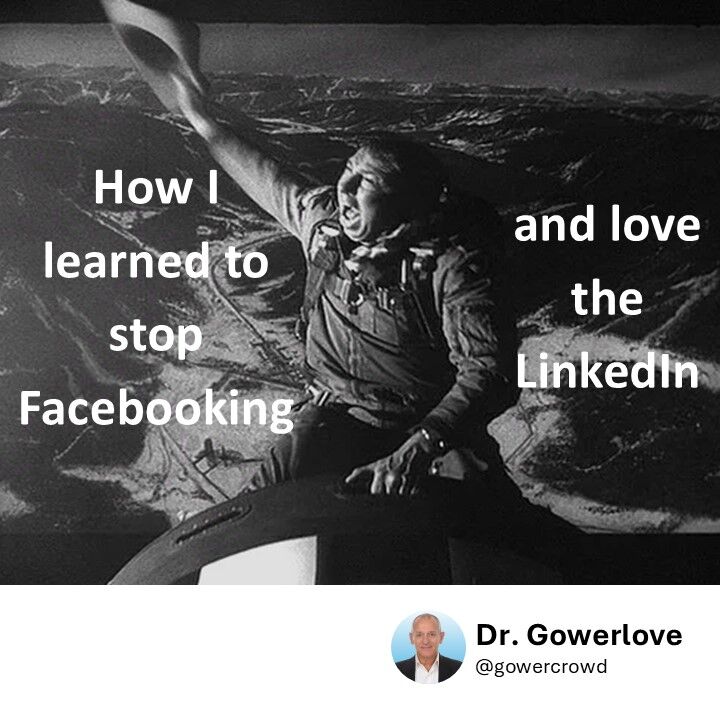
After building a business that has helped clients raise upwards of $1 billion in equity capital, I’ve realized something surprising: the real challenge isn’t ambition—it’s overcoming the mundanity of everyday routine. While capitalizing deals bring energy and excitement, the routine tasks in between can sap focus and bury opportunities. Strategic approach: • Diagnosis: ↳ The grind of emails, meetings, and constant marketing can dull the sharpness needed to see and seize opportunities. • Strategy Development: ↳ I set out to balance routine with the energy and clarity that come from high-reward moments. • Implementation: ↳ I created space for deliberate reflection—weekly ‘reset days’ where I turn off screens to recalibrate and reimagine what’s possible. • Shift: ↳ That space reignited the excitement and focus typically reserved for deal-making, uncovering overlooked opportunities. Results: • Immediate Outcomes: ↳ An underperforming marketing channel (Facebook) was replaced (with LinkedIn), which became a major win—only after I had the mindset to recognize and explore its potential. • Long-Term Impact: ↳ Balancing routine with intentional focus has led to clearer insights and greater consistency in execution. The grind isn’t the problem—losing the spark to see beyond it is. Build moments of clarity and creativity, and results will follow. How do you break out of the daily grind to find moments of focus and opportunity?
Adam Gower tweet media
English
0
0
0
63
Adam Gower
Adam Gower@GowerCrowd·
@Note_Buyer I spoke with some of the brightest and most successful people in the industry. Get the book - it’s complimentary - and see for yourself! BTW. the audio episodes are fabulous too- they’re on the same page.
English
0
0
0
8
Charles Dunbar 👋
Charles Dunbar 👋@buyorsellhouse·
@GowerCrowd Failures can indeed feel daunting. They often offer profound lessons that shape future success—if we choose to reflect on them. Trust is delicate, shaped by experiences and expectations in business dynamics. What insights have you gained from your interviews?
English
1
0
1
9
Adam Gower
Adam Gower@GowerCrowd·
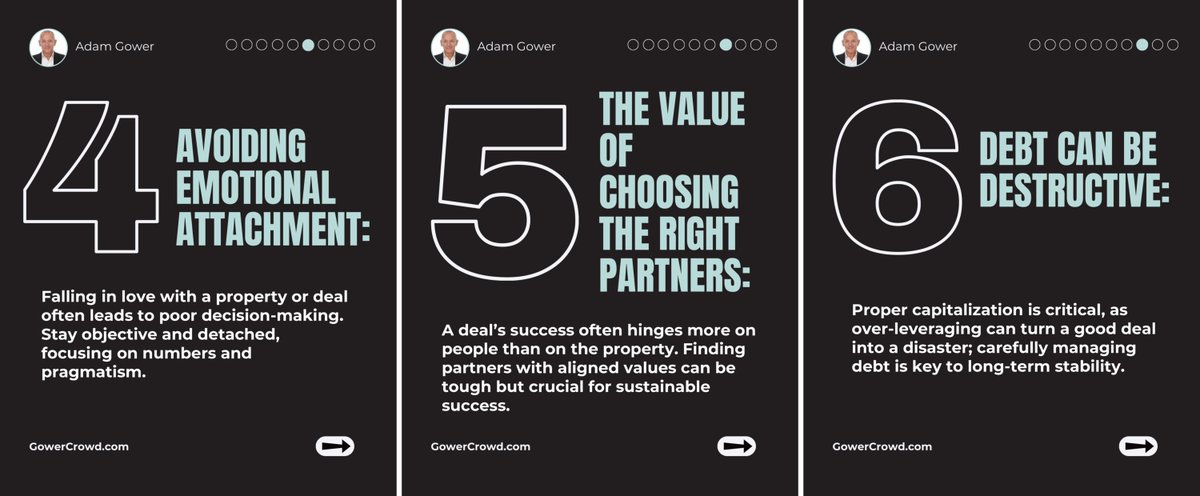
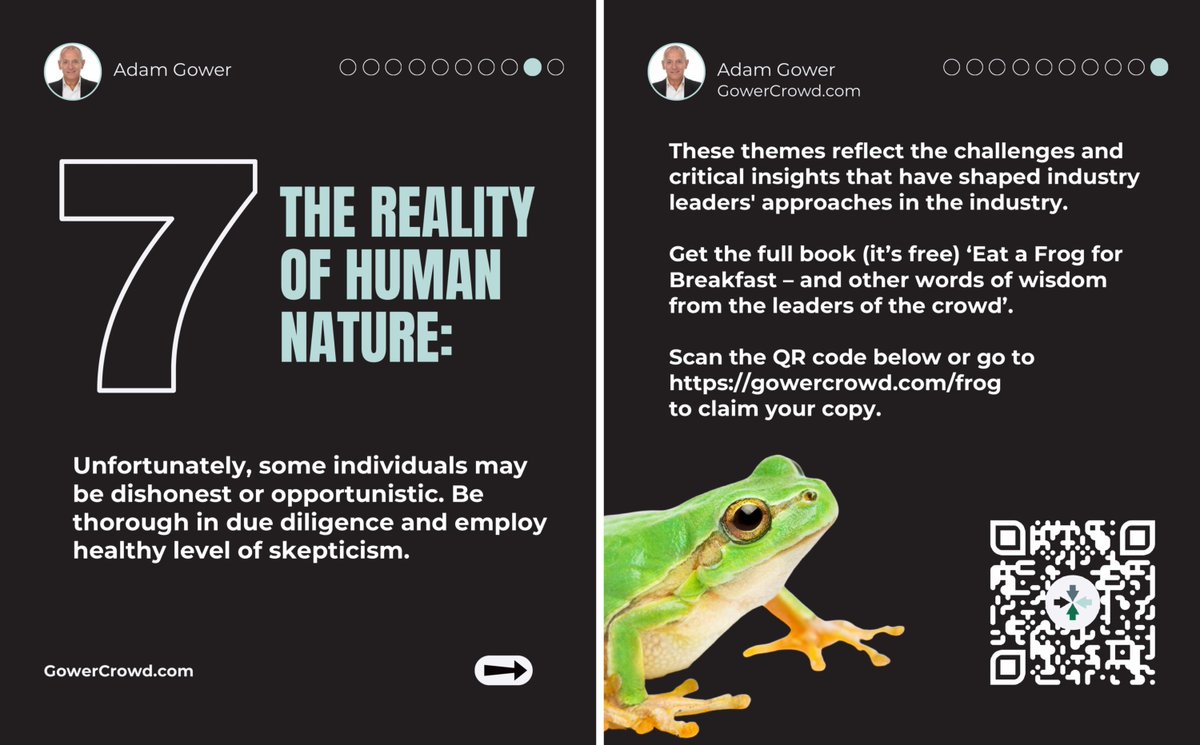
Hard lessons are the building blocks of success in real estate—but only if you learn from them. Have you ever felt stuck after a failure? Or wondered why trust in business is so fragile? You're not alone. I have had the pleasure of interviewing some of the top leaders in the real estate industry for my podcast and, in an earlier series, I asked all my guests what the hardest lesson was they had learned in real estate. The lessons they shared remind us of the importance of accountability, trust, and patience. Indeed, they show that success is often a journey through failures. You might think success is about avoiding mistakes, but the truth? It's about how you handle them. Here are some of the common themes my guests discussed had been hard lessons for them: The Importance of Patience: ↳ Success in real estate investing is a slow process requiring disciplined patience, especially when it comes to timing and waiting for the right opportunities. Trust Must Be Earned: ↳ In an industry reliant on partnerships, trust cannot be given freely; it has to be earned and verified. Use Fear as a Guide, Not a Roadblock: ↳ Fear can either paralyze or propel forward. Leverage fear as a cautionary signal rather than letting it prevent action altogether. Avoiding Emotional Attachment: ↳ Falling in love with a property or deal often leads to poor decision-making. Stay objective and detached, focusing on numbers and pragmatism. The Value of Choosing the Right Partners: ↳ A deal’s success often hinges more on people than on the property. Finding partners with aligned values can be tough but crucial for sustainable success. Debt Can Be Destructive: ↳ Proper capitalization is critical, as over-leveraging can turn a good deal into a disaster; carefully managing debt is key to long-term stability. The Reality of Human Nature: ↳ Unfortunately, some individuals may be dishonest or opportunistic. Be thorough in due diligence and employ a healthy level of skepticism. *** I produced an eBook covering all the lessons my guests told me they had learned. Get your (free) copy by scanning the QR code on the last slide of today’s carousel. Or comment ‘book’ and I’ll DM you a link. What’s the hardest lesson you’ve learned in your real estate career? Share below.
Adam Gower tweet mediaAdam Gower tweet mediaAdam Gower tweet mediaAdam Gower tweet media
English
1
0
1
46
Adam Gower
Adam Gower@GowerCrowd·
LinkedIn isn’t social media. It’s business casual media. Sure, LinkedIn looks like a social media platform. But treating it the same as Facebook or Twitter/X? That’s like showing up to a board meeting in flip-flops. Here’s the reality: LinkedIn operates by its own set of rules. ↳ Casual, but not too casual. ↳ Professional, but not overly stiff. ↳ Focused on connection, but with substance. Think of it like this: LinkedIn is the coffee chat after a big meeting. The handshake at a networking event. It’s where you bring your authentic self—but with a button-up shirt, not a hoodie. And here’s the thing: People don’t come to LinkedIn for memes (okay, maybe occasionally). They come for insight, inspiration, and opportunities. They’re here to learn, network, and grow—not scroll mindlessly. So, how do you thrive on “business casual media”? ↳ Add value. ↳ Share lessons, stories, or expertise that help others. ↳ Be human. People connect with people, not résumés. ↳ Respect the vibe. Keep it professional-ish—like you would at an after-hours networking event. Social media is for showing off. LinkedIn is for showing up. What’s your take? Do you think LinkedIn is more “business casual” than social?
Adam Gower tweet media
English
0
0
1
79
Bob Knakal | NYC Investment Sales
Thanksgiving day dilemma: the 1964 Bowmore or the 1951 Macallan?? Not a bad option but can’t make up my mind!!
Bob Knakal | NYC Investment Sales tweet media
English
87
4
435
61.1K
Adam Gower
Adam Gower@GowerCrowd·
Think LinkedIn pods are the secret to success? Think again. Pods are groups of people who agree to like, comment, or share each other’s posts to boost engagement. While they may seem like a quick way to game the algorithm, there are risks: ↳ Pods violate LinkedIn’s user agreement, putting your account at risk of being flagged or penalized. ↳ The interaction is often irrelevant and fails to connect you with your target audience. ↳ Managing and participating in pods takes time, with minimal long-term payoff for to reach your goals. Pods may look like a shortcut, but the penalties far outweigh the benefits for real estate professionals and investors. ‘Spheres of influence’ involve strategically engaging with your network to build organic reach and credibility. This method is algorithm-friendly and effective. LinkedIn rewards authentic engagement, like comments and shares from your actual network, amplifying visibility to the right audience. By focusing on meaningful interactions, your posts reach people who are most likely to be interested in working or investing with you. Building spheres of influence strengthens your reputation and fosters trust—critical for predisposing prospects into working with you before you even meet them. I chose to focus on spheres of influence, engaging authentically with my network and strategically connecting with new prospects. The results? My content consistently reaches my ideal prospects, generating high-quality leads that convert into real relationships. Does it mean it will work for you? Depends. If you’re just starting and tempted by pods, remember the risks. Spheres of influence yield better results for real estate pros committed to growing their networks and scaling their portfolios. Choosing between pods and spheres of influence isn’t just about immediate reach; it’s about building trust and credibility to scale your success over the long term – and doing it with integrity. Consider what resonates most with your goals. There’s no single right answer but aligning your strategy with LinkedIn’s algorithm will always work in your favor. *** But, I hear you cry, what is a ‘sphere of influence’ and where do I get one? Fear ye not, in my LinkedIn Mastermind coming up next week, I’ll reveal all. Plus I’ll give you some pro-tips on how to create them quickly and effectively. The training starts next week, right after Thanksgiving. For more info comment ‘LinkedIn’ and I’ll send you a link with Black Friday special discount coupon.
Adam Gower tweet media
English
0
0
3
56
Adam Gower retweetledi
Reid Bennett
Reid Bennett@ReidBennettCCIM·
📉 Negative Leverage - A significant challenge for 79% of the more than 5,800 #multifamily loans (about $96 BILLION) currently with a DSCR below 1 ⏸️ Let's pause for a second to really understand what this means... 🔍 Most lenders are looking for a (Debt Service Coverage Ratio) DSCR to be about 1.20-1.25x. Meaning the property has AT LEAST $1.20 to $1.25 of Net Operating Income (NOI) for every $1.00 of Debt. This is the minimum margin certain lenders would like to see in order to feel comfortable the asset will cover the debt, hence "Debt Coverage Ratio" 🤒 So... a DSCR BELOW 1 indicates that a property is unable to pay back its debts from the NOI. Now, back to the current situation of the $BILLIONS of loans that are under a 1 DSCR. How long into 2025 will the lenders be able to kick the can down the road? 💸 Some of these owners are trying to raise their rents but are unable to catch up to two significant expense items... RE Taxes and RE Insurance, which have been skyrocketing. 😵 So if the NOI is stagnant or worse, decreasing, this will pose a challenge for all involved. 📈 We have created a system called the #MidwestMultifamilyMatrix to show owners of multifamily complexes where there property sits with regards to the current market. Let us know if we can help. #MultifamilyReidOut
Reid Bennett tweet media
English
0
2
7
332
Adam Gower
Adam Gower@GowerCrowd·
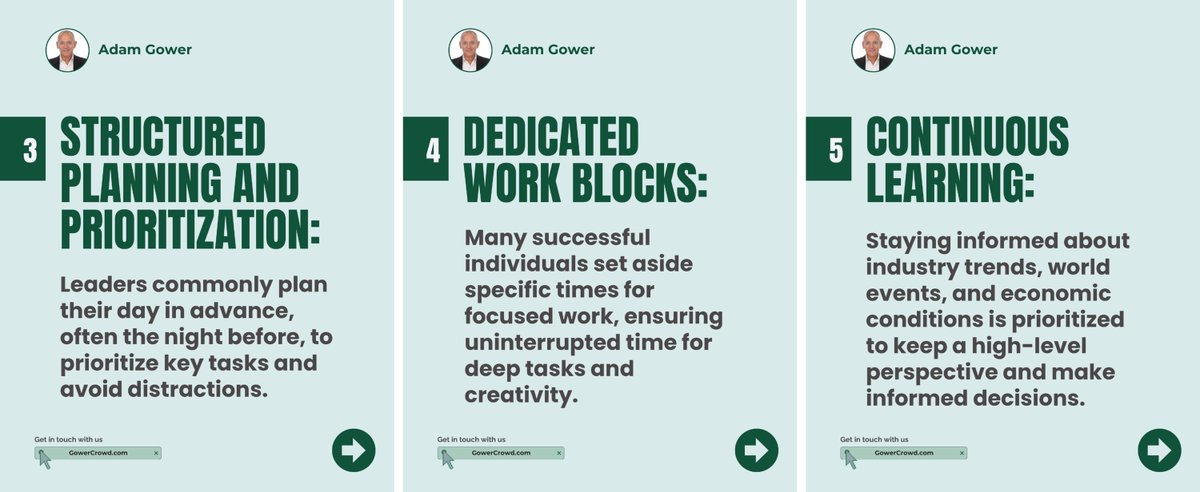
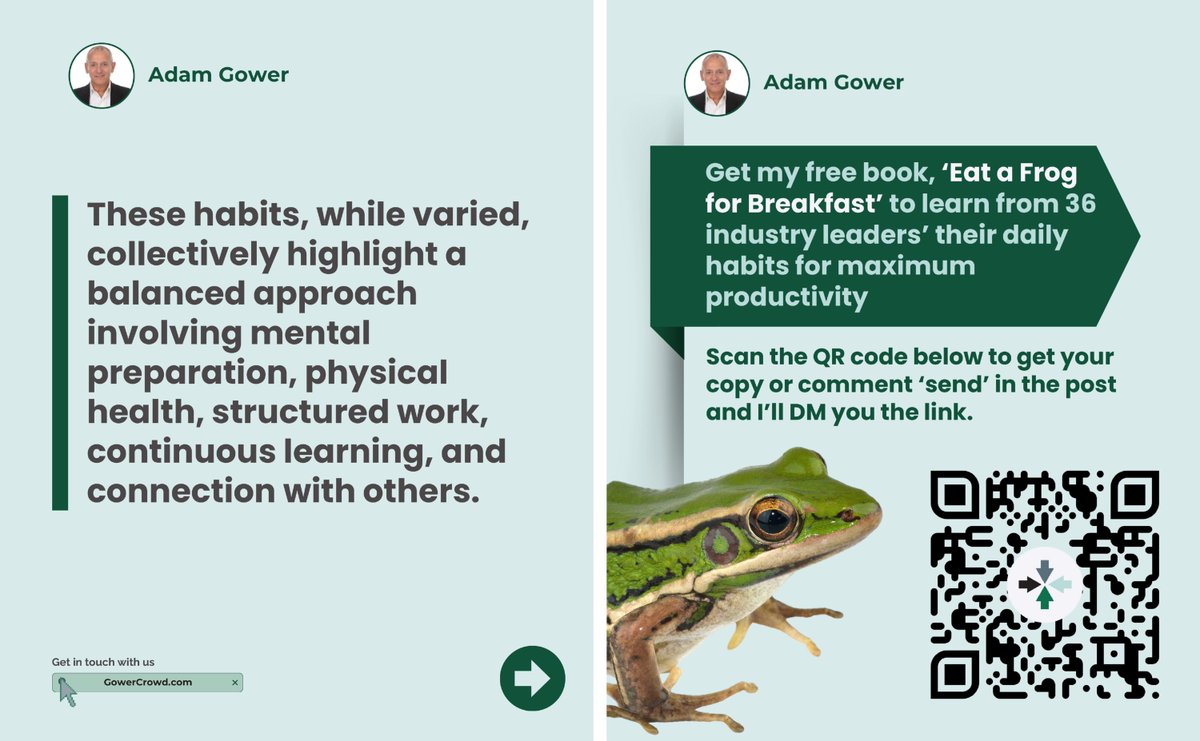
You’re caught in the grind. ↳ Never-ending emails. ↳ Constant overwhelm. ↳ Back-to-back meetings. ↳ Always more to read, more to learn, more to do. The result? Each day slips by without real progress on your most important goals. But there’s another way… Imagine a daily routine that actually fuels your success. ↳ Intentional habits. ↳ Focused priorities. ↳ No more reactive days. ↳ A structure that reclaims your time. ↳ No more feeling like you’re just keeping up. Instead, you’re in control, moving forward—every single day. *** During one of my earlier podcast series, where I interviewed some of the top professionals in the real estate industry, I asked all my guests 'what are your daily habits that make you successful?' And I wrote an eBook (it's really inspiring!) compiling all their answers. Scroll to the last page of this carousel and scan the QR code there to get your copy of the book. Or comment 'Send' and I'll get you a link to the book.
Adam Gower tweet mediaAdam Gower tweet mediaAdam Gower tweet mediaAdam Gower tweet media
English
0
0
0
35
Adam Gower
Adam Gower@GowerCrowd·
How you can attract more prospects using a 3-step process on LinkedIn in just two weeks. When I started helping sponsors raise capital online, we initially leaned heavily into Facebook advertising. But lead quality is low, and the screening process takes a lot of human resources. (With a conversion rate of just 2%, Facebook ads demand follow-up calls to all new leads to optimize conversions—a brain-damaging 98% failure rate.) LinkedIn, on the other hand, has huge potential to connect with investors (or any target audience), though it’s not as straightforward as the Facebook platform which makes spending your money all too easy. I needed a repeatable, effective process, and after a lot of trial and error, I've developed a 3-step approach that engages and converts high-value prospects far more effectively. Challenges I Encountered: 1. Targeting Precision: ↳ Defining a narrow audience to attract high-quality leads without pulling in tire-kickers is tricky. 2. Content Engagement: ↳ Finding content formats that maintain sustained interest required experimentation and A/B testing. 3. Consistency: ↳ Staying top-of-mind requires a steady stream of valuable content that doesn't take ages to produce. Benefits I Found: 1. Audience Accuracy: ↳ LinkedIn’s targeting features allows you to focus on ideal prospects by job title, industry, and other specific demographics with finer precision than on Facebook. 2. Relationship-Building: ↳ Consistent engagement leads to warm leads who already trust your approach before your first conversation with them. 3. Scalability: ↳ Once the system is set up, it consistently delivers high-quality leads and begins to snowball in scale and results. This 3-step process has become a core strategy, helping me attract and nurture a steady stream of prospects. Bonus: It’s a lot of fun to implement! *** I’m going to be teaching what I've figured out in a LinkedIn Mastermind right after Thanksgiving, where I’ll break down everything you need into quick, actionable steps to help you build your own LinkedIn lead-gen machine. Four days, one hour each, focused, actionable and results driven. If you're reading this, you're on LinkedIn (duh). Invest the time with me in the Mastermind and I guarantee you'll see results. (Yes, guarantee.) There’s a link at the top of my profile to learn more—and if you comment ‘LinkedIn,’ I’ll DM you a special Black Friday discount coupon to join us.
Adam Gower tweet media
English
0
0
1
52
Adam Gower
Adam Gower@GowerCrowd·
"Build wealth with real estate!" How many times have you heard that tired slogan? It’s plastered onto every website, training program, and LinkedIn post—often by those more interested in selling the dream than understanding the work it takes to make it real. But let’s stop and think for a moment. Sure, wealth is great—but why are we chasing it? Is it to live in a bigger house? Drive a nicer car? Secure our kids’ future and retire comfortably? Or is it about saying, "I’ve got more than you," and flipping the bird to the world? Here’s the truth: Wealth doesn’t guarantee happiness. And the data backs it up. Take the United States: With a GDP per capita of $85,000, we’re one of the wealthiest nations in the world (#9 in wealth). But when it comes to happiness? We drop to #23 globally, with a score of 6.7. Now compare that to Finland. Ranked only #25 in wealth, it holds the #1 spot in happiness with a score of 7.7. Or Costa Rica: With a GDP per capita of just $21,000—less than a quarter of the U.S.—Costa Ricans are nearly as happy as Americans (7.0 vs. 6.7). Clearly, happiness isn’t just about wealth. So, what really drives happiness? The longest-running happiness study, Harvard’s Study of Adult Development, reveals: ↳ More money helps—but only up to $75,000 annually. Beyond that, the law of diminishing returns kicks in. ↳ Relationships matter more than possessions. Close connections bring joy, not the next shiny car. ↳ Experiences > things. Memories with loved ones far outweigh material purchases. ↳ Self-reflection creates alignment. A meaningful life comes from aligning our goals with our values—not our net worth. So when I see people shouting, "Build wealth with real estate!" I have to ask: What are they really selling? Because real estate can build wealth—but maybe we should focus on what that wealth enables: ↳ Freedom to spend time with family. ↳ Flexibility to pursue passions. ↳ Security to live life on your terms. As we head toward Thanksgiving, it’s worth pausing to consider what we’re truly thankful for. Chances are, it’s not the size of our bank account or the car in the driveway—it’s the people in our lives, the memories we create, and the freedom to live with purpose. Let’s rethink the narrative. It’s not about wealth for wealth’s sake. It’s about building a meaningful, fulfilling life—and yes, real estate can help with that. Am I way off here? What do you think the real point of investing in real estate is?
Adam Gower tweet media
English
1
1
2
245
Adam Gower
Adam Gower@GowerCrowd·
You know LinkedIn is a great place to connect with high-value prospects, but no matter what you try, the platform just doesn’t work for you. You see people in your feed who are clearly thriving—semi-famous, with lots of followers and tons of engagement. Meanwhile, even your best posts barely get noticed, and your lead-generation results? Let’s just say they’re not exactly overwhelming. I’ve been there. For nearly 15 years, I struggled to make LinkedIn work. But here’s the thing: I refused to give up. I started to think: * How can I keep up with all these interactions? * Will it ever become easier? * Can I really make LinkedIn an efficient, repeatable part of my business? And then, step by step, I cracked the code. Today, LinkedIn is no longer a frustration for me. It’s an asset. My network is growing fast, my lead generation is consistent, and I’ve built a system that works without wasting time. Here’s what made the difference: → I have a routine. Every day, I dedicate an hour to intentional LinkedIn engagement. It’s business casual—not stressful, and it’s productive. → I have a system. I’ve streamlined how I write posts, engage with key people, and follow up with prospects. → I have results. The time and effort I put into LinkedIn now lead directly to growth—of my network and my pipeline. Through trial and error, I built this system with one focus: making LinkedIn work specifically for real estate professionals and investors. I’m no guru—I’m just someone who loves solving marketing challenges. If LinkedIn feels like a struggle for you, you’re not alone. But you don’t have to stay stuck. In early December, I’ll be teaching my system in a LinkedIn Mastermind designed specifically for real estate professionals and investors serious about scaling their portfolios. Comment 'LinkedIn' if you want me to send you the details and a discount code for the training.
Adam Gower tweet media
English
0
0
0
55
Adam Gower
Adam Gower@GowerCrowd·
For real estate professionals and investors, LinkedIn is far superior to Facebook ads for generating high-quality leads. But here's the catch: success on LinkedIn requires strategy and finesse. One key element? Writing posts that don’t just promote but educate, establish your thought leadership, and deliver real value - and to attract prospects predisposed to working with you. I’ve analyzed what works best on LinkedIn - specifically for real estate professionals and investors - and have identified eight proven post structures designed to achieve specific goals, from building trust to driving engagement. 1. The Proven Strategy Breakdown ↳ Highlights success stories by breaking down actionable steps that led to measurable outcomes. ↳ Builds credibility and inspires replication of the process. ↳ Positions the author as an industry expert while providing tangible value. 2. The Guide to Deciding ↳ Offers a balanced comparison of two options to help the audience make informed decisions. ↳ Demonstrates thought leadership and a nuanced understanding of industry dynamics. 3. Unconventional Solution ↳ Introduces fresh, unexpected methods to tackle familiar problems. ↳ Captures attention with innovative perspectives and positions the author as a creative problem solver willing to challenge the status quo. 4. Practical Tips for Success ↳ Delivers actionable insights in an easy-to-digest list format. ↳ Breaks down complex strategies into simple, step-by-step guidance to make big goals feel attainable. 5. Breaking Through Barriers ↳ Focuses on challenges faced and the strategies used to overcome them. ↳ Inspires resilience and determination by sharing triumphs over adversity. 6. Learning from Mistakes ↳ Shares personal growth stories through significant missteps. ↳ Builds authenticity by reflecting on lessons learned, showing vulnerability and resilience. 7. Challenging the Status Quo ↳ Questions widely accepted beliefs and invites the audience to rethink conventional wisdom. ↳ Sparks discussion and positions the author as a bold thought leader willing to disrupt norms. 8. Uncovering Hidden Truths ↳ Reveals surprising insights that challenge surface-level assumptions. ↳ Encourages deeper thinking and critical analysis by sharing actionable revelations. *** Want to take your LinkedIn game to the next level? I’m hosting a LinkedIn training right after Thanksgiving, where you’ll learn these 8 post structures in detail. Plus, you’ll get access to my exclusive white paper covering these structures, which includes: ↳ AI prompts to generate posts with ease. ↳ Detailed breakdowns of each structure, including the psychology behind them. ↳ Real-life examples you can model. Comment ‘LinkedIn’ below if you’d like an early Black Friday discount—and I’ll send you a discount code for the training and the white paper once you enroll. ♻️ repost to share these post structures with others in your network (the better they do, the better you'll do too).
Adam Gower tweet media
English
0
0
1
35
Adam Gower
Adam Gower@GowerCrowd·
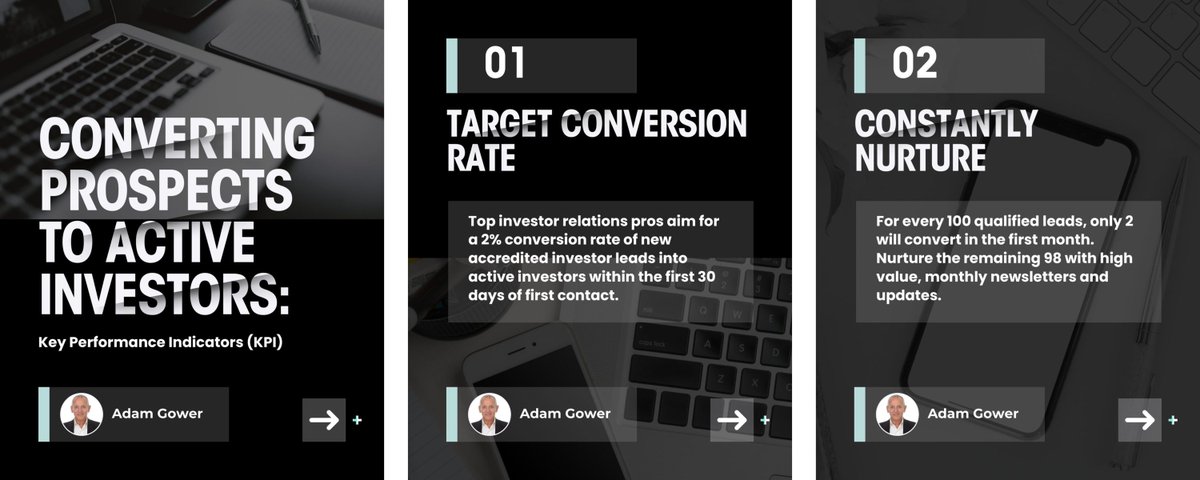
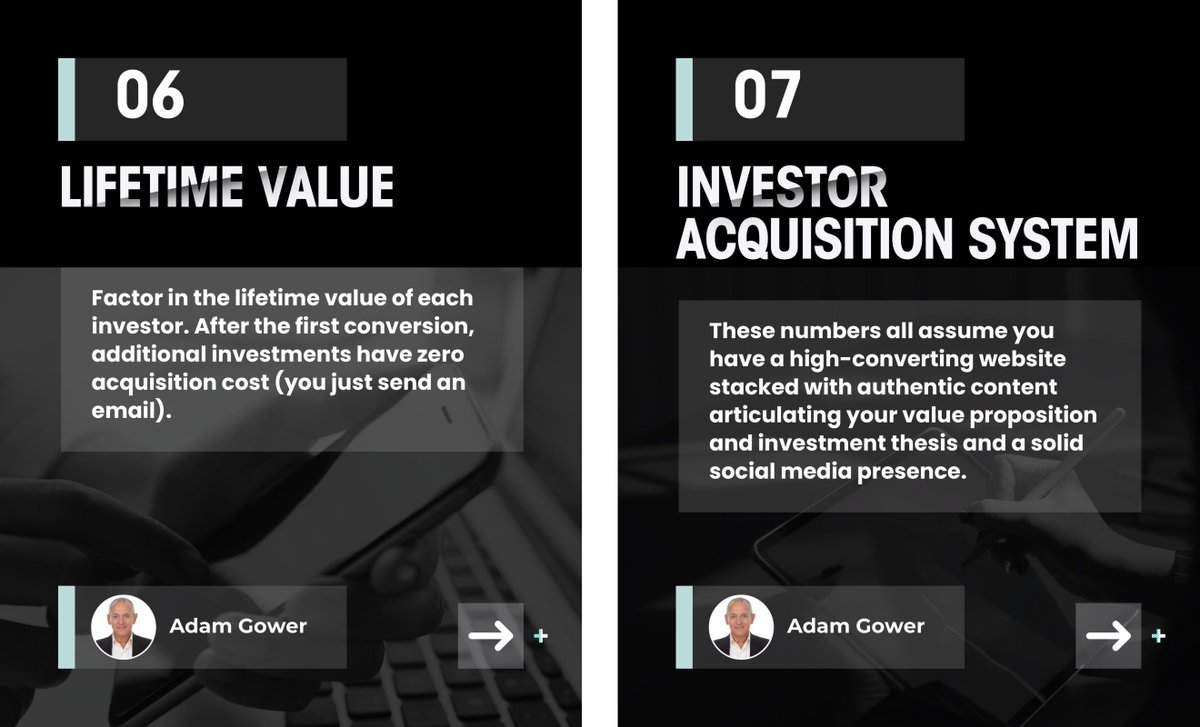
Want to convert more prospects into being active investors? Here's how. Turning prospects into active investors takes strategy and precision. These metrics (below), used by top Investor Relations professionals, are based on proven results to help you optimize your conversions, streamline costs, and scale effectively. 1. Target Conversion Rate ↳ Top IR pros aim to convert 2-3% of new leads ↳ Within 30 days of first contact. ↳ Use this standard to measure your own conversion rates. 2. Nurture Unconverted Leads ↳ Typically, only 2 out of 100 qualified leads convert in the first month. ↳ For the other 98, send monthly updates and value-rich newsletters. ↳ This will keep them engaged and aware of your next opportunity. 3. Cost Per Active Investor ↳ Expect up to $4,500 in total ad spend per new active investor, ↳ Use social ads, webinars, newsletters. ↳ And rented email lists are great too, but never buy lists and blast. 4. Average First Investment ↳ Average first investments surpass minimums (by definition). ↳ $25,000 minimum: Average initial investment ~$45,000. ↳ $50,000 minimum: Expect ~$95,000 per first time investor. 5. Ad Spend Efficiency ↳ For strong ROI, plan for ad spend to be up to 4% of capital raised. ↳ i.e. expect to spend $40,000 in paid marketing to yield $1 million in equity raised. 6. Lifetime Value ↳ Once an investor converts, subsequent investments cost nothing additional to secure ↳ just send well-timed follow-up email sequences. 7. Strong Acquisition System To hit these KPIs, your Investor Acquisition System should include: ↳ a high-converting website, ↳ value-driven content, ↳ and a solid social media presence. ________________________________________ Using these KPIs, you can see what’s working, refine as needed, and scale with confidence. For more capital-raising conversion insights, I’ve produced a Guide for you based my experience with some of the top Investor Relations professionals across the country. Include 'send' in the comments below and I'll email you a link to the Guide. (Or just scan the QR code on the last page of the carousel).
Adam Gower tweet mediaAdam Gower tweet mediaAdam Gower tweet mediaAdam Gower tweet media
English
0
0
1
25