
Graeme Cameron

22.1K posts

Graeme Cameron banner
Graeme Cameron

Graeme Cameron

@GraemeCameron2

Art Historian/Researcher specialising connoisseurship & scientific research leading to the rediscovery of lost masterpieces by the great masters of art history.

Katılım Haziran 2012
46.6K Takip Edilen42.5K Takipçiler
Graeme Cameron retweetledi
El Club del Arte 🎨📷📚🖼🕍🎼
Un café de París, donde el arte brota por todos lados, donde llegan cartas a tu yo futuro cinco años después… Ese lugar es el Café des Psaumes, ubicado en el histórico barrio de Le Marais (4.º distrito de París). Este café es famoso por una iniciativa llamada "Lettre à soi-même" (Carta a uno mismo). Te sientas a disfrutar un café, pides papel y sobre, y escribes una carta dirigida a ti mismo. El café resguarda tu carta y se encarga de enviarla por correo postal a la dirección que indiques exactamente cinco años después.
Español
7
158
784
59.1K
Graeme Cameron retweetledi
The Best
The Best@Thebestfigen·
It's a very special feeling when animals trust you.
English
179
2.2K
20.2K
281.1K
Graeme Cameron retweetledi
Massimo
Massimo@Rainmaker1973·
Before continuing his shift, a police officer took a moment to pray with his loyal four-legged companion. The simple yet powerful scene has touched the hearts of thousands on social media.
English
249
2.4K
20.6K
313K
Graeme Cameron retweetledi
All day Astronomy
All day Astronomy@forallcurious·
A civilization 2,000 light-years away pointing a powerful enough telescope at Earth right now would see the Roman Empire. They'd see Jesus alive.
English
22
39
318
15.7K
Graeme Cameron retweetledi
All day Astronomy
All day Astronomy@forallcurious·
16th century German ring that unfolds into an astronomical sphere
All day Astronomy tweet media
English
3
19
236
8.2K
Graeme Cameron retweetledi
Massimo
Massimo@Rainmaker1973·
A full-scale reconstruction of the Myklebust Ship, one of the largest Viking ships ever discovered, now sailing through the fjords of Norway.
English
16
75
466
25.6K
Graeme Cameron
Graeme Cameron@GraemeCameron2·
Accordingly, this incredibly advanced insight of the rarest 'internal universe' workings shown within just one Human Cell, is in many respects just as significant as a groundbreaking achievement to witness, as Elon's 'external universe'' Mars mission, and much cheaper as well.🧑‍🎨
English
0
0
1
42
Graeme Cameron
Graeme Cameron@GraemeCameron2·
Interestingly,Leonardo also observed from his intense research,of the inner body & other beings,they consist of a Universe like structure,virtually an'internal universe'of components which replicate down in ever decreasing scale-He would have much marveled at this cellular view🧑‍🎨
Massimo@Rainmaker1973

Scientists have created one of the most detailed 3D reconstructions of a human cell (eukaryotic cell) ever produced. This groundbreaking model, often termed a "Cellular Landscape Cross-Section Through a Eukaryotic Cell," combines data from X-ray tomography, nuclear magnetic resonance (NMR), and cryo-electron microscopy to map molecular structures in extreme detail.

English
1
0
2
121
Graeme Cameron
Graeme Cameron@GraemeCameron2·
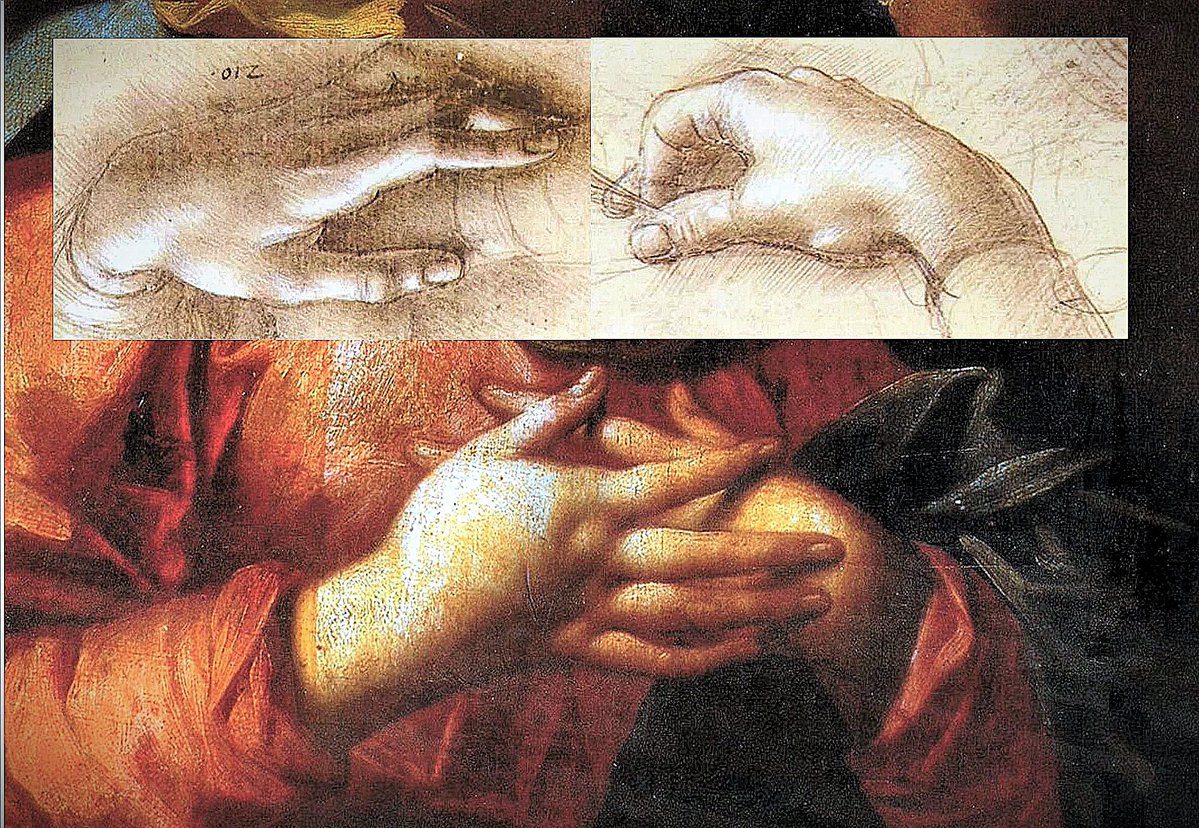
SECTION Ultimate grace of the clasped Hands of Leonardo Da Vinci's lost"The Madonna Annunziata" rediscovered by this research Among finest depictions of these anatomical features. TOP Leonardo's prior "Study of Hands" Drawing for this future"Annunziata"-Life model Bianca Sforza🧑‍🎨
Graeme Cameron tweet media
English
0
0
5
107
Graeme Cameron retweetledi
love aniamals
love aniamals@loveanimal111·
Scenes where friends reunite after a long absence
English
35
258
2.3K
33.7K
Graeme Cameron retweetledi
Frases Barbie
Frases Barbie@barbie_context·
Un hombre fue a adoptar a un perrito a un refugio, y él lo guió hasta su madre anciana para que también la adopte.
Español
109
4.4K
67.6K
1.1M
Graeme Cameron retweetledi
Wolf 🐺
Wolf 🐺@PsyGuy007·
🇦🇺 INSOLITE : Chaque jour, Champy le cheval vient chercher son pote Morris le chat en Australie. Le chat grimpe sur son dos et ils partent faire un tour tranquille… 🐴🐱
Français
153
2.4K
17K
352.4K
Graeme Cameron retweetledi
🇨🇵✌️ Alexy
🇨🇵✌️ Alexy@alexysiktrice·
La Galerie Doria Pamphilj, située dans le Palazzo Doria Pamphilj à Rome, l'un des palais privés les plus prestigieux et les plus vastes de la ville. Le palais abrite la Galerie Doria Pamphilj, qui est l'une des collections d'art privées les plus importantes au monde. Elle appartient toujours à la famille aristocratique Doria Pamphilj. On y trouve des chefs-d'œuvre de maîtres tels que Le Caravage, Titien, Raphaël et Vélasquez (notamment son célèbre portrait du Pape Innocent X). Les magnifiques peintures que l'on aperçoit sur la voûte représentent les "Travaux d'Hercule". Elles ont été réalisées par l'artiste bolognais Aureliano Milani au XVIIIe siècle. Les tableaux sont accrochés selon une disposition du XVIIIe siècle, couvrant les murs du sol au plafond, ce qui permet de vivre l'expérience d'une galerie d'art telle qu'elle existait il y a trois siècles.
Français
3
20
66
2K
Graeme Cameron retweetledi
Dr. M.F. Khan
Dr. M.F. Khan@Dr_TheHistories·
They built roads so perfect that 2,000 years later, you might be driving on one right now... When Roman engineers first broke ground on the Via Appia in 312 BC, they were not simply building a road. They were engineering a masterpiece that would outlast their entire civilization. Commissioned by the Roman censor Appius Claudius Caecus, the Via Appia stretched 132 miles from Rome to Capua and would eventually extend all the way to Brindisi on the heel of Italy. Romans called it the "Queen of Roads," and that title was earned through extraordinary engineering precision that no civilization would match for nearly two millennia. The secret to their legendary durability was a layered construction system that modern engineers still marvel at. Workers began by digging a trench up to three feet deep, then carefully filled it in stages. The bottom layer consisted of large flat stones set in mortar. Above that came a layer of crushed rock and rubite, a type of volcanic gravel. Then a thick middle layer of concrete made from lime, sand, and small stones was packed down tightly. The final surface featured large, carefully fitted polygonal stones, often basalt, cut and placed so precisely that a knife blade could not fit between them. The entire roadway was also slightly crowned in the center, forcing rainwater to drain off the sides rather than pooling and eroding the surface from within. At its peak, the Roman road network spanned an almost incomprehensible 250,000 miles across three continents, connecting Britain in the northwest to Mesopotamia in the east, and stretching deep into North Africa. To put that in perspective, that network could circle the Earth more than ten times. Rome maintained roughly 29 major highways radiating outward from the city, and over 113,000 miles of these roads were paved. Every single mile was marked with a stone milestone indicating the distance back to the Milliarium Aureum, the "Golden Milestone" erected by Emperor Augustus in the Roman Forum around 20 BC. The construction workforce behind these roads was staggering. Roman legions built the majority of military roads themselves, with each soldier expected to contribute to road construction during campaigns. A single legion of 5,000 men could build approximately one mile of road per day under ideal conditions. Specialized workers called "liberatores" cleared the path, while "fossores" dug the trenches. Surveyors used an instrument called the groma, a remarkably accurate tool, to ensure roads ran as straight as possible across the landscape, cutting through hills rather than winding around them. The roads served purposes far beyond simple travel. They were the arteries of Roman power, allowing legions to move with shocking speed across vast territories. A Roman soldier could march 20 to 25 miles per day on these roads without difficulty. The cursus publicus, Rome's official postal and transport system established by Augustus around 20 BC, used relay stations called mansiones placed every 25 to 30 miles along major routes, allowing messages to travel up to 50 miles per day. This communication network gave Roman emperors effective control over territories that would otherwise have been ungovernable. Many specific roads survive in remarkable condition today. The Via Appia Antica outside Rome still has its original basalt paving stones, worn smooth by millions of ancient feet and wheels but fundamentally intact. In Britain, the famous road known as Ermine Street, built by Roman engineers in the 1st century AD, forms the foundation of the modern A1 highway running from London to York. Watling Street, another Roman road built after the conquest of Britain in 43 AD, corresponds almost exactly to the modern A2 and A5 routes. Drivers in Spain, France, Germany, and across the Middle East are often unknowingly following routes first surveyed by Roman engineers over two thousand years ago. #drthehistories
Dr. M.F. Khan tweet media
English
18
195
601
12.8K
Graeme Cameron retweetledi
Birds Colour 🕊️
Birds Colour 🕊️@birdscolour56·
The most wholesome and beautiful thing I've seen in awhile! 🥹
English
67
783
6.7K
109K
Graeme Cameron retweetledi
Massimo
Massimo@Rainmaker1973·
In Japan, some fruit and vegetable boxes show photos of the farmers who grew them.
Massimo tweet media
English
397
3.4K
25.4K
504.5K