Granite Bio Innovation

12 posts

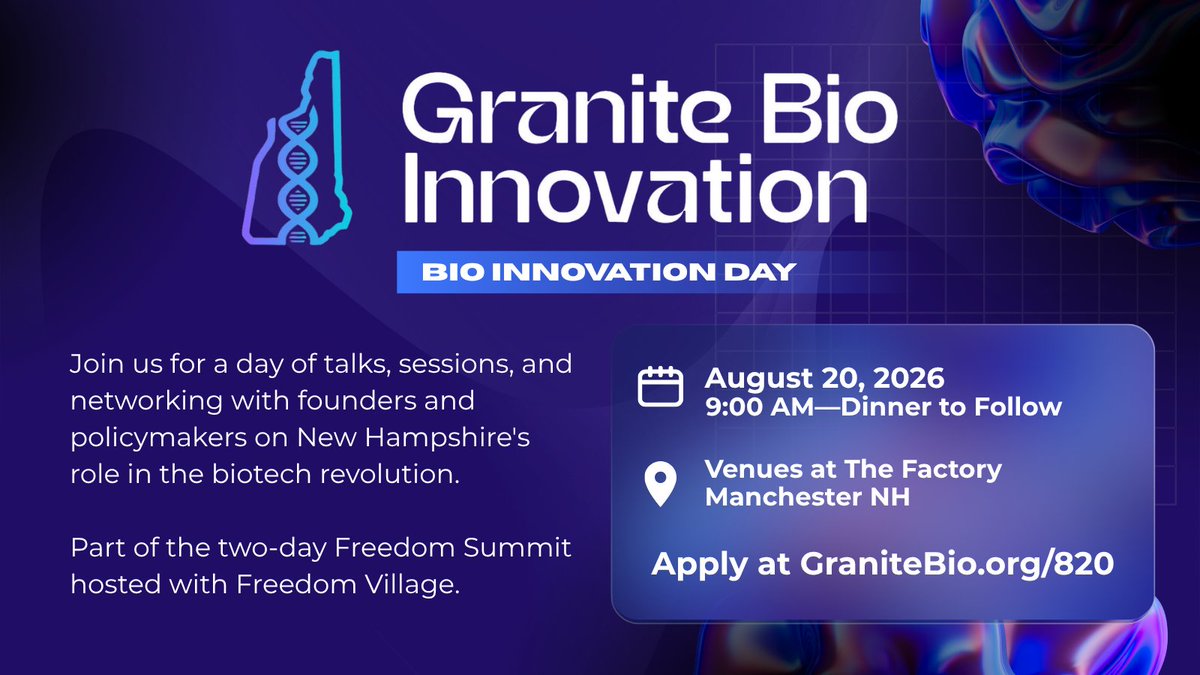
Granite Bio Innovation banner
Granite Bio Innovation

Granite Bio Innovation

@GraniteBio

Advancing human flourishing in New Hampshire and America by promoting ethical, experimental biotechnology in the Granite State.

Manchester, NH, USA Katılım Mart 2026
39 Takip Edilen77 Takipçiler
Granite Bio Innovation
Granite Bio Innovation@GraniteBio·
A roadmap for commercializing cancer vaccines and gene editing, starting with New Hampshire:
Ian Huyett@IanHuyett

The formal, legal answer is yes: the federal regulatory regime effectively blocks it entirely. But there are near-term political solutions to this problem, and some are already happening. The FDA’s commissioner and chief medical officer recently acknowledged in NEJM that there is no viable federal regulatory pathway for offering bespoke therapies at commercial scale. That’s also my legal opinion after talking to patients, providers, and innovators about emerging therapies. The FDA went on to outline a proposed “plausible mechanism pathway” to address this problem. But this pathway can’t accommodate bespoke therapies at commercial scale either. It would require a well-characterized, natural history of each disease and require each patient to provide a mouse model or equivalent nonclinical model before getting FDA approval. This kind of thing is typical of federal agency attempts at supporting innovation. In earlier guidance on rare diseases, the FDA said they may accelerate approvals by requiring only a single-arm trial instead of an RCT. So how did we get here and what are the solutions? The FDA’s congressional mandate comes from two fossilized, FDR-era statutes: the FD&C Act and the PHS Act. The PHS Act extends FDA regulation to all biologics—which it defines to include all viruses, vaccines, proteins, and “analogous products” intended to treat or cure any condition. The FDA views bespoke gene therapy as a biologic. Any biologic can also be regulated as a “drug” under the FD&C Act. A “drug” includes any “article” intended to affect “any function of the body.” This is as broad as it sounds. For example, courts have held that your own stem cells are a “drug” if they are cultured in a solution before being reintroduced to your body. But—and this is the key to any near-future solution—everyone appreciates that the FDA has vast non-enforcement discretion. The FDA has never regulated the practice of IVF, for example, even though it could clearly choose to do so under FD&C and/or PHS. Instead, the FDA views IVF as the practice of medicine. This hasn’t made IVF into the Wild West. IVF is still subject to four other kinds of legal authority: state statutory rules, state professional codes, state regulatory agencies, and medical malpractice liability. That is enough to prevent many abuses. Individualized gene therapy and other bespoke therapies could simply be regulated the same way. Gene therapy should be regulated as gene surgery. The idea that Congress is going to overhaul FD&C and PHS anytime soon is ridiculous. But we have two good solutions that simply go around Congress. First, 200+ Americans have already received experimental treatments under state right-to-try laws, which operate outside the FDA approval framework. While the FDA could legally preempt these laws, it has never invoked preemption in response to a state-compliant right-to-try treatment. Most state right-to-try laws are far too narrow and weak to be used at scale. But in the last few years, expansive new laws have been enacted in Montana, Florida, and New Hampshire which could accommodate commercial-scale experimental therapies. New Hampshire's proximity to Boston makes us ideally positioned to become a hub of emerging biotech. These laws are promising. The FDA is unlikely to renege on 10 years of de facto non-enforcement just because more patients are being treated. In the same way, the DEA has allowed a multibillion-dollar marijuana industry to grow in some states under three different presidents. The letter of the law says the DEA could entirely preempt these laws tomorrow. Political reality says they will not. Secondly, the FDA can promulgate memoranda adopting new, more limited interpretations of the law and/or formalizing non-enforcement policies. Ideally, the FDA should say that it has gotten IVF right and gene therapy wrong. The FDA should declare that it now considers bespoke therapy, at least under certain conditions, to be part of the practice of medicine. Eventually, we should scrap the entire FDR-era statutory framework and pass new laws grounded in the reality of AI-based sequencing, gene editing, and other bespoke therapy tools. In the meantime, though, patients can’t wait.

English
0
4
14
251
Granite Bio Innovation retweetledi
Granite Bio Innovation
Granite Bio Innovation@GraniteBio·
Outdated regulation is holding back the biotech revolution. But this failure is New Hampshire's opportunity. Two bills by @KesselringSteve and @cole4nh will take the best pro-biotech laws from other states and adapt them to NH. @RepKeithAmmon and Dylan Livingston explain:
Granite Bio Innovation tweet media
English
2
9
29
1.2K
Granite Bio Innovation retweetledi
Ryan
Ryan@Ryan_G_Lambert·
Was proud to be a cheerleader for this bill. When you look at the law, we're really starting to push the needle back to the place it should be... You gotta start somewhere I guess. Let's go New Hampshire!
Granite Bio Innovation@GraniteBio

America stands on the verge of a revolution in biotechnology—and it could start here in NH. The NH House has just passed @KesselringSteve's HB 1734 and @cole4nh's 1735. These bills will give NH the strongest protections for experimental biotech in America.

English
0
1
9
187
Granite Bio Innovation
Granite Bio Innovation@GraniteBio·
America stands on the verge of a revolution in biotechnology—and it could start here in NH. The NH House has just passed @KesselringSteve's HB 1734 and @cole4nh's 1735. These bills will give NH the strongest protections for experimental biotech in America.
Granite Bio Innovation tweet media
English
4
6
54
24.6K
Granite Bio Innovation retweetledi
Brian Cole for Congress
Brian Cole for Congress@cole4nh·
Yesterday in the New Hampshire House we passed HB 1735, legislation I introduced to expand access to life saving medical treatments for patients battling rare diseases and severe medical conditions. This bill builds directly on the Right to Try law championed last year by Rep Lisa Mazur. Her legislation created a pathway for terminally ill patients to access investigational treatments. HB 1735 expands that framework so more patients suffering from rare and severe diseases can pursue promising therapies under the care of their physicians when traditional treatments have failed. This is especially important because New Hampshire is already home to companies and researchers doing groundbreaking work such as growing bone, regenerating cartilage, and repairing tissue using a patient’s own cells. These innovations have the potential to change lives. Without legislation like HB 1735, many of these treatments could not move forward here in New Hampshire. Patients would be forced to travel to another state or even leave the country to access procedures that could save or dramatically improve their lives. HB 1735 helps ensure New Hampshire remains a place where medical innovation thrives and where patients are given every possible chance to fight for their lives.
English
1
5
22
455
Granite Bio Innovation retweetledi
Sarah Scott
Sarah Scott@Sarah_Scott95·
More good news from the NH House: Just passed bills expanding Right to Try, creating experimental treatment centers, and opening the door to more affordable care options. More options for patients signal that NH is becoming a hub for medical innovation and biotech investment.
English
1
8
50
1.1K